1987 Movie Review: SPACEBALLS, 1987


SPACEBALLS MOVIE POSTER
SPACEBALLS, 1987
Movie Reviews

Directed by Mel Brooks
Starring: Mel Brooks, John Candy, Rick Moranis, Bill Pullman, Daphne Zuniga
Review by Mark Engberg

SYNOPSIS:

Having squandered their own air supply, the inhabitants of Planet Spaceball kidnap a wealthy princess to rob her planet of its precious resources.

CLICK HERE and watch 2009 MOVIES FOR FREE!

REVIEW:

“Everybody got that?” Dark Helmet asks the audience after his chief-in-command Colonel Sandurz delivers the plot exposition to his fellow villains.

This late 80’s parody of science-fiction fanfare may have been tardy in satirizing the “Star Wars” empire that George Lucas built a decade earlier. In describing his prime target in making “Spaceballs”, Mel Brooks calls the sci-fi epic “the final frontier. It is the last genre I can destroy. So I am destroying it.”

Additionally, he has categorized this entry as “half wit, half physical, half disgusting, and sometimes beautiful. It’s my appreciation of the human event.”

While some critics have challenged Mr. Brooks’ timeliness in the sci-fi parody, this film has enjoyed a cult appreciation in terms of its clever writing and enjoyable characters. Another factor to appreciate: Apogee, Inc accomplished the special effects in this comedy in the dwindling days of pre-digital CGI. Like the original “Star Wars” trilogy, Agogee’s special effects team had to construct models with computerized motion control systems to give the flying Winnebago and endless Spaceball One the illusions of movement.

During these contemporary days of special effects design where anything and everything can be done with digital enhancement, it is refreshing to watch a master like Mel Brooks carve genuine comedy out of handcrafted science fiction.

Even though “Spaceballs” features lasers, spaceships, and alien make-up galore, Brooks never steps too far away from his fan base in delivering the pratfalls and one-liners that made the man a comic icon. He even gets a guy in a bear suit to get a cheap laugh in the third act.

The movie begins with a “Star Wars” scroll giving the audience a brief history of the Spaceballs universe. Under the hilarious leadership of President Skroob (Mel Brooks, hmm, I just realized the name is an anagram) the citizens of Planet Spaceball are forced to invade new worlds in order to steal their air supply.

Mimicking “Star Wars” to the last detail, Dark Helmet (Rick Moranis) and Colonel Sandurz (George Wyner) kidnap Princess Vespa (Daphne Zuniga) in an effort to blackmail her father, King Roland (Brooks all-star for father figures, Dick Van Patten).

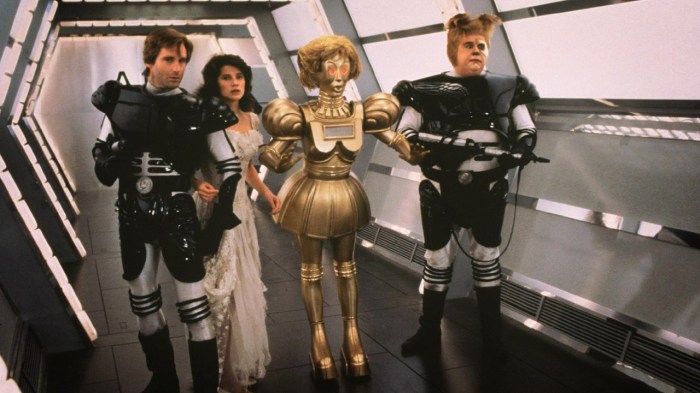
This is where Bill Pullman and John Candy come in, as Captain Lone Starr and his sidekick Barf, an allusion to Chewbacca in that he is half-man, half-dog. Candy is hysterical in his performance of the mawg, but the real winners of this role are the operators of Barf’s mechanical canine-like ears. Every time Barf appears to listen, his auto-receptive ears perk up like antennae. The effect is comic gold.

Like Han Solo, the character of Lone Starr is motivated by money. With perfect deadpan, Pullman says, “Barf, we’re not doing this for the spacebucks. We’re doing it for a shitload of spacebucks!”

The reason for the greed is that Lone Starr has a heavy debt to pay Pizza the Hut (voiced by the recently departed Dom DeLuise). And Pullman plays the character of Lone Starr with a humorous yet touching sentiment that would have made Harrison Ford proud. With a note of sadness, Lone Starr tells Vespa he hails from the Ford Galaxy. Those who do not remember the Ford Galxie 500 have come to assume that this joke is a reference to the actor who played Han Solo.

But there is more than enough of “Star Wars” reference to go around. Brooks even uses the famous Wilhelm scream as one of his Spaceball troops is shot in the ass by incoming laser fire.As a matter of fact, keep an eagle eye out for the Millennium Falcon parked next to Lone Starr’s Winnebago at the interstellar gas station.

This is not to say that George Lucas’ beloved saga of “Star Wars” is the sole target of Mr. Brooks’ parodying lightsabre. In “Spaceballs”, he references “The Wizard of Oz”, “Star Trek”, “Alien”, and even “Planet of the Apes”. Keep a sharp ear ready for that last one. That is the voice of Michael York playing the second ape on horseback.

Brooks definitely goes above and beyond his traditional self-reflective voice in this film. In ways like never before, the writer/director/producer/star lists his former Hollywood achievements as videotapes stored upon a futuristic spaceship.

“Instant cassettes,” says Col. Sandurz. “They’re out in stores before the movie is finished.”

In one of my favorite comedic sequences of all time, the villainous Spaceballs fast-forward through their own movie in order to discover the location of the good guys. After which, Dark Helmet and Sandurz engage in an Abbott and Costello routine of existential misunderstanding.

And the self-reflective filmmaking joke continues throughout the movie. Before teaching Lone Starr about the powers of the Schwartz, Yogurt (also played by Mr. Brooks) explains his profession upon his lonely planet.

“Merchandising,” says Yogurt. “Where the real money from the movie is made.” Yogurt then goes on to sell the audience item after item of Spaceballs merchandise, all of which is a joke. In fact, Mr. Lucas allowed Brooks to make “Spaceballs” on the condition that there would be no merchandising for this movie. This would, of course, account for the spotty nature of the “merchandise”. Notice that “Spaceballs: The Coloring Book” is nothing more than a Transformers illustration book (Twenty years before Michael Bay began ruining my beloved robotic heroes himself!)

There are many other individual items of “Spaceballs” to enjoy for the pure sake of silliness. John Candy wins the award for the best use of the middle finger (beating out Keanu Reeves in “The Matrix” and Jennifer Aniston in “Office Space”) after Lone Starr and Barf park the Winnebago in the Spaceball penal territory.

I am also a big fan of the great Stephen Tobolowsky’s short yet pleasing scene as an effeminate Captain of the Guards. He only has a couple of lines, but there is just something about his delivery that makes his character as memorable as Barf.

“Spectacular stunt, my friends, but all for not . . .” he lectures to his captives before realizing they are nothing more than stunt doubles.

The scene when Dark Helmet is caught playing with the Spaceballs action figures is also one of my favorite reactions in filmed comedy. According to cinema trivia, Moranis performed this scene impromptu after Brooks suddenly conjured up the premise on set. How they got the action figure so quickly is anyone’s guess.

And let’s not forget Joan Rivers as the voice of Dot Matrix, Princess Vespa’s personal assistant droid. Ironic, though, that the Joan Rivers of today currently resembles the physical appearance of the golden android.

A subtle shout is also made to fans of literary essays. When Spaceball One is revealed to be a gigantic transformer about to engage in “metamorphosis”, Dark Helmet prompts his officer: “Ready, Kafka?” Think about that one.

Final thought: Does the alien that bursts out of John Hurt’s stomach play a song that seems familiar to all who watched those classic Looney Tunes cartoons? It should. The song and top hat dance number is homage to “One Froggy Evening”. You know, the one where the frog grabs a cane and dances to “The Michigan Rag.”
SPACEBALLS, 1987.jpg

Also, Free logline submissions. The Writing Festival network averages over 95,000 unique visitors a day.
Great way to get your story out: http://www.wildsound.ca/logline.html

Deadlines to Submit your Screenplay, Novel, Story, or Poem to the festival:http://www.wildsound.ca

Watch recent Writing Festival Videos. At least 15 winning videos a month:http://www.wildsoundfestival.com

1987 Movie Review: ROBOCOP, 1987


Robocop (1987)
Directed by: Paul Verhoeven
Classic Movie Review
Starring: Peter Weller, Nancy Allen, Kurtwood Smith
by Mike Peters

Synopsis:

After being murdered by a ruthless gang of criminals, Alex Murphy (Peter Weller) is resurrected as a crime-fighting cyborg named ‘Robocop’.

Review:

Albert Einstein once said that: “It has become appallingly obvious that our technology has exceeded our humanity”. It is a very true fact indeed that technology has become an unstoppable entity. It is ever-growing and constantly on the move. It has strived to make our lives easier but has managed to gain the reputation as a slave master. We, as society, have become enslaved to the very idea of technology. It has taken us over and has rendered us vulnerable to its’ utopian ideals. Some of have said that it has stripped us of what many hold dear to them; our humanity.

Robocop is a film that does much more than entertain. It strives to understand the relationship man has with technology/machine. The fact that Robocop is a man controlled by technology is a statement unto itself. Even the title of the film is a hybrid of two opposing factors; man and machine. After being systematically slaughtered, it is only through the power of technology that Murphy is allowed to live once again. However, as a result, technology has rendered him a thoughtless and emotional free being. He is mundane and computer like in his speech and his suit is highly symbolic of the cold/sterile and colorless world that technology represents.

The film, on the surface, is about his role as a crime fighter, striving to uphold the law no matter the cost. On a much deeper level however, the film is about his fight against the technology that now controls his body. Throughout the course of the film, Robocop attempts to retrieve some evidence of his once prevalent humanity. When he first became Robocop, all his memories and emotional content were erased, thus making him an invalid without the proper guidance of human beings. It is only through a relapse and his quest to regain his old self that the audience begins to realize that man cannot always control technology. It now has the ability to control us.

Robocop soon begins to act irrationally as he begins to have dreams, memories and thoughts (He is now beginning to retrieve some of the individual characteristics that made him human in the first place). The scientists governing him have no idea what has happened as they are no longer able to control him. In one telling scene near the end of the film, Robocop removes his mask and fights without it, revealing the face of Murphy. It is a very shocking sight since Murphy’s human face is fused with the mechanical properties of a machine. The very fact that he begins to speak, think and feel as a human once again during this sequence represents his quest to separate himself from the machine that is now in control of him.

Paul Verhoeven, in his second American film, presents an idea that technology can be understood as a major threat to our very own civilization. In the film, many scenes, in which Robocop or Ed-209 (Robocop’s nemesis) appear, strongly depicts the failures that technology is capable of. In one particular scene, Dick Jones (Ronny Cox) is presenting the new and improved machine crime fighter, Ed-209. In a demonstration, one of the business men present, is told to point a gun at Ed. He does so and the machine tells him to drop it. The man relinquishes the weapon but the machine continues to warn him. In the background, scientists scramble to fix the problem but it is too late. Ed-209 opens fire and massacres the man to death with automatic weapons. It is an undeniable statement that technology which cannot be controlled by man is capable of eventually decimating mankind to the point of extinction.

The film is very strongly-opinionated. It not only critiques technology but, as well, society, politics and commercialism. With that being said, the film is also a solid form of entertainment. It is a must see for action buffs. The film is very violent and unrelenting in it’s’ brutality but it does manage to tell a cohesive story while simultaneously critiquing many things. The next time one watches this film however, try to understand how undermining it truly is. There is a lot more going on then mere action filled sequences. It is a highly subversive piece of work and manages to illicit many reactions as a result.

*Humanity is acquiring all the right technology for all the wrong reasons. ~R. Buckminster Fuller


Also, Free logline submissions. The Writing Festival network averages over 95,000 unique visitors a day.
Great way to get your story out: http://www.wildsound.ca/logline.html

Deadlines to Submit your Screenplay, Novel, Story, or Poem to the festival:http://www.wildsound.ca

Watch recent Writing Festival Videos. At least 15 winning videos a month:http://www.wildsoundfestival.com
1987 Movie Review: RAISING ARIZONA, 1987


RAISING ARIZONA
Movie Reviews

Directed by Joel and Ethan Coen
Starring: Nicolas Cage, Holly Hunter
Review by Andrew Rowe

SYNOPSIS:

When a childless couple of an ex-con and an ex-cop decide to help themselves to one of another family’s quintupelets, their lives get more complicated than they anticipated.

REVIEW:

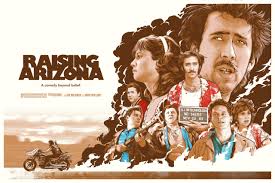
10 minutes, that’s how long Raising Arizona rolls until the title card hits. If this sounds odd it is, but so is everything else about the Coen Brothers’ second film. As they’ve often done throughout their career, the brothers normally follow-up a serious film with a comedy. Fargo led to The Big Lebowski, No Country for Old Men led to Burn After Reading. With Raising Arizona the brothers had just come from the neo-noir Blood Simple, their first ever film. Where as that film dealt with deception and murder in the shadows of Texas, Raising Arizona basks in the sun with non-stop slapstick, silly fun.

Nicholas Cage stars as Hi, or H.I. if you’re talking to his friends. He’s a petty criminal who has a thing for robbing convenience stores with ammo-less guns. Because he doesn’t use armed weapons his jail sentences are always small in length, which allows for multiple visits. During these multiple visits he meets Ed, a policewoman played by Holly Hunter. Ed’s fiance leaves her, which opens up the door for Hi to reform and win her heart. This is when the Raising Arizona title card hits.

The unlikely couple moves into a trailer in the desert and realize they need something more in their life because they have too much love to give. After multiple attempts of conception, they learn that Ed is unable to bare children and due to Hi’s criminal record, unable to adopt. Devastated, hope arrives in the form of the ‘Arizona Quints’, 5 boys that are born to a locally famous unpainted furniture storeowner, Nathan Arizona.

Hi and Ed decide that abducting one of the boys for themselves is a good idea and do so. After welcoming the child into their home, Hi and Ed are greeted by two of Hi’s friends from prison, Gale and Evelle, John Goodman, and William Forsythe. The two inmates have broken out of prison because the institution no longer had anything to offer them. Against Ed’s wishes, the two fugitives stay at their home where they begin to influence Hi.

At this same time a heavily armed bounty hunter by the name of Leonard Smalls, “My friends call me Lenny… only I ain’t got no friends”, is on the hunt for the child. Blowing up bunny rabbits with grenades, Leonard is fear itself. Gale and Evelle eventually learn of the child’s actual identity and decide to turn him in for the reward money. Everyone collides on a strip in the middle of the desert highway that involves a bank robbery, gunfire, hand-to-hand combat, screeching tires, and a large explosion.

The script, written by the Coens possesses their trademark tongue-in-cheek dialogue as well as an explosive climax and slow burn denouement. No one writes stupid characters like the Coens do. These people that inhabit the film aren’t very bright, and it’s hard to believe anyone in the world could be of this level of intelligence, but the Coens draw you in, first making the world they live in real, then the characters, then the silly things they do. Besides the charming dialogue, there are so many ridiculous sight gags that you may not even catch them all the first time around.

Raising Arizona is arguably the craziest movie the Coen Brother’s have made in their three-decade career, and that’s saying a lot. The film acts as a live-action Saturday morning cartoon. Working for the second time with cinematographer Barry Sonnenfeld who had shot their debut film Blood Simple, the visuals on screen are closer to a Dr. Seuss book than any of the current film adaptations. Using his trademark wide angles, everything remains in focus allowing the viewer to fully appreciate the immaculate Art Direction. The camera also moves with the action at the right time giving certain scenes a feeling that the camera is a character in the film, namely a chase scene through a house, and a fistfight between two characters.

The actors do a tremendous job of bringing these cartoon characters to life. John Goodman who would go on to work with the Coens several more times is perfect as Gale, the harder of the two brothers and number one bad influence on Hi. Nicholas Cage and Holly Hunter have great comedic chemistry and give weight to characters that otherwise wouldn’t have much soul. Hi may just be a dummy, but he’s a dummy with a large heart that wants nothing more than for his Ed to be happy. He is like Bugs Bunny mixed with Wilde Coyote, he’ll get away from Elmer Fudd only to celebrate and have an anvil fall on his head. Randall “Tex” Cobb is a towering inferno on wheels, and makes lighting a match look almost as cool as Clint Eastwood.

It’s of course the Coens that bring it all together. The characters all seem real in this colorful world they’ve created. The slapstick is done wonderfully and gives you a nostalgic feeling of when these Buster Keaton-style comedies were king. It’s just a really fun movie that’ll have you laughing and shaking your head in tandem. This film is also the Coen’s most family friendly; it is almost Disney-like in some aspects.

The film’s innocence is something rarely seen in today’s crop of comedies as well as in the Coen’s filmography. It doesn’t feature as dark of humor or the violence that comes with most Coen Brothers’ films, but here that’s a good thing. The film is a great little gem that shouldn’t be missed.

raising arizona

Also, Free logline submissions. The Writing Festival network averages over 95,000 unique visitors a day.
Great way to get your story out: http://www.wildsound.ca/logline.html

Deadlines to Submit your Screenplay, Novel, Story, or Poem to the festival:http://www.wildsound.ca

Watch recent Writing Festival Videos. At least 15 winning videos a month:http://www.wildsoundfestival.com

TIFF 2017 FINAL REPORT – BEST OF THE BEST

The last day, the 17th of September marks the end of another year of the Toronto International Film Festival. Most noted difference is the fewer number of films programmed, as attendances over the past years have been dropping. Reasons for this state of affairs are many including higher unaffordable movie prices, the removal of the festival all movie pass and movie pirating.

Of the 79 festival films seen this year, I have selected my 10 best – the best of the best.

These are listed in alphabetical order:
ANGELS WEAR WHITE (China/France)
BPM (France)
BRAWL IN CELL BLOCK 99 (USA)
THE CHILDREN ACT (UK)
L’INSULTE (THE INSULT) (France)
LES GARDIENNES (THE GUARDIAN) (France)
LOVELESS (Russia)
THE KILLING OF A SACRED DEER (Ireland)
THE SQUARE (Sweden)
SWEET COUNTRY (Australia)

The public is the most important and the PEOPLE’S CHOICE AWARD went to THREE BILLBOARDS.

Other winners as selected by the Toronto Intrenational Film Festival, are, as listed below, in the different categories.

Till next year…….

The Toronto International Film Festival® announced its award winners at the closing ceremony at TIFF Bell Lightbox today, hosted by Piers Handling, CEO and Director of TIFF, and Cameron Bailey, Artistic Director of TIFF. To watch the presentation, visit tiff.net/ceremony. The 42nd Festival wraps up this evening.
The short film awards below were selected by a jury comprised of Marit van den Elshout, Head of CineMart at the International Film Festival Rotterdam; award-winning filmmaker Johnny Ma (Old Stone); and Cannes 2017 Art Cinema Award winner Chloé Zhao (The Rider).

IWC SHORT CUTS AWARD FOR BEST CANADIAN SHORT FILM

The IWC Short Cuts Award for Best Canadian Short Film goes to Marc-Antoine Lemire’s Pre-Drink. The jury remarked the film “is a monumental yet intimate portrayal of a woman in transition. Lead by the towering performances of the film’s two actors, both of who are worthy of receiving their own awards. The jury were especially taken by the leading actress who gives one of the best performances we saw in the Short Cuts programmes. The 2017 Short Cuts jury honors Pre-Drink for Best Canadian short film.”

The award offers a $10,000 cash prize, made possible by IWC Schaffhausen.

IWC SHORT CUTS AWARD FOR BEST SHORT FILM

The IWC Short Cuts Award for Best Short Film goes to Niki Lindroth von Bahr’s The Burden (Min Börda). The jury remarked, “Whimsical but tragic, imaginative and just plain weird, this is exactly what one can expect from a Scandinavian musical with fish in bath robes singing out their existentialist crisis. This is a film that stands out in this program and any film program it will ever be part of.” The award offers a $10,000 cash prize made possible by IWC Schaffhausen.
The jury gave honourable mentions to Matthew Rankin’s The Tesla World Light (Tesla: Lumière Mondiale) and Qiu Yang’s Xiao Cheng Er Yue (A Gentle Night).

The Canadian awards below were selected by a jury comprised of Mark Adams, Artistic Director of the Edinburgh International Film Festival; Canadian documentarian and Hillman Prize winner Min Sook Lee (Migrant Dreams); and artist and filmmaker Ella Cooper, who is also the founder of Black Women Film! Canada.

CITY OF TORONTO AWARD FOR BEST CANADIAN FIRST FEATURE FILM

The City of Toronto Award for Best Canadian First Feature Film goes to Wayne Wapeemukwa’s Luk’ Luk’l. The jury remarked, “The award goes to a striking debut film that disrupts borders – of form and content and suggests new cinematic territories.This beautifully realized film offers a unique Canadian perspective, made with real compassion, insight and remarkable characters from Vancouver’s East Side.” This award carries a cash prize of $15,000, made possible by the City of Toronto.

The jury gave honourable mention to Sadaf Foroughi’s Ava.

CANADA GOOSE AWARD FOR BEST CANADIAN FEATURE FILM

The Canada Goose Award for Best Canadian Feature Film goes to Robin Aubert’s Les Affamés. The jury remarked, “This year the Canada Goose Award for Best Canadian Feature Film goes to a hybrid art-house film that proved to be something of a revelation. Wonderfully scripted and perfectly cast, this film managed the rare feat of featuring genuinely interesting and well-rounded characters; surprising dramatic and comedic moments with well thought-out multi-generational female roles (who were totally badass, I might add) while also dealing with poignant and contemporary issues, set against a striking rural backdrop and hundreds of ‘ravenous’ zombies.”

This award carries a cash prize of $30,000 and a custom award, sponsored by Canada Goose.

The jury gave honourable mention to Simon Lavoie’s The Little Girl Who Was Too Fond of Matches (La petite fille qui aimait trop les allumettes).

THE PRIZES OF THE INTERNATIONAL FEDERATION OF FILM CRITICS (FIPRESCI PRIZES)

The Festival welcomed an international FIPRESCI jury for the 26th year. The jury members comprised of jury president Jonathan Rosenbaum (USA), Robert Daudelin (Canada), Martin Horyna (Czech Republic), Ivonete Pinto (Brazil), Marietta Steinhart (Austria), and Jim Slotek (Canada).

Prize of the International Federation of Film Critics (FIPRESCI) for the Discovery programme is awarded to Sadaf Foroughi for Ava.

Prize of the International Federation of Film Critics (FIPRESCI) for Special Presentations is awarded to Manuel Martín Cuenca for The Motive (El Autor).

NETPAC AWARD

As selected by a jury from the Network for the Promotion of Asian Pacific Cinema for the sixth consecutive year, the NETPAC Award for World or International Asian Film Premiere goes to Huang Hsin-Yao’s The Great Buddha+.

Jury members include jury chairperson Rashmi Doraiswamy (India), Jian Hao (China), and Savine Wong (Canada). The jury remarked, “The NETPAC Jury awards The Great Buddha+ for depicting the interface between the haves and have-nots, with black humor and style, innovating with noir in representing the social reality of Taiwan today.”

TORONTO PLATFORM PRIZE PRESENTED BY AIR FRANCE

This is the third year for Platform, the Festival’s juried programme that champions directors’ cinema from around the world. The Festival welcomed an international jury comprised of award-winning filmmakers Chen Kaige, Małgorzata Szumowska, and Wim Wenders who unanimously awarded the Toronto Platform Prize, presented by Air France, to Warwick Thornton’s Sweet Country.

“This is a spiritual epic taking place in 1929 in Australia’s Northern Territory,” said the jury in a statement. “It is a great saga of human fate, and its themes of race and struggle for survival are handled in such a simple, rich, unpretentious and touching way, that it became for us a deeply emotional metaphor for our common fight for dignity.

Speaking about their deliberations, the jury added: “We saw 12 films from all over the world that took us into very different universes of the soul and to extremely different places on our planet. We were thankful to be able to see these films and we very much appreciated that actually exactly half of them were made by women. TIFF is leading the way, we feel.”

“As we only had one award to give, we had to be quite radical. We also limited ourselves to only one special mention, even if other films might have imposed themselves for best acting, writing or directing.”

Awarding a special mention to Clio Barnard’s Dark River, the jury said: “This film, deeply rooted in the Yorkshire countryside, convinced us, as its characters and actors, its photography, its story and its sense of place were all so much ONE, so utterly believable and controlled, that we were totally taken by it.”

The Toronto Platform Prize offers a custom award and a $25,000 cash prize, made possible by Air France.

New this year, the Festival presents a free screening of Toronto Platform Prize winner Sweet Country at TIFF Bell Lightbox at 8:30 pm on September 17. Tickets will be available on a first-come, first-served basis beginning at 6:30pm.

GROLSCH PEOPLE’S CHOICE AWARDS

This year marked the 40th year that Toronto audiences were able to cast a ballot for their favourite Festival film for the Grolsch People’s Choice Award. This year’s award goes to Martin McDonagh for Three Billboards Outside Ebbing, Missouri. The award offers a $15,000 cash prize and custom award, sponsored by Grolsch. The second runner-up is Luca Guadagnino’s Call Me By Your Name. The first runner-up is Craig Gillespie’s I, Tonya.

The Grolsch People’s Choice Midnight Madness Award goes to Joseph Kahn’s Bodied. The second runner-up is Craig Zahler’s Brawl in Cell Block 99. The first runner-up is James Franco’s The Disaster Artist.

The Grolsch People’s Choice Documentary Award goes to Agnès Varda and JR’s Faces Places. The second runner-up is Morgan Spurlock’s Super Size Me 2: Holy Chicken! The first runner-up is Long Time Running directed by Jennifer Baichwal and Nicholas De Pencier.

TIFF 2017 Movie Review: CATCH THE WIND (PRENDRE LE LARGE) (France 2017)

Movie Reviews of films that will be playing at TIFF (Toronto International Film Festival) in 2017. Go to TIFF 2017 Movie Reviews and read reviews of films showing at the festival.

Catch the Wind Poster
A middle-aged factory worker’s life is upended when she follows her employer to Morocco.

Director:

Gaël Morel

Writer:

Gaël Morel

Stars:

Sandrine BonnaireLubna AzabalIlian Bergala

CATCH THE WIND is a personal look at what happens when companies second source to a cheaper country. The story concerns Edith (Sandrine Bonnaire) informed that the job she’s held for her entire adult life is being relocated to Morocco. She refuses to accept a healthy severance package.

Against the advice of her colleagues, her self-absorbed son, and even the consultant hired to fire her, Edith instead opts to follow her job to Tangier.

Arriving with the naïve energy of a teenager on their first overseas trip, Edith realizes before long what she’s up against: the expected subpar working conditions and subpar pay, but also an adjustment to new social and cultural realities — nuances that her failure to grasp would mean her job and, more importantly, her dignity.

The film works for two factors. One is the detailed account by director Morel on what living is like in Tangier – the factory corruption, the poverty, the strife to support families and the danger on the streets.

The second is Bonnaire’s calculated and worthy performance. Brutal yet sensitive, PRENDE LE LARGE finally gets Morel’s characters a happy ending but not without sheer determination and strong will.

Trailer: https://www.youtube.com/watch?v=LsfAPoCk5AA

CATCH THE WIND

TIFF 2017 Movie Review: LAISSEZ BRONZER LES CADAVRES (Let the Corpses Tan)

Movie Reviews of films that will be playing at TIFF (Toronto International Film Festival) in 2017. Go to TIFF 2017 Movie Reviews and read reviews of films showing at the festival.

Let the Corpses Tan Poster
The Mediterranean summer: blue sea, blazing sun….and 250 kg of gold stolen by Rhino and his gang! They had found the perfect hideout: an abandoned and remote hamlet now taken over by a …See full summary »

Writers:

Jean-Pierre Bastid (novel), Hélène Cattet 

Stars:

Marc BarbéBernie BonvoisinDorylia Calmel

The film credit sequence begins with the title splattered on the screen one word at a time sets up the stage for what audiences are to expect in the upcoming 92 minutes gore fest.

An extreme close up of events and we are talking seeing a screen of a close up of a close up like a the teeth in a mouth. This effect can be terribly annoying if one is sitting up close to the screen, so best be at least in the middle to thee back of the theatre when viewing this one. The story is simple enough. A gang of thieves absconding with 250kg of stolen gold arrives at the abode of a listless artist caught in a bohemian love triangle.

The scenario quickly escalates into a desperate day-long firefight between cops and robbers throughout the remote ruins of a Mediterranean hamlet — and genre and art-house tropes collide in a relentless reverie of action spectacle. It should be noted that as bloody as this film is, it is not as bloody as the other Midnight Madness, nor is it as inventive.

Hélène Cattet and Bruno Forzani are also fond of using colour saturated silhouettes as in the spaghetti westerns.

Trailer: https://www.youtube.com/watch?v=8Cx48AN5_y8
 

TIFF 2017 Movie Review: THE THIRD MURDER (Japan 2017) ****

Movie Reviews of films that will be playing at TIFF (Toronto International Film Festival) in 2017. Go to TIFF 2017 Movie Reviews and read reviews of films showing at the festival.

The Third Murder Poster
Mikuma has a criminal record dating back many years and is now under the spotlight again. It looks like and open and shut case for Mikuma has confessed to the new charge. Enter prominent …See full summary »

Director:

Hirokazu Koreeda

Writer:

Hirokazu Koreeda (screenplay)

Stars:

Masaharu FukuyamaKôji YakushoIsao Hashizume

THE THIRD MURDER is director Hirokazu Kore-eda’s (AFTER LIFE, AFTER THE STORM LIKE FATEHR LIKE SON) first murder mystery/courtroom drama and one that encompasses deep thoughts on morality. From the first scene, Misumi (Kôji Yakusho) robs and kills an industrialist. Misumi freely confesses to the cops, claiming he was desperate to settle a gambling debt.

But defence attorney Shigemori (Masaharu Fukuyama) isn’t entirely satisfied with his mild-mannered client’s testimony. As Shigemori and his team go about their research, secret histories are brought to light, inconsistencies surface and unlikely alliances point to a more complicated set of circumstances.

One flaw of the film is the point is that it is brought up later Misumi might not have killed the industrialist and someone else could have done it. But showing the killing at the start of the film, dismisses the fact that someone else could have done it.

It is the film’s classic case where a director should never lie in a flashback scene. (Hitchcock did it once in STAGE FRIGHT and was never forgiven for it.) Kore-eda’s shot of Misumi’s reflection in the glass in the film’s final scene when he finally concludes his case with his attorney demands mention. The image in the reflection is different from his actual face reflecting the two sides of the man.

Brilliantly thought of and executed THE THIRD MURDER marks Kore-eda as his continuous best.

Trailer: https://www.youtube.com/watch?v=Plr3V4TYBQE

THE THIRD MURDER

TIFF 2017 Movie Review: THE DAY AFTER (South Korea 2017) ***

Movie Reviews of films that will be playing at TIFF (Toronto International Film Festival) in 2017. Go to TIFF 2017 Movie Reviews and read reviews of films showing at the festival.

The Day After Poster
The married Bongwan leaves home in the dark morning and sets off to work. The memories of the woman who left weigh down on him. That day Bongwan’s wife finds a love note, bursts into the office, and mistakes Areum for the woman who left.

Director:

Sang-soo Hong

Writer:

Sang-soo Hong

Stars:

Yunhee ChoKi JoabangMin-hee Kim

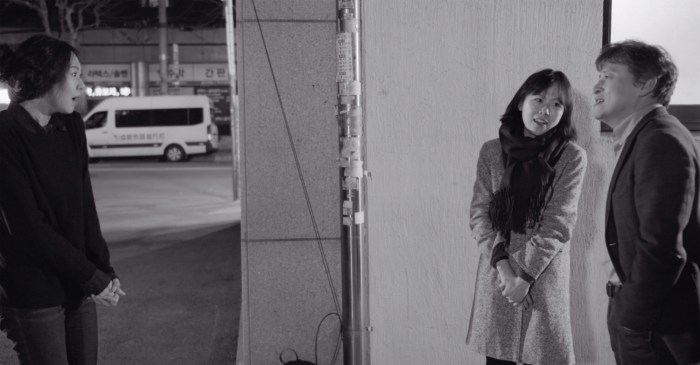
Hong Sangsoo is a Korean director that makes small films on a little budget. Films like his, will never get seen aside outside festivals. Like HILL OF FREEDOM that was also screened a few years back at TIFF, Hong’s THE DAY AFTER is a comedy of errors with lots of dialogue, confused identities and missed meetings.

The protagonist of the story is Kim Bongwan (Kwon Haehyo), the manager of a small, independent publishing company, recovering from his recent affair with Lee Changsook (Kim Saebyuk), his young, attractive, and now former, employee. All the said information is revealed over conversations of the characters.

Song Areum (Kim Minhee) takes over Changsook’s position, unaware of what has transpired and unprepared for the misguided wrath of Bongwan’s furious wife (Cho Yunhee) who suddenly appears at her husband’s office and accuses her of being his lover.

While Kim is initially on display as a deceiver with no redeeming qualities, director Hong reverses that notion by the end of the film. Hong also composed the original music for his film – a quiet entertaining piece.

Trailer: https://www.youtube.com/watch?v=jv0QPchaINk
 

THE DAY AFTER

TIFF 2017 Movie Review: EUPHORIA (Sweden/Germany 2017)

Movie Reviews of films that will be playing at TIFF (Toronto International Film Festival) in 2017. Go to TIFF 2017 Movie Reviews and read reviews of films showing at the festival.

Euphoria Poster
Sisters in conflict travelling through Europe toward a mystery destination.

Director:

Lisa Langseth

Writer:

Lisa Langseth

Stars:

Alicia VikanderEva GreenCharles Dance

When sisters Ines (Alicia Vikander) and Emile (Eva Green) are greeted at an institution (for the dying) with the standing figure of Charlotte Rampling wearing an overall, one can immediately tell what will happen is not going to be good. Ines is about to die of cancer and she wants to find closure with her sister as to the past.

EUPHORIA marks the English-language debut of Sweden’s Lisa Langseth and it is simply terrible. This is new age stuff that many will just gawk at.

The written dialogue is also plain awful. The kind of words Emile uses, the swearing and all is also used by Ines’ character. The words or ideas of different characters should be distinct. The film could do with a bit of humour – as dealing with death is a topic ripe for some black humour. Whenever Ines coerces Emile to talk about an incident in the past, she will later use that against her and lose it.

If Emile could not see this coming, the audience certainly can, for the script is too predictably cliched. Charles Dance puts a bit of life into the film as a dying man who organizes his own farewell party. The film turns out to be a muddled look on death mortality.

Trailer: https://www.youtube.com/watch?v=TMX3Dw-GjIA

TIFF 2017 Movie Review: APRIL’S DAUGHTER (LAS HIJAS DE ABRIL)(Mexico 2017) ***

Movie Reviews of films that will be playing at TIFF (Toronto International Film Festival) in 2017. Go to TIFF 2017 Movie Reviews and read reviews of films showing at the festival.

April's Daughter Poster
Valeria is 17 and pregnant. She lives in Puerto Vallarta with Clara, her half sister. Valeria has not wanted her long-absent mother, April, to find out about her pregnancy.

Director:

Michel Franco

Writer:

Michel Franco

Stars:

Emma SuárezAna Valeria BecerrilEnrique Arrizon

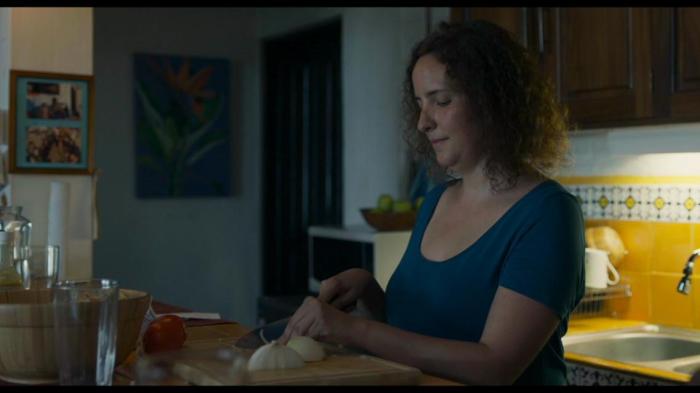
Emma Suarez (Almodovar’s JULIETA) plays a crazy mother, one that appears warm and caring at first glance but turns out to be calculating and ruthless. April, mother of a pregnant teen re-enters her daughter’s, Valeria (Ana Valeria Becerril) life, her energetic, take-charge attitude taking on considerably more disturbing hues once the child is born.

She eventually kidnaps the baby and horrors, as if that is not enough, sleeps with Valeria’s boyfriend, the child’s father, Mateo (Enrique Arrizon).

Mateo is good-looking enough to temp both mother and daughter but is a character with no backbone. Director Franco shows what happens when maternal instincts are taken to the extreme – and it is not nice!

The rest go the film follows Valeria as she searches for her kidnapped daughter. One wishes for a more upbeat ending given the film’s theme as the ending is a bit of a letdown. Excellent performance by Emma Suarez! A good female film from a male director.

Trailer: https://www.youtube.com/watch?v=OEVp4rvpD7I
 

aprils_daughter