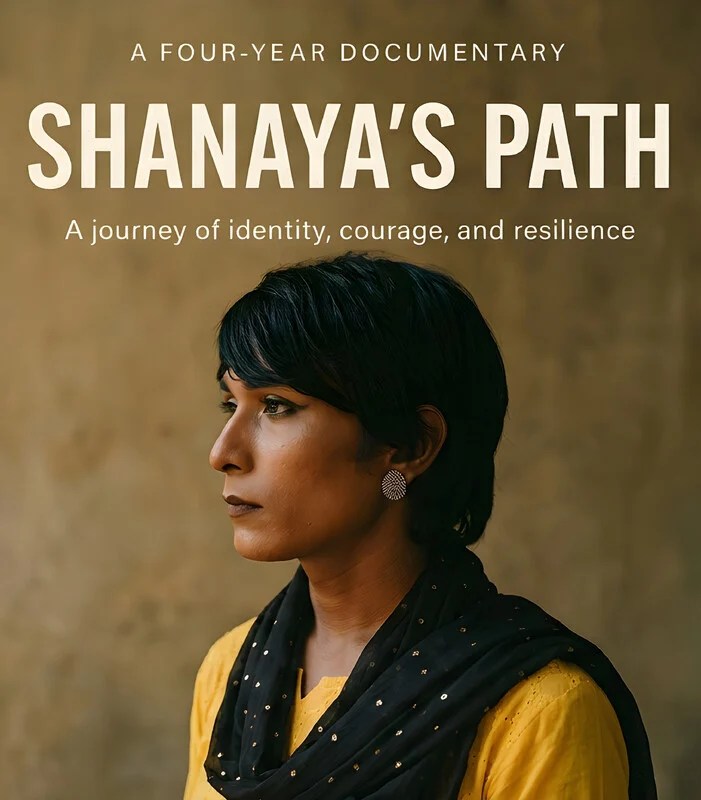
Shanaya’s Path follows the intimate journey of Shanaya, a young person from Darjeeling who identifies as a woman and dreams of transitioning despite immense social and familial resistance. Since gender norms are rigid and visibility for trans people is scarce in her home town, Shanaya leaves for New Delhi, but her desire to become her true self is met with hostility, shame, and fear.
1. What motivated you to make this film?
I am very interested in how a person can change. I underwent a period of deep change at the end of 2019 and it lasted a few years. These were fundamental changes where I questioned what had been the status quo of my own life and personality up to that point. I have often admired transgender people for their ability and energy to fundamentally change their whole world despite immense resistance, which is much deeper than the changes I made in my own life. Transgender people are the bravest people I know.
2. From the idea to the finished product, how long did it take for you to make this film?
About 5 years.
3. How would you describe your film in two words!?
Deep, moving.
4. What was the biggest obstacle you faced in completing this film?
There was a moment when the project was at the point of collapse when Covid-19 broke out. International travel was severely hampered and close public contact prohibited, which the project depended upon.
5. There are 5 stages of the filmmaking process: Development. Pre-Production. Production. Post-Production. Distribution. What is your favorite stage of the filmmaking process?
I love being in India and have been there so many times, I have lost count. India is always so full of energy, beautiful and horrific at the same time, and I can’t help myself recording it, so my favourite filmmaking process is Production, at least when it comes to India.
6. When did you realize that you wanted to make films?
In 2019 I was on my way to Lumbini to take photos for an NGO there. I was planning to stop in Delhi and then take the train. I met Shanaya at that time and listened to her story. I immediately realised that I wanted to record her amazing story, but I also knew that photos would not do it justice. So I started filming.
7. What film have you seen the most times in your life?
I have no idea but I like to revisit film sequences, usually for the interplay of music and picture. There are some sequences that move me to tears every time.
8. In a perfect world: Who would you like to work with/collaborate with on a film?
I would like to shoot a music video with Marwan Pablo, a rapper from Cairo.
9. You submitted to the festival via FilmFreeway. How has your experiences been working on the festival platform site?
Pretty good platform and keeps everything in one place.
10. What is your favorite meal?
Dal Tadka with garlic Naan and Masala Chai.
11. What is next for you? A new film?
I am planning a new big project in India which may go in production this year, otherwise next year. The title is: “Ganga – A Sacred Journey Of Rebirth”. There is a (small) change it may still change.
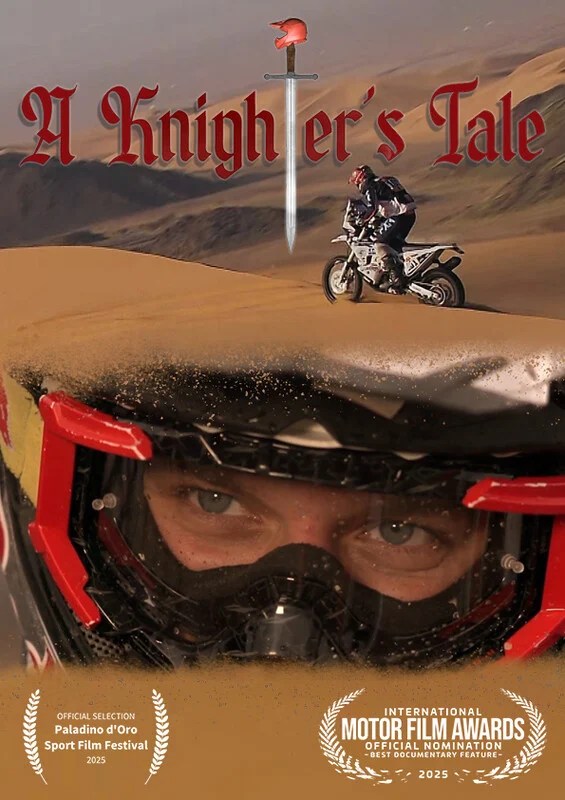
A Knighter’s Tale, 81min., Ireland Directed by Barney Edwards Deeply in debt and abandoned by his backer, hemmed in by storms and further twarted by a global pandemic, world champion motorcyclist David Knight must cut a path to his lifelong dream of racing in that deadliest of races: The Dakar.
Get to know producer Róisín Clarke:
1. What motivated you to make this film?
We met David and were inspired by his drive, commitment to the sport and his passion for life.
2. From the idea to the finished product, how long did it take for you to make this film?
Two and a half years
3. How would you describe your film in two words!?
Relentless perseverance
4. What was the biggest obstacle you faced in completing this film?
Financing
5. What were your initial reactions when watching the audience talking about your film in the feedback video?
Delighted to see genuine joy on their faces and in their voices.
6. When did you realize that you wanted to make films?
When my best friend heroically battled Breast Cancer in a way that was unfathomable to me and I wanted to do something to honour her fight. I knew that filming a documentary about her journey was the only way to do it justice.
7. What film have you seen the most in your life?
Juno
8. What other elements of the festival experience can we and other festivals implement to satisfy you and help you further your filmmaking career?
A recent film festival had a whatsapp group for the award nominees. It created a great feeling of inclusivity and connectedness between the film makers leading up to and after the festival itself.
9. You submitted to the festival via FilmFreeway. How has your experiences been working on the festival platform site?
FilmFreeway has worked great to date. There are a wide variety of festivals to enter and reminders if you want to track closing dates. Very happy with it.
10. What is your favorite meal?
Steak and veggies!
11. What is next for you? A new film?
Two doc features and a horror feature both to hopefully film this year.
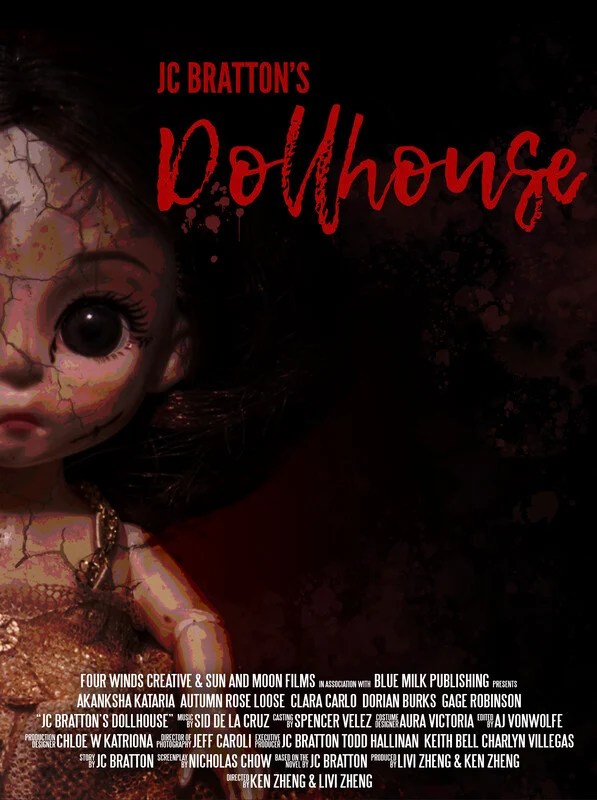
In the wake of a mysterious family death, a couple’s night of mourning is interrupted by a strange delivery containing an antique dollhouse and a terrifying tale about its lone occupant.
What motivated you to make this film?
I grew up as a “latchkey kid” of the 1980s and immersed myself in horror movies and short terror tales. A big fan of “Point Horror” tales from Scholastic, including Slumber Party by Christopher Pike and Twisted by R.L. Stine, I also consumed short-form terror tales on the small and big screens, including titles such as Creepshow, The Twilight Zone, Tales from the Darkside, and Tales from the Crypt. This lifelong interest in the macabre shaped my creative voice. Under the pen name “JC Bratton”—a tribute to my paternal great-grandmother—I crafted a series of short terror tales that paid homage to the authors I respected. I founded Blue Milk Publishing, LLC, as a small horror press to release these stories. One title in particular, Dollhouse—a “story-within-a-story” about three Japanese dolls—sold over 1,500 copies. I secured a seed investment to bring a portion of this tale to life. I went with the story of “Buffy,” the doll that torments a young couple, Mike and Amber.
From the idea to the finished product, how long did it take for you to make this film?
Well, the intention was to eventually take my stories to the big screen. So, I’d say about 3 years (I have a busy day job… I am working on my Doctorate… So, you can say that my time is limited!). The adapted screenplay took about a week. Pre-production took about 2 months. However, the actual filming took only two days!
How would you describe your film in two words!?
Playful terror
What was the biggest obstacle you faced in completing this film?The production team, actors, and crew were amazing! The biggest challenge was getting this ready in time for the large genre festivals. We made it happen, though! And, I am proud to say that we did very, very well in the film festival circuit!
There are 5 stages of the filmmaking process: Development. Pre-Production. Production. Post-Production. Distribution. What is your favorite stage of the filmmaking process?
I actually like post-production, where editing is involved. I think if I had made film my career, I would have chosen to become an editor.
When did you realize that you wanted to make films?
Well, my intention for writing my short stories was to see them eventually hit the small or big screens!
What film have you seen the most times in your life?
The original Star Wars (“A New Hope”).
In a perfect world: Who would you like to work with/collaborate with on a film?
Definitely Lucasfilm! From what I hear, they may be interested in doing horror soon…?
You submitted to the festival via FilmFreeway. How has your experiences been working on the festival platform site?
It’s been really good! It’s a very easy way to submit our work to festivals around the globe!
What is your favorite meal?Probably breakfast. I am all about going to Starbucks in the morning. What is next for you? A new film?
Well, I am working on my Doctorate. My experience making a movie in the indie film industry has become a potential dissertation topic. I would love to make a feature-length version of Dollhouse or maybe more shorts about the other dolls, Muffy & Duffy!
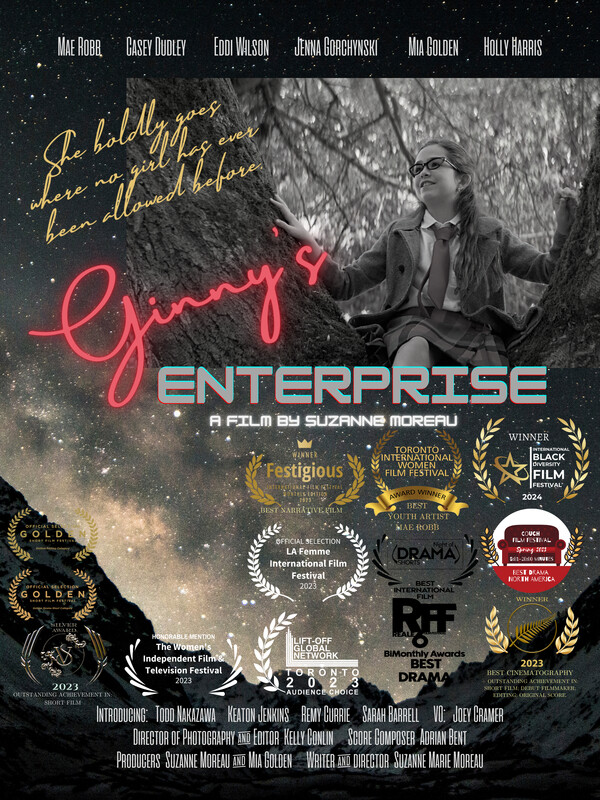
GINNY’S ENTERPRISE, 18min., Canada Directed by Suzanne Marie Moreau She boldly goes where no girl has ever been allowed before! How a young Star Trek fan foils her family’s restrictive roles for girls by becoming the Captain of her own starship.
Get to know the filmmaker:
1. What motivated you to make this film?
I was motivated by my own coming of age experiences as a girl growing up in the sixties Cold War at a time when gender roles were strictly enforced by a generation traumatised by war. This origin story is a version of my own loss of innocence and a stark recognition of truth as an enigma. It is a reckoning of how I coped with injustice and intergenerational, complex trauma over a lifetime – like Ginny does in the film, at times inappropriately. The film is very meta. It’s a path towards forgiveness of self and others, and of healing. It’s how I found a way, through storytelling,to those who may have experienced their own version of trauma, to offer a glimmer of hope.
2. From the idea to the finished product, how long did it take for you to make this film?
Ginny’s Enterprise was one of several short screenplays I began writing in 2019. The screenplay was selected by Toronto and Montreal film festivals, and became a festival finalist in Vancouver, New York, Vienna and Paris, France in 2021. After launching my first short film, Blood Buddies (2022), I began pre-production in summer 2022 and wrapped filming in October that year. Ginny’s Enterprise completed post-production and made its debut in film festivals in early 2023.
3. How would you describe your film in two words!?
Female empowerment.
4. What was the biggest obstacle you faced in completing this film?
Emotionally, there was a sudden death in the family of one cast member, to whom the film is dedicated. Practically, scheduling over the Canadian Thanksgiving weekend made it tricky to have the same crew members in the same roles on each day of the three-day shoot. It made for a very large crew and continuity issues, but we pulled it off in true indy fashion. I’m so grateful for the compounding of riches in the amazing work of the art department, the cinematographer, and the entire cast and crew.
5. What were your initial reactions when watching the audience talking about your film in the feedback video?
I was so gratified to hear that the reviewers completely understood the film! Theirs were such succinct and insightful expressions of their thoughts, they gave so much credibility to the film. It was lovely that they appreciated the two time periods and the attention to detail in creating them through set dec, costumes, hair and makeup. As a relatively new filmmaker, I tend to second-guess my ability as a visual storyteller, but this response smashed those doubts. It is also great to see that the experiences I had so long ago still have relevance, and timeless issues that resonate with young adults today.
6. When did you realize that you wanted to make films?
Perhaps since the time I tried to ‘direct’ my mother on her Super8 to film my age 6 skipping prowess! Fast forward to post-retirement and craving a creative outlet – independent filmmaking presented itself as a way to incorporate writing and photography – as a visual artist I had limited myself to physical painting and photography. Smartphones and social media were the first steps towards an electronic medium, then immersion in screenplay writing, then a mentorship course on filmmaking, which led to the realisation that the best way to have my scripts produced was to make them myself – and voila!
7. What film have you seen the most in your life?
There are so many films! The one that was broadcast on repeat every year in the 60’s was “The Wizard of Oz” so that’s the first film I saw multiple times on the B&W TV. But on viewing the 1989 50th anniversary DVD, I was shocked to see that Oz is in Technicolor! Second most frequent was “Butch Cassidy and the Sundance Kid” which I saw on my first date (to which I snuck out) at age 13, and 4 more times in theatres during its original release in 1969. Both films have bold, adventurous female leads as does the original Star Trek series aired in 1967. It’s made me realise that female presence and stories are so important to be told on screens so girls and women can see themselves as more than a second fiddle to men and boys.
8. What other elements of the festival experience can we and other festivals implement to satisfy you and help you further your filmmaking career?
The most thrilling aspect of my film festival experience is in-person screening in a theatre with a big screen and surround sound. As a filmmaker I travel to festivals that screen my films – I’ve been fortunate enough to do so in Los Angeles, Toronto and Victoria. To be able to meet and mingle with other filmmakers and fans is the best. Industry panels, presentations, masterclasses and networking events are also a fantastic way to find connections to further independent filmmaking or to break into industry filmmaking. I was honoured to be invited to a panel of filmmakers at one Toronto festival in front of a live audience with real time interaction – it was wonderful! However, it is a major undertaking for the festival and if there’s any way to emulate that experience over distances it would be most welcome!
9. You submitted to the festival via FilmFreeway. How has your experiences been working on the festival platform site?
I’ve submitted several of my films through FilmFreeway since 2021 and found it to be a very effective and easy way to navigate the festival circuit.
10. What is your favorite meal?
Any meal shared with my family and friends is my favourite.
11. What is next for you? A new film?
I am currently editing my first exploratory, documentary short film, which I shot over the last year. I have several narrative live action film scripts ready for pre-production, and a feature and series in development. I continue to write!
My mother was adopted and never met her biological mother. I think it hurt her. This film envisions what that encounter would have been like had it happened.
2. From the idea to the finished product, how long did it take for you to make this film?
Two years.
3. What was the biggest obstacle you faced in completing this film?
On-set obstacles, but that always happens.
4. There are 5 stages of the filmmaking process: Development. Pre-Production. Production. Post-Production. Distribution. What is your favorite stage of the filmmaking process?
Production, of course! I live to be on set!
5. When did you realize that you wanted to make films?
Six years old.
6. What film have you seen the most times in your life?
GOODFELLAS or GHOSTBUSTERS.
7. In a perfect world, who would you like to work with/collaborate with on a film?
Eva Victor!
8. You submitted to the festival via FilmFreeway. How have your experiences been working on the festival platform site?
Great! l love FilmFreeway!
9. What is your favorite meal?
Steak, rare.
10. What is next for you? A new film?
My team and I have another short film titled REUNION that we are expanding into a feature; we will shoot that film summer 2026!
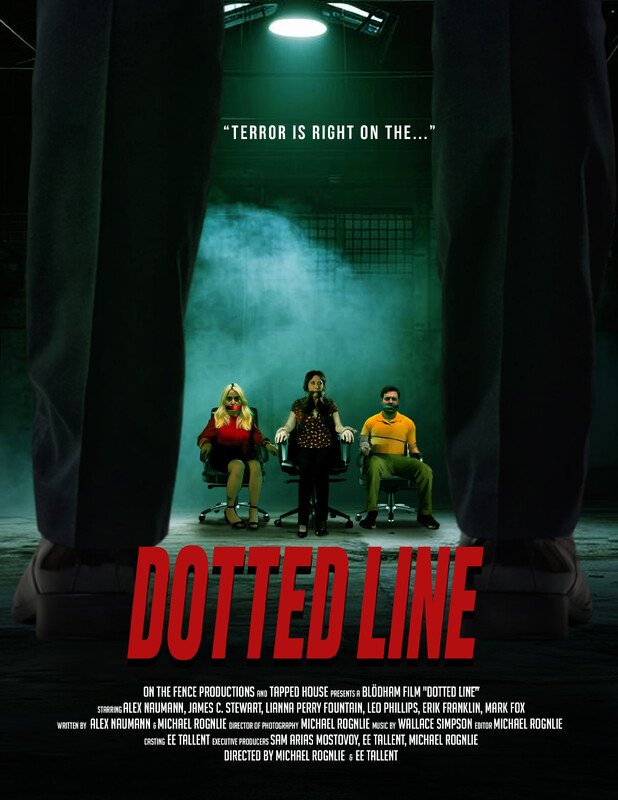
A reclusive woman is drawn into a waking nightmare when she is stalked by a deranged lunatic, who is convinced that she holds the key to his twisted redemption.
1. What motivated you to make this film? – After the last film I co-directed with EE Tallent, Bad Chemistry, screened at a local festival, we noticed the audience responding more to the comedic moments over the heavier material. Our lead actress, Alex, suggested making a film based on something silly, like the extended car warranty meme, and the story evolved from there as we co-wrote the film.
2. From the idea to the finished product, how long did it take for you to make this film? The idea spawned on 10/25/2025 and we finished post Dotted Line on July 9th, 2026.
3. How would you describe your film in two words!? Big characters.
4. What was the biggest obstacle you faced in completing this film? Shooting with no focus puller.
5. There are 5 stages of the filmmaking process: Development. Pre-Production. Production. Post-Production. Distribution.
What is your favorite stage of the filmmaking process? Being that I usually edit, color, and do sound design in addition to cinematography, the production and post-production are pretty evenly matched for me.
6. When did you realize that you wanted to make films? Ever since I can remember.
7. What film have you seen the most times in your life? Hard to say but it could be The Shining, Christine, Its a Wonderful Life.
8. In a perfect world: Who would you like to work with/collaborate with on a film? I’m working with them now, which is fantastic, but if I could add some more perhaps Ari Aster.
9. You submitted to the festival via FilmFreeway. How has your experiences been working on the festival platform site? Super easy.
10. What is your favorite meal? I probably said this last time, but a rib-eye with a wedge salad. Then a fresh baked chocolate chip cookie in a skillet with a dollop of vanilla bean ice cream resting on top.
11. What is next for you? A new film? Yes, a new film! It’s called “Method” and I can’t wait to get started. I’ll be returning with my team and co-directing with EE Tallent again. Method is a sequel, not-sequel, to my 2020 film Gary, or at least it takes place in the same universe. I co-wrote Method with my buddy Juan Lee who lives in Brooklyn, who is also the co-writer of Gary.
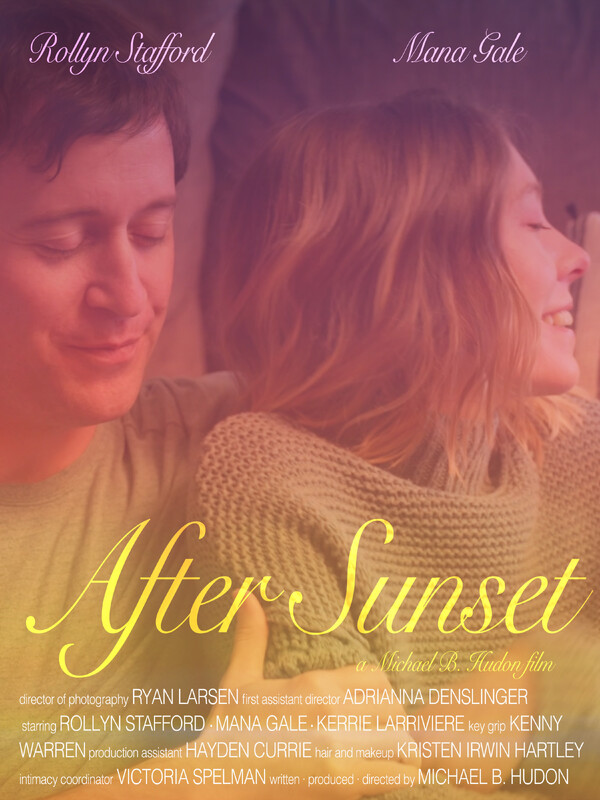
After Sunset, 7min., USA Directed by Michael Blake Hudon A man, reeling after a serious breakup, reflects on his past relationship and finds a new perspective.
I’ve loved movies for as long as I can remember. I finally decided to purse my passion and enrolled in The Los Angeles Film School’s online Digital Filmmaking program in 2021. I was entering my final six months with the school and had to produce my final project. Writing has always been therapeutic for me, and I was going through a breakup at the time. I don’t necessarily think I sat down and said let’s make a movie out of it but I believe it was a more subconscious thing and I was searching for answers.
2. From the idea to the finished project, how long did it take for you to make the film?
Two years, which I’m not proud to state, but I’ve sure learned a lot. Most of that time was post-production. It’s a really long story and we’d be all day but from pre-production through production, was four months.
3. How would you describe your film in two words?
Compassionate and reflective
4. What was the biggest obstacle you faced in completing this film?
Gosh, so many. I’d say the answer would have to be the same that all filmmakers face- the money. Like many others before me, this project was almost entirely self-financed.
5. What were your initial reactions when watching the audience talk about your film in the feedback video?
Tears! I shed a few tears. I don’t know that I ever thought about how others might relate to the project when I first sat down to write. I only discovered that when I first started to pass the script around. Though the story is incredibly personal, I found that the experience isn’t unique to me alone. It’s universal. Shared.
6. When did you know that you wanted to make films?
I’ll say I was probably around 11 or 12. That was the age where we’d get the camera and make movies as kids. Though we were really just having fun and that certainly wasn’t when I thought to pursue it as a career choice. That didn’t come until my late twenties. I also think it’s always been there, even if I wasn’t conscious of it. I’ve always loved stories/movies. This probably sounds weird but I remember being really little – the tv would be turned off and I’d just stare at it, imaging my own films in my head. True story!
7. What film have you seen the most of in your life?
This is tough…probably Braveheart, or Titanic. Two of my favorite films of all-time. Though, I do recall watching Stepbrothers an unhealthy amount of times when it first came out.
8. What other elements of the festival experience can we and other festivals implement to satisfy you and help you further your filmmaking career?
I wish I had a good idea here. Honestly, you guys have done so much and I’m so grateful for the opportunity. Your festival is so unique!
9. You submitted to the festival via FilmFreeway. How has your experiences been working on the festival platform site?
Incredibly easy and user/filmmaker friendly.
10. What is your favorite meal?
I base everything I eat on whether or not I can make it spicy. I love cooking Gumbo. It’s got all the best stuff in it.
11. What is next for you? A new film?
What’s next for me is being kept tightly under wraps at the moment. I’m sorry! I know there’s no fun in that answer. What I can tell you is that I am writing a limited series and you heard it here first.
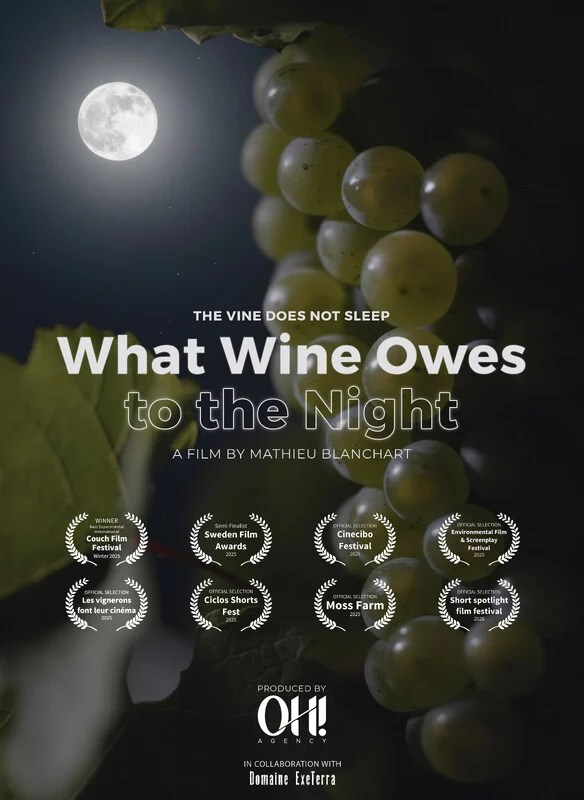
Night has fallen, but the vineyard does not sleep.
In the silent darkness, the vines whisper, the leaves quiver, and the earth still breathes. What the Wine Owes the Night is a visual and sensory poem, an intimate dive into the nocturnal life of a vineyard. With little or no dialogue, the film captures breaths, fleeting lights, and unseen presences that watch over the land as humans withdraw.
1. What motivated you to make this film?
The film grew out of a visit to the Exettera vineyard in Alsace (France). While walking through the vines, I spent time talking with the winemaker about his biodynamic approach and his relationship with the living world. At one point, I asked him what happens in the vineyard once night falls. He led me to another plot, almost untouched by light pollution. In that quiet darkness, the vineyard felt alive in a different way, and I was immediately drawn to it. The project was born there, without a clear intention or outcome in mind. It was an experience first, an attempt to listen, to observe, and to let the night reveal its own presence. I never imagined it would eventually travel to festivals around the world.
2. From the idea to the finished product, how long did it take for you to make this film?
I first visited the location in April 2025, and the film was shot in August 2025. The edit was completed a few weeks later. What truly took time was not the production itself, but waiting for the right conditions. I wanted to film under a full moon, at the moment when the vineyard reaches its peak just before the harvest, and only if the sky remained clear. In that sense, the film followed a natural rhythm, shaped by the moon, the season, and a bit of patience.
3. How would you describe your film in two words!?
Quietly alive
4. What was the biggest obstacle you faced in completing this film?
The biggest obstacle was the lack of margin for error. Everything had been carefully scripted and planned in advance, but once on location, I had to confront the reality of the environment and adapt in real time. I was filming in lighting conditions I had never experienced before, with only one chance to get it right. It required focus, flexibility, and trust in the moment.
5. There are 5 stages of the filmmaking process: Development. Pre-Production. Production. Post-Production. Distribution.
What is your favorite stage of the filmmaking process?
For this project, definitely production. It was a truly magical night, accompanying the vineyard from sunset to sunrise. Being present as the landscape slowly transformed in the darkness was a unique experience. Ending the shoot sitting on a bench, quietly contemplating the place while drinking the glass of wine seen in the film, felt like a natural and meaningful conclusion to the night.
6. When did you realize that you wanted to make films?
My desire to make films comes from an endless curiosity about the world around me and a need to share that curiosity with others. It wasn’t a career I initially planned. It gradually became evident around the age of 19 or 20, as filmmaking felt like the most natural way to combine observation and expression.
7. What film have you seen the most times in your life?
Probably Good Will Hunting by Gus Van Sant.
8. In a perfect world: Who would you like to work with/collaborate with on a film?
Too many possibilities and desires, but Gus Van Sant could be so rewarding. 9. You submitted to the festival via FilmFreeway. How has your experiences been working on the festival platform site?
Very smooth and straightforward. It’s an efficient platform that makes submitting and tracking films easy for filmmakers.
10. What is your favorite meal?
Anything that comes with good company and wine
11. What is next for you? A new film?
There’s no fixed project yet. For now, the focus is on staying curious, exploring the world around me, and letting the next story reveal itself naturally.
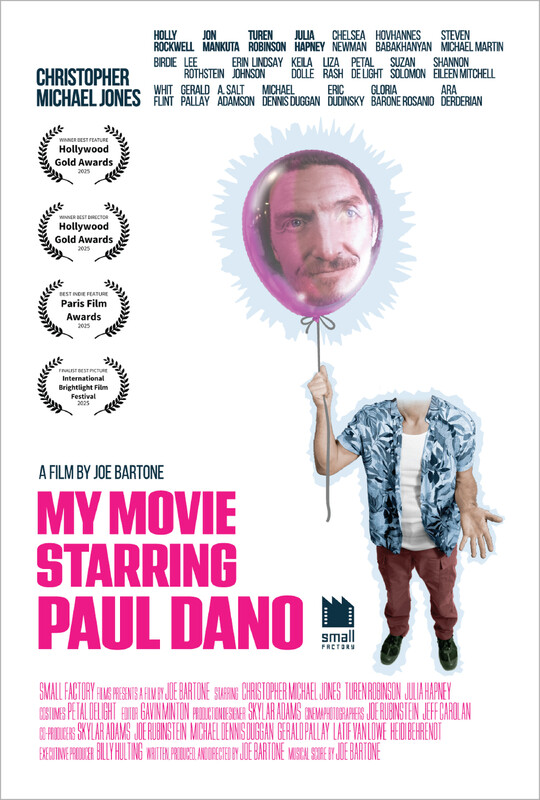
The famous actor comes to Herman in a dream, convincing him to make his feature “Bear Naked Amazonians from Mars.” If he makes the deadline, the film will take Best Feature at South by Southwest, making Herman an international celebrity.
1. What motivated you to make this film?
I was inspired by No Wave film – a movement from NYC 1976-1982. In this style, you shoot it now. Before you even have a complete understanding of the story. You blast your way into the production and trust instincts. I thought this would be a great departure from my first narrative film, in which I was much more careful. I think in the future I will return to a more traditional, methodical plan, having learned what I needed in the process of making a No Wave inspired film.
2. From the idea to the finished product, how long did it take for you to make this film?
18 weeks and two days from the first day of writing to the last shot of principal photography, then 18 months of editing and graphics, VFX, etc.
3. How would you describe your film in two words!?
Hope High
4. What was the biggest obstacle you faced in completing this film?
Other than time and money? Personalities. If even one cast member is not doing an indie film for the love of it, but rather from the money or career advancement it might bring, the whole cast and crew gets infected with negativity.
5. There are 5 stages of the filmmaking process: Development. Pre-Production. Production. Post-Production. Distribution.
What is your favorite stage of the filmmaking process?
I do not have one. each of these stages in an entire film making process on its own.
Distribution is my least favorite though.
6. When did you realize that you wanted to make films?
There is loving films – which happened at a Towering Inferno / MASH double feature. I was 12. it was my birthday and I wanted to see Towering Inferno. My friends and I stayed for MASH by Robert Altman. Even at 12 I understood I was seeing something powerful. Something truly important.
But I spent my life as a musician and music producer, and it was not till my late 40s that I switched to film as a sound recordist and composer. Then I decided to try film and it clicked for me.
7. What film have you seen the most times in your life?
Manhattan, City Of Lost Children, Lawrence of Arabia, Chinatown, Wings Of Desire. Many others. I often watch the first twenty minutes of movies over and over again. To learn how they set up the story.
8. In a perfect world: Who would you like to work with/collaborate with on a film?
Geez. I have worked with SAG actors and I always have trouble with them.
My greatest fear is to work with an A lister and spend the shoot dealing with their personalities.
I think I would have to make the audition process a time to figure out if I actually like this person.
I did a film with Tim Roth once. I like him. Tm Roth I would make a movie with again.
9. You submitted to the festival via FilmFreeway. How has your experiences been working on the festival platform site?
There are a lot of “scammy” festivals. Grey area tricks like one company will own multiple festivals. they will on ly pick you for one of them, but you accidentally apply for all of them. That’s a grey area. Other festivals have different names and different notice dates but the event date and location is the exact same spot. That’s a scam as well. Online is kinda a scam. Frankly, I was recently appointed as a director of a festival and I am trying to change the entire format to better suit filmmakers and revenue.
Filmmakers do not need 4-walls for their films. They need footage of them talking about their film and others talking about their film they can use for social media. And they need awards. Semi-, Finalist, Honorable mention, best actor, best actress, etc. My plan is to award more certificates for more categories but leave the Best of the Festival as a real trophy. and I plan to switch from four-walling films to showing clips and a panel discussion. Then I will four-wall just the winners only. what do you think?
10. What is your favorite meal?
Any meal with my wife.
11. What is next for you? A new film?
I wrote a larger budget film script and a children’s book that I illustrated as well. Now I am working on a new script for a low budget horror comedy that we can shoot next fall. That and scoring a feature for another film.
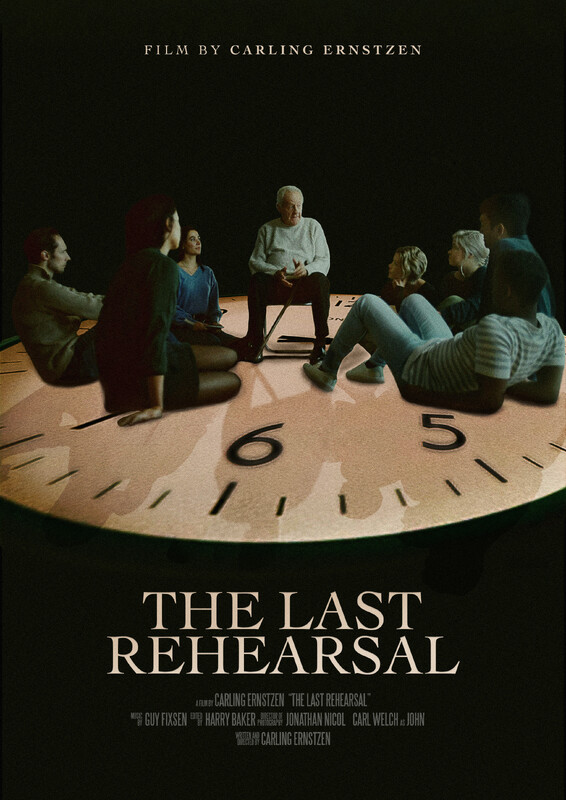
Inspired by true events. Faced with terminal cancer, a beloved acting teacher rallies his favourite students one last time to stage his final play.
1. What motivated you to make this film?
It began with a group of close acting friends in London who wanted a project to work on together, purely for the joy of acting together again.
The story itself is rooted in the loss of a dear acting teacher and mentor who passed away while we were rehearsing a play he had written for our troupe. At the time, none of us knew it would be his final work. When he died, what I felt most sharply was not only grief, but a creative rupture. He was someone who gave language to us as artists, and suddenly that voice was gone.
I wrote The Last Rehearsal instinctively in response to that absence. It came from a simple question: who carries the work forward when a guiding voice disappears? The film became a meditation on unfinished work, mentorship, and artistic inheritance. It is inspired by true events, but it is not a literal retelling. A small number of my mentor’s words to me appear as voiceover, used sparingly and with intention, not as explanation, but as presence.
2. From the idea to the finished product, how long did it take you to make this film?
The script was written around seven years ago, at the very beginning of my writing journey. At the time, it was deeply personal, so I kept it private.
About two years ago, a group of my acting friends and I were talking about wanting to collaborate again. One of the actors who went on to play the protagonist remembered the script clearly and strongly encouraged me to return to it. He championed it as the project we should make together, and that recognition became the catalyst for bringing The Last Rehearsal back to life.
From there, the process moved very organically.
We shot over five days, wrapping principal photography at the end of November 2023. We went into post-production in January 2024, and the film was completed in March 2025. From shoot to final delivery, the process took roughly a year and a half.
3. How would you describe your film in two words?
Unfinished inheritance.
4. What was the biggest obstacle you faced in completing this film?
Stepping fully into directing.
I come from an acting background, and directing was not something I initially set out to do. It required trusting my instincts while holding the emotional and creative centre of the work. What made it possible was the generosity and trust and skills of the cast and a brilliantly supportive seasoned crew, who approached the material with care, intelligence and belief.
5. What is your favourite stage of the filmmaking process?
Honestly, I have loved every stage of the process. Pre-production, production, and post-production each brought a different kind of discovery, and each was rewarding in its own right.
If I had to choose, it would be the creative thrill of inception. Seeing the characters and the world come to life for the first time in rehearsal was unforgettable. I remember floating home afterwards, in awe of watching a group galvanise around an idea and make something feel suddenly real.
6. When did you realize that you wanted to make films?
I started in music at school piano and singing, and then trained as an actor at a film school in Cape Town called AFDA, with music as a sub-major. Acting always felt instinctive, particularly film acting. I was drawn to subtext, emotional structure, and script analysis more than performance for its own sake.
Writing emerged later, almost accidentally, and directing followed naturally from that. The Last Rehearsal marked a shift for me, from purely acting to writing, and then to directing. I realised I loved shaping the whole, being a creative architect, and working closely with collaborators to build something cohesive and meaningful.
7. What film have you seen the most times in your life?
This is difficult, because I tend to return to a small handful of films rather than a single favourite.
Taxi Driver and Rebel Without a Cause were formative early on. Dead Poets Society and Billy Elliot deeply shaped how I think about mentorship and creative encouragement. I have returned many times to Steven Soderbergh’s King of the Hill and Fame (1983).
French cinema was also formative for me, particularly Amélie for its emotional lyricism, and La Haine for its urgency and clarity.
More recently, the work of Joachim Trier feels closest to my creative DNA.
8. In a perfect world, who would you like to collaborate with on a film?
Paul Thomas Anderson, Greta Gerwig, and Damien Chazelle.
I am drawn to filmmakers who balance emotional intimacy with cinematic ambition, and whose work feels deeply human while remaining formally precise.
9. You submitted to the festival via FilmFreeway. How has your experience been working with the festival platform?
Wildsound has been incredibly meaningful. I love the emphasis on audience feedback and conversation. That exchange is why we make films. Being genuinely seen and engaged with as a filmmaker is rare, and Wildsound creates that space.
10. What is your favourite meal?
More than a specific dish, it is about context and community we have back home in South Africa a braai which is akin to a barbecue.
Growing up in Cape Town, food was always communal. Long meals shared over conversation, music, and debate. That sense of togetherness stays with me. I do also have a sweet tooth, and I love food that feels celebratory and of the moment.
11. What is next for you? A new film?
Yes. The Last Rehearsal feels very much like a calling card. It was the one I wanted to make first and reveals the most about me as a writer and director.
I have written multiple short films of around fifteen minutes each as well as dark comedy TV pilot. I now have several scripts actively in development. I am excited to expand my creative team and collaborate with producers, agents, and partners who are aligned with this kind of intimate, human-centred storytelling. My next 2 scripts are larger in scope and daunting in the best possible way as I tackle very heavy subject matters but always with a thorough line of hope and aspiration.
Lastly I would be remiss if I didn’t mention my collaborators;
This film was shaped by extraordinary collaborators.
Jonathan Nicol , Director of Photography, whose work captured the delicacy and restraint of the story.
Guy Fixsen, sound recordist and sound designer, who built the sonic world and held the voiceover with precision and meaning.
Harry Baker, editor, who shaped the film with clarity, dignity, and emotional intelligence.
Tony Osborne, colourist, who finished the film to the highest level, making it feel lived in and true.
Above all, my cast, largely an acting troupe I have worked with for many years, who brought truth above all else.
 Festival Reviews