1987 Movie Review: THE DEAD, 1987

THE DEAD, 1987
Movie Reviews

Directed by: John Huston

Starring: Anjelica Huston, Donal McCann, Donal Donnelly, Marie Kean, Dan O’Herlihy, Ingrid Craigie, Helena Carroll, Cathleen Delany
Review by Virginia DeWitt

SYNOPSIS:

On January 6, 1904 in Dublin, Gabriel and Gretta Conroy arrive for the annual dinner to celebrate Epiphany with family and friends hosted by Gabriel’s maiden aunts, Julia and Kate Morkan. As the evening wears on, Gabriel notices Gretta seems preoccupied and distracted despite the convivial atmosphere of the celebration. Later that night, when they are finally alone, Gretta reveals to Gabriel a long buried episode in her life which he never suspected.

REVIEW:

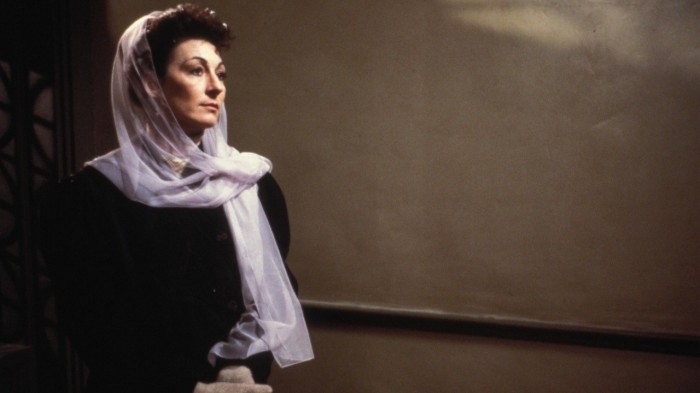
This adaptation of James Joyce’s short story from the collection “Dubliners” (1914) is the last film John Huston completed. The project has many sentimental components, as two of Huston’s children worked with him; Anjelica Huston in the lead role as Gretta and Tony Huston, who wrote the screenplay. As well, Ireland had long provided a home for him and his family. Nonetheless, the film is beautifully clear eyed and restrained in its presentation of Joyce’s story, allowing the writer’s vision and language to take precedence. The core of the story is concerned with the social, cultural and familial byways of Dublin life, which are so much a fixture of Joyce’s writing. Its climactic scene, however, occurs later between Gabriel (Donal McCann) and Gretta and was inspired by Joyce’s wife, Nora’s, own youthful experiences growing up in Galway. The story itself, the crown jewel in the string of jewels that comprises “Dubliners”, is a beautifully observed meditation on memory, loss, and the impermanence of life.

These themes, not unsurprisingly, seem to resonate with the dying Huston. The film is a departure for him on every level. He had spent his career chronicling the often nefarious exploits of con artists, thieves, misfits and adventurers, and always with an unblinking, but still affectionate and understanding, eye. But Huston’s reverence for Joyce’s writing is complete and, as director, he submits to the writer’s language and vision wholeheartedly. “The Dead” is Joyce’s careful evocation of a very particular strata of Irish life. This is the genteel, middle class Irish society from which Joyce had fled and yet he details their concerns, their seemingly inconsequential interactions, their quiet desires with patience and sensitivity. John Huston, directing from Tony Huston’s Oscar nominated screenplay which is an intelligent and careful rendering of the original story, clearly relates to Joyce’s empathy for these people. As a result, the film is laden with delicately observed moments from a veteran ensemble Irish cast.

It’s worth noting that Huston also delights in Joyce’s humor which is seamlessly woven into the fabric of the story. Local drunk, Freddy Malins (Donal Donnelly), and his comrade in drinking, Mr. Brown (Dan O’Herlihy) present a constant challenge to the Misses Morkan, Aunt Kate (Helena Carroll) and Aunt Julia (Cathleen Delany) and their niece, Mary Jane (Ingrid Craigie) as well as their guests, as everyone struggles to keep the booze away from Freddy, in particular. Equally, Freddy’s relationship with his domineering mother, played by Marie Kean, which might have been unbearable as she makes it clear she is thoroughly disappointed in him as a man, is rendered in subtly funny asides and exchanges that are enhanced by the two actors’ amusing rapport and sure handling of these short scenes.

The focus on character in “The Dead”, as opposed to a plot driven dynamic, allows Huston to meticulously unfold the details on these people’s lives. As the elderly Aunt Julia sings “Arrayed For the Bridal” in a voice wavering with age, Huston’s camera lovingly captures, via the use of montage, the visual details of her private world upstairs. The careful pace of the film also allows writer and director to explore the theme of lost love that Joyce delineated, and it echoes throughout the story. Whether it is the maid, Lily’s (Rachael Dowling), hurt reply when Gabriel casually inquires if they’ll all be attending her wedding soon; or, Mr. Grace’s (Sean McClory) reading of the haunting poem “Broken Vows”; or, finally Aunt Kate’s bittersweet, romantic reverie of the beautiful English tenor of her youth; all hint fleetingly at the sense of loss that will culminate in Gretta’s revelation to Gabriel regarding her first love and his tragic end.

The flawless Irish cast, headed by Anjelica Huston and Donal McCann, are pitch perfect in their reading of Joyce’s characters. There is not a false note to be heard in the suite of overlapping voices that is so integral to the success of recreating this vanished world. Of particular note, is Donal McCann’s quiet emotion as he, in voice over, speaks the final, lyrical words of “The Dead”:

“Yes, the newspaper are right , snow is general all over Ireland …. softly falling into the dark, mutinous Shannon waves. One by one we are all becoming shades. Better to pass boldly into that other world, in the full glory of some passion, than fade and wither dismally with age… Snow is falling, …. falling faintly through the universe and faintly falling like the descent of their last end upon all the living and the dead.”

The film is further enhanced by Alex North’s graceful, delicate score which is made up primarily of Irish harp music. But the actor’s voices, spoken and sung, provide their own kind of music and Huston lets them ring out. In a perfect example of what a film can give you, which even a literary masterpiece like “Dubliners” cannot, is the sense of being present with these people and hearing them express themselves in language and song. Bartell Darcy’s (Frank Patterson) haunting rendition of “The Lass of Aughrim” after dinner, as Gretta stands transfixed on the stairway, moved by the beauty of the tenor voice singing provides a pivotal moment in the story. While Joyce is able to sketch it for us, Huston is able to take us there and provide an unforgettable visual and emotional moment.

“The Dead” is the rare example of the cinematic adaptation of a literary masterpiece that satisfies completely and lives up to the high expectations we bring to it. Perhaps, it is precisely because it is a short story, and therefore its parameters can be encompassed. Huston was smart enough not to attempt “Ulysses”, for example, as his final project, and so he brought all of his understanding and skill to this small, quiet and deeply felt film.

SCREENPLAY CONTESTSUBMIT your SCREENPLAY
Voted #1 screenplay contest in the world!
NEW MOVIE REVIEWSNEW MOVIE REVIEWS
Read Today’s POSTED REVIEWS
MOVIE KILLSEE 1000s of PICTURES
Best of photos, images and pics
MOVIE YEARMOVIES YEAR BY YEAR
Pages from 1900 to present


THE DEAD

1987 Movie Review: DATE WITH AN ANGEL, 1987


DATE WITH AN ANGEL, 1987
Movie Reviews

Directed by Tom McLoughlin
Starring: Michael E. Knight, Phoebe Cates, Emmanuelle Béart
Review by Melissa R. Mendelson

SYNOPSIS:

Jim is soon to be married to Patty, but when he wakes up after a bachelor party thrown by his friends, he finds an injured angel in his pool. When Patty sees her, she thinks he’s seeing someone else and gets upset and tells her father. Now he has to figure out how to; cure the angel, tell Patty what happened, keep his friends from taking the angel to the papers, and keep Patty’s father from killing him. It’s no wonder he has a headache.

REVIEW:

I thought I knew love. I thought I was ready to change my life for her. This was what I wanted. I was ready to take that next step, but then she fell from the sky. And everything changed.

The headaches were like miniature thunderstorms. The pain sliced through me, and the pills were losing their effect. But I had to find a way to make it through, but I never realized that it would be my end. And she came on white wings to take me away.

We say we believe in angels, but do we really believe? Would we recognize one, if they were to cross our path? If they needed our help, would we help them, or would we turn them away? And if we met an angel, would we discover a love never thought possible, or would we find death waiting in the wings?

The rain fell heavily from the skies. A pivotal moment in time was derailed by a senseless prank, and the night came to a crashing end. And as yesterday struggled to stay, one man stumbles outside to find an angelic figure floating across the waves of his swimming pool.

Never in his life did Jim Sanders think he would ever meet an angel especially one that nearly drowned in his swimming pool, and with a broken wing, she was grounded. And he had no idea what to do with her, but as he struggles to find a way to help her, his life begins to unravel. And he soon finds himself on the run with an angel at the wheel.

Nothing made sense until he saw her again, and then everything fell into place. Her mission was derailed by a broken wing. Her target was him, and those headaches were the red lights flashing, warning. But if the mission had gone as planned, the layers of his life would never have been pulled away, and he would never have found true love. But now it was time to go, and she was here to take him away. But as bright, white light enveloped the room, everything changed.

Love is a mystery that walks beside us, and what we think is love is merely the illusion. And as our eyes struggle to hold it are we captivated by stories, movies from the heart. And complicated lives weave into delicate webs, and lies, betrayal, and greed try to cut those threads. And as the storylines hold us in its hand, we laugh, and we cry. And in the end, love survives, and Date With An Angel soars high.

SCREENPLAY CONTESTSUBMIT your SCREENPLAY
Voted #1 screenplay contest in the world!
NEW MOVIE REVIEWSNEW MOVIE REVIEWS
Read Today’s POSTED REVIEWS
MOVIE KILLSEE 1000s of PICTURES
Best of photos, images and pics
MOVIE YEARMOVIES YEAR BY YEAR
Pages from 1900 to present


MSDDAWI EC032
DATE WITH AN ANGEL, Phoebe Cates, Michael E. Knight, Emmanuelle Beart, 1987

1987 Movie Review: BARFLY, 1987

Barfly, 1987
Classic Movie Review
Directed by Barbet Shroeder
Starring Mickey Rourke, Faye Dunaway and Frank Stallone
Review by Carey Lewis

Synopsis:

A slice of life film about an admitted drunk and his adventure.

Review:

There was a time in the 80’s when Mickey Rourke was on his way to becoming the biggest movie star; if he wasn’t already at that status for a brief moment. It was in roles such as Barfly, Diner, The Pope of Greenwich Village, Nine and ½ Weeks, and Angel Heart that was showing his tremendous talent, and solidifying him as a Hollywood heavyweight with a bright future ahead of him. Then it all kind of fell apart.

But this is a review about the movie, not the man, and google will be your friend if you’d like to know the story about Mickey Rourke. Barfly is simply one of the films that you can see how good of an actor Rourke was, and how much talent has been squandered. Sure, he’s back now, mainly smaller roles in Rodriguez films, but who knows what might have been? Another question that arises is, “can he still deliver on the talent he was given if only given the chance of bigger, juicier roles?” Well, I’m personally hoping someone asks that question and puts Mickey to the test.

So enough about Rourke, let’s talk about Rourke in Barfly.

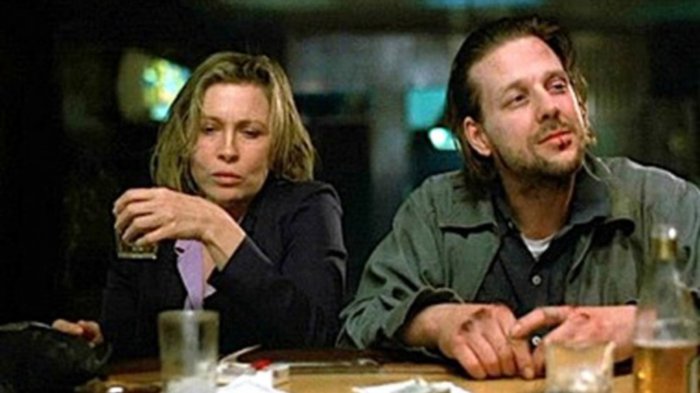
Rourke plays Henry Chinaski, a self acknowledged drunk that repeats the same routine, day in and day out. He gets to his local bar, gets drunk, goes home to write a bit, goes back to the bar, gets drunk(er) and picks a fight with the bartender Eddie (Frank Stallone). Eddie always wins, Henry goes home, and the cycle repeats the next day.

However, one day Henry manages to beat Eddie, and as he tries to get a beer to celebrate his victory, Eddie refuses to let anyone serve him. Rather than mope or cry about it, Henry goes to another watering hole, where he meets Wanda (Faye Dunaway), another drunk, or “barfly.” Both are weird to say the least, so they hit it off immediately.

The next day Henry moves in with Wanda, and their rocky relationship begins. At one point she tells Henry that “she’ll leave with anyone who has a fifth of vodka.” At least she’s straight up and honest. Facing rent payments, and the bill for booze to be had, Henry goes out to get a job. While gone, Eddie happens to be around with a fifth of vodka.

This is the one person that Henry despises the most in the world. Not because Eddie is always handing Henry his ass, but because he sees the polar opposite of himself in Eddie. Eddie is all the things in life and the world which Henry hates. After a brief moment in the film, Wanda returns back to her apartment, and the two reconcile.

Meanwhile, throughout the story, Henry is being followed by Tully (Alice Kruge). It is unknown why, as Henry has blown her off every time she’s contacted him, until the final third of the film. It turns out Henry has submitted some of his writing to her magazine, and they have decided to publish it.

It is in this final bit of the movie that the film took a left turn that didn’t quite work for me. Tully sleeps with Henry the first day they finally meet and is ready for him to move into her guest house and become a writer and be with her. Now, I can understand the drunks getting together quite easily, but a highly established, educated publisher? That’s kind of a stretch for me. It’s alluded to that she fell in love with his writing and his way of life, but I wish a little more time would have been given to her motivation for this action. Yes, I know it fits into the themes of the movie, and definitely works to the favor of Henry’s character, but I wished it would’ve been down without the sacrifice to the Tully character.

Now, you may know that I usually do a shorter synopsis of the movie, stopping before giving away any major plot points of the film. I didn’t do that here. I gave away the whole film because this isn’t a film about a plot, this is a film about characters. It’s a classic character study that feels like a slice of life film. Shroeder plops you down onto a bar stool in a dive and says “hey, check these people out.”

Shroeder also does a great job of letting the actors “act” in their scenes together. He doesn’t force the pace with editing or weird camera angles. In fact, the way this film is directed by Shroeder, and shot by Robby Muller, you’d swear this film is from the 70’s. I was actually surprised to find out it was made in 87, and not in the earlier part of the decade.

The cinematography is definitely something to note here. This is one of the most naturally lit films I’ve seen in awhile. The light seems to always come from natural sources, such as windows, open doors, or lamps. The nighttime scenes are obviously lit, but not in a way that makes you notice that it’s been “lit.” The production design by Bob Ziembicki is also something to note as well, as the whole film looks dirty with stains on the walls, grungy locations, old mismatching furniture, and small apartments looking on the verge of being condemned.

Another ingredient that makes this film feel like the reality obsessed films of the 70’s is the lack of music in the film, other than source music. Source music in a scene, is when the music being heard is coming from somewhere within the movie, such as a character listening to the radio, or passing by an apartment with blaring music. Sydney Lumet also used this technique wonderfully in a couple of his masterpieces “Network” and “Dog Day Afternoon.” It is these key components of cinematography, production design, direction, lack of music, and writing, which sell this as a quality character film that seems very realistic. Because of these elements, it really does feel like you’re dropped on a stool at the Golden Horn.

The writing by Charles Bukowski is seemingly simple, but complex. Rather than take the easier choices out of a situation, Bukowski instead stays true to his characters and never at any point in the film, does it feel like the film’s “written.” The characters never wallow in self-pity, but rather seem to accept who they are, and are happy being who they are. At one point, Henry has the opportunity to make it out, but that’s not what he wants, and Bukowski stays true to that.

Like most films dealing with alcoholics, a voice is heard telling the characters what they are doing, and doing to themselves, is wrong. This is often times a staple in this type of movie, and can easily come across as condescending. This film doesn’t do that. In fact, I would say it romanticizes the inebriated lifestyle. As I understand it, it is somewhat based on Bukowski’s life, which could be a reason for the romantic feel of the drunks. Oddly enough, they make you happy, and that’s a hard thing to do to make drunks make you happy when they have no desire to change at all. With the subject matter, you’d think this film would be either a slap-stick comedy, or a serious drama. Bukowski manages to make it fit comfortably in the middle.

Faye Dunaway is good in this film as Henry’s love interest; a girl who likes to drink and talk. After all, you don’t become “Faye Dunaway” by not being good. Normally, I’d say she was great in this film but truthfully, everyone else pales in comparison to Rourke in this show. In contrast to Rourke, Dunaway looks like she matted her hair after not washing it for a few days, and threw on some clothes that were in the hamper for a week. That’s not to say Dunaway is bad in this film, it’s just that Rourke’s so damn good. Yes, the lovable, charming drunk has been done in movies before, but they’re usually a supporting character. Rourke is the lovable, charming drunk in a lead role that almost begs you not to like him. He walks weird, he talks slow, and he has no ambition to be anymore than what he is. Rourke is also not afraid to look ugly either, which is definitely a necessity for this type of role. He doesn’t do good things, and he certainly doesn’t say good things, but there’s something about him that makes you think you just might want to be his friend. Maybe it’s because he’s more honest and sincere than most sober people, and those traits are rare.

So if you feel like getting to know some entertaining people and having them show you a little slice of their life, I recommend you grab a stool, order a beer, and watch the barflys in The Golden Horn. Or if your only experience to Mickey Rourke is Sin City and Once Upon a Time in Mexico, take a look at what this guy could do more than twenty years ago.

TOP 100 MOVIESTOP 100 MOVIE PAGES
WATCH and SEE the best of film!
SEXY PHOTOSSEXY PHOTOS TOP 100
Sexiest people on the planet!
TOP 100 SEXTOP 100 SEX PAGES
WATCH and SEE the best of sex pages online
NAKED SCENESWATCH the TOP 100 NUDE SCENES of all-time
SEE the best of naked film!


BARFLY.pjg

1987 Movie Review: BAD TASTE, 1987

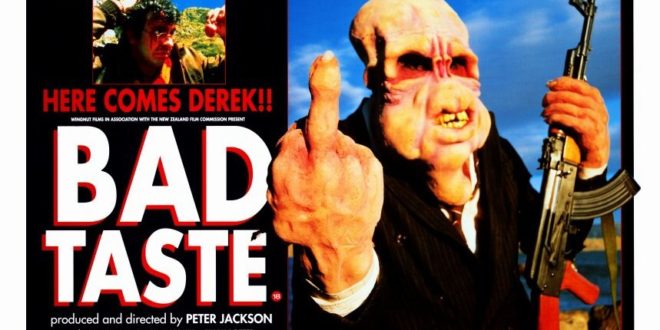
BAD TASTE  MOVIE POSTERBAD TASTE, 1987
Movie Reviews

Directed by Peter Jackson

Cast: Terry Potter, Pete O’Herne, Craig Smith, Mike Minett, Doug Wren
Review by James Mansell

SYNOPSIS:

When an army of aliens arrive on a small New Zealand town and attempt to turn the entire population into the key ingredient for their intergalactic fast-food chain, a small group of men from the Astro-Investigation and Defense Service are sent to investigate. What ensues is a dangerous rescue mission, a full on assault on the alien’s head-quarters and a whole series of precarious situations.

REVIEW:

When you hear the name Peter Jackson, one film, or three perhaps will spring to mind. The highest box-office grossing trilogy in the history of cinema, most number of Academy Awards won, equalled only by Ben-Hur and Titanic, and a faithful and unique adaptation rarely seen on the screen. Peter Jackson propelled himself into legendary director status with his version of J.R.R. Tolkien’s ‘the Lord of the Rings’ trilogy, wowing cinema and fantasy goers alike for three Christmas’s in a row. A feat unimaginable until the New Zealander decided to tackle it.

But aside from his epic fantasy tale, you may also know him from his re-working of his childhood favourite ‘King Kong’, his Kate Winslet period piece ‘Heavenly Creatures’, his gore-drenched masterpiece ‘Braindead’ or even his story of depravity, debauchery and puppets in ‘Meet the Feebles’. But before all this, before any priests kicked ass for the lord, before any puppets played Russian roulette in Vietnam, a group of aliens landed on a small New Zealand town in what can only be described as timeless low-budget horror that Sam Raimi would be proud of.

When a distress call comes through from a small New Zealand town, ‘the boys’ are sent to the location to investigate the disturbance. Enter a gloriously graphic opening scene of an exploding head to the manic laughter of one of Peter Jackson’s two characters, Derek. Within 10 minutes, we’ve had a healthy dose of black humour, pseudo mysterious music and brains sprayed across the ground. The film is set up perfectly, aliens have landed, and Derek and his team are there to save the world from the extra-terrestrials wrong doing.

Things don’t begin to do totally as planned, as Derek, who has captured one of the aliens (interestingly enough, also played by Jackson) begins to torture it for information, the ‘inter-galactic wanker’ as Derek describes it. As its screams of pain emanate across the town, Derek is surrounded by them, resulting in dire consequences. Jackson’s directing comes through in waves in this scene, his timing is impeccable, and the effects (shooting through an alien’s stomach) are so inventive it only but makes you grin with excitement. How they shot a scene teetering on the edge of a cliff is beyond me, and a fight between two Peter Jackson’s is nothing short of breath-taking.

After a local town collector is kidnapped by the aliens, and there heinous scheme is revealed to ‘the boys’, an all out assault on the aliens ensues. Once the headquarters have been located, and a repulsive tasting session of sorts occurs for the one of the boys, Derek returns and an action-packed and blood-soaked gun fight follows that Sam Peckinpah would be proud of. Jackson’s home made prosthetics come to force during the finale of the film, as the aliens break out of their human bodies, and into their own form.

For cult, low-budget horror that has its tongue firmly in its cheek, this is one of the best ever made. And the climax is so hilarious and memorable; it makes you want to watch more of Peter Jackson before the world became aware of him. It is a pure and unadulterated rollercoaster through a young filmmaker’s love of horror, shot over 4 years and totally improvised; it is an achievement in low-budget filmmaking.

Bad Taste is an onslaught of do-it-yourself prosthetics made with enough ingenuity and precision to make it all work. Yes this is low-budget horror, and yes you can see the joins, but this is why we love it. This is low-budget greatness at its most simplistic and basic, but with a balls out attitude and no holds barred what more could you ask for?

SCREENPLAY CONTESTSUBMIT your SCREENPLAY
Voted #1 screenplay contest in the world!
NEW MOVIE REVIEWSNEW MOVIE REVIEWS
Read Today’s POSTED REVIEWS
MOVIE KILLSEE 1000s of PICTURES
Best of photos, images and pics
MOVIE YEARMOVIES YEAR BY YEAR
Pages from 1900 to present


BAD TASTE