1997 Movie Review: GUMMO, 1997

GUMMO, 1997
1990s Drama Movie Review
Directed by Harmony Korine
Starring Jacob Reynolds, Chloe Sevigny
Review by Alex Haight

SYNOPSIS:

Lonely residents of a tornado-stricken Ohio town wander the deserted landscape trying to fulfill their boring, nihilistic lives.

REVIEW:

“When I sit down to eat, I get sexy! When I go to bed, I get hungry! I saw a man lying in the street, and I said, “Can I help you?” He said, “No. I just found a parking space. Now I’m waiting for my wife to go buy a car!” – Tummler (played by Nick Sutton)

There is no preparation possible before viewing the directorial debut of Harmony Korine’s follow up to “KIDS” (which he wrote it at the age of 19). With the latter he provided an honest and abrasive script about the affect of underage sex and drug use in America- and the spawn such acts breed.

His follow-up seems like a De Sade horror show.

By way of “Gummo”, Korine instead offers a nightmare-fairytale of nihilism and faithlessness set against the desolate backdrop of Xenia,Ohio. Set between a mirage of sideshow characters, non-actors, and troubled underage youth’ (this stuff would make John Waters shutter) it plays out like vignettes hand made to disrupt most sensibilities. Anyone who relies on a strong moral fiber, should be warned…this is hard stuff to swallow. There are images here that will be burned into your mind for days, weeks, dare I say-years later.

It’ll be that film that you compare to every other “shocking” one made to.

It sets the bar…then sets it again…then makes a new bar…only to set it. He goes about crafting this voyeuristic sophomore effort by stitching together absurd images and storylines, ie. bacon on the wall, clogging in a mirror, dead cats, homosexual midgets, mentally handicapped prostitutes etc…to subject the viewer to answer the same questions he asked in KIDS-the nature of good and evil and the persuaded path life leads you on towards each one.

This time around however, he tips that thesis on its ear and adds a large heaping spoonful of broken glass disguised as sugar. That is his method…to wash the audience with frames of intense subject to the point of nausea , then bring you down with careful intent.

He himself has even said that the movie was about jokes sans the punch lines.

Try and keep that fact in mind and see how far that gets you.

1997 Movie Review: GROSSE POINT BLANK, 1997


GROSSE POINT BLANK, 1997
Movie Reviews

Directed By George Armitage

Starring John Cusack, Joan Cusack, Minnie Driver, Dan Aykroyd, Jeremy Piven
Review by Christopher Upton

SYNOPSIS:

Finding himself dissatisfied with his life as a professional killer, Martin Blank returns home to take stock of his life, visit his high school reunion and make one final hit. Nothing could ever be simple though and while he attempts to make it up to his jilted date before the big reunion, he has to contend with a large collection of men trying to kill him.

REVIEW:

Contract killers aren’t known for being the warmest of characters. As such you’d think it’d be difficult to get a whole load of laughs from them, unless of course Dan Aykroyd and John Cusack play them. Sarcastic and silly combine to create a hilarious situation comedy with the added bonus thrill of knowing that either of the two leads could be killed at any moment. Talk about edge of your seat comedy.

Martin Blank (Cusack) is having an existential crisis; he’s girlfriendless, childless, his therapist is scared of him and he’s lost the taste for his work, which just so happens to be shooting people in the head. All of this is bought home to him when he receives an invitation to his ten-year high school reunion. Though he refuses to go fate conspires to send him back to Grosse point to face the music for abandoning the town and its inhabitants.

It’s not all existential though as he has a very real crisis to contend with. His colleague Grocer (Aykroyd) is trying to get him to join his killers union and he’s very insistent that they join forces. So insistent in fact that he has hired government-contracted killers to take him out if he refuses. On top of this there is a bounty on his head for a job gone wrong involving an over friendly dog and some explosives.

Being killed strangely becomes the least of Martin’s worries though, when he runs into an old flame that he abandoned on prom night ten years ago and feelings are reignited. So now he must win back the girl and re-evaluate his life while at the same time trying to remain bullet hole free. Not many people would be able to tie so many strings together so convincingly but John Cusack as Martin Blank is such a brilliantly sarcastic and quick-witted performance that you know if anyone can, he can.

The character maintains a near constant narration of his life telling everyone his anxieties, almost Woody Allen-esque. While this might seem like an annoying trait if handled by anyone else, Cusack manages to make it endearing, making Martin Blank very relatable if you ignore the killing part.

Outside of Pulp Fiction professional killers are all portrayed in a pretty similar way; they have some variety of deep inner torment and they are remorseless, lonely, psychopaths. In Grosse Point Blank the killers have personalities and ingratiate themselves to the audience; something that is particularly difficult to do when your job is to get rid of people. In fact, Grocer and Blank don’t just make you feel comfortable with them; you actually end up in a bizarre way emphasising with them because of their charisma. As Martin Blank says, “If I show up at your door, chances are you did something to bring me there.”

It isn’t just the leads that perform excellently though. The shockingly overlooked Jeremy Piven plays an old friend of Martin Blank, still living in the town that he hates and is hilariously bitter because of it. The blasÈ government guns for hire, in the form of Hank Azaria and K. Todd Freeman, are so laid back that the only thing that can get them out of their job inspired stupor is making fun of these violent killers. This makes them equally funny and monstrous and every bit as bad as the people they are after.

One of the most impressive things about Grosse Point Blank is there isn’t really a bad performance in it. Even the smallest characters are perfectly formed little caricatures that manage to squeeze laughs out of every inch of the film. This also has a lot to do with the script, which is frenetic in it’s pacing, rarely passing a scene without inserting some kind of witty one liner or aside. This means that if you aren’t paying attention a lot will go past you, but it also means that if you miss one joke there’ll be another one along in a second.

The script excels in making mockeries of some very dark situations and deriving a lot of laughs from things you really shouldn’t be laughing at. It’s not just through assassinations where the guilty laughs come either. You can’t help but laugh as the reunited lovers insult all their old classmates, most of which have become depressing caricatures of small town life. The coked up bully who runs his own dealership, the small town cop desperate to enforce some variety of law or the girl desperate for approval are easily what you could imagine your old classmates turning into.

Mention must also be made of the incredible soundtrack. Put together in part by the late Joe Strummer, the music flows throughout the entire film creating a solid backbone and allowing for some of the most memorable scenes; like a fight to the death to the tune of 99 Luftballons. The addition of the radio station playing hits of the day is a great choice, not only in terms of story but also in allowing the directors obvious love of music come through.

There aren’t a lot of bad points to aim at Grosse Point Blank, but if you were looking for them then the immediate one is the fact that this is very much a nineties film. In terms of look, scripting and storyline it is very much of its time, but this is an exceptionally small complaint against such a strong film. The combination of quality soundtrack, outstanding performances and a viciously tight script means that this is one of the best, is not one of the most overlooked, romantic comedies of the decade.

grosse point blank


1997 Movie Review: GOOD WILL HUNTING, 1997


GOOD WILL HUNTING MOVIE POSTER
GOOD WILL HUNTING, 1997
Movie Reviews

Directed by Gus Van Sant
Starring: Matt Damon, Ben Affleck and Robin Williams
Review by David D

SYNOPSIS:

Will Hunting, a janitor at MIT, has a gift for mathematics which is discovered, and a psychologist tries to help him with his gift and the rest of his life.

REVIEW:

If you can put aside the rumor that William Goldman doctored the Oscar winning script for Good Willing Hunting AND that it features funnyman Robin Williams in a serious role, you are in an excellent two hours of viewing.

Written by a young Matt Damon and Ben Affleck, the story focuses on a young prodigy named Will Hunting. Will (aptly played by Matt Damon and nominated for an Academy Award) is a genius foster kid that works as a janitor in a prestigious university (MIT) in South Boston. Ben Affleck plays his best friend, Chuckie.

The plot focuses on the discovery of Will’s genius and other people attempts to either use or save him from himself. Will Hunting, on the other hand, has plans of his own.

Robin William pulls in a great performance as Will’s therapist (Sean), pushing him past the anger and sarcasm, to discover what his life is really all about.

This film works on couple of levels. As a viewer, we admire Will’s photographic memory and his uncanny ability to solve incredibly complicated math problems with ease, but at the same time resent the fact that he takes these abilities for granted. The audience musters the requisite ‘If I had that kind of ability I would…’ rhetoric but the script and director ask a much harder question ‘How do we define happiness?’

Will wants a simple life; he doesn’t want the complications of his genius. His actions betray his words as he voluntarily studies late into the night on various subjects, espouses classic lines from English texts and solves mathematical problems on a university blackboard without being asked. Inside, there is a person wanting to break free.

The another level is questioning whether a person is chained to their past. Will was shuffled & abuse from foster home to foster home, and because of this, very wary of human closeness and contact. It is akin to the sting we feel when we fall in and out of love. He is chained to his past because of the anger he still feels towards these betrayals.

His session with Sean (Robin Williams) also belies his true desires. With Sean as his therapist, Will is critical, confrontational and always on the defensive. Fortunately, Sean never pushes too far and because of this understanding, a critical bound is formed between them. Will has a distrust of adults because of the abuse he suffered at the hands of a foster father – one of the many reasons he distances himself from figures of authority.

Will spends most of his time with his friends who would ‘lay down their life for him’. They provide the only human closeness that Will feels towards anyone. When a mathematician Gerald Lambeau (Stellan Skarsgard) saves Will from a stretch in prison, Will can only thank him with harsh words and scorn.

During Will’s sessions with Sean, he learns that it is ok to take a chance and falls in love with Skylar (Minnie Driver). This relationship has all the hallmarks of defeat as we learn that Will cannot deal with the closeness that comes from trusting someone.

This last plot point is truly what the film hinges on: Will’s inability to trust because of his past. The final reel is emotional and satisfying. We see the journey that Will takes both on an emotional and physical level; from a wounded, cornered animal to a person that realizes hurt is a part of life. As an audience we feel for Will and participate in his struggle to reconcile his past feelings with his chance at a better future and happiness.

GOOD WILL HUNTING.jpg

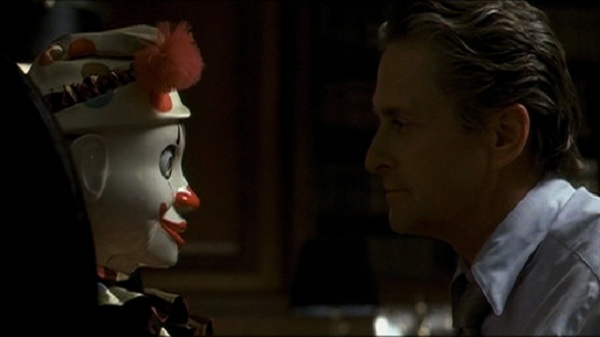
1997 Movie Review: THE GAME, 1997 (David Fincher, Michael Douglas, Sean Penn)

THE GAME, 1997
Movie Reviews

Directed by David Fincher
Starring: Michael Douglas, Sean Penn
Review by Mike Peters

SYNOPSIS:

Nicholas Van Orton (Douglas) is an investment banker who is always in control of the situation. He is cold, calculating and always on his game. Nicholas lives a well-ordered life-until an unexpected birthday gift from his brother, Conrad (Sean Penn), destroys it all.

Review:

David Fincher has once been quoted as saying “I don’t know how much movies should entertain. I’m interested in movies that scar”. Whether he is referring to the scarring of the characters within his films or of the audience voyeuristically partaking in his dark and twisted tales is unclear. What is definitely accurate about Fincher’s films is that they leave an undeniable mark on each and everyone involved.

It is hard to mistake a Fincher film. They usually contain very little natural light and the atmosphere will be extremely unsettling. This will then force the audience to share the protagonists’ feelings of unease and paranoia. As well, by the end of the film, Fincher’s “hero” has usually undergone some sort of life-changing trauma.

The Game is a film that may be the least known of Fincher’s. It arrived in between Seven (1995) and Fight Club (1999) and has seemed to have been overlooked as a great film. This is a great film. The manipulative control Fincher seems to possess over his audience is mastery in its calculation and concoction.

The story is simple. A man is given a present that will eventually drive him to the depths of depravity and despair by turning him into the character he has always deemed offensive and unimportant. It is a well known story cliché. He will then become a better person as a result of his journey which will be expressed through his change in character and his thoughts and actions towards others. However, Fincher beautifully makes this simple story his own. Fincher is a master of brooding and depressing atmospheres. There is no life in his films. Oh, there are people alive but his focus seems to be on reanimating the dead that exists within the body. Nicolas Van Orton is a character who lives alone. He is rich, powerful and most of all, successful. But yet, he is dead within. He rarely smiles and seems to have become who he is now as a result of witnessing his father’s suicide at a young age. Other than talking to his housekeeper and his lawyer (which he still does to a limited degree), he is a man who keeps to himself. He does not want to be bothered and will only bother another if there is progress to be made. He is sort of a 90’s version of Gordon Gekko from Wall Street (who Douglas played as well) who is more in touch with control and intimidation then he is with emotional contact.

The idea that Nicolas was unable to prevent his father’s suicide left him in a state of shock. He was unable to control the situation and thus he felt pain for the very first time. The film starts off with images of Nicolas as a child and his father and it is clear that this event was crucial in the shaping of Nicolas as a man. He lost a very important person in his life and as a result, he became a closed off and emotionally detached human being. He feels that being in control will prevent him from ever feeling pain again but yet (unaware to him until after the “game” begins) he yearns for closure in regards to his father’s death. It is only when the “game” begins that he slowly begins to exist once again and to reemerge as a living entity.

Douglas is masterful in his performance. He refuses to break character at any moment until it is deemed necessary by the script. Even when this “game” begins, Douglas portrays Nicolas as a character who still believes he is in control of the situation. He believes he has it all figured out until, of course, he doesn’t. When things do not go as planned, he panics as a result. He does not know how to control the situation which leaves him vulnerable and confused (feelings he has cut himself off from). He has never had to cope with change because he has never attempted to change himself. He must rediscover his inner self before there is any chance of redemption or rebirth.

Within moments of the films’ commencement, we come to identify with Nicolas. He may not be the most friendly and admirable protagonist in film history but yet we still attempt to identify with him. As a result, we form some sort of control over the narrative. We believe that we understand the simple structure of the story and will not be undermined by it in any manner (as Nicolas feels when the “game” begins). However, as this film progresses, we, the audience, become lost and confused. We, as Nicolas, are unaware of our surroundings and have become paranoid and fearful of the people within the narrative. Who do we trust? Where do we go from here? It is now the blind leading the blind.

This film may not be noted as one of Fincher’s more important pieces of work but yet it is a beautifully crafted piece of entertainment. The writing is taut and the acting is superb. Yes, many of the events are implausible and rely heavily on coincidence and chance but it is told and shot in such a high octane sort of way that the audience is quick to forgive the filmmakers for these insignificant and basically pointless quibbles.


the game.jpg

1997 Movie Review: FUNNY GAMES, 1997

FUNNY GAMES
FUNNY GAMES, 1997
Movie Reviews

Directed by Michael Haneke
Starring: Susanne Lothar, Ulrich Mühe
Review by Matthew C Holmes

SYNOPSIS:

Two psychotic young men take a mother, father, and son hostage in their vacation cabin and force them to play sadistic “games” with one another for their own amusement.

REVIEW:

Austria has given the world a variety of coolness over the years: The city of Vienna, Sacher-torte (jam filled chocolate cake), Mozart, and a tidbit of cinematic insanity called Funny Games.

This film just plain works, from the setup to the final frame, there is an uneasy anticipation that permeates the atmosphere and writer/director Michael Haneke is to be cheered and pelted with small plush toys for his manipulation of both the camera and the watching audience.

So, Anna and Georg are going to spend some time at their vacation home with little Georgie and the dog in tow. Relaxation, music, and sailing are all on the menu, but when Peter and Paul arrive at the house, asking for eggs, everything goes out the window and the true horror of the film begins, and doesn’t ever stop.

The classification of this film is a bit tricky, and I am hesitant to stick it with a strict genre label, in spite of the fact that I have already used the word horror. (see previous paragraph) It is definitely a dramatic film, being that it is filled with moments of drama and little to no overt humor.

It also has thrilling moments, filled with tension and unspoken anticipation. And with two tennis-sweater and white short shorts wearing psychos in the mix, the horror elements become obvious and wonderfully disturbing. Writer/director Haneke has stated frequently that he did not make this to be a horror film but instead a “moralistic comment about the influence of media violence on society”. Ultimately it is all of these and more.
The most compelling and the most bizarre aspect of Funny Games is the half a dozen or so times that the two antagonists “break the fourth wall” or acknowledge the watcher, foregoing the illusion of a purely spectator audience. It is not a frequent occurrence, but it happens enough that the mood remains unbroken and the instance it happens becomes unforgettable.

They are as obvious as the character speaking directly into the camera, as obscure as the two psychos discussing the film’s runtime, and as devilishly subtle as a quick wink into lens when the character thinks you might not be paying attention. These little instances are the real meat of the point that Haneke was trying to make.

Bottom line, Funny Games takes psychological and physical torture to place unseen in film. Honestly, it can be difficult to watch at times, not because it is gory or overtly maniacal, but the sheer magnitude of disquiet and discomfort that pours off of the screen will keep you fidgeting in your seat.

Funny Games has since been remade for English speaking audiences. It was written and directed by Haneke himself and is shot for shot, line by line, exactly the same as the original, still called Funny Games, the only difference being the cast. I suggest trying to seek out the Austrian version if you can, the actors, being unknown in this country, put on a truly convincing and terrifying show as the hapless victims and the gentle psychos.

Do not let this film pass you by.
funny games

1997 Movie Review: FROM DUSK TILL DAWN (1997)


FROM DUSK TILL DAWN (1997)
Classic Movie Review
Directed by Robert Rodriguez
Starring George Clooney, Quentin Tarantino, Harvery Keitel, Juliette Lewis
Review by Jared Bratt

SYNOPSIS:

On the run from “Johnny law”, Seth (George Cloony) and Ritchie (Quentin Tarantino) Gecko, two newly escaped convicts, hot off the heels of their most recent bank heist, abduct a family of innocent commuters as they proceed to evade the authorities by fleeing across the U.S. border, into Mexico, so that they can rendezvous with their foreign criminal counterparts at a local dive bar known as the “Titty Twister”. Using their freshly acquired hostages as collateral, so as to ensure the stability of their otherwise expendable lives, the two ruthless brothers force the family’s father, Jacob, a faithless preacher, (Harvey Keitel) and his two kids, his son, Scott, and his daughter, Kate, (Julliette Lewis) to accompany them into the excited bar while they wait to meet up with their Mexican affiliates. Unbeknownst to them, however, is the fact that the seedy establishment actually serves as a well-disguised feeding ground for a bloodthirsty cult of famished vampires lead by their equally ferocious queen, (Salma Hayek) who slyly masquerades as the joint’s main attraction, a seductive stripper who opportunely diverts the club’s clientele from realizing the absurd, horrific horrors that lie ahead.

REVIEW:

From Dusk Till Dawn is one of those movies that appear to always be playing on T.V. throughout all hours of the night. Essentially two films for the price of one, the movie accounts for an extremely distinctive blend of the taught “70sesque” crime-caper, exploitation film meets the comically grounded, gratuitous gore fest of an Evil Dead picture. Both these genres are wrapped up even further in, what you could say, accounts for the film’s third genre known as “Tarantinoism”.

Director Robert Rodriguez makes sure to keep that well known brand of Tarantino madness in tact while he still keeps things fresh, bringing to the table, his own unique eye for a quick cut, spaghetti western, John Woo “shoot ‘em up” style of filmic execution. Essentially, Rodriguez applies the same acclaimed style that initially propelled him to become one of the most innovative filmmakers of his generation to the horror genre. Working from a screenplay written by Tarantino himself, Rodriguez creatively retains that “no-holds-barred” sense of horror movie-making aesthetic. Harkening back homage to the great, grotesque gore-fests of the 60s, 70s and 80s, From Dusk Till Dawn’s own 1996, release, unfortunately, didn’t quite generate nearly half as much the buzz as anyone of those eras, yet since then, it undoubtedly has gone on to be hailed as an innovative cult classic.

The film kicks off with a drop kick to the face that sets the viewer in check reminding us to acknowledge the fact that this is indeed a movie based on all things Tarantino. We are immediately introduced to the movie’s abundant amount of “badassery” from the second the actors start to retort Tarantino’s unique brand of unconventionally witty dialogue.

Michael Parks’ first screen incarnation of Texas Ranger Earl McGraw initially warms us up to the film’s crime-caper element while setting us up for the ridiculously cool, deadpan cast that is to follow directly after his own arrival into the picture. He enters a local convenient store, wandering into a classic Tarantino monologue ranting politically incorrect obscenities with his old-fashioned, raspy voice and squinting Dirty Harry mannerisms in the store clerk’s direction. Park’s screen time, here, is brief, nevertheless, he truly owns every second of it. He is magnetically charismatic in a John Wayne type of way while his poised delivery of Tarantino’s “talky” dialogue alone is enough to make you believe the film itself revolves around his character That is until he is shot dead, with a bullet through the head, by the cold-blooded Geckos. The brothers then proceed to shoot up, and burn down, the convenient store, adding more corpses to their rapidly escalating body count, while the film’s tone is deceivingly established as reflecting yet another exercise in post Pulp Fiction crime lore. Nevertheless, midway though what appears to be a predictable ride, Rodriguez brilliantly shifts his movie into Desperado horror movie mode as the film devilishly reveals its true identity; the local “barflys” populating the film’s sleazy bar setting unexpectedly reveal themselves to be well disguised vampires equipped to feast on anyone unlucky enough to be trapped within their horrific, evil domain.

Once this brilliant shift in genres occurs, From Dusk Till Dawn truly alters into something shockingly different. Not only does Cloony’s anti-hero protagonist become the guy the audience is ultimately rooting for but also the movie itself takes on an exceptionally absurd sense of style and filmic execution. Rodriguez uses the action spawned switch, within the story, as a well advised cue to up the stakes as he takes the opportunity to run creatively rampant shooting every type of gratuitous gore gag in the book. Gone is the downcast, moody, angst filled suspense pacing of the film’s first half and, while the tension is indeed still apparent, accompanying it, is a slyly comedic pastiche blend of “in your face” action and squirting blood and guts-carnage. All of this is eccentrically strung together by an underlining sense of campy hilarity that seems to get stronger as the film’s action scenes grow gorier and more graphically excessive in nature.

Starring in his first screen role post E.R. fame, George Cloony deserves major “cred” as the brothers’ hard-bitten, yet persistently professional, leader; enthusiastically playing the movie’s anti-hero as if he were the rejected reservoir dog cousin of Snake Plisken. Cloony’s Seth Gecko seems bound to leap off the screen, destined to shove a 357 magnum down the throats of the film’s collective viewers. Indeed Cloony stylishly brings a certain amount of suave charm and charisma to the role; however, he fuses these likable traits with such a towering level of contrasting toughness that his performance truly shines as this constant, indestructible force of brooding male machismo. Almost as equally impressive as Cloony’s unconventional acting is Tarantino’s own subdued portrayal of a sex addicted rapist. Atypically restraining his well-known flamboyantness, Tarantino opts to portray Ritchie Gecko as a disturbingly reserved individual with a clear sense of pent up sexual rage. Essentially, Tarantino makes his role work because he plays it straight while, for the most part, cleverly managing to avoid slipping into just another self-referential caricature of himself.

Also, adding to the list of actors playing against type, the great, and underused, Harvey Keitel is featured, here, as a swift speaking, holy man with a shattered belief in god and himself. Keitel humbly downplays his obvious command until it ‘s tonally time for him to digress the faithless preacher persona into a vampire slaying, scripture citing badass. Keitel plays his role with such prevailing and convincing delivery that even when the movie drastically transforms into a surrealistic horror-action-comedy, his performance, and ultimate unflinching dedication to the role, never once seems false.

From Dusk Till Dawn is a volatile burst of creative oomph. While, admittedly anyone looking for an award friendly crime picture will most likely leave with a bad taste in their mouths, Tarantino enthusiasts, action junkies, and horror freaks alike should rejoice in seeking this flick out … and grab a beer.
from dusk to dawn


1997 Movie Review: FACE/OFF, 1997

FACE/OFF, 1997
Movie Reviews

Director: John Woo

Stars: John Travolta, Nicolas Cage, Joan Allen, Alessandro Nivola, Gina Gershon, Dominique Swain, Nick Cassavetes, Colm Feore, Colm Feore, John Carroll Lynch

Review by Matthew Toffolo

SYNOPSIS:

A revolutionary medical technique allows an undercover agent to take the physical appearance of a major criminal and infiltrate his organization.

REVIEW:

There is a creepy feeling when watching Face/Off. The main theme of this action packed drama is about dealing with loss and death as Travolta’s character is having an extremely difficult time getting over the murder of his son. Of course fiction became truth later on as Travolta lost a son in real life. So when you’re watching these scenes you can’t help but feel for the real life actor who is crying on screen for his son’s loss, even though it hadn’t happened yet.

I remember when this film came out in 1997 and how much I enjoyed it as a 20 year old kid. My friend Wes Berger and I were what you call teenage idealistic film buffs as we used to go to the movies weekly and see as many foreign and independent movies as we could living in the Niagara Region. To some we were also film snobs, looking down on all of the shoot em up blockbusters that were beginning to hit its peak. But we weren’t ashamed to admit that we both liked Face/Off enormously because it seemed to have a nice psychological edge to it while filled with incredibly unrealistic but exciting action moments.

This was also the time when both Travolta and Cage were at their peaks professionally. Cage in particular was coming off his Oscar win for Leaving Las Vegas as was considered one of the best actors on the planet. That comment seems kind of silly in present day, as Cage is considered kind of a hack, as he continues to do about 3-4 poor films a year. In 1997 Cage had his whole career ahead of him and was in considerable demand in Hollywood. So having Travolta and Cage in this action romp in 1997 caused a lot of attention for me and my friendly film snobs. Perhaps John Woo’s film was more than just blow em up!

There are some interesting moments in Face/Off as Woo sure is a fine director who makes a lot of unique choices to heighten the excitement and emotions in the film. The only thing I remember talking about with people afterwards was the key question – Was Cage better at playing Travolta? Or was Travolta better at playing Cage?

Questions like this is what 20 year olds growing up in the Tarantino generation discuss. Even though in hindsight these are wasted conversations, at the time I do remember having fun with it. My friend Wes was on team Cage as I was on team Travolta. And the circle talk of meaninglessness began for hours on end. Both actors really chew up the scene as they seem to be acting in a strange land of over-the-top-ness while the other actors around them are grounded in reality. The performance of Travolta’s wife (who became Cage’s wife but was actually Travolta – it was confusing!) in particular stands out. Joan Allen pulls off a fantastic performance in the film without anyone really realising it. I remember even at age 20 how pulled in I was by her character. Perhaps today that role would of went to some 30s supermodel who would only be capable of just playing the beats in the script and nothing more.

Face/Off is a fun film even today as I really was impressed how much it stands up. That same year Cage acted in another action film, Con Air, that really doesn’t stand up at all and is almost laughable in its action executions to today’s 21st century world.That says a lot about John Woo. In Face/Off, Woo directs all of the action sequences with the emotions of the character’s angst and inner conflicts. So when Travolta for example is involved in a boat chase with Cage, we as the audience are hooked in because we just previously saw a scene of his struggles to survive the pains of his son’s death. So there is context in the action without just having the action. So his films hold up generation after generation because we feel while the guns are a blazing across the screen.
face off

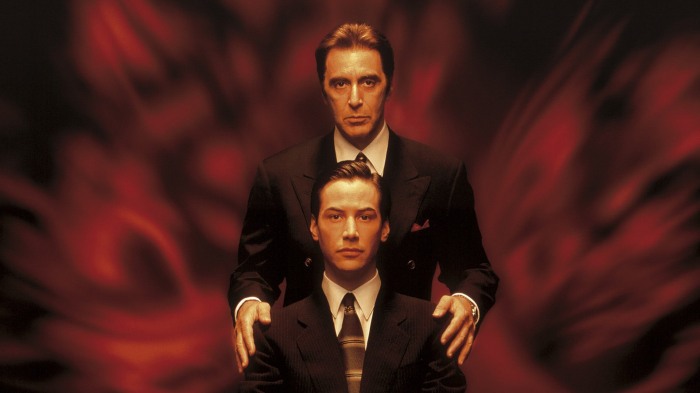
1997 Movie Review: THE DEVIL’S ADVOCATE, 1997

THE DEVIL’S ADVOCATE, 1997
Movie Reviews

Directed by Taylor Hackford

Cast: Al Pacino, Keanu Reeves, Charlize Theron, Connie Nielson, Jeffrey Jones, Craig T. Nelson,
Review by Surinder Singh

SYNOPSIS:

Hotshot lawyer Kevin Lomax (Keanu Reeves) accepts an invitation to join a prestigious New York law firm notorious for it’s track record of getting its guilty clients cleared of all charges. Lomax is drawn in by the money and power that comes with the job; a seduction cleverly orchestrated by the firm’s boss John Milton (Al Pacino). But as Lomax delves deeper into the firm’s legal dealings he discovers there’s more to Mr. Milton’s success than meets the eye…

REVIEW:

It’s fair to say that Pacino did his share of mentoring during the nineties. As well as winning his Oscar and churning out some great central performances, he also played a number of supporting roles aside the new generation of leading men. In Donnie Brasco (1997) he supported Johnny Depp and with Any Given Sunday (1999) he did the same for Jamie Foxx. It’s always important for a screen-acting veteran to take stock in the new generation because it gives them the chance to see how good they really are! Perhaps one of the greatest tests for any upcoming actor is: “can I hold my own against Al Pacino on screen?”

As Kevin Lomax, Keanu Reeves was offered the challenge! Reeves arrives on screen looking suitably sharp and suave, he oozes confidence as soon as he enters the courtroom. We are shown someone so ambitious that he’ll happily tear up a poor young girl on the witness stand to win his case. It’s not long until he attracts interest from like-minded people in his field. As the film’s title suggests we’re witnessing someone on a moral journey in a job that continuously puts morality up for question. Reeves plays Lomax brilliantly as a man who is quite comfortable with drawing a line of professionalism between himself and the case. At this point in his journey it’s not important whether his client is guilty or not, only that he wins!

The film really gets going once Lomax is in New York and poised to begin his case with the new law firm. Enter Al Pacino: in a wonderful scene on top of the huge sky-rise looking down at the world below, Milton acquaints himself with his new employee Lomax. Director Taylor Hackford does a great job of balancing a realistic drama set against a modern day New York with the supernatural and mythic elements at play. The scene is totally plausible but at the same time positions Pacino’s Milton as the Master of the Universe. He’s more than just a successful man; his power clearly reaches further than Lomax is presently aware of.

Many actors in the past have played the Prince of Darkness: Jack Nicholson in The Witches of Eastwick (1987), Robert De Niro in Angel Heart (1987) and of course Tim Curry in Legend (1985). By default, any actor who takes on such a notorious character will be compared to the previous incarnations. Pacino is charismatic and carries his character with a sense of cool that draws you in from the moment you meet him. Pacino may be a small guy but in The Devil’s Advocate he owns every space he walks into and everyone in it! Pacino’s Milton is by far the most contemporary and convincing incarnation of Satan for many years.

Like he did in Donnie Brasco, Pacino plays a mentor and takes Keanu Reeves’ Lomax under his wing. Milton explains his philosophy leaving his new apprentice in awe: “Look at me! Underestimated from day one. You’d never think I was a master of the universe, now would ya?” Rather than exert superhuman physical powers, Milton is the puppet master who prefers discretion: “I’m the hand up Mona Lisa’s skirt. I’m a surprise, Kevin. They don’t see me coming!” Lomax sees this simply as advice to help him progress as a lawyer. All the while his new mentor who is ten steps ahead is manipulating him!

The movie is full of devilishly splendid set pieces. Lomax is advised to seek out a man named Moyez (Delroy Lindo) a witchdoctor who’s on trial for the ritualistic butchering of animals. Moyez offers Lomax a helping hand (via a strange ritual with a decapitated tongue) and sure enough the prosecution cannot get a word out in the following trial. The scene gives supernatural depth to the power of Milton and his associates, showing the unsettled Lomax the extent to which his “unfaltering success” is being secured. Perhaps the greatest set piece is the killing of Eddie Barzoon (Jeffery Jones). As he jogs through Central Park we hear Pacino’s piercing voice off-screen, the feeling of an impending doom takes over until we see the poor Barzoon fall to his bloody fate.

Like most films about the Spirit of Evil (walking amongst us in modern times) The Devil’s Advocate is essentially a story about someone saving their soul from Evil. The idea that through all Evil’s temptations we eventually choose the path to light and salvation. On reflection this movie is unlike the others in the way it delivers the age-old story to you in a fresh, contemporary and engaging manner. The performances are strong and Pacino’s performance completely convinces you he’s the modern incarnation of the Prince of Darkness. Plus, on purely popcorn terms this movie is a solid thriller that doesn’t rest too heavily on religious fact and while the symbols of Christianity are ripe throughout they do not alienate the audience.

The Devil’s Advocate is a great movie to watch over and over. Not exactly ‘light-entertainment’ but a strong contemporary thriller that will satisfy. It also contains arguably the best portrayal of Satan on film…yet another testament to the awesome acting talent of Al Pacino!

 the devils advocate

1997 Movie Review: THE CASTLE, 1997

THE CASTLE,    MOVIE POSTERTHE CASTLE, 1997
Movie Reviews

Directed by Rob Sitch
Starring: Michael Caton, Anne Tenney, Stephen Curry, Anthony Simcoe, Eric Bana
Review by Jay Radosavljevic

SYNOPSIS:

The Kerrigan family live happily beside an airport, beneath a pylon. They are a close family with strong morals and traditions. A man from the local council comes by to do a routine valuation of the property which father, Darryl thinks is great. Little does he know that the council are preparing to kick the Kerrigans out of their home to expand the airport. Darryl goes on a crusade to stop the council and protect his family home.

REVIEW:

A low-budget underground cult hit from Austrailia, ‘The Castle’ will go down (under) in history as one of the funniest films ever made but still suffers from under-exposure and is eclipsed in popularity by any number of the traditional (yet wholly inferior) American follies into comedy.

‘The Castle’ is the Kerrigans’ family home – it is right next door to the airport (which would be handy if the family ever needed to fly anywhere) in a small and scarcely populated cul-de-sac, High View Crescent. Their neighbours comprise a female divorcee, a poor old man and a Lebanese immigrant who prefers the planes that fly overhead here than the ones that drop bombs back home.

The Kerrigans are the happiest and sweetest family you would ever have the pleasure of meeting: the father, Daryl (a tow truck driver) has principles and just loves his wife’s cooking – the mother, Sal is devoted to her family and to prettying up the house with her own unique tastes – the youngest son, Dale is lovely but dim (he can dig a good hole though) and narrates the story – the middle son, Steve is an ideas man with a keen eye for a bargain in the trading post – the oldest son, Wayne is in prison for his part in a robbery but it wasn’t his fault … he fell in with the wrong crowd – the daughter, Tracey is the only member of the family with a tertiary education (beauty school) and was once on ‘The Price Is Right’. Tracey is engaged to Con (played by a young Eric Bana) who is an immaculately dressed and overly polite keen amateur kick-boxer.

All the family members have ridiculously bad haircuts (mullets for the boys and a frizzy bouffant adorns the heads of the girls) – their sweaters are amazing too. Check them out!

Now, something terrible happens to disrupt the family bliss and the harmony of the whole neighbourhood. The airport wants to expand and build another runway – the Airport Authority are too cheap to fill in the old quarry and build there so decide to compulsorily acquire all the houses in High View Crescent to build there instead. Darryl is incensed into action – after all, its not a house, it’s a home and a man’s home is his castle.

The film follows Darryl’s attempts to have the compulsory acquisition order overruled by the courts. He hires a big-shot (how do you write with sarcasm?) lawyer (the same one that represented Wayne in his trial for the robbery) and they hit the legal trail of the Airport Authority’s dastardly desires.

It feels and acts like a true story: compulsory acquisition really does displace people against their wishes. It is all the more poignant when you consider the film’s location, Australia where the Aboriginal first nation people were displaced by the ruling authorities from the moment the country was discovered. Darryl even says he now knows how the Aborigines feel – their home is like their ancestral land – it holds their memories and no one deserves to have that taken away from them.

It may seem like a dull plot with not much funny going on at all for a comedy (how do you find ground breaking laughs in a court-room drama?) but this film truly has it all: tension, twists, turns, great one-liners, hair-raising hair cuts, floundering fashions, memorable catch-phrases, horrific hair cuts, a tightly refined all-round quotable script … and did I mention the hair?!

You really have to watch ‘The Castle’ three, maybe four times before you fully see and understand the many layers of the comedy. On your first view you will laugh at all the obvious stuff and miss other obvious comedy simply because you are laughing too much to catch the next gag. The second viewing will remedy this. On your third and fourth viewings you will really start to notice the detail and minutiae of the comedy: you will take in all the elements of the set dressing, the wardrobe department, the hair and make-up – all important cogs in the machine that when put together create one of the most intelligent combinations of comedic essentials ever seen on the silver screen.

This is a big statement to make but believe me, when you are up to your twentieth viewing (or even thirtieth, like me) you will be a staunch advocate of this film too. It never gets boring, it never gets tired and it will never get old.


1997 Movie Review: THE BOXER, 1997


THE BOXER,  MOVIE POSTERTHE BOXER, 1997
Movie Reviews

directed by: Jim Sheridan

Starring: Daniel Day-Lewis, Emily Watson, Brian Cox, Nye Heron, Jer O’Leary
Review by Virginia De Witt

SYNOPSIS:On the eve of peace being declared in Northern Ireland, Danny Flynn is released from prison after serving 14 years for his youthful involvement with the IRA. Danny’s former girlfriend, Maggie, married his best friend, Tommy Doyle, and had a son, Liam. Tommy is now in prison himself and Maggie is watched vigilantly by the local community as she is now a prisoner’s wife and must be above reproach at all times. Danny sets out to start his life anew, and continue with his boxing career which had been interrupted by his prison term. He begins by initiating a training program for young boxers in the youth centre where Maggie also works. They reconnect even though it is dangerous for them to be seen together. At the same time, Danny begins to fight professionally again. Events spiral out of control as Maggie’s young son, Liam, is furious over his mother’s attachment to Danny. As well, Danny’s newfound commitment to the peace process sets him on a collision course with members of the local IRA.

REVIEW:

This third collaboration between writer/director Jim Sheridan and Daniel Day-Lewis is the least well known. It was shot from an original screenplay co-written by Sheridan and Terry George. Their main object in telling the fictional story of Danny Flynn was to dramatize the culmination of the peace process and the consequences of it in the lives of ordinary people living in Belfast. In an interview on the DVD, Sheridan says the idea for the story came to him while he was living in New York in the ‘80s watching the news from Ireland, which was all bad. Then one night, a young Irish boxer, Barry McGuigan, was featured and said, “Leave the fighting to McGuigan.” Sheridan relates how he found it “… kind of innocent and naive a little bit, but great. Here was a guy in a violent profession saying stop fighting. That contradiction interested me.”

It’s that contradiction that is at the heart of the drama Sheridan and Geoge have crafted here. It is a thoughtful and intelligent take on the sometimes painful and dramatic progress of the peace process in Northern Ireland, which however, lacks some of the focus and tightness of storytelling that distinguished “My Left Foot” and “In The Name of the Father.” The tension that drives the story comes from the split on the republican side over whether to accept the terms being offered by the British to achieve peace, ie decommissioning weapons, etc. Danny (Daniel Day-Lewis), his friend and boxing mentor, Ike Weir (Ken Stott) and Maggie’s father (Brian Cox), an IRA chief, are all on the side of negotiating. They are each, in turn, confronted by Harry (Gerard McSorley), a break away IRA member, in violent episodes meant to sabotage the peace process. In the midst of this political drama, Sheridan works in a love story that is affecting and simply drawn.

Sheridan is ambitious here, attempting to combine what initially seem like too many elements for a small film. He does manage, however, to keep the political story, the love story and finally the boxing narrative of Danny’s attempted career comeback, balanced for most of the film. It is not until well into the last act when Sheridan cuts to Danny’s big fight in a London hotel that the film loses its momentum and bogs down. The London sequence is unnecessary dramatically as it doesn’t show us anything we haven’t already seen in Belfast regarding the peace process. It does, however, allow the filmmaker to make his point about violence by having Danny refuse to keep fighting a man who is clearly in distress. This scene is also an emotional nod to Barry McGuigan (who worked on the film as Daniel Day-Lewis’s trainer). McGuigan relates in an interview on the DVD how, when he was a professional boxer, he had fought a man in London, who had died later of head injuries. As admirable as all of this is, the point has already been made about Danny’s desire to use his boxing skills for peace in the earlier Belfast scenes. The result is that the build up to the final confrontation between Danny and Harry at the end of the film has been crucially interrupted.

Despite this lapse, overall the film works well. As usual Sheridan, and his actors, are wonderful at capturing the nuances of Irish life believably and dramatically. In the extended wedding scene that opens the film or in the depictions of the daily interactions at the Holy Family Boxing Club, the rhythms of language, the pleasures and pressures of family life and social obligations are all caught knowingly, and yet seem completely natural in their context.

The cast is crucial in this process. Daniel Day-Lewis is intense, but quiet, as Danny Flynn, displaying a barely acknowledged sadness just beneath his surface that is moving. This is a man who is aware of what he has lost by virtue of his earlier decisions and has now grown used to being alone. It is easy for us to understand how Danny now only wants to start his life again. As an important part of that new life, Emily Watson, as Maggie, displays a disarming simplicity. Maggie is quiet too, but it is a quiet strength. We come to know that in her world to talk too much is dangerous. Maggie learned long ago how to navigate her way through the byways of a life lived in proximity to violence. Watson lets us know subtly that this endless process, both personal and political, is now wearing her down. As well, she has a nice rapport with Daniel Day-Lewis in their scenes together. Ken Stott, as Danny’s trainer, is memorable as an older man who, like Danny, is desperately trying to begin again but knows the odds are against him.

The original music by Gavin Friday and Maurice Seezer is eery, evocative of tribal chants, mixed with Celtic sounds. The cinematography by Chris Menges has a sometimes strangely blueish tint to it, but is clear and sharp and captures the dark world out of which these characters are struggling to emerge.

The ending of “The Boxer” lacks the joyous completion of “My Left Foot” or the triumphal vindication of “In The Name of the Father.” There is, instead, an air of quiet resolution about it, and the film overall. Nonetheless, “The Boxer” deserves its place alongside these other two excellent films and should be revisited