Film Review: LIZZIE (USA 2017) ***1/2

Lizzie Poster
Trailer

A psychological thriller based on the infamous 1892 murders of the Borden family.

Writer:

Bryce Kass

The name LIZZIE will sound familiar to many.  Even to kids, LIZZIE is a well-repeated nursery rhythm containing more sinister connotations.  LIZZIE is also the first name of Lizzie Borden who was accused but acquitted of the vicious hatchet murders of her stepmother and father.  The incident occurred in Fall River, Massachusetts in 1892.

Why would this dated biography be of interest to today’s audiences?  For one, Lizzie is alleged to be a lesbian and the script by Bryce Kass re-imagines Lizzie to be guilty of the heinous crime.  Lizzie is also highly abused by the male gender in a time where gay relationships were disallowed.  One scene has her uncle grabbing her by the throat threatening her. 

The film is bookended with the ghastly murder of a man hacked to death.  The guilt falls on the daughter Lizzie which the film sets to prove committed the deed despite her acquittal.

The film goes back 6 months with the arrival of a female at a three story house, obviously owned by a wealthy family.  The female is revealed to be Brigitte Sullivan (Kristen Stewart), a single Irish woman, who has come to live with the family and work as a live-in maid.  Lizzie, of the film title, is living with her wealthy father (Jamey Sheridan), stepmother (Fiona Shaw) and sister (Kim Dickens).  Her father is up to no good, while her stepmother silently enables.  Worst still, it seems that her uncle (Denis O’Hare) may end up controlling her inheritance.  Socially isolated, with her comings and goings strictly monitored, Lizzie finds solace in her pet pigeons. 

Brigitte works hard.  The patriarch of the family recognizes Brigitte’s hard work but his visits to her room prove him to be a sex abuser.  At the same time, Lizzie and Brigitte start an affair.

The script ups the angst with the father becoming more abusive towards Lizzie.  Lizzie also suffers from fits.

The film benefits from the creation of claustrophobia of the prison of the family home.  Lizzie is discouraged from going out and if allowed, must return by midnight.  The camera is quick to always show the high walls as if acting like imprisoning barriers.  When Lizzie does get to go out, she is attacked by society as the Borden family are cheap and disliked large house renters, still using candle light instead of the new electricity of the times.  The audience is made to feel that Lizzie has no way to escape psychically and emotionally.  Which drives her towards the act.

Whereas in real life Lizzie was acquitted for the fact that the jury could not imagine a woman performing such a violent act, the film shows otherwise with Lizzie hacking her father to death with repeated blows, and in the nude with blood splattered all over her body.  This shows director Macneill over-confident that he has convinced his audience believe that Lizzie is so desperate that she has nothing to lose (she would otherwise lose her inheritance as well as love for Brigitte) but to commit gruesome murder.

Performances are top-notch with Stewart getting away with her Irish accent. But the main star of the film is Noah Greenberg lush cinematography that captures the period atmosphere of the times and the claustrophobic imprisonment of the girls.

Trailer: https://www.youtube.com/watch?v=t-QJ81-k6w8

Film Review: UNDER THE TREE (Iceland/Denmark/Poland/Germany 2017) ***1/2

 Submit your Screenplay to the Festival TODAY

Under the Tree Poster
Clip

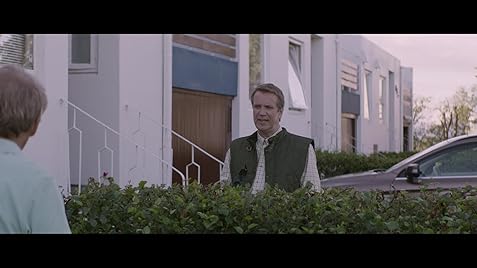
When Baldwin and Inga’s next door neighbours complain that a tree in their backyard casts a shadow over their sundeck, what starts off as a typical spat between neighbours in the suburbs unexpectedly and violently spirals out of control.

Writers:

Huldar Breiðfjörð (story and screenplay), Hafsteinn Gunnar Sigurðsson (screenplay)


UNDER THE TREE is a simple story that unfolds in all its unpredictability and horror.  It is trouble for two neighbours, something that many can relate to.  The shade from a front yard tree brings tensions to a boil for two families in an Icelandic suburb.  The husbands Baldvin (Edda Björgvinsdóttir) and Konrad (Þorsteinn Bachmann) have a small argument over trimming the big tree as Konrad’s wife, Eybjorg (Selma Björnsdóttir) likes to lie in the sun and does not want the shade from the tree.  But the wives argue.  The tires of  a car are slashed followed by rude gnomes ornaments placed in the front of the house.  Then when the cat goes missing, all hell breaks lose.  

Amidst the arguing, there is a subplot of the son, Atli (Steinþór Hróar Steinþórsson) losing custody of his daughter after cheating on his wife., Agnes (Lára Jóhanna Jónsdóttir).   

Director Sigurdsson knows how to up the angst, as evident at the film’s start, the wife catches the son watching porn.  “Is that you in the porn?”  she suddenly notices.  “Isn’t that Rakel in it with you in the porn?”  she asks again before kicking him out of the house and taking custody of their daughter.  Again this is an incident that many separated couple go through, fighting for custody.   Sigurdsson also keeps certain factors unknown to keep the audience guessing.  Did the neighbour really slash the tires?  Did the neighbour really put in the gnomes?  And where is that darn cat that has disappeared, though the final incident is revealed at the end of the film.

Sigurdsson keeps his film engaging from start to end by making his characters real, reacting and doing things that normal people all over the world might end up doing, when pushed to the limit.  

Of all the characters, Inga (Edda Björgvinsdóttir) seems the nastiest.  She seems to be director Edda Björgvinsdóttir’s favourite. Inga slings dog shit at Eybjorg, calls her a cow and even calls her son a loser when he cheats on his wife.  The wives inch their husbands, who seem more tolerant, on.

Besides the black comedy, the film also contains segments of dramatic tension, like in the ones where Atli abducts his daughter or when he abuses her at her workplace.

The film is shot in the suburbs of the Icelandic capital of Reykjavik.  These houses are modern looking, colourful, modest and too close to each other for comfort.   Trees and sun are scarce in Iceland so one can understand a neighbour not wanting the shade and the other not wanting his tree touched.

Edda Björgvinsdóttir’s film demonstrates the worst there is in human beings, creating a dark comedy at its blackest. His characters are unforgiving (Agnes cannot forgive Atli for cheating), vindictive (Agnes calls her cheating husband out as a masturbator of sex videos he indulges in, at a community meeting) and cowardly.

The ending comes with a good twist that leaves audiences satisfied that they have seen a really black comedy/drama.  The film dominated the Edda Awards (Icelandic equivalent of the Oscars) with seven wins, including best film, director, actor (Steinþór Hróar Steinþórsson), actress (Edda Björgvinsdóttir), supporting actor (Sigurður Sigurjónsson), screenplay and visual effects.

Trailer: https://www.youtube.com/watch?v=tU7KeDwJCAc


 Submit your Screenplay to the Festival TODAY

Film Review: FOXTROT (Israel/France/Germany/Switzerland 2017) ****

Submit your Screenplay to the Festival TODAY

Foxtrot Poster
Trailer


FOXTROT as most people know is the name of a dance, which is performed a third through the film by a bored soldier at his deserted outpost.  It is also known in the military to stand for the letter ‘F’ when spelt out as taught in signalling courses to prevent confusion in communication.  (Alpha is for ‘A’, Bravo for ‘B’ etc.)  In the film it is also the name given to a military operation.

The film is divided into 3 parts, each almost equal in running time.  The opening sequence is reminiscent of Steven Spielberg’s SAVING PRIVATE RYAN when a mother faints after hearing the news of her son’s death during WWII.  The story begins at the home of Michael Feldman (Lior Ashkenazi) and his wife Dafna (Sarah Adler), where an army detail arrives with the news of their son Jonathan ((Yonatan Shiray).  Dafna faints and is sedated.  Meanwhile Michael spirals from anguish to anger.  He even kicks his poor unsuspecting dog.  Nothing new here, the film seems treading on water.  The film picks up when he begins to suspect that he has not been told the whole story when the army refuse to let him see the son’s body in the coffin during the military funeral.  Not soon after, there is news that the boy is alive.  Apparently, there is another Jonathan Feldman and it is this other Jonathan that died.  Michael freaks out and demands that his son be returned home right away.  Michael and Dafna have an argument, she accusing him of being nasty, he of her being too nice being sedated on drugs.

The film ends on a bright note, with a touch of surrealism.  The second section begins with the narrator describing the foxtrot dance followed by a very uplifting and amusing dance sequence.  The musical interlude jumps out of the blue and is a fantastic surprise.  The audience then learns of Jonathan’s mundane military duties at the check post, identifying everyone that drives through.  The soldiers also let a camel through.  Writer/director Maoz pulls another trick up his sleeve with a twist in the plot.  When  a passenger in a car tosses out an empty drink can, the soldiers open fire thinking it to be a grenade.  There are been more twists in the plot but they will not be mentioned in the review to prevent to many spoilers.   A few of these twists could be reduced for the film to be more effective.

The film works as a very different film audiences have never seen before.  FOXTROT is a  surrealistic film set in the midst of the israeli/Palestinian conflict, a very unlikely setting, which makes the surrealism work even better.  Maoz’s story also shows that fate plays games with people’s lives – and there is nothing one can do about it.  Michael and Dafna try to make sense of what is happening.  At their best moment, as their daughter, Alma tells them: “You two look beautiful when you are together.”  Perhaps, that is the only thing human beings can hang on to, each other in the midst of the quirky hands of fate.

The film won the Silver Lion (Grand Jury Prize) at the 2017 Venice Film Festival.  FOXTROT is definitely worth a look.

Trailer: https://www.youtube.com/watch?v=wrBEDEmUceM

Submit your Screenplay to the Festival TODAY

Film Review: THANK YOU FOR YOUR SERVICE (USA 2017) ***

Submit your Screenplay to the Festival TODAY

Thank You for Your Service Poster

Trailer

A group of U.S. soldiers returning from Iraq struggles to integrate back into family and civilian life, while living with the memory of a war that threatens to destroy them long after they’ve left the battlefield.

Director:

Jason Hall

Writers:

David Finkel (based on the book by), Jason Hall (screenplay) (as Jason Dean Hall)

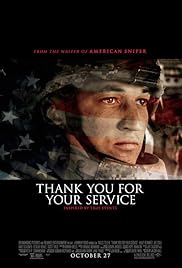
THANK YOU FOR YOUR SERVICE is a biographical film based on true events (the closing credits reveal the pictures of the real characters) on the subject of PTSD (post-traumatic stress disorder).  Returning after a war and adjustment back to civilian life has been dealt time again in films like the well-known THE BEST YEARS OF OUR LIVES, but few have dealt specifically with the Iraqi War.

The film opens appropriately with the cause of Sergeant Adam Schumann’s (Miles Teller) trauma.  After a bomb goes off and injures fellow soldier Emory (Scott Haze), Adam fireman lift’s him down to safety.  Well, almost.  He drops him down the stairs resulting in some brain injury.

The film shifts to the return home.  The homecoming is shown with the fanfare of waiting family and loved ones.  The film centres on three soldiers, all of whom find things are not so smooth sailing.  The other two are Solo (Beila Koale) and Will Waller (Joe Cole).  Waller has it the worst when he finds himself abandoned by his wife who takes his child and empties his bank account.  Waller shoot himself in front of her at the bank she works in.  That part seems quite incredible, though it must have happened as in the non-fiction book of the same name written by David Finkel.  The rest of the film follows the other two as they adapt to their PTSD.

The script is adapted by Jason Hall who won an Academy Award nomination for his adapted screenplay of AMERICAN SNIPER.  When Steven Spielberg pulled out of the director’s reigns, Hall jumps in and makes his directorial debut.

The first time direction is obvious in the way the film unfolds in a safe, standard way predictable with no unexpected punches pulled.  The obstacles preventing Solo and Adam from getting their psychiatric care are all there – the long queues; the red tape requiring proof; the waiting time; with the soldiers finally getting their way after some needed shouting and anger outbursts.

Miles Teller in the main role of Adam proves once again his ability to carry a film on his own.  With recent rave reviews for his performances in films like WHIPLASH and the recent ONLY THE BRAVE, this film will add to his impressive resume.  Of all the actors, comedian Amy Schumer (TRAINWRECK, COMEDY CENTRAL) is totally miscast in the serious role of the dead soldier’s wife, Armanda.  

As for the rehabilitation of the soldiers, it seems too convenient that Adam is recovered after Armanda tells him that her dead husband wanted Adam to continue living, this removing Adam from the guilt he feels.  The same kind of convenient removal of guilt occurs in the recent film STRONGER where the bomb victim rehabilitates after one meeting with the guy who helped in during the Boston. marathon bombing.  But Hall’s script at least shows the long path towards recovery.

THANK YOU FOR YOUR SERVICE is a heavy film with a heavy theme.  One might argue that it is a story that needs be told – and that is right.

Trailer: https://www.youtube.com/watch?v=50LQGcb5knE

Submit your Screenplay to the Festival TODAY

1957 Movie Review: THE INCREDIBLE SHRINKING MAN, 1957

Submit your Screenplay to the Festival TODAY

THE INCREDIBLE SHRINKING MAN,  MOVIE POSTERTHE INCREDIBLE SHRINKING MAN, 1957
Movie Reviews

Director: Jack Arnold

Starring: Grant Williams, Randy Stuart, April Kent, Helene Marshall
Review by Kevin Johnson

SYNOPSIS:

A man is exposed to a freak radiation cloud while on vacation, causing him to gradually shrink.

CLICK HERE and watch TV SHOWS FOR FREE!

What is WILDsound?

REVIEW:

I was actually rather surprised by The Incredible Shrinking Man, which began typically like the average B-film but dovetailed into a dark yet intrinsic inspirational tale without the classic Hollywood revisioning. It is a film that espouses more novel or short story-like elements than cinematic ones.

Since this is based on Richard Matheson’s novel of the same name, and since he also penned the screenplay, it’s to be expected. But the lack of specific changes to make the film more engaging to audiences, such as happier ending and a satisfying explanation of the shrinking, is rather audacious, especially taking in account the time period. This gives the film a deeper resonance now, but I can’t imagine audiences being too receptive to it back in 1957.

When a happily-married couple is vacationing on a boat by themselves, the husband (a overly-dashing Grant Williams) is exposed to a random radiation cloud, causing him to shrink daily. He and his wife hold out hope that a cure will be found in time, but Williams soon becomes a celebrity freak show, and then, a miniscule prisoner in his own basement.

Williams’s size changes are accomplished by a judicious use of large props, camera angles, and efficient editing. I was rather impressed by the accuracy and details of the oversized household goods, and crafty camera work is a long dead art, replaced by CGI and green-screens. Which is why I was disappointed with the use of projections in some scenes; but, to be fair, they were used for the more complex scenes, such as when Williams battles the spider.

The sets rival that of some modern-day films, most notably Honey, I Shrunk the Kids. Both movies exercise a swath of campy elements, but Honey, I Shrunk the Kids mixed its miniscule fear with a childlike wonder; The Incredible Shrinking Man strove for a more overly-serious, overly-dramatic venture into the undersized unknown. It does get rather ridiculous, with Williams narration over his predicament delving into bad epic poetry, and one can’t help but notice how grim he gets within five minutes of his situation. Considering man can go a few weeks without food, did he REALLY need to go through hell-and-high-water to reach a cake? And, really, was the spider THAT much of a threat?

Prior to this, reaching his three-foot stature made him an object of the media, a spectacle for prying eyes and curious voyeurs. His inability to handle such attention is remedied, at least for a while, when he meets the most beautiful midget in the whole world! No, it’s a generic Hollywood pretty face clambering over the same oversized props at our protagonist. Needless to say, it is somewhat uncomfortable watching such an obvious misrepresentation of the life (and physicality) of a small person, but the 50s didn’t care too much in the way of political correctness – except for the Hayes code, which seemed to discourage a budding romantic relationship between Grant and the “midget.” After all, we wouldn’t want to showcase something as evil as sympathetic adultery, now would we?

Shrinking Man works its strongest points as a polemic, at the points where the narrator and leading man discuss the emotional and spiritual toll the incident is taking on him. And, again, it pushes way too much into the over-dramatic, but in a way, it works, especially when he comes to the realization that his shrinking will not stop. After losing his wife, livelihood, and even his identity, he avoids certain madness with a casual, cool, and serene acceptance of his fate, of acknowledging God’s role in all this, in his gradual decent into the atomic, which, in some metaphysical circles, reflect the very nature of the elliptical universe itself. By becoming small, he becomes large. By dwindling into nothing, he becomes part of everything. (The speech at the end spouts it better than I do.)

The Incredible Shrinking Man certainly over-dramatize its story and over-sexualizes its characters; from the swimsuit-clad wife at the beginning, to the attractive circus midget in the middle, and to the Amazonian garb Williams somehow sports when stalking his basement-jungle, the movie does little to present any problems with showcasing perfect bodies. But the technological aspects of the film are well done, and its novelistic readings are impressive. While the latter may be better served in book format, it was still brave to fit such deep, dark overtones in the film. That’s something on which The Incredible Shrinking Man should be commended.


THE INCREDIBLE SHRINKING MAN

Submit your Screenplay to the Festival TODAY

1987 Movie Review: SPACEBALLS, 1987


SPACEBALLS MOVIE POSTER
SPACEBALLS, 1987
Movie Reviews

Directed by Mel Brooks
Starring: Mel Brooks, John Candy, Rick Moranis, Bill Pullman, Daphne Zuniga
Review by Mark Engberg

SYNOPSIS:

Having squandered their own air supply, the inhabitants of Planet Spaceball kidnap a wealthy princess to rob her planet of its precious resources.

CLICK HERE and watch 2009 MOVIES FOR FREE!

REVIEW:

“Everybody got that?” Dark Helmet asks the audience after his chief-in-command Colonel Sandurz delivers the plot exposition to his fellow villains.

This late 80’s parody of science-fiction fanfare may have been tardy in satirizing the “Star Wars” empire that George Lucas built a decade earlier. In describing his prime target in making “Spaceballs”, Mel Brooks calls the sci-fi epic “the final frontier. It is the last genre I can destroy. So I am destroying it.”

Additionally, he has categorized this entry as “half wit, half physical, half disgusting, and sometimes beautiful. It’s my appreciation of the human event.”

While some critics have challenged Mr. Brooks’ timeliness in the sci-fi parody, this film has enjoyed a cult appreciation in terms of its clever writing and enjoyable characters. Another factor to appreciate: Apogee, Inc accomplished the special effects in this comedy in the dwindling days of pre-digital CGI. Like the original “Star Wars” trilogy, Agogee’s special effects team had to construct models with computerized motion control systems to give the flying Winnebago and endless Spaceball One the illusions of movement.

During these contemporary days of special effects design where anything and everything can be done with digital enhancement, it is refreshing to watch a master like Mel Brooks carve genuine comedy out of handcrafted science fiction.

Even though “Spaceballs” features lasers, spaceships, and alien make-up galore, Brooks never steps too far away from his fan base in delivering the pratfalls and one-liners that made the man a comic icon. He even gets a guy in a bear suit to get a cheap laugh in the third act.

The movie begins with a “Star Wars” scroll giving the audience a brief history of the Spaceballs universe. Under the hilarious leadership of President Skroob (Mel Brooks, hmm, I just realized the name is an anagram) the citizens of Planet Spaceball are forced to invade new worlds in order to steal their air supply.

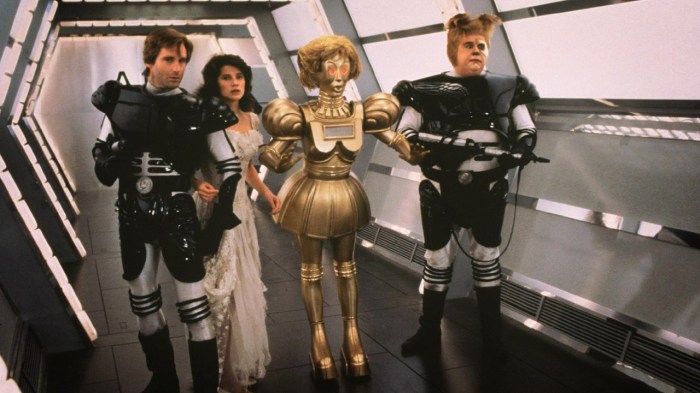
Mimicking “Star Wars” to the last detail, Dark Helmet (Rick Moranis) and Colonel Sandurz (George Wyner) kidnap Princess Vespa (Daphne Zuniga) in an effort to blackmail her father, King Roland (Brooks all-star for father figures, Dick Van Patten).

This is where Bill Pullman and John Candy come in, as Captain Lone Starr and his sidekick Barf, an allusion to Chewbacca in that he is half-man, half-dog. Candy is hysterical in his performance of the mawg, but the real winners of this role are the operators of Barf’s mechanical canine-like ears. Every time Barf appears to listen, his auto-receptive ears perk up like antennae. The effect is comic gold.

Like Han Solo, the character of Lone Starr is motivated by money. With perfect deadpan, Pullman says, “Barf, we’re not doing this for the spacebucks. We’re doing it for a shitload of spacebucks!”

The reason for the greed is that Lone Starr has a heavy debt to pay Pizza the Hut (voiced by the recently departed Dom DeLuise). And Pullman plays the character of Lone Starr with a humorous yet touching sentiment that would have made Harrison Ford proud. With a note of sadness, Lone Starr tells Vespa he hails from the Ford Galaxy. Those who do not remember the Ford Galxie 500 have come to assume that this joke is a reference to the actor who played Han Solo.

But there is more than enough of “Star Wars” reference to go around. Brooks even uses the famous Wilhelm scream as one of his Spaceball troops is shot in the ass by incoming laser fire.As a matter of fact, keep an eagle eye out for the Millennium Falcon parked next to Lone Starr’s Winnebago at the interstellar gas station.

This is not to say that George Lucas’ beloved saga of “Star Wars” is the sole target of Mr. Brooks’ parodying lightsabre. In “Spaceballs”, he references “The Wizard of Oz”, “Star Trek”, “Alien”, and even “Planet of the Apes”. Keep a sharp ear ready for that last one. That is the voice of Michael York playing the second ape on horseback.

Brooks definitely goes above and beyond his traditional self-reflective voice in this film. In ways like never before, the writer/director/producer/star lists his former Hollywood achievements as videotapes stored upon a futuristic spaceship.

“Instant cassettes,” says Col. Sandurz. “They’re out in stores before the movie is finished.”

In one of my favorite comedic sequences of all time, the villainous Spaceballs fast-forward through their own movie in order to discover the location of the good guys. After which, Dark Helmet and Sandurz engage in an Abbott and Costello routine of existential misunderstanding.

And the self-reflective filmmaking joke continues throughout the movie. Before teaching Lone Starr about the powers of the Schwartz, Yogurt (also played by Mr. Brooks) explains his profession upon his lonely planet.

“Merchandising,” says Yogurt. “Where the real money from the movie is made.” Yogurt then goes on to sell the audience item after item of Spaceballs merchandise, all of which is a joke. In fact, Mr. Lucas allowed Brooks to make “Spaceballs” on the condition that there would be no merchandising for this movie. This would, of course, account for the spotty nature of the “merchandise”. Notice that “Spaceballs: The Coloring Book” is nothing more than a Transformers illustration book (Twenty years before Michael Bay began ruining my beloved robotic heroes himself!)

There are many other individual items of “Spaceballs” to enjoy for the pure sake of silliness. John Candy wins the award for the best use of the middle finger (beating out Keanu Reeves in “The Matrix” and Jennifer Aniston in “Office Space”) after Lone Starr and Barf park the Winnebago in the Spaceball penal territory.

I am also a big fan of the great Stephen Tobolowsky’s short yet pleasing scene as an effeminate Captain of the Guards. He only has a couple of lines, but there is just something about his delivery that makes his character as memorable as Barf.

“Spectacular stunt, my friends, but all for not . . .” he lectures to his captives before realizing they are nothing more than stunt doubles.

The scene when Dark Helmet is caught playing with the Spaceballs action figures is also one of my favorite reactions in filmed comedy. According to cinema trivia, Moranis performed this scene impromptu after Brooks suddenly conjured up the premise on set. How they got the action figure so quickly is anyone’s guess.

And let’s not forget Joan Rivers as the voice of Dot Matrix, Princess Vespa’s personal assistant droid. Ironic, though, that the Joan Rivers of today currently resembles the physical appearance of the golden android.

A subtle shout is also made to fans of literary essays. When Spaceball One is revealed to be a gigantic transformer about to engage in “metamorphosis”, Dark Helmet prompts his officer: “Ready, Kafka?” Think about that one.

Final thought: Does the alien that bursts out of John Hurt’s stomach play a song that seems familiar to all who watched those classic Looney Tunes cartoons? It should. The song and top hat dance number is homage to “One Froggy Evening”. You know, the one where the frog grabs a cane and dances to “The Michigan Rag.”
SPACEBALLS, 1987.jpg

Also, Free logline submissions. The Writing Festival network averages over 95,000 unique visitors a day.
Great way to get your story out: http://www.wildsound.ca/logline.html

Deadlines to Submit your Screenplay, Novel, Story, or Poem to the festival:http://www.wildsound.ca

Watch recent Writing Festival Videos. At least 15 winning videos a month:http://www.wildsoundfestival.com
Film Review: TULIP FEVER (UK 2016) **

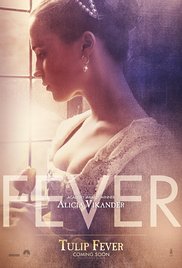
tulip fever.jpgAn artist falls for a young married woman while he’s commissioned to paint her portrait during the Tulip mania of 17th century Amsterdam.

Director: Justin Chadwick
Writers: Deborah Moggach (screenplay), Tom Stoppard (screenplay)
Stars: Alicia Vikander, Dane DeHaan, Jack O’Connell

Review by Gilbert Seah

The press is having a field day with the news of the new film TULIP FEVER based on a scandalous affair set in 17th Century Amsterdam. When the film critics were asked to sign an embargo for their reviews to appear no earlier that 1 pm of Friday, the film’s opening day, something must be afloat. The film was expiated to be awful. In addition, rumours were going around that TULIP EVER had been siting on the shelves for 3 years.

To be fair to the film, the film was in production in 2014 and the film was scheduled for a 2016 release. So, the film was on the shelf for a year and not 3. As for the embargo, the studios have their reasons. The film is not that bad, though it is not that good either. Despite the film’s flaws, it is quite watchable and pleasant viewing.

For one, the film has an impressive cast that includes Oscar Winner Judi Dench, hardly recognizable in cloister apparel. She is the Abbess who specializes in growing tulips. The film also stars rising start Alicia Vikander, Dane DeHaan, Jack O’Connell and Christoph Waltz. This is Waltz in his strangest role not as an antagonizer but as a victim of various plots. DeHaan, who has become quite the household name now with this third big expensive flop in a row after A CURE FOR WELLNESS (in turn quite a good film despite flopping at the box-office) and the same could be said for VALERIAN.

The film is told from the point of view and voiceover of a maid, Maria (Holly Grainger). She works hard for her mistress Sophia (Vikander) who was bought from the orphanage for a wealthy Cornelis (Waltz) who is desperate to have a son. Maria has an affair with a fishmonger (O’Connell) who delvers fish to the household. Sophia has an affair with a painter, Van Loos (DeHaan) behind Cornelis’ back. When Maria becomes pregnant ,s he blackmails her mistress as she knows of Sophia’s affair with Van Loos. Sophia decides to have Maria’s baby as her own to fool her husband. Complications arise in this complicated tale of deceit, with tulip truing brought into the picture.

It is are to market a film in which those who plot and have various affairs flourish and the poor faithful and believing husband doesn’t. He ends up, forgiving his transgressors and even grating them his residence.

The film is set in Holland, in the 17th century when tulips were the talk of the town. Business people were trading on tulips, very similar to the stock market at present. As expected, while many may make their fortunes, oner less fortunate ones stand to lose everything.

TULIP FEVER benefits from an interesting though hardly credible story. The period setting in Amsterdam helps too, despite the film shot totally in English with largely English and European actors. TULIP FEVER ends up an interesting failure. It costs only $25 million to make, so it might just make a little profit.

Trailer: https://www.youtube.com/watch?v=5RpGTBnf158

COMMFFEST Toronto – Interview with the Festival Director

COMMFFEST mission statement: To advance education by raising the cultural, artistic and aesthetic expression of the community. And to advance the public’s appreciation of the arts through related artistic workshops and panel discussions, while promoting the works of filmmakers and artists alike.

10th COMMFFEST celebrates great cinema , the power of global community and cultural heritage

The 2015 COMMFFEST (Community Film Festival) celebrates its 10th anniversary from September 23 to 30, screening in movie theatres and exhibition spaces, presented yearly by a group of dedicated volunteers. COMMFFEST a non-profit charitable corporation makes its home in one of Toronto’s most fast growing, economically diverse neighbourhood, Old Town Toronto, where many languages are spoken and where memorable films were made.

Go to the website and learn more about the upcoming 2015 festival: http://commffest.com/

Matthew Toffolo recently chatted with the Festival Director Sandie de freitas:

MT: What is the goal of your film festival?

Sandie: It‘s main objective is to bring communities together in a global cultural exchange under one or more venues to share in their differences and similarities educating them in their struggles and finding their common bonds through film and other artistic disciplines. A place where filmmakers can connect with their audience and network with their peers

MT: How has the festival changed since is began until now?

Sandie: The festival began with 20 films over a three day period from mostly Canada and has now grown into a week long event showcasing over 60 international films with panel discussions as well as a kids film fest attended by schools from across Toronto. It now includes an international art exhibition of renown painters, photographers, mixed media artists. and The festival has an award show called (MADA) the making a difference award presented at our filmmaker’s brunch to filmmakers whose work champions’ social good and community enrichment.

MT: Can you give us a sneak peak of what to except for the 2015 Festival?

Sandie: Celebration of COMMFFEST’s first ten years combining film with art and music with panel discussions/forums with guest speakers. Special guest appearances TBA.

MT: Is there going to be a theme for the 2015 festival?

Sandie: The general theme of socially oriented cinema

MT: Where do you see your festival in 5 years?

Sandie: A world class media event that showcases socially relevant films alongside multiple panel discuss intertwined with art and music

MT: What’s the current status of the Film Scene in your city?

Sandie: A very thriving mecca for film festivals and filmmakers

MT: What film have you seen the most in your life?

Sandie: The Color Purple

Matthew Toffolo, Interviewer BIO

Matthew Toffolo is the current CEO of the WILDsound Film and Writing Festival . He had worked for the organization since its inception in 2007 serving as the Short Film Festival’s moderator during the Audience Feedback sessions.

Filmmaker of over 20 short films and TV episodes. Took over full reins of the WILDsound Festival in May 2013. From then to the end of 2014, he’s presented over 90 movies at the monthly FEEDBACK Film Festival in Toronto, plus has had over 60 screenplays and stories performed by professional actors at the bi-monthly Writing Festival.