Full Review: ANGELS WEAR WHITE (China 2017) Top 10 *****

 Submit your Screenplay to the Festival TODAY

Angels Wear White Poster
In a small seaside town, two schoolgirls are sexually assaulted by a middle-aged man in a motel. Mia, a teenager who was working on reception that night, is the only witness. For fear of losing her job, she chooses to keep silence.

Director:

Vivian Qu

Writer:

Vivian Qu


One of the best films I previewed at last year’s Toronto International Film Festival, ANGELS WEAR WHITE proves its excellence on second viewing.  This is writer/director Vivian Qu at her best, with her tense, relevant and powerful film of young female abuse.

Young women under pressure in a corrupt seaside town.  The question Qu’s excellent study is whether one can hold on to ones dignity in the midst of such over-powering adversity.

One reason Qu’s film works so well is that she is able to get right into the skin of her characters’ emotions.  This tactic can be observed several times within only the film’s first 15 minutes.  When Mia (Vicky Chen) is first introduced, the audience sees her observing what appears to be a huge statue of Marylyn Monroe.  The camera never reveals the full statue, as if telling the audience that the height of her stays can never be reached.  Mia looks up and down as the camera follows her to her work in  a seedy seaside motel, where she is watering the plants.  What is going on in her head?  When she later watches the closed circuit camera on the goings-on in a motel room where two young schoolgirls are accosted for sex, the audience becomes a voyeur while at the same time wishing Mia would intervene.  A later argument at the hospital shows a vigorous argument taking place between the father and mother of one for the schoolgirls as she is being tested for her virginity.  Qu shoots the argument off screen where the audience can only hear (or read the subtitles) without seeing the actors, thus emphasizing the importance of the words.

Qu also captures the essence of Chinese society and all its corruptness.  The first is the higher ups, Commissioner Liu abusing his authority.  On a lower level, corruptness is still apparent.  Mia records a larger number of towels than actually taken to be washed to the daily laundry pick-up while she gets a kickback.  The school system is candidly shown with a school prefect stopping a fight and how students are chastised in the school system.  When Mia is questioned by the inspector on the illegal goings-on, she remains silent – typical of the Chinese way of say nothing, get into no trouble.  The inspector is also shown accepting a bribe from the hotel owner.

Female director Qu’s film has a strong female slant.  The main characters are female, most of them mistreated by their male counterparts.  When the male motel manager wants the truth out of Mia and the hotel receptionist as to what happened, he hoses them down with water.  Women have it bad.  “I don’t want to be re-born as a woman.”  That all-important line says to all, when Lily suffers the pain from hymen reconstruction (to show that she is still a virgin).

Qu’s film is beautifully shot by Belge cinematographer Benoît Dervaux.  There is one crystal clearly shot scene where Mia rides her motorbike in a drizzling rain, with no noticeable drops of water on the camera lens.

The film’s most prominent charter that only comes into the story half hour through the film is the female attorney Hao (Shi Ke).  This is a well written extremely strong character, brilliantly performed by Shi Ku.  Hao must be director Qu’s favourite character, judging from the way the camera tracks her movements.  Hao’s character is smart but most important is the fact that she is trustworthy and caring human being.  She gains the trust of school Wen (Zhou Meijun) enabling the investigation to progress.  This contrasts the male Inspector’s scare tactics.

Qu’s film is intriguing, suspenseful, occasionally exciting and emotional in all aspects.  The film’s main conquest is depicting the travails of women in a society so corrupt all all levels that there is little hope for all.  But still there is hope in a few that care like lawyer Hao.  

Young women user press ANGELS WEAR WHITE is a real knock-out that demands to be seen!

Trailer: https://www.youtube.com/watch?v=-LrXwXZQ5hY
 

 Submit your Screenplay to the Festival TODAY

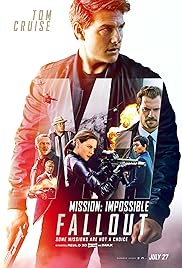
Film Review: MISSION: IMPOSSIBLE – FALLOUT (USA 2018) ***1/2

Mission: Impossible - Fallout Poster
Ethan Hunt and his IMF team, along with some familiar allies, race against time after a mission gone wrong.

Writers:

Christopher McQuarrieBruce Geller (television series)

The 6th instalment and touted last of the Mission Impossible franchise sees Tom Cruise reprise his role as IMF’s Ethan Hunt who went rogue in the last film and getting into more trouble in this one.  Christopher McQuarrie, a veteran of action picks as in MI: ROGUE, X-MEN, THE MUMMY and the two Tom Cruise JACK REACHER films, writes and directs FALLOUT, a non-stop series of action setups punctuated by a forgettable story line or one that does not really matter.  It thus plays like a James Bond movie, which is a good thing, as success at the box-office has proven.

Cruise is back, though looking more his age.  No nude or even upper body shots of the actor who is now 55 years of age, but still hunky-looking as a true action star.  He still has the chops.  His crew is back which includes Luther (Ving Rhames) and technical field agent, Benji Simon Pegg), the new IMP Secretary Hunley (Alec Baldwin) and new director of the CIA, Erica (Angela Bassett).  New to the cast is Superman Henry Cavill in the odd role of August Walker, a CIA agent who is initially on Ethan’s side then sanctioned to kill him.

When the film begins, an IMF mission ends badly and villain Solomon Lane (Sean Harris) escapes custody, the world is faced with dire consequences.  McQuarrie allows the villain 5 minutes to deliver his spill on terrorism, which is funny and somewhat logical in a twisted sort of way.  As Ethan Hunt takes it upon himself to fulfill his original briefing, the CIA begins to question his loyalty and his motives.  Hunt finds himself in a race against time, hunted by assassins and former allies while trying to prevent a global catastrophe.  Like most action films, the world needs saving, and just in the nick of time (James Bond in 007 seconds, Ethan Hunt in just one) by the film’s titular hero.

The skydiving sequence at the film’s start is a real nail-biter though this one is topped.  The fight scenes are violent, fast and well executed like the one in a club toilet.  The only credibility point is the few people in it.  At a typical packed club, the toilet is always full with customers lining up for the stalls, urinals, right up to its entrance.  There is a bike chase with Hunt on a motorcycle again, though not on a bright red Ducati as in MISSION IMPOSSIBLE 2.  This one has Hunt unable to start his bike, starting only in the nick of time when the cops show up, an excuse for another chase.  Just as one might think McQuarrie has run out of ideas, he comes up with one of the most inventive and exciting climax in an action film ever.  Though the film runs a lengthy 147 minutes, the extended action sequence with Hunt and Walker battling it out on a  perfectly smooth vertical rock face after their helicopters crash into each other is nothing short of amazing.  The sequence also shows how difficult it is to climb up a taut tight rope (to the helicopter).  Added to the thrills is suspense as Hunt has to retrieve a detonator as his team dismantle two bombs simultaneously.  It is an impossible task.  The film emphasizes this, but one has to remember that this is, after all, a Mission Impossible film. 

A solid actioner that should leave MI fans wanting for more.  Maybe one more really last MI film in the franchise.

Trailer: https://www.youtube.com/watch?v=wb49-oV0F78

Film Review: THE BLEEDING EDGE (USA 2018) ****

 Submit your Screenplay to the Festival TODAY

The Bleeding Edge Poster
Trailer

A look at the unforeseen consequences of advanced technological devices used in the medical field.

Director:

Kirby Dick


THE BLEEDING EDGE is a Netflix original documentary that premiered at the Tribeca Film Festival and will launch globally on Netflix this week. Co-written and directed by Kirby Dick, this is another of the docs that he specializes in – the expose doc.  In THE INVISIBLE WAR and THE HUNTING GROUND, he exposed the military and university campuses for female abuse.  His target this time around is the medical industry – narrowed down to medical devices.

The film begins with praises in the technological health care system.  From ultrasound before birth, to health testing of delivered babies to adults, devices have aided human beings in their health monitoring.  A talking head Jeanne Lenzer with the title on the screen ‘The danger Within Us’ adds her praise.  Those familiar with director Dick’s films, know that he is priming the audience to take the bait.  America has the most technologically advanced health care system in the world.  Dick bang-on reveals that medical interventions have become the third leading cause of death, and the overwhelming majority of high-risk implanted devices never require a single clinical trial.  With his producer/writer film partner Amy Ziering, they turn their sights on the $400 billion medical device industry, examining lax regulations, corporate cover-ups, and profit driven incentives that put patients at risk daily.  Weaving emotionally powerful stories of people whose lives have been irrevocably harmed, the film asks: what life-saving technologies may actually be killing us?  Dick covers the FDA, the government agency that approves medical devices and exposes the defect in the system.

Dick finally narrows down his film, systematically to a few targets – hip replacement devices and hence, the hip replacement companies; the metal tube inserted into the women by  the company ESSURE to prevent pregnancies.  His whistle blower is Dr. Stephen Towers who not only has a medical practice but a hip replacement.  After trashing his hotel room one day, a result of chrome poisoning (the metal was discovered in his blood after blood tests) from his medical devices in his hip poising his body including the brain, he gets the device removed only to miraculously discover all his previous pain and ailments disappeared.  The two main organizations targeted are Johnson and Johnson and the agency, the FDA.  

Essure is indicated for women who desire permanent birth control (female sterilization) by bilateral occlusion of the fallopian tubes.  Essure is currently no longer available in Canada.  It is still available in the United States.

The ultimate question asked is whether the risk of medical devices is worth the benefits reaped from them.  Dick’s answer is a clear no but leaves the audiences to make an educational decision given the relevant facts.

Kirby Dick and Amy Ziering have given audiences another disturbing but entertaining and cautionary winner.  The film ends with guidelines to follow for anyone considering medical implants.

Trailer: https://www.youtube.com/watch?v=slmilObZl28


 Submit your Screenplay to the Festival TODAY

Film Review: SHOCK AND AWE (USA 2017) ***

 Submit your Screenplay to the Festival TODAY

Shock and Awe Poster
Trailer

A group of journalists covering George Bush’s planned invasion of Iraq in 2003 are skeptical of the president’s claim that Saddam Hussein has “weapons of mass destruction.”

Director:

Rob Reiner


As the film title might imply, the fictionalized events of a true story is intended to shock and awe.   But the title of the film, SHOCK AND AWE (technically known as rapid dominance) is a military tactic based on the use of overwhelming power and spectacular displays of force to paralyze the enemy’s perception of the battlefield and destroy its will to fight.  This doctrine was applied by the United States in the Iraqi invasion

The film, based on a true story (that it proudly declares at the start of the film) is an account of the journalists investigating the assertions by the Bush Administration concerning Saddam Hussein’s alleged possession of weapons of mass destruction as an excuse for the 2003 invasion of Iraq.   Two determined reporters, Jonathan Landay (Woody Harrelson) and Warren Stroebel (James Marsden), their boss, John Walcott (Rob Reiner), and war correspondent, Joe Galloway (Tommy Lee Jones), lift the lid on abuse of power at its highest level and expose the truth about what led us into the longest and costliest war in American history.  

Written by Joey Hartstone and directed by Rob Reiner (A FEW GOOD MEN, LBJ, THE PRINCESS BRIDE), SHOCK AND AWE is unfortunately no ALL THE PRESIDENT’S MEN.  Part of the reason appears to be the writer and director’s over eagerness to please.  This means getting the blood of the audiences riling with anger at the injustices done to both the American people and Iraq.  The dialogue is always full of one-liners and punch ones with insults frequently thrown at the guilty (Donald Rumsfeld is called ‘looney tunes’) for the pleasure of the audience.  

But the script distracts with the female presence, no doubt put in to entice female audiences to see the film.  Warren’s romantic fling with neighbour, Lisa (Jessica Biel) leads nowhere as does Jonathan’s wife, Vlatka’s (Milla Jovovich) objections to the danger her husband might have got himself into.

In the words of Joe Galloway, When the government fucks up, the soldiers pay the price.  This is illustrated by the story of a black soldier put into the story.   Adam (Luke Tennie), has his spinal cord severed in an explosion just three hours after he landed in Iraq.  The incident is emphasized on the day Adam enlists to what he believes, in serving the country. His angry mother points out that he does not even know where Afghanistan and he wants to travel there to fight.  And worse still in a war that is lied about by the Bush Administration.  The film poses the question as to who is the most detestable U.S. President in history.   It would be a tough fight with George W. Bush as the frontrunner. 

Director Reiner gives himself, playing Journalist Night Ridder chief, John Walcott the best role and the best lines.  “Bossman got balls!”  Warren tells Jonathan at one point in the film.  And “We don’t write for people that send other people’s kids to war!” says Walcott angrily – another best line.

Reiner’s film achieves its purpose in whistle blowing the Bush Administration and with shock and disgust rather than awe.  In being more entertaining, the film loses a little of its dramatic effectiveness though audiences should not be complaining.

Trailer: https://www.youtube.com/watch?v=CVdHJuVydb4

 Submit your Screenplay to the Festival TODAY

Film Review: SCOTTY AND THE SECRET HISTORY OF HOLLYWOOD (USA 2018) ***

 Submit your Screenplay to the Festival TODAY

Scotty and the Secret History of Hollywood Poster
Trailer

2:30 | Trailer
A portrait of unsung Hollywood legend Scotty Bowers, whose bestselling memoir chronicled his decades spent as sexual procurer to the stars.

Director:

Matt Tyrnauer


Many have not heard of Scotty Bowers.  Who is this man and why is it that important for a whole documentary be devoted to him?

Director Matt Tyrnauer’s (VALENTINO: THE LAST EMPEROR) begins his doc with a grand introduction of Scotty Bowers.  He is celebrating his 90th birthday.  His rise to fame is attributed to the gas station he operated that served escorts to a host of Hollywood stars.  Everyone loves a scandal.  Stephen Fry interviewed admits:  “Scotty only made these Hollywood stars real by giving them what they want.”  But then a more valid argument is whether Scotty had the right to out anyone gay in Hollywood.  The doc then flashes dozens of gay stars on the screen to whet audiences appetite on the secret history of Hollywood.  Randolph Scott had an affair with Cary Grant and the list goes on….

It is fortunate that Scotty Bowers is till alive at the time of making the doc as he appears in most of the film, talking about himself and about what he has done as well as life in the old days.  The film contains a lot of black and white archive footage, especially of the area whee the infamous gas station stood.  When footage is unavailable, re-enactments are done, often without  faces but with the images of bodies.  For instance, when an escort is ivied from the gas station to bathe his beautiful body in the star’s swimming pool, the audience sees a nude body (no face) swimming in the pool.  In a way, the image looks even more erotic.

The goings-on, the audience are told are well planned and orchestrated.  In the business world, Scotty could have been the C.E.O.of General Motors, says a close friend.  The goings-on are indeed shocking, like a hill drilled in a wall in the nearby motel so that voyeurs can peep at the sex happening in the next room.  It all feels like a dirty red-light district given a make-over for the Hollywood stars.

Just when you think that the film will run out of material, something saucier comes around.  More famous star names are revealed, more intimate details of the sex parties revealed or secrets in the closet uncovered.  The restricted era of 1950’s is also highlighted in the film – a time where cops witched hunted gays in parks and bars.  And there is Scotty’s life that in itself is quite interesting.  Returning home from WWII as a pretty boy, he was gay before settling down into marriage with Lois, who hereof is interviewed in the film.  Their family home is also on display.  Scotty is revealed as a hoarder.  His house contains piles and piles of junk, such as every issue of Playboy Magazine

Scott claims to be the perfect host.  He says he provided an introduction service not a pimp service, emphasizing the fact that he never took any money for the  introductions.  The only money he made was at the parties as a bartender.

The film emphasizes that Scott’s philosophy on life was to make people happy as there is already so much unhappiness in the world.  But director Tyrnauer includes some sadness in Scotty’s life – the lost of his daughter, his friend Beach, his pet dog and the arrival of A.I.D.s.

Tyrnauer always inserts enough of the details to keep his film interesting – like the truth on Katherine Hepburn and Spencer Tracy.  His film ends up a good mix of the life of Scotty, his contribution to the secret History of Hollywood and revealing ‘Enquirer’ type material.

Trailer: https://www.youtube.com/watch?v=1qn6HxTJp0k


 Submit your Screenplay to the Festival TODAY

Film Review: UNDER THE TREE (Iceland/Denmark/Poland/Germany 2017) ***1/2

 Submit your Screenplay to the Festival TODAY

Under the Tree Poster
Clip

When Baldwin and Inga’s next door neighbours complain that a tree in their backyard casts a shadow over their sundeck, what starts off as a typical spat between neighbours in the suburbs unexpectedly and violently spirals out of control.

Writers:

Huldar Breiðfjörð (story and screenplay), Hafsteinn Gunnar Sigurðsson (screenplay)


UNDER THE TREE is a simple story that unfolds in all its unpredictability and horror.  It is trouble for two neighbours, something that many can relate to.  The shade from a front yard tree brings tensions to a boil for two families in an Icelandic suburb.  The husbands Baldvin (Edda Björgvinsdóttir) and Konrad (Þorsteinn Bachmann) have a small argument over trimming the big tree as Konrad’s wife, Eybjorg (Selma Björnsdóttir) likes to lie in the sun and does not want the shade from the tree.  But the wives argue.  The tires of  a car are slashed followed by rude gnomes ornaments placed in the front of the house.  Then when the cat goes missing, all hell breaks lose.  

Amidst the arguing, there is a subplot of the son, Atli (Steinþór Hróar Steinþórsson) losing custody of his daughter after cheating on his wife., Agnes (Lára Jóhanna Jónsdóttir).   

Director Sigurdsson knows how to up the angst, as evident at the film’s start, the wife catches the son watching porn.  “Is that you in the porn?”  she suddenly notices.  “Isn’t that Rakel in it with you in the porn?”  she asks again before kicking him out of the house and taking custody of their daughter.  Again this is an incident that many separated couple go through, fighting for custody.   Sigurdsson also keeps certain factors unknown to keep the audience guessing.  Did the neighbour really slash the tires?  Did the neighbour really put in the gnomes?  And where is that darn cat that has disappeared, though the final incident is revealed at the end of the film.

Sigurdsson keeps his film engaging from start to end by making his characters real, reacting and doing things that normal people all over the world might end up doing, when pushed to the limit.  

Of all the characters, Inga (Edda Björgvinsdóttir) seems the nastiest.  She seems to be director Edda Björgvinsdóttir’s favourite. Inga slings dog shit at Eybjorg, calls her a cow and even calls her son a loser when he cheats on his wife.  The wives inch their husbands, who seem more tolerant, on.

Besides the black comedy, the film also contains segments of dramatic tension, like in the ones where Atli abducts his daughter or when he abuses her at her workplace.

The film is shot in the suburbs of the Icelandic capital of Reykjavik.  These houses are modern looking, colourful, modest and too close to each other for comfort.   Trees and sun are scarce in Iceland so one can understand a neighbour not wanting the shade and the other not wanting his tree touched.

Edda Björgvinsdóttir’s film demonstrates the worst there is in human beings, creating a dark comedy at its blackest. His characters are unforgiving (Agnes cannot forgive Atli for cheating), vindictive (Agnes calls her cheating husband out as a masturbator of sex videos he indulges in, at a community meeting) and cowardly.

The ending comes with a good twist that leaves audiences satisfied that they have seen a really black comedy/drama.  The film dominated the Edda Awards (Icelandic equivalent of the Oscars) with seven wins, including best film, director, actor (Steinþór Hróar Steinþórsson), actress (Edda Björgvinsdóttir), supporting actor (Sigurður Sigurjónsson), screenplay and visual effects.

Trailer: https://www.youtube.com/watch?v=tU7KeDwJCAc


 Submit your Screenplay to the Festival TODAY

Film Review: UNFRIENDED: DARK WEB (USA 2018) ***

 Submit your Screenplay to the Festival TODAY

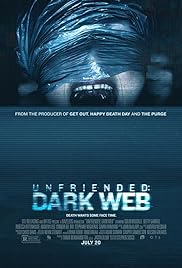
Unfriended: Dark Web Poster
Trailer

A teen comes into possession of a new laptop and soon discovers that the previous owner is not only watching him, but will also do anything to get it back.

Director:

Stephen Susco

Writer:

Stephen Susco


Writer/director Stephen Susco’s sequel to the laptop horror UNFRIENDED can hardly be called a sequel (note there is no number 2 tagged on to UNFRIENDED) as it is a stand-alone sequel with completely new characters and a totally fresh storyline.  The only similarity between the two films is that the films unfolds as if seen on a lap top.  So, expect to be watching a laptop screen for 90 minutes or so.  It is quite a torturous 90 minutes, which requires a lot of concentration to follow the story as one will be required to not only read the texts on screen but watch multiple goings-on as well as  group of friends communicate online via Skype.  UNFRIENDED: DARK WEB like the original UNFRIENDED is a clever novelty resulting in a tidy economically made film that caters to the new large target market of computer/lap tops users.  Who does not use a lap tip theses days?  The original film costs only $1 million to make and grossed more than $65 million.  Susco’s film, which contains a cast of unknowns teens took only a week to film.

The film opens with a user trying to get into a found lap top by trying different combinations of passwords.  Password, nope.  Password 123, nope.  After a dozen or so tries, ? works and Matias (Colin Woodell from UNSANE) gets into the used laptop.  He begins a game on Skype with his friends, computer-savvy Damon (Andrew Lees), Lexx (Savira Windyani), newly engaged couple Nari (Betty Gabriel from GET OUT) and Serena (Rebecca Rittenhouse) and Matias’ deaf girlfriend Amaya (Stephanie Nogueras). As the game night progresses, an intruder who calls himself Charon IV, begins sending messages to Matias, instructing him to return the laptop and keep his friends online.  The reason is that the lap top contains a list of crooked people as well as $10 million in crypto currency.  If he is unable to return the lap top, he will kill Amaya.

Despite the simple looking plot, the script is clever enough to include modern age technology like Skype, messaging, Bitcoin, Ethereum and other cryptocurrencies.  To those unfamiliar with computers, best advised be to avoid this film.  Political correctness in the film include having a lesbian couple in the story and a deaf character (played by Nogueras, herself a deaf actress).  Though UNFRIENDED: DARK WEB is a horror film, Susco’s horror film has neither blood or gore though the killing scenes are just as horrifying (pushing the victim on to a subway track upon an approaching train).

The film also contains two different endings.  Audiences will not know which cinema will be screen which ending and watching the film twice (the film is ok, but not really worth watching a second time) is still not guarantee of viewing both endings.  

It looks like Blumhouse has another low-budget horror winner.  How much money will this one make?

Trailer: https://www.youtube.com/watch?v=gM7N5u40KHk


 Submit your Screenplay to the Festival TODAY

Film Review: UNDER THE TREE (Iceland/Denmark/Poland/Germany 2017) ***1/2

 Submit your Screenplay to the Festival TODAY

Clip

When Baldwin and Inga’s next door neighbours complain that a tree in their backyard casts a shadow over their sundeck, what starts off as a typical spat between neighbours in the suburbs unexpectedly and violently spirals out of control.

Writers:

Huldar Breiðfjörð (story and screenplay), Hafsteinn Gunnar Sigurðsson (screenplay)


UNDER THE TREE is a simple story that unfolds in all its unpredictability and horror.  It is trouble for two neighbours, something that many can relate to.  The shade from a front yard tree brings tensions to a boil for two families in an Icelandic suburb.  The husbands Baldvin (Edda Björgvinsdóttir) and Konrad (Þorsteinn Bachmann) have a small argument over trimming the big tree as Konrad’s wife, Eybjorg (Selma Björnsdóttir) likes to lie in the sun and does not want the shade from the tree.  But the wives argue.  The tires of  a car are slashed followed by rude gnomes ornaments placed in the front of the house.  Then when the cat goes missing, all hell breaks lose.  

Amidst the arguing, there is a subplot of the son, Atli (Steinþór Hróar Steinþórsson) losing custody of his daughter after cheating on his wife., Agnes (Lára Jóhanna Jónsdóttir).   

Director Sigurdsson knows how to up the angst, as evident at the film’s start, the wife catches the son watching porn.  “Is that you in the porn?”  she suddenly notices.  “Isn’t that Rakel in it with you in the porn?”  she asks again before kicking him out of the house and taking custody of their daughter.  Again this is an incident that many separated couple go through, fighting for custody.   Sigurdsson also keeps certain factors unknown to keep the audience guessing.  Did the neighbour really slash the tires?  Did the neighbour really put in the gnomes?  And where is that darn cat that has disappeared, though the final incident is revealed at the end of the film.

Sigurdsson keeps his film engaging from start to end by making his characters real, reacting and doing things that normal people all over the world might end up doing, when pushed to the limit.  

Of all the characters, Inga (Edda Björgvinsdóttir) seems the nastiest.  She seems to be director Edda Björgvinsdóttir’s favourite. Inga slings dog shit at Eybjorg, calls her a cow and even calls her son a loser when he cheats on his wife.  The wives inch their husbands, who seem more tolerant, on.

Besides the black comedy, the film also contains segments of dramatic tension, like in the ones where Atli abducts his daughter or when he abuses her at her workplace.

The film is shot in the suburbs of the Icelandic capital of Reykjavik.  These houses are modern looking, colourful, modest and too close to each other for comfort.   Trees and sun are scarce in Iceland so one can understand a neighbour not wanting the shade and the other not wanting his tree touched.

Edda Björgvinsdóttir’s film demonstrates the worst there is in human beings, creating a dark comedy at its blackest. His characters are unforgiving (Agnes cannot forgive Atli for cheating), vindictive (Agnes calls her cheating husband out as a masturbator of sex videos he indulges in, at a community meeting) and cowardly.

The ending comes with a good twist that leaves audiences satisfied that they have seen a really black comedy/drama.  The film dominated the Edda Awards (Icelandic equivalent of the Oscars) with seven wins, including best film, director, actor (Steinþór Hróar Steinþórsson), actress (Edda Björgvinsdóttir), supporting actor (Sigurður Sigurjónsson), screenplay and visual effects.

Trailer: https://www.youtube.com/watch?v=tU7KeDwJCAc

 Submit your Screenplay to the Festival TODAY

Film Review: THE EQUALIZER 2 (USA 2018) ***

 Submit your Screenplay to the Festival TODAY

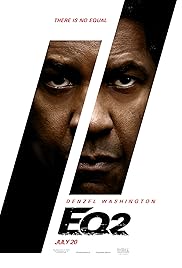
The Equalizer 2 Poster
Robert McCall serves an unflinching justice for the exploited and oppressed, but how far will he go when that is someone he loves?

Director:

Antoine Fuqua

Writers:

Richard WenkMichael Sloan (television series) |1 more credit »


Watch the TV series, the first film adaptation and then the sequel!  Denzel Washington returns as what has been touted as his first sequel, reprising the role as vigilant fighter for the people.

The lean and lazy plot involves EQUALIZER 2, Robert McCall (Washington) learning that one of his longtime friends, Susan Plummer (Melissa Leo, the best thing about the movie – watch her fight), has been murdered.  McCall decides to return to his old ways and seek out, find and punish the perpetrators.  In the mean time, he helps several Bostonians including a young black man who has the gift of painting, Miles (Ashton Sanders, from MOONLIGHT) and Fatimah (Sakina Jaffrey).  In the midst of all this, he pines over the loss of his wife.  He is still friends with his ex-partner, Dave York (Pedro Pascal), his pal and former partner in the CIA who turns out to be a and guy, quite early in the film.  Dave has a family and children, which the story totally neglects towards the end of the film.

Washington puts in his 2-cents worth as McCall even going over emotional in trying to lead Miles to turn over a brew leaf.  Veteran actor Bill Pullman is largely underused as Susan’s husband, targeted to be killed being a ‘loose end’.

The film has a few interesting points like the first appearance of Washington at the start of the film on a train in Turkey.   When the camera first offers the audience a glimpse of him, he is wearing an orange beard with a white cap and glasses looking like devout Muslim.  The scene is obviously milked for laughs. It is very funny, though I found self the only one in the theatre breaking into laughter.  Director Fuqua also inserts a few suspenseful scenes that deserves mention, like the one in which Miles is hiding in a panic room where there is a two-way glass separating the killer and Miles.

Impressive too, is the storm cinematography.  The film’s climax coinciding with a hurricane arriving in Boston by the sea where the fighters engage in the fight out in the open amidst strong winds and gushing sea water makes a welcome change.  This climax does remind one of the blowing tumbleweeds in the ending shoot out in THE MAGNIFICENT SEVEN, Fuqua’s last action movie.  Cinematography is by Oliver Wood ( who normally does work of this kind in action movies like the BOURNE series and DIE HARD, who first gained attention with his work using natural light to light up the 1969 cult movie THE HONEYMOON KILLERS).  One could argue that a hurricane in the climax might be distracting to the action, but one must give director Fuqua credit for trying something different.

There was a clash of times for the promo screening for EQUALIZER 2 and MAMMA MIA2.  I had picked EQUALIZER 2 as I hated MAMMA MIA one, especially having to watch Meryl Street jumping up and down the bed like an annoying teenager, not to mention hearing Pierce Brosnan sing.  The latter film has so far gotten positive reviews compared to EQUALIZER 2, likely for the reason of expectations.  One expect better and different from EQUALIZER 2 director of turning point films like TRAINING DAY.  EQUALIZER 2 is not that bad.  It is what one would expect from the action director – a generally slower moving actioner, with over quick fight edit sequences and lots of blood and gore.

Trailer: https://www.youtube.com/watch?v=HyNJ3UrGk_I


 Submit your Screenplay to the Festival TODAY

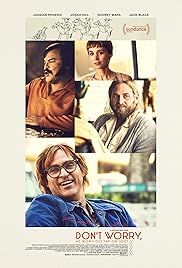
Film Review: DON’T WORRY, HE WON’T GET FAR ON FOOT (USA 2018) ***1/2

Submit your Screenplay to the Festival TODAY

Don't Worry, He Won't Get Far on Foot Poster
Trailer

On the rocky path to sobriety after a life-changing accident, John Callahan discovers the healing power of art, willing his injured hands into drawing hilarious, often controversial cartoons, which bring him a new lease on life.

Director:

Gus Van Sant

Writers:

John Callahan (based on the book by), John Callahan (story by) | 4 more credits »

DON’T WORRY HE WON’T GET FAR ON FOOT is a comedy-drama biography film based on the memoir of the same name by John Callahan.  Gus Van Sant (DRUGSTORE COWBOY, MY OWN PRIVATE IDAHO, GOOD WILL HUNTING, GERRY, ELEPHANT) wrote the screen adaptation and directed the film.  

When the film opens, John Callahan (Joaquin Phoenix) is addressing an audience after winning some award for his cartoons.  Callahan is in a wheelchair as a result of a car accident involving drinking.  But Callahan is still drinking though he is attending an AA group led by Donnie Hill (a totally unrecognizable Jonah Hill).

The film unfolds in non-chronological order, centring on Callahan before and after the accident, including his rise to fame with his cartoons.

DON’T WORRY will inevitably be compared to the French film, Julian Schnabel’s The Diving Bell and the Butterfly (French: Le Scaphandre et le Papillon), a 2007 biographical drama based on Jean-Dominique Bauby’s memoir of the same name, on a man’s disability and rehabilitation.  The film depicts Bauby’s life after suffering a massive stroke that left him with a condition known as locked-in syndrome. Bauby is played by Mathieu Amalric.  Bauby is totally conscious but unable to move all parts of his body but his left eye that he used to write the memoir.   The Diving Bell and the Butterfly won awards at the Cannes Film Festival, the Golden Globes, the BAFTAs, and the César Awards, and received four Academy Award nominations and is considered by critics as one of the best films of the decade.

DON’T WORRY never reaches the high standard hit by Le Scaphandre et le Papillon but goes towards a different direction, stressing more on the emotional than physical comeback.  Whether Callahan can have sex is one of the main conditions examined.  The main difference between the two films lie in the difference in the two main characters.  In the French film, Bauby was strong and fixed on recovery while in this film, Callahan is self destructive and wallows in self pity.  This is not helped by the fact that Callahan is still an alcoholic.

The film also considers the emotions that Callahan goes through right after the accident in the hospital.  Ironically the drunk driver, Dexter (Jack Black) that caused the accident walked away with only a few scratches.  Callahan met Dexter by chance at a bar and spent the night drinking heavily and driving.  The film fails to mention what happened to Dexter after the accident.  But Callahan asks key questions like: “Why is this happening to me?” – a question that is invariably asked by probably every person undergoing such a tragic accident.  Callahan also confesses to a worker, Annu (Rooney mara) that he promised God that he would do anything and or would make a pact with the devil to become normal again.   These key emotions differentiate DON’T WORRY from the French film.

Callahan’s birth as an artist only begins at the film’s one hour mark.  A few of the cartoons are revealed to the audience and to Callahan’s credit, they are quite funny –  a kind of THE FAR SIDE by a guy in a wheelchair.

Van Sant’s DON’T WORRY encompasses the best of his ‘lonely’ films like ELEPHANT and GERRY and ‘hidden talent’ films like GOOD WILL HUNTING, offering audiences gut wrenching insight in his soulful biography of a troubled human being.

Trailer: https://www.youtube.com/watch?v=2BwxeOzSx8A


Submit your Screenplay to the Festival TODAY