I was fortunate to get an interview with the very talented and very busy Production Designer Beth Mickle. She is currently in the middle of production on the highly anticipated film “Collateral Beauty”. We talked about that film and much more in our chat together:
Matthew Toffolo: You have been the Production Designer on over 30 films in the last 15 years. Is there a film or two that you’re most proud of?
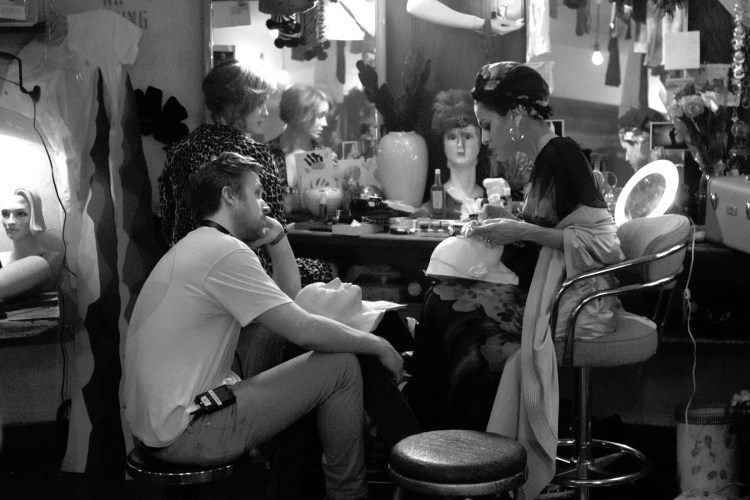
Beth Mickle: I’m incredibly proud of so many films that I’ve been involved with—fortunate to have had so many great opportunities! One that I’m especially proud of is “Lost River”, Ryan Gosling’s directorial debut. It was such a special project from the very beginning—Ryan wrote such a beautiful script with so much imagination, so many fantastical backdrops to play with. It was a smaller movie, and we all lived and worked together in downtown Detroit, collaborated closely to really shape that film as a team. I remember many adventurous weekends with Ryan and our cinematographer Benoit Debis, exploring the many awesome hidden areas of that great city. With limited resources, everyone jumped and got their hands dirty, and we built so many elements out of cardboard, tape, late-night pizza, and music…so proud of how every one of those sets came together, and the tone we found in that film. It’s one of my favorite films of all time!!!
PHOTO: Ryan Gosling, Eva Mendes & Christina Hendricks on set in “Lost River”:
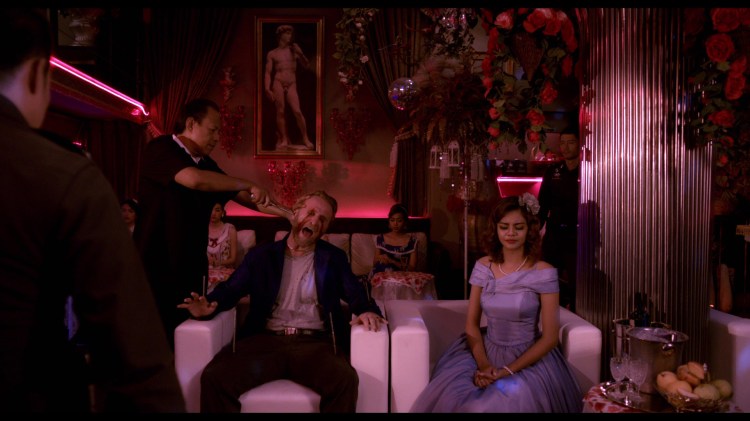
The other film I’m wildly proud of is “Only God Forgives”, which Nic Refn directed and Ryan starred in. This was another lower-budget film, this one in Bangkok, where we all lived and worked together very closely once again. Exploring every neighborhood in Bangkok was a complete joy for a gal who loves to travel as much as I do, and Nic gave me so much creative freedom with that film. My fiance Russell Barnes (an incredibly talented Production Designer) joined me on the project as the art director, and we had the most memorable 7 months together in Thailand. the lower-budget nature of the production meant that we did a lot of the heavy lifting along with our amazing Thai crew—building, painting, and decorating sets with our own hands. And the markets were phenomenal!! We ran around to tons of different vintage markets and flea markets every week, loading the trucks with so many beautiful and unique pieces. Bringing together these rich, vividly stylized sets in this unbelievable country where we were living was such an unforgettable time in our lives.
PHOTO: Set Design on “Only God Forgives”
MT: You started your career working on lower budget/Indy films as a Production Designer. Would you suggest other people who are striving to become Production Designers in this industry take this route? What are the pros/cons of taking this route in comparison to starting on the low rung and working on Union productions?
BM: I would absolutely recommend this route for aspiring production designers. The lower budget world is where you learn to be resourceful, where you can somewhat safely make mistakes which can be recovered, where you learn the complete fundamentals of how a film is made. I try to approach every production—large or small–with a calm nature, and I think that comes from being in the trenches for so many years and learning how to adapt to in all situations. The biggest con to this route is that formal “union” filmmaking can be a bit jarring when you do finally make the leap to the larger arena—but once you learn those nuances, the process really smooths out. That is definitely one pro if you do start in the larger union world—you learn those protocols right away, so you enter the film world knowing how union positions are categorized and how the different departmental responsibilities are broken down.
In terms of career growth—I also think designers can make that mental shift of thinking on a smaller scale early in their careers on smaller films, to thinking on a larger scale as projects grow in size. But I think it’s much more difficult for designers to start with thinking on a larger scale, then downsizing their approach and expectations on a smaller project. And as we’ve seen so much lately—some of the highest quality films being made right now are the smaller, independent projects (“Ex Machina”, “12 Years a Slave” to name a few), and if a designer catapults you to doing an $80 million film as his or her first film, downshifting to this smaller budget range can prove to be a difficult maneuver.
MT: What is the biggest difference when working on an Independent film in comparison to a Hollywood Union Production?
BM: Union rules and guidelines!!! On an independent film, everyone is moving and touching and painting everything…on a union film, none of that flies. this took me forever to learn!!!! I’m always eager to grab the other side of a couch, to rehang picture frames on my own, always telling the set dressers “this is how i keep my muscles!!”…some laugh and some are not amused at all:)…At first I resisted the union delineations, preferring the all-hands-on-deck team approach, but after doing over 20 union films, and seeing that crews are treated so fairly and safety is so championed, I do see the benefits of having a regulated system. Film productions are such incredible, finely-tuned organisms that function so efficiently….though I’d still paint walls if they’d ask me!..:)
MT: Some will argue that DRIVE is one of the best films in the last 10 years. Do you remember the initial conversations with the director and your team about the overall look, feel, and tone of the film?
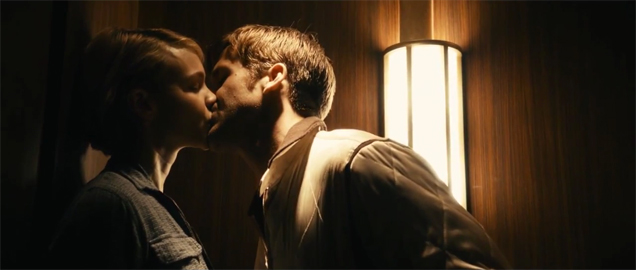
BM: “Drive” is a film is very near and dear to me. It made my career the incredible adventure that it is right now. I remember my initial meetings with Nic Refn well. I think he’s one of the most brilliant directors working today, and seeing how he approaches filmmaking is nothing less than inspiring. He’s constantly striving to shoot scenes in ways they’ve never been shot before, to make every frame as great as it can be. And his mandate is always “more is more.” So for a designer, taking this approach is a dream…every set can be as elevated and amplified as you want it to be. Every color can be as rich as possible, the idea of “extreme” is always embraced. so making “Drive”—as well as Nic’s following movie “Only God Forgives”—were a career highlight for me.
PHOTO: Ryan Gosling and Carey Mulligan in “Drive”:
MT: Whiskey Tango Foxtrot is out in theaters. What can people expect to see? How were your experiences working on that film? A lot of exterior scenes.
BM: “WTF” was another fascinating project to do. All but 4 minutes of the film takes place in Afghanistan, and we shot the entire film in New Mexico!!! It was by far the most challenging film I’ve ever done, but I was lucky enough to be working alongside the best art department I’ve ever had. We built 2 Kabul city street sets—both nearly a football field in size, and both almost built from scratch. Building so much scenery was such a great challenge on a relatively small studio film—we reused so many facades, repurposed so much architecture, repainted so many pieces….at first it seemed nearly impossible to pull off the tall order, but once we started improvising and playing around, the possibilities really became endless. Anthony Syracuse was our construction coordinator on that film, and I’m certain that he’s one of the best construction coordinators this industry has ever seen.
 Festival Reviews