TELEVISION FEEDBACK Screenplay Festival – Deadline Today 

All entries receive FULL Feedback from our team of industry professionals.

TV SCREENPLAY FESTIVAL takes place every single month. At least 4-15 winning screenplays. Winners get their script performed by professional actors and then made into a promotional best scene video (see examples on the submission page). Submit via the site or via FilmFreeway.

https://filmfreeway.com/TELEVISIONFEEDBACKScreenplayWebSeriesFestival

This festival has a guaranteed 4-tier set up for each accepted script. (No matter what, all screenplays submitted receive FULL FEEDBACK on their work.)

1st Tier: FULL FEEDBACK on your screenplay (all submissions)

2nd Tier: Accepted scripts (25% on average of submitted entries) get a best scene of their screenplay performed by professional actors and made into a promotional video.

3rd Tier: We will send you a list of questions to answer for our blog interview that will promote you and your film.

4th Tier: Then we will set up a podcast interview on our popular ITunes show where will we will promote the winning writer and script.

(BONUS: 5th Tier. A winning screenwriter’s WhatsApp group has just been formed. Over 50 writers to date. Great way to share ideas and contacts with people in the industry.)

You can also take advantage of the Best Scene Screening Video Reading Deal:
https://tvfestival.org/best-scene-screenplay-deal/

What this festival does is give the writer exposure. With our best scene video reading, plus the 2 interviews, this festival simply makes the screenwriter’s name and script searchable and out there to the world. Plus, submissions receive full feedback on their script no matter what.

TELEVISION FEEDBACK Screenplay & Web Series Festival – Deadline Today

TV SCREENPLAY FESTIVAL takes place every single month. At least 4-15 winning screenplays read monthly.

https://filmfreeway.com/TELEVISIONFEEDBACKScreenplayWebSeriesFestival

This festival has a guaranteed 4 tier set up for each accepted script. (No matter what all screenplays submitted receive FULL FEEDBACK on their work by industry professionals.)

Submit via the site or via FilmFreeway.

1st Tier: FULL FEEDBACK on your screenplay (all submissions)

2nd Tier: Accepted scripts (25% on average of submitted entries) get a best scene of their screenplay performed by professional actors and made into a promotional vehicle.

Then (Tier #3) we will send you a list of questions to answer for our blog interview that will promote you and your film. Then after that (Tier #4) we will set up a podcast interview on our popular ITunes show where will we chat with you about the process of how the film was made.

You can also take advantage of the Best Scene Screening Video Reading Deal:

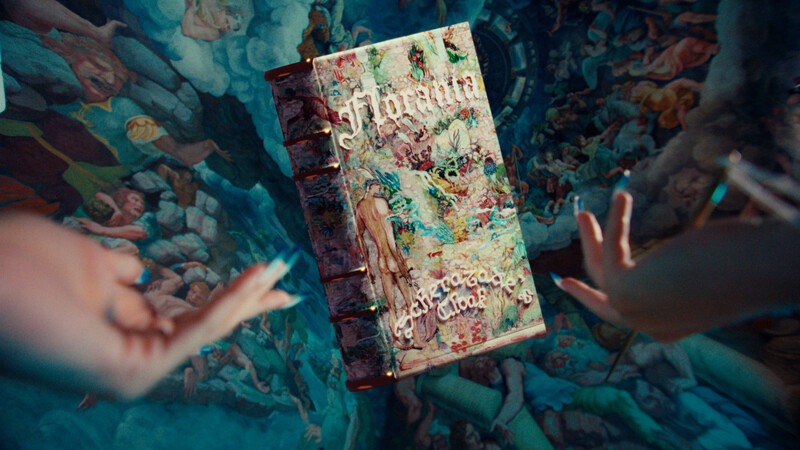
Short Film Review: Scherazade’s Clock, Italian Fashion Film

Synopsis:

A prince called Kalendar falls in love with a prostitute, Scherazade, who’s under the protection of an evil witch. Thanks to his friends and the help of a goddess, he frees Scherazade.

Review by Parker Jesse Chase:

Michele Stella’s “Scherazade’s Cloak” is an enchanting journey into a world of love, dreams, and the magical threads binding them together. Set against this extravagant backdrop of biblical and mystical folklore elements, the film tells the story of Prince Kalendar’s love for Scherazade, a prostitute protected by an evil witch, and the extraordinary lengths he goes to free them with the help of his brothers and a goddess.


The film begins by inviting the audience to gaze up into the clouds, as if we’re at heaven’s gates, leading us into the realm of dreams. The narrative unfolds in acts like a dream within a dream, with Kalendar as the bringer of feast and the swan, tied to Scherazade by a magnificent cloak. The importance of friendship and familial bonds encourages viewers to see one another as family, with statements like “Let’s feel like brothers.” adds definitive layers to the visual experience.


The destruction of the cloak becomes a pivotal moment, but the dream aids the brave, and with the help of a gifted sewing needle, Kalendar and his friends craft a new cloak for Scherazade. The film beautifully explores the ephemeral nature of dreams, suggesting these fantastical elements “never were but always are.”


The film’s execution is beautiful and artistically compelling. The cinematography seamlessly blends individuals into the lens, creating a visual tapestry becoming a part of the art itself. The production design, reminiscent of the Sistine Chapel, enhances the visual storytelling experience, with page master elements coming to life in the surrounding paintings. The costume design, hair and makeup, and production design collectively build a believable world in which effortlessly transports the audience into the heart of the story.

The narrator, with an expressive dialect, skillfully captures and allures the audience deeper into the unfolding narrative. Despite the witch’s opposition, viewers find themselves emotionally invested in the couple’s journey, especially as the torn cloak becomes a symbol of rebellion and resilience.


“Scherazade’s Cloak” is a visually stunning short in which captivates with its embellished cinematography and expressive storytelling. The film successfully marries its artistic freedoms with classical storytelling elements, resulting in an overall visually enchanting experience.

Project Links

Inside the Chaos: Cinema writing 101- 5 Things About Overwriting

overwriting.jpg
Everyone who has ever put fingers to keys on a computer with the attempt to write a cinematic piece has probably had to deal with overwriting. Everyone has overwritten something and it’s nothing to be ashamed about- as long as you know how to correct it.  But in this reviewer’s’ time as a script coverage provider, it is surprising how much, (and how easily) overwriting happens. Below are five things about overwriting you might want to refresh on for your next revision.

  • YOU DON’T DIRECT YOUR STORY


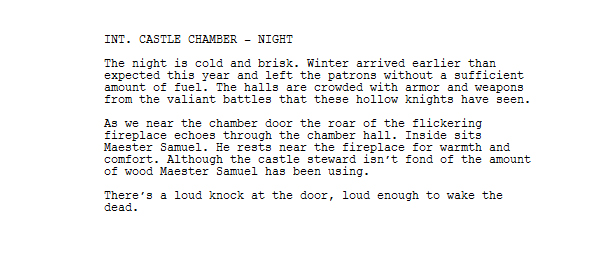
Writing is often considered to be playing God to a very tiny universe. In novels, this is certainly true. Collaboration pieces, where many hands touch the work before it is seen by the eyes of the masses, such as stage plays or screenplays, have a slightly different approach. Specifically for Screen writing, the script provides dialogue, setting and action- the combination of which creates story. But it is important to understand the parameters of that confine: you don’t direct the piece.

BASIC RULE: In cinematic writing, you want to avoid overt descriptions of the way a character moves, delivers or reacts to their lines, their micro expressions or mannerisms, or excessive details of their minute actions.


EXAMPLE: It is established that Character X always rings their hands when they lie. They are lying in this scene and Character Y needs to find out. Then you can write “Character X rings their hands. Character Y sees.”


EXCEPTION: If a scene or line is otherwise ambiguous and clarity can only be reached with a direction, or that direction is crucial to understanding the context of the scene.

 WSB1.jpg

  1.  DON’T TELL US WHAT WE DO NOT NEED TO KNOW

Sixteen years earlier the mother of Character A and the Father of Character B had an affair, but no one knows or will ever find out and it’s all water under the bridge now. Characters 1, 2, 3, 4 and 6 are staying at the Bed and Breakfast once owned by character 3’s great-great-grandmother whose husband fought in the war.  The details that make your characters rich, robust histories might be incredibly satisfying to read about in a novel, where we have hundreds of pages to bring out full deep back stories and elaborate web. But Cinema has time constraints. Constraints on the reader, and constraints on the audience. Stick to the story that is relevant.


BASIC RULE: If it’s not going to show up directly in the story, then we don’t need to know.


EXAMPLE: If it’s important, have a character make reference to it. If it’s not important enough to waste a line of dialogue on, or if the plot is not directly entangled in it, don’t bother putting it in.


EXCEPTION: Historical pieces, where details about characters’ based on real life people may, in fact, be needed. Consider adding them into a director’s’ note at the end of the piece instead of building them into a scene.


  1. BE CONCISE WITH YOUR ACTION

It is absolutely okay to reference that action in your scene, but you must say it plainly and to the point. Elongating the piece by over explaining the work only hurt the piece in the long run.


BASIC RULE: The Best Cinematic writing will create the clearest and most vivid images necessary, with as few words as possible.


EXAMPLE: Character X punches Character A in the face. Character A falls hits the floor. Their nose is broken and bleeds profusely. OR: Character X punches Character A. A crashes to the floor, smashed nose bleeding, instantly plastering in blood.


EXCEPTION: It is not unheard of to see the occasional flowery sentence in the scene description. Use the greatest discretion with these; one per page is often enough. If you use a more flowery or poetic line in your work, make sure it draws together the scene clearly and purposefully.
showdonttell.jpg

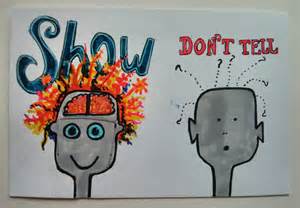
  1. SHOW, DON’T TELL, and TRUST YOUR AUDIENCE

Anyone who has ever had to write an essay gets caught up in over explaining ourselves in order to make ourselves perfectly clear…and fill up those huge required word counts. But you want to disregard that training in cinematic writing. Utilize the power of suggestion and trust your audience is smart enough to pick up the clues. Don’t have Character 1 tell his buddies he’s going out on the town to cheat on his wife. SHOW Character 1 ignoring his wife’s calls, removing his wedding band and offering to buy a girl at a bar a drink.


BASIC RULE: Consider how’d you get this information across visually- then describe exactly what you see.


EXAMPLE: (After slug line establishes Character is at the Bar) Character 1 removes his wedding band, puts it in his pocket. Gestures for two drinks from the bar tender. Sees a call from his wife. Ignores it.


EXCEPTION: “On-the-nose” Lines, or lines that are overtly obvious, can be very impactful and incredibly useful WHEN USED SPARINGLY. Like, once an entire piece kind of sparingly. For an example, check out TV shows like BOJACK HORSEMAN. This show employs excellent and tactful use of on-the-nose lines. They are always emotionally compelling because they are done strategically and with exceptional care.

trust.jpg

  1. REMEMBER- OVERWRITING HURTS YOUR PIECE


Overwriting can hurt your work. Excessive or unnecessary details can weigh down the action of your script, making your piece read heavy and slow. The quicker your story starts into the action and more fluidly (and clearly) that action moves, the stronger your piece will read.


BASIC RULE: Be clear, quick and efficient. Show, don’t tell.


EXAMPLE: *Taken from Graeme Manson’s Pilot script of Orphan Black.

Shower running.  Sarah undresses.  Beneath the clothes, bruises hint at a rough exit from her life with Vic.


EXCEPTION:  Historical, fantasy and Science-Fiction may require a slightly full description to establish world building.


Writing is a craft, and art and an on-going process. First drafts will always be rough and ideas will always need polishing. The clearer and quicker you can be, the better your work will read.

 

Writer’s confessions: 4 Struggles of the Part-Time Writer and 4 Solutions

by Kierston Drier

Anyone here a professional or aspiring-to-be professional writer? Regardless of your level of success, professional writer is likely working contract or freelance. An aspiring writer is likely writing on weekends in order to polish their work and get it noticed. Sound familiar? What do both of these people have in common? Both of them are probably writing in their down time- one to hone their skills and one to stay sharp.

Here are five common problems of the weekend writer, and 5 ways to fix them.

PROBLEM: Motivation.

Whether you just finished your last paid script or you’ve spent the last two
years at a 9-5 job, motivation (or lack thereof) affects us all. You may be too tired to write, you may have a hard time thinking of new ideas. You may just have low moral thinking about how difficult the industry can be.

solution.jpgSOLUTION: Remember What You Love.

Remind yourself why you started doing this in the first place. Remind yourself why you love writing, and what stories you want to tell. Go back through your work and read the pieces you are most proud of. This is your passion, and you have it in you to follow it.

Also remember: it is okay to take a night off. But don’t let a night off slip into two months off.

time.jpg2. PROBLEM: Time

We hate to overuse the reason, but it is true. Time constraints affect us all. Between work, our homes, our partners, our family responsibilities- some of us also juggle school or parenthood in the mix of that, our weekends are shorter than they use to be and our work days longer than ever before. When do you find the time?

SOLUTION: Rethink Your Time.

No. I’m going to say “Make time.” Everyone hears that. But frankly, unless you want to forgo sleep, “making time” can be as impossible and squeezing a wall clock to get extra minutes out of it. So rethink the time you have.

Working a 60 hour week? Jot down your plots, characters and ideas during your commute. Evenings loaded down with chores and various time-sucking responsibilities? Text yourself the joke you just thought, and use it for future reference.

Weekends loaded with social plans? Call your writers friends and turn your next night out into a writer’s night in- Make cocktails and bring your latest spec idea to the table- get feedback on it from the people who love you and share your passion.

Discouragement.jpg3. PROBLEM: Discouragement

Someone two years younger than you is already in a writers’ room. You career rudderless, financially treading water while other people seem to get what they want so easily. The story you’ve been working on just got made, and now you’re idea is worthless. It’s hard to stay upbeat when discouragement hits you.

SOLUTION: Reassess Your Goals.

Remember that success is not a party at the end of a long night. Success in the film and television industry is often more like a wheel that is forever rotating. Someone at the top today may not be tomorrow. Persistence, humility and hard work will take your farther than creeping someone else’s success ever will. Forget what other people are doing, and just do you.

Maybe it is something else getting you down? Maybe you’ve been nurturing a screenplay based on a historical figure, and just found out that same movie is coming out? Take some time to grieve, but then remember that you are not a one trick pony. If you want to tell stories for a living, remember that cranking out ideas is a part of that process. Find your passion for the next story you want to tell.

take risks4. PROBLEM: INSPIRATION
Okay, I have the time, the attitude, and the motivation- why don’t I have any ideas?!?!?! Someone tell me how to jumpstart my creativity!!

SOLUTION: GO OUT AND DO STUFF.

Great question, glad you asked. How do you jumpstart your inspiration for a piece? We often under-estimate that writing is very inclusive solitary work that frequently hauls us up in our rooms locked away from the world for hours at a time. How do you fix that? GO OUTSIDE.

If the best writing comes from real life, then writers must be students of life. It may seem counter-intuitive that in order to be a better writer you should…ahem…stop writing for a bit. Yet, this is a strategic choice. Go outside, meet people, do things, watch your favorite movies and TV shows with friends and family and talk about them. Go to mixers, go to film screenings, go to film festivals. Talk about the things you do and listen to other people. Ideas happen when life happens. So live your life, and ideas will follow.

Happy Birthday: Tracy Letts

tracylettsHappy Birthday actor/writer Tracy Letts

Born: July 4, 1965 in Tulsa, Oklahoma, USA

[re August: Osage County (2013)]I know that there’s another dimension in the film that is not in the play, and that’s Osage County. I would take them [filmmakers] to my home and show them the landscape, that’s kind of profound for me as a guy who not only has written a play, but written a play that’s somewhat autobiographical. The landscape itself becomes a character.


HOMELAND REVIEWS of EVERY EPISODE
Watch video reviews of every single episode.
TV POSTERHOMELAND
Best of the series. Over 100 pages of pics, reviews, bios.

TV POSTERHOMELAND SEASON 3
2013
Best of the series
Best of PRISON BREAK
over 100 pages of the hit show!