Movie Review: BATMAN V SUPERMAN (2016) #BatmanvSuperman

Deadlines to Submit your Screenplay, Novel, Story, or Poem to the festival: http://www.wildsound.ca

batmansupermanBATMAN V SUPERMAN: DAWN OF JUSTICE (USA 2016)

Directed by Zack Snyder

Starring: Ben Affleck, Henry Cavill, Amy Adams, Jesse Eisenberg, Diane Lane, Laurence Fishburne, Holly Hunter, Jeremy Irons, Gal Gadot

Review by Gilbert Seah

Before the film starts at the press/promo screening of BATMAN V Superman, director Zack Snyder appears on screen practically begging the audience not to give away plot points and spoilers to the rest of the world in order for them to enjoy the film. True to word, there are a lot of spoilers that could be revealed but this latest multi-million dollar effort is so bad that no spoiler could have made the film any worse.

Snyder makes no qualms at reminding the audience that he directed the Spartan film 300. At the film start, after Bruce Wayne rushes into the dust from the rumble of a fallen skyscraper, a lone horse is seen on the screen. 3/4 through of the movie, a cop and a horse is again shown on the screen. Of course lots of muscled bodies like the Spartans in 300 are on display throughout the film.

One can tell that a movie is bad from its continuity. The car chase segment makes no sense whatsoever. The reason for the chase is zero. When it takes place, there are lots of overturned other vehicles, lots of explosions but the scenes could have be taken out of 4 different streets for all that matters. The editing is awful and continuity is non-existent.

At the promo/press screening the executive introducing the film touted the imax technology involved in the making of the film. 40% more images can be seen in the imax version. But in the in the imax version that I saw, only the last sequence and the Batman Superman fight was in full imax top to bottom presentation.

There is little to enjoy in this film – the main problem being that the film is all over the place and all the filmmakers seem more content with the special effects. Comic book fans will be flabbergasted at the way the filmmakers have taken liberties to change what fans deem unchangeable and a staple to the comic book fan base. The main premise for example, would be that if ever anyone would want to see Superman fight Batman? And who would care which one would win? A true comic book fan would cringe every time anyone of the heroes, Superman or Batman was hurt.

The plot of the film involves Superman and Batman questioning each others tactics in order to save the world. The reasons are superfluous and unconvincing. All this leads to a confrontation and fight at the film’s climax.

BATMAN V SUPERMAN is a very dark film no doubt. So was the recent DEADPOOL. But DEADPOOL was smart enough to be funny and tongue-in-cheek while the latter took itself far too seriously.

And there is the question of the villain and a few other loose ends. Jesse Eisenberg’s Lex Luthor is an odd one. Eisenberg seems to have sculptured his role from Heath Ledger’s edgy Joker before his death. Esisenberg does what he does best – speaking his lines at a thousand words per minute but in this film, with creepy twitchings. It is not what is expected from classic Lex Luthor. Eisenberg dons his long hair till shaved off bald when in prison. Aquaman and Wonder Woman make their appearances but for no real reason. It seem a total farce and they should have been better totally omitted from the script.

In one segment of the film, a character says that people hate what they do not understand, referring to the suspicion they have of Superman being an alien doing good but causing destruction of the planet. Audiences might hate this film for it is impossible to understand for its purpose or plot.

*****

Also, Free logline submissions. The Writing Festival network averages over 95,000 unique visitors a day.
Great way to get your story out: http://www.wildsound.ca/logline.html

Deadlines to Submit your Screenplay, Novel, Story, or Poem to the festival:http://www.wildsound.ca

Watch recent Writing Festival Videos. At least 15 winning videos a month: http://www.wildsoundfestival.com

National Puppy Day. Best of the Twitter #NationalPuppyDay

Best posts on twitter today for #NationalPuppyDay

FilmFreeway Founder Zachary Jones – 2 Year Anniversary Interview

matthewtoffolo's avatarMatthew Toffolo's Summary

FilmFreeway has taken the film industry by storm since this indy startup launched 2 years ago. It is now the #1 platform in the world for filmmakers to submit their films and screenplays to festivals, trumping Withoutabox, which is owned and operated by the billion $ corporation Amazon. It’s quite an achievement. And they have succeeded by doing the right thing, and with integrity.

filmfreewaylogoI recently sat down again with the founder of FilmFreeway, Zachary Jones:

Matthew Toffolo: Last time we spoke was a little over 16 months ago in late November 2014. You were then at 1200 festivals signed up. How many festivals do you now have signed up today? How many filmmakers/screenwriters?

Zachary Jones: Wow, that’s incredible to think that less than a year and a half ago we had just crossed the 1,000 mark. Now here we are just after our 2 year anniversary and we’re approaching…

View original post 978 more words

Interview with Festival Director Todd Looby (BendFilm Festival)

13th Annual BendFilm Festival : October 6th – 9th, 2016

BendFilm celebrates the brave voice of independent cinema through films, lectures and education. A constant member on Movie Magazine’s 50 Fests worth the entry fee.

http://www.bendfilm.org/

Interview with Todd Looby:

Matthew Toffolo: What is your Film Festival succeeding at doing for filmmakers?

Todd Looby: We provide a platform for underrepresented / under-appreciated filmmakers. We want to help them build their careers. Our feature filmmakers are now receiving travel stipends to encourage attendance. We also provide lodging for all filmmakers. We want our filmmakers to spend their money on their films and not on plane tickets. We also want to provide an atmosphere where our filmmakers can network with each other and the public to encourage future collaborations. We also offer $8,500 in cash awards (including $5,000 for Best in Show) and a $60,000 Panavision Camera Package.

MT: What would you expect to experience if you attend the festival this year (2016)?

TL: If you’ve been to BendFilm before, you’ll expect to see our best addition yet. We just brought on Erik Jambor as programmer. He has 17 years experience Directing some of the best Fests out there: Sidewalk Moving Pictures, IndieMemphis and even a short stint at BendFilm in 2007. Erik is already putting together a program that will give everybody something to see and hold on to. And, of course…since we are serious about “Celebrating” independent Film, our parties and events will not disappoint!

MT: What are the qualifications for the selected films?

TL: We typically prefer Oregon premieres, but we often screen films that will have played at Ashland or Portland. What we really look for are the diamonds in the rough – again, films that have been underappreciated or we predict will be so. We want to see someone do the impossible. An example is a film that just shouldn’t work on paper and when you actually see what the director, actors and crew were able to do with nothing, you walk out amazed.

MT: Do you think that some films really don’t get a fair shake from film festivals? And if so, why?

TL: Yes. I think some festivals rely too much on where the films have played previously. We want to be a discovery fest and that fits well with Erik’s philosophy as well. Of course, we also program more popular films, but we want to give the smaller films the same amount of exposure and better chances to win our cash awards.

MT: What motivates you and your team to do this festival?

TL: We’re motivated by our belief in the power of film to change lives and improve our community. Bend is relatively isolated in the middle of Oregon. Though a popular destination, our community doesn’t get regular access to working artists. We also only have one small arthouse in town. Our fest provides access to films that wouldn’t otherwise screen in Bend and also provides access to the artists that make these films. Independent Films are more conversation starters than the Hollywood fare. Our community and visitors learn more about hot-button issues and the outside world. Independent films also have higher minority and women representation. We are introducing our community and visitors to different points of view they do not see in mainstream films or media.

MT: How has the festival changed since its inception?

TL: We do a lot of things the same as we’ve always done. However, Bend is changing fast and we are keeping up with the changes and expanding exponentially. In 2015, we received 3x the amount of submissions we did in 2014. This year we expect more. We are doing many more screenings and events throughout the year. We are also expanding our education programs.

MT: Where do you see the festival by 2020?

TL: I think BendFilm has the potential to be a leader in the independent film festival industry. This town can’t be beat. I’m relatively new here and still awed by it’s natural beauty and laid-back feel. Though as a filmmaker I never screened here, the minute I came I had an inking of what a filmmaker sees when coming here for the first time. They’re in awe. Our feedback each year gets better and better. As we improve our programming and national exposure, I think even more and more people will come here for the fest. It’s simply the perfect place to host a festival like ours.

MT: What film have you seen the most times in your life?

TL: Probably “Midnight Run”. Our family finally got cable in 1989 and I was introduced to so many films I hadn’t seen before, but “Midnight Run” sticks with me (though it’s been awhile since I’ve seen it). There was a time when I knew it by heart. It’s my perfect kind of film: It’s hilarious, it has incredible heart, it has a great moral compass and it can change tone at the drop of a hat. It’s really one of the more underappreciated films in existence. I also think it was either that or Untouchables that introduced me to DeNiro and, thus, the other movies I’ve watched most are DeNiro films: Goodfellas, Mean Streets, Raging Bull, Deer Hunter, etc, etc.

MT: In one sentence, what makes a great film?

TL: My compass for a great film is simply that elicits a strong emotional response – whether it’s laughter, tears, genuine shock or deep thought (which I consider emotive). I see too many films these days that are languid. I understand that filmmakers want to get away from the action and plot-driven Hollywood fare, but I think they also sacrifice the need to emotionally connect with an audience. Great filmmakers are able to make character-driven films that are artful, heady, yet engaging and accessible.

MT: How is the film scene in your city?

TL: Our community has a deep appreciation of cinema. This fest is really a community-driven event. It’s so well supported locally. And as far as filmmakers, more and more move here each year. They may fly out to shoot, but the more they’re here, the more local filmmaking will increase. At BendFilm, we’re trying to coalesce everyone together at least quarterly to network and develop collaborations. We also have a great relationship with Tim Williams at the Oregon Film Office. A former BendFilm Director, Sandy Henderson, is also opening up a Central Oregon Film Office to increase local filmmaking.

____

Interviewer Matthew Toffolo is currently the CEO of the WILDsound FEEDBACK Film & Writing Festival. The festival that showcases 10-20 screenplay and story readings performed by professional actors every month. And the FEEDBACK Monthly Festival held in downtown Toronto on the last Thursday of every single month. Go tohttp://www.wildsound.ca for more information and to submit your work to the festival.

Interview with Festival Coordinator Emily Smith Beitiks (Superfest: International Disability Film Festival)

Superfest: International Disability Film Festival is a showcase of juried films held in the San Francisco Bay Area. For nearly 30 years, this annual competition has celebrated cutting-edge cinema that portrays disability in all its diverse, complex, and empowering facets. We are proud to be the longest running disability film festival in the world.

http://www.superfestfilm.com/

Interview with Emily Smith Beitiks:

Matthew Toffolo: What is your Film Festival succeeding at doing for filmmakers?

Emily Smith Beitiks: Superfest provides an opportunity for filmmakers to tell stories about disability that are more nuanced and complex than what we typically see in Hollywood, unfortunately. We celebrate the work of filmmakers with disability and explore how the insights of living with a disability enrich their work. In addition, we work closely with our filmmakers to help them get their films audio described and captioned. Even though the films are about disability, many filmmakers have never considered the importance of making films accessible to people with disabilities. We coach them on how they can go about this, as it is a mandatory requirement for all films that screen at our festival.

MT: What would you expect to experience if you attend the festival this year (2016)?

EMB: Our 2016 attendees will experience some exceptional films that will push our audiences to reconsider what they know about disability and disabled people worldwide, but there’s much more to Superfest than just watching the films. We deliberately choose to limit our festival to a weekend so that it can serve as a more unified cultural event. From our hilarious emcee Nina G (the world’s best female, stuttering comedian) to our rich panels with filmmakers to our event party, Superfest allows our attendees to come together as a community to celebrate how disability enriches the arts. This year is the 30th anniversary of our festival, so we’re working even harder to make this our best year yet.

MT: What are the qualifications for the selected films?

EMB: Most importantly, we seek films that avoid the common but problematic tropes of disability. For example, we’re looking for films that neither patronize nor deify people with disabilities, that avoid stereotypes to go beyond disabled people as victims or villains. We get a lot of submissions that the disability community calls “inspiration porn.” These films look at the stories of individual disabled people while they do things like climbing Mt Everest or biking across continents to show what they can do in spite of their disabilities, never addressing the discrimination people with disabilities face nor questioning why a disabled person should have to do such herculean tasks in order to prove their social worth. Those get rejected real fast.

MT: Do you think that some films really don’t get a fair shake from film festivals? And if so, why?

EMB: It depends on the festival of course, but some prioritize high standards for technical quality and production, which hurts some really great (but radical and incredibly low-budget) stories from getting screened. While we of course want films that are executed with high quality, a film with a really great message made on a shoestring budget can make it into Superfest.

MT: What motivates you and your team to do this festival?

EMB: Personally, I’m grew up with a disabled mother so I witnessed how our society treats people with disabilities. I believe that disability need not be seen as tragedy nor pity, and feel that having a disabled mother transformed me for the better. This upbringing motivates my efforts to showcase how disabled people bring creativity and expertise that enriches our world.

The directors of the festival, Catherine Kudlick, Director of the Longmore Institute on Disability, and Bryan Bashin, CEO of the SF LightHouse for the Blind and Visually Impaired, are both disabled people themselves who are motivated to participate in Superfest because of the festival’s rich history among Bay Area disability groups and long-standing record of promoting the rights and interests of disabled people. All of our judges are disabled people, so we proudly support the disability rights slogan “Nothing About Us, Without Us” through out festival’s grassroots approach.

MT: How has the festival changed since its inception?

EMB: After its developmental years in Los Angeles, Superfest was transferred to the Bay Area in 1998. Operated as a project of Culture! Disability! Talent! (CDT), annual film festivals were held in Berkeley 1998-2011. In 2012, CDT began to search for new leaders with the vision, talent and energy to take Superfest to the next level. They found Catherine Kudlick and Bryan Bashin. Because the festival is now connected two organizations, we have a stronger infrastructure to put on a bigger festival and to promote it more widely. In addition, we’re now making Superfest a model of accessibility. All films screen with audio description and captioning, our spaces are wheelchair accessible, and ASL interpreters are always present.

MT: Where do you see the festival by 2020?

EMB: Since the Paul K. Longmore Institute on Disability and the SF LightHouse for the Blind and Visually impaired took over the festival in 2012, we’ve sold out every single one of our screenings. By 2020, we want to maintain the feeling of community that we’ve achieved in our past three festivals but we want to be able to accommodate an even larger audience so that no one will have to miss out. This would also allow us to make new partnerships and broaden the festival’s reach to groups that might not be thinking about disability in the arts (but would benefit from doing so – veterans are a good example of this).

MT: What film have you seen the most times in your life?

EMB: Well my real answer would probably be something that I watched repeatedly as a kid like The Labyrinth. But if you’ll allow me to connect it to Superfest: in 2014, we screened a short film called “The Interviewer” and since, I’ve probably watched it over 20 times. Many colleagues and friends have spread the word about how great it is and keep requesting that I play it for others. And honestly, I still laugh in earnest every time I see it – that’s how good it is.

MT: In one sentence, what makes a great film?

EMB: A great film takes something ordinary but helps me think about it an entirely new way, or it takes something extraordinary and yet allows me to connect with it.

MT: How is the film scene in your city?

EMB: So, so, so good. San Francisco is a hard place to live with the high cost of rent, but man, the support for diverse culture and arts here is pretty phenomenal. That being said, I’m a mom of two young kids, so I don’t take full advantage of it.

____

Growing up with a disabled mother, Emily Smith Beitiks witnessed how our society treats people with disabilities. She believes that disability need not be seen as tragedy or pity, and feels that having a disabled mother transformed her for the better. Beitiks received a PhD in American Studies at the University of Minnesota in April 2012. In her current position as Associate Director of the Paul Longmore Institute on Disability at San Francisco State University, she continues her work as a scholar and advocate of disability to showcase how disabled people bring unique value that can benefit us all. She is the coordinator of Superfest: International Disability Film Festival.

Interviewer Matthew Toffolo is currently the CEO of the WILDsound FEEDBACK Film & Writing Festival. The festival that showcases 10-20 screenplay and story readings performed by professional actors every month. And the FEEDBACK Monthly Festival held in downtown Toronto on the last Thursday of every single month. Go tohttp://www.wildsound.ca for more information and to submit your work to the festival.

March 2016 Feature Screenplay Winners

WILDsound Festival's avatarWILDsound Festival

Watch the 2 winning feature screenplay table readings from the festival in March 2016. 

Feature Screenplay – MOTHS TO FLAME
Written by Fredric Maffe

SYNOPSIS:

Genres: Horror, Thriller

Days from receiving his inheritance, young Nick hops in his truck and is California bound. Starved for a mentor/hero in his life, Nick hooks up with as canny a secret predator as ever was. One sizzling night on the town with babe-magnet Henry, and Nick flutters about him like a moth to flame. Enter Bunny! Smart and gorgeous, she’s an African-American filmmaker intent on making a documentary about Nick’s deceased dad, a little-known novelist of a bygone day. But when Bunny and Nick strike up a flame of their own, a jealous Henry looking on — there’s death to pay! Now Henry has not one but two moths to play with, to seduce, to cause to breathlessly hurl themselves against the deathly…

View original post 212 more words

Interview with Cinematographer Checco Varese (The 33, Miracles From Heaven)

matthewtoffolo's avatarMatthew Toffolo's Summary

Chatting with Cinematographer Checco Varese on the phone for almost an hour inspired me. He brought so much passion to the way he talked about cinematography and creativity in general. He’s a man that obviously loves what he does.

To learn more about Checco, go to his website: www.checcovarese.com

checco_varese.jpgInterview with Checco Varese:

Matthew Toffolo: Tell us about “Miracles in Heaven”? How were your experiences working on the film?

Checco Varese: It’s a very beautiful movie. It’s more than a faith based movie. It’s really a spirituaul film. It was shot in Atlanta, Georgia – a fantastic experience.

MT: This is your 2nd film in a row that’s based on a true story. You want to tell a cinematic story of course, but I’m assuming you also want to keep the real experiences as accurate as possible. What is the process of making this type of movie?

CV: With true…

View original post 1,600 more words

Movie Review: TIME TO EAT (short film) Directed by Luke Guidici

  MOVIE POSTERTIME TO EAT, 4min, USA, Horror/Comedy
Directed by Luke Guidici

After being sent to timeout, a mischievous boy’s trip to the basement leads to a monstrous revelation.

WEBSITES

www.timetoeatfilm.com
www.facebook.com/timetoeatfilm/

Read review by Amanda Lomonaco:

Super clever, great cinematography, excellent special effects, Director Luke Guidici has truly achieved so much with so little. Time to Eat is really among one of the more unconventional horror films our there, but it’s certain to please even the most critical of horror film buffs.

To begin with, Guidici chooses an incredibly bright and cheerful colour scheme. Nevertheless he definitely proves the importance of musical score in any film, by superimposing his bright images with the perfect eery tune to leave us just suspicious enough about what might happen. Likewise, the lack of dialogue itself helps to add to this sense of unease.

At first glance Time to Eat seems like an innocent enough film. You pretty much expect it to be your typical, cliché, basement horror. Then it gives us a wonderful reminder to never underestimate what can be done with just a couple of minutes of time and an incredibly talented crew. In fact, credit must be granted to all the cast and crew of Time to Eat. Every piece of this film was extremely well executed and the care with which each cast and crew member performed their individual roles is palpable.

I was very pleasantly surprised by Luke Guidici’s work. While I have repeatedly admitted my bias towards the horror genre, I like to think it makes me more discerning as oppose to an unquestioning follower. In light of this, Time to Eat must be praised for its outstanding execution, uniqueness, and cleverness. Whether you’re a lover of the horror genre or not, this film can be appreciated by a variety of audiences and is certainly a very well spent 4 minutes of time.

 Watch the Audience FEEDBACK Video of TIME TO EAT:

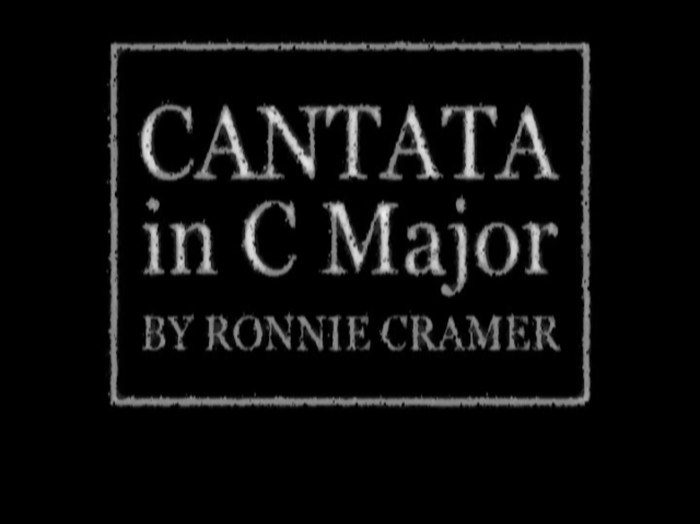
Movie Review: CANTATA IN C MAJOR (short film) Directed by Ronnie Cramer

CANTATA IN C MAJOR, 7min, USA, Horror/Musical
Directed by Ronnie Cramer

Six-hundred-five film clips are assembled and used to create a piece of electronic music. As the visual component appears in the center of the screen, the original analog audio is sent to the left channel while it is simultaneously converted into digital music data and sent to the right channel.

Read review by Amanda Lomonaco:

Definitely not your average night out at the movies. Cantata in C Major is a shock to the system in more than one way. From the very beginning the film jars you with its unconventional structure; introducing itself and its composition from the very start. Even so, director Ronnie Cramer, manages to maintain a sense of intrigue by never quite explaining the purpose of such a rigidly constructed film.

There are definite moments of despair in this film, and not for the reasons you might imagine. Though I will admit, about a minute or so into Cantata I found myself wondering when it would end. Still as the jolting mixture of images and sounds continued something clicked in me.

You suddenly become incredibly immersed in the patterns and tropes you never would have otherwise noticed. Cantata almost seems to cancel out your other thoughts, feelings, and sense, until all you can see, hear, think about and experience is what’s right in front of you. It’s almost as if Cramer’s intention was to invoke some sort of disturbing meditative experience, an intention that seems almost implied by the film’s closing titles.

Cantata in C Major isn’t really the kind of movie you watch to experience a storyline, or to submerge yourself into someone else’s life for a short while. Cantata is a film about sound, patterns, and noise. It’s a film about films, how we watch them, how we make them, how they construct and provoke different emotions. It’s certainly not the kind of film everyone will enjoy equally, but it seems to be an introspective piece that might provide you with some interesting food for thought.

 Watch the Audience FEEDBACK Video of CANTATA IN C MAJOR:


cantata_in_c_major_movie_poster.jpg

Best of Movie Stunt Performer Interviews

WILDsound Festival's avatarWILDsound Festival

Read the best of the best stunt performers working in Hollywood today. Great insights. Entertaining stories about the field. Educational for any filmmaker.

Interview with Stunt Performer Adam Kirley (Batman Begins, Casino Royale, Grimsby)
Interview with Stunt Performer Adam Kirley (Batman Begins, Casino Royale, Grimsby)

Interview with Stunt Double Olga Wilhelmine (10 Cloverfield Lane)
Interview with Stunt Double Olga Wilhelmine (10 Cloverfield Lane)

Interview with Special Effects Coordinator Donnie Dean (Emmy Winner – American Horror Story)
Interview with Special Effects Coordinator Donnie Dean (Emmy Winner – American Horror Story)

Interview with Stunt Performer/Actress Kayla Adams (Deadpool, Oblivion)
Interview with Stunt Performer/Actress Kayla Adams (Deadpool, Oblivion)

Interview with Stunt Performer James Cox (Star Wars VII, The Dark Knight Rise)
Interview with Stunt Performer James Cox (Star Wars VII, The Dark Knight Rise)

****
Also, Free logline submissions. The Writing Festival network averages over 95,000 unique visitors a day.
Great way to get your story out: http://www.wildsound.ca/logline.html

View original post 26 more words