FILM REVIEW: PHOENIX FORGOTTEN (USA 2017)

Deadlines to Submit your Screenplay, Novel, Story, or Poem to the festival: http://www.wildsound.ca
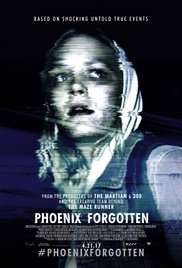
PHOENIX FORGOTTEN.jpg20 years after three teenagers disappeared in the wake of mysterious lights appearing above Phoenix, Arizona, unseen footage from that night has been discovered, chronicling the final hours of their fateful expedition.

Director: Justin Barber
Writers: T.S. Nowlin, Justin Barber
Stars: Florence Hartigan, Luke Spencer Roberts, Chelsea Lopez

Review by Gilbert Seah

PHOENIX FORGOTTEN arrives with the hype that it comes from not only the same producers as the blockbuster hits 300 and THE MARTIAN but also with Ridley Scott’s name attached to the producer credits. Of course this might not mean much, but at least one can be assured that at least the concept of the film must have been worth something.

Which it does, judging from the film’s opening scene that provides the film some promise. From the point of view of a home made video, the audience sees a jittery framework of footage of a family birthday party for young Sophie, bespectacled and looking all puzzled while everyone else talks to the camera.

The something weird occurs. The roof of the house is almost taken down by what seems to be low hovering UFO’s apparently caught on the video camera as well. Voiceover on the footage claims that this was the last time a picture was taken of the family all together. A good quirky start for a movie that then moves to the present time.

The film takes its cue from the spring of 1997 when several residents of Phoenix, Arizona claimed to have witnessed mysterious lights in the sky. This phenomenon, which became known as “The Phoenix Lights,” remains the most famous UFO sighting in American history.

The film’s premise continues that on July 23, 1997, three high school student filmmakers went missing while camping in the desert outside Phoenix. The purpose of their trip was to document their investigation into the Phoenix Lights. They were never seen again. Twenty years later, Sophie (Florence Hartigan), a documentary filmmaker and younger sibling of one of the missing, returns to Phoenix to delve into the their disappearances and the emotional trauma left on those that knew them. Sophie being a documentarist is the excuse of the found footage style for story telling, But it is hard to believe later on in the film, that the three are continuing their filming when they are running for dear life.

The problem of this movie is that one can guess that the three are going to be abducted and the found footage would indicate that. This results in a very dull middle section of the film.

The found footage horror sci-fi flick has the same look and feel as THE BLAIR WITCH PROJECT and inevitably PHOENIX FORGOTTEN will be compared to that film.

For one the found footage technique has been used already not once too often and always in this kind of low budget film. So, the novelty is gone and director Barber might as well do this horror story in the conventional way. No real advantage can be seen in having the film done in the found footage way, except to give the audience a sense of false authenticity of the proceedings.

PHOENIX FORGOTTEN is now available on iTunes! It will hit VOD and DVD/Blu-Ray on August 1st. Clearly not the best film of the year but it is available quite cheap for all that it is worth.

Trailer: https://mail.google.com/mail/u/0/#inbox/15d5b8398300bde2?projector=1

Also, Free logline submissions. The Writing Festival network averages over 95,000 unique visitors a day.
Great way to get your story out: http://www.wildsound.ca/logline.html

Deadlines to Submit your Screenplay, Novel, Story, or Poem to the festival:http://www.wildsound.ca

Watch recent Writing Festival Videos. At least 15 winning videos a month:http://www.wildsoundfestival.com

 

Film Review: IN THE CORNER OF THE WORLD (Japan 2016) ****

Deadlines to Submit your Screenplay, Novel, Story, or Poem to the festival: http://www.wildsound.ca

IN THE CORNER OF THE WORLD.jpgSet in Hiroshima during World War II, an eighteen-year-old girl gets married and now has to prepare food for her family despite the rationing and lack of supplies.

Director: Sunao Katabuchi
Writers: Sunao Katabuchi, Fumiyo Kono (manga) |
Stars: Non, Megumi Han, Yoshimasa Hosoya
Review by Gilbert Seah

 This animated feature from studio MAPPA is a rare treat. It is seldom that North Americans get to see a Japanese anime that is not violent manga and not from Studio Ghibli. That is not to say that Studio Ghibli stuff is bad but variety is the spice of life as they say. Based on the award-winning Japanese manga by Fumiyo Kouno, IN THE CORNER OF THE WORLD is written and directed by Sunao Katabuchi and produced by GENCO and Japanese animation studio MAPPA.

Bolstered by emotionally resonant storytelling, as is evident from the very first frame and exquisite hand-drawn animation, this acclaimed animated feature recently won the coveted Animation of the Year award at this year’s 40th Japan Academy and the Jury Prize at ANNECY 2017.

Director Katabuchi opens his tale in 1933 setting the stage for his coming-of-age story of a girl called Suzu affected by the War setting. The subject is said to be a daydreamer, which gives the film chance for fantasy and imagination.

Though the characters do not move as fluidly as in American animation, the background of many segments look something out of a water colour paining – especially the buildings, rocks, forests and mountains.

The film centres of Suzu, first seen as a little girl in school who loves to draw. The title of the film refers to place where Suzu first meets her further husband. The marriage is an arranged one and she moves from Hiroshima to Kure to live with her husband and his family. She does the chores but much more once World War II begins. Suzu experiences the horrors of World War II including the dropping of the atomic bomb in Hiroshima.

World War II is seen from the view of Suzu and her family and husband’s family. There are no combat scenes but the effects of the war are still as devastating. Families are always in danger from bombings and the daily routines involve constant running to the bomb shelters. Suzu loses her niece and a part of her body due to one of the bombings and director Katabichi does not shy away from showing the horrors of war. The dropping of the atom bomb on Hiroshima where Suzu’s family lives also occurs during the film’s climax. Katabuchi does not judge the Americans for the catastrophe neither does he mention their collaboration with Germany.

An arranged marriage is always full of ‘ifs’. The one here, laid out bare for Suzu’s point of view is similarly one full of both fear and anticipation. Suzu leaves her home she is used to to live with her new husband and his family. The wedding is a small one with lots of unfamiliarities. But Suzu is finally comforted when her husband eventually shows her affection on the wedding night – in the film’s most enchanting sequences.

IN THE CORNER OF THE WORLD ends up an empowering coming-of-age tale set against the backdrop of World War II, while parading the resilience and triumph of the human spirit.

Trailer: https://www.youtube.com/watch?v=s8FIdhofagA

Also, Free logline submissions. The Writing Festival network averages over 95,000 unique visitors a day.
Great way to get your story out: http://www.wildsound.ca/logline.html

Deadlines to Submit your Screenplay, Novel, Story, or Poem to the festival:http://www.wildsound.ca

Watch recent Writing Festival Videos. At least 15 winning videos a month:http://www.wildsoundfestival.com


1967 Movie Review: LE SAMOURAI, 1967

LE SAMOURAI, 1967
Thriller Movie Review
Directed by Jean-Pierre Melville
Starring Alain Delon, Francois Perier, Cathy Rosier
Review by Alex Haight

Hitman Jef Costello is a perfectionist who always carefully plans his murders and who never gets caught. One night however, after killing a night-club owner, he’s seen by witnesses. His efforts to provide himself with an alibi fail and more and more he gets driven into a corner.SYNOPSIS:

REVIEW:

“There is not greater solitude than that of a Samourai, unless it’s that of a tiger in the jungle…perhaps.” -Bushido (Book of the Samourai)

Modeled on the notion that emotion shows weakness, Alain Delon’s eponymous role as a hired assassin plays as strong a performance than any other who have attempted to bring bravado and sleekness to the muscle persona.

Delon plays Jef Costello a minimalist, cold and precise gun for hire who’s on the run after botching his most recent job at a swanky French nightclub. While the subject doesn’t sound particularly striking, it plays out like an expansive avant-garde exercise in patience, technique and vulnerability.

Those who have seen the film , will know that the story is about process and a mans understanding of a solitary existence-that by choice we lead ourselves towards an inevitable end…what happens to us on our way there, cannot be stopped…but it can be persuaded.

This thinking bleeds out of Alain’ Jef. With a cold stare and equally frigid heart, Jef lives in a state of limbo throughout the picture. He is the human gray area. Not truly defined by earnest emotion, but rather a striking sense of arrogance and helplessness living between the role of citizen and killer. It’s when those characteristics meld that we see the efficient, and controlled mind of Le Samourai emerge.

“Never has a man put on a hat and coat so perfectly.”

Shot with immaculate precision by Henri Decae, the film truly defines the new wave/neo-noir style. Where once shadows existed to hide the brooding sinister beings looking to terrorize us, Melville strips away the dark and pushes them right in our face.The use of colour and tone really sets up the movie from the very first second. A two minute static shot of a lone gunman smoking inside his empty apartment while his pet bird chirps from inside his cage screams for the arthouse crowd. More importantly though rather than solely being eye candy this shot perhaps juxtaposes that inside Jef too is trapped and crying out? Perhaps this leads to his mis–calculation at the club?Maybe?

When one thinks of it, takes a pretty cold bast’d to be able to give you chills in broad daylight, and Melville understands this…making every shot, transition and cut logical and effective. The man is really painting here. Bold washed out stripes of fury and isolated blobs of colour- the summation of Le Samourai’ effectiveness as something much more than just 105 minutes of film. There is energy, and prowess, achieving something more than the traditional genre gazer would anticipate.

However, those expecting a taught, action based shoot ‘em up fraught with quips and womanizing- ala James Bond may be a little let down. Think of it as the art-house 007. A French Bourne, perhaps. Less hulk, more sulk.

Leading the way for such filmmakers as John Woo, Gus Van Zant, The Coen Brothers (view this, then screen the duo’s minimalist masterpiece NO COUNTRY FOR OLD MEN-eerie no?)…Melville fills the screen with many washed out, static shots, tracking the supposed arrogance of the title character, and the tumultuous existence he lives, displays and balances.

It is for all these reasons that I continue to re-watch this movie and turn people onto this otherwise unknown story, so that they too can experience one of the most calculated characters in modern cinema.3/5-AH

I also recommend these titles: Man Bites Dog, Un Flic, Les Diaboliques.

LE SAMOURAI

1967 Movie Review: I AM CURIOUS, 1967


I AM CURIOUS POSTERI AM CURIOUS, 1967
Movie Reviews

Directed by Vilgot Sjoman

Starring: Lena Nyman, Börje Ahlstedt, Vilgot Sjoman.
Review by Jordan Young


A film that revolves around Lena, a young Swedish sociologist, that is on a quest to find an answer to every question that her mind creates. These questions usually revolve around love, politics, sexuality, and Sweden’s current cultural taboos.SYNOPSIS:


REVIEW:

Sometimes a film makes headlines just because of the controversy that it creates. This is certainly the case with Vilgot Sjoman’s ” I Am Curious (Yellow)”. In this bizarre, pseudo-documentary, Lena interviews and investigates a myriad of people to try to determine answers to the hot button issues of that time.

This film was shot in the same fashion as the New Wave films. There are a lot of non-linear jump cuts that are very distracting, but nonetheless, some of the subjects explored are captivating topics. One of which, being sexuality, became a giant controversy and prevented the release of the film in the States. Sjoman was not reportedly not a fan of the policies of censorship in the States, or in his native Sweden.

Serious subject matter within this film is shown in a very light manner. On several occasions through out the film, the effects used, come off as campy and smarmy. Sjoman is telling us to not take his subject matter too seriously.

In addition to the “plot” of Lena investigating, there is an aspect of this film that focuses on the how this film is being made. There are some very interesting dynamics between the director and actress. This relationship only raises more questions for the viewer. How much of Lena’s role in the film is due to the director wanting to sleep with her? This is a nice addition to the already confusing sexual politics of the 1960’s.

Easily the most controversial scene in the film, the sex scene, is one of the most anti-climactic sex scenes in the history of the film. It is clear that Sjoman didn’t intend for this to be viewed as a “Showtime Red Shoe Diary” type of sex scene. As a viewer, you disconnect from all erotic aspects of this scene, and you view it almost from a sociological perspective.

It is just a sex scene, which is a nice change of pace from the over-stylized, big presentation type of sex scenes of films we are currently used to… there is no payoff. However, I was a little distracted by thinking about how Sjoman himself feels about filming a sex scene with a girl he wants to have sex with.

This film should be taken in as a time capsule of the 1960’s. There are many political causes that Lena is protesting. The film itself should just be viewed as one giant protest. It comes off as anything you would normally expect from a 60’s protest film, but it shows it in the styles of the French New Wave. This new ideology combined with these new aesthetics creates a really refreshing package as a whole. Also, a appearance and speech by Dr. Martin Luther King Jr. makes this film a must see for budding sociologists, as well as anyone interested in activism.

1967 Movie Review: HOW TO SUCCEED IN BUSINESS WITHOUT REALLY TRYING, 1967
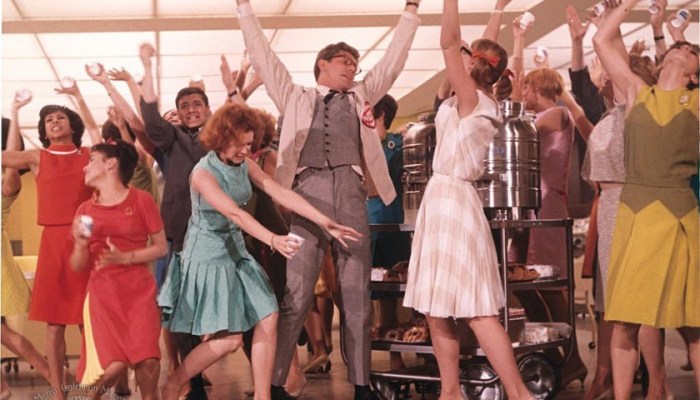
HOW TO SUCCEED IN BUSINESS WITHOUT REALLY TRYING, MOVIE POSTERHOW TO SUCCEED IN BUSINESS WITHOUT REALLY TRYING, 1967
Movie Reviews

Directed by David Swift
Starring: Robert Morse, Michele Lee, Rudy Vallee, Anthony ‘Scooter’ Teague, Maureen Arthur, John Myhers
Review by Jayvibha Vaidya

SYNOPSIS:

J. Pierpont Finch, a window washer, has dreams of rising up the corporate ladder. With the help of a little book, he follows all the instructions and finds himself exactly where he wants to be in a matter of days! But now he actually has to work – or pretend to.


REVIEW:

“Mediocrity is not a mortal sin.”

At a nearby newspaper stand, J. Pierpont Finch (Robert Morse) grabs a book titled “How to Succeed in Business Without Really Trying.” Peeling off his window washing uniform, he strides into The World Wide Wicket Company and sings:

“In a three-button suit,
With that weary executive smile.
This book is all that I need:
How to, how to succeed!”

Based on a Pulitzer Prize winning play and Tony Award winning Broadway production, How To Succeed In Business Without Really Trying is a fast-paced, amusing satire about American corporate politics in the 1960s. Climbing his way to the top through a series of chance encounters, misunderstandings and blatant trickery, Finch travels from the mail room to an executive office in a rapidly short time. He’s unqualified and unprepared, except he’s got more guts, charisma and smarts than anyone in the company.

Finch charms his way to the president, Mr. Biggley (Rudy Vallee) by pretending to pull all-night shifts and sharing his favourite hobby: knitting. Exclaiming, “I feel sorry for men who don’t knit. They lead empty lives,” Finch grabs Mr. Biggley’s attention and favour. Instant promotion! Targeting the man whose job he wants, Finch finds his weakness and exposes it – sexual appetite, a rival alma mater, nepotism – and promptly steps into a new role – every few days! With all this back-stabbing and corporate shifting, no one really knows anyone in the world of business. But along comes Rosemary Pilkington (Michele Lee), a warm, helpful secretary who befriends Finch on his first day. She’s smart, level-headed and quick on her feet. And she’s sincere; taking the time to find out who Ponty Finch really is. In many ways she’s the stereo-typical ‘60s secretary; groped by sexist old men and crushing on the new employee, but she also shines as the only character that displays honesty and integrity.


“A secretary is not a thing
The musical numbers are delightfully tongue-in-cheek, commenting on company promotions, the role of secretaries and office rivalry. Legendary choreographer Bob Fosse’s original staging is kept intact for the film, showing up especially in “A Secretary is Not a Toy” where movements match the sounds of a typewriter or pencils scratching on notepads. Complex blocking utilizing a large group of dancers are coupled with lyrics like:

Wound by key, pulled by string.
Her pad is to write in
And not spend the night in.
A secretary is not …
A secretary is not a toy.”

It’s an amusing, satirical number; fascinating to watch decades after the Women’s Liberation movement. “Been A Long Day” also stands out as it is well-timed, sweet and fun to watch. Using tableau, blocking and voice-over, the songs are staged well and the lyrics hilarious with sharp touches of truth.

Robert Morse as Finch carries the film with consistent energy, infusing all his scenes with the right amount of comedy, smarm and goofiness so the audience roots for him despite his sneaky maneuvering. Reprising his role from the Broadway production, Morse displays excellent timing and a great voice. In her film debut, Michele Lee as Rosemary is fresh and sincere, showcasing a beautiful voice in “I Believe in You.” From Mr. Biggley to his bumbling nephew Bud (Anthony Teague) to Hedy LaRue (Maureen Arthur) the ditzy receptionist/mistress, the supporting characters are comic creations of personalities one may encounter in a corporate environment.

Regularly cutting to shots of New York City, gliding through busy streets or observing from a bird’s eye view, the film has a gorgeous look. Interiors are ‘60s mod; bright colours and unusual shapes. When Finch finally makes it to the very top – Chairman of the Board – his office has high ceilings, pillars and archways. Resembling a church, his final achievement is the ultimate corporate office; a place where power and money can be worshipped. And does he get the girl? Of course! But only when he displays some honesty, gaining the approval – and job! – of the Chairman. Such is “the company way.”

How To Succeed In Business Without Really Trying is a musical poking fun at American corporate politics, ‘How-To’ books and office romances. Although at times it feels like the camera is merely capturing the stage production, using static shots to frame the musical performances, the actors bring a consistent energy that keeps the story moving at an enjoyable pace. With an ending that wraps up everything in a neat bow with a dash of cheesy fun, the film is a great look into the corporate game one must play to get to the top as rapidly as possible.

HOW TO SUCCEED IN BUSINESS WITHOUT REALLY TRYING

Happy Birthday: Selena Gomez

festreviews's avatarFestival Reviews

selenagomez.jpgSelena Gomez

Born: July 22, 1992 in Grand Prairie, Texas, USA

THE MUPPETS
dir. James Bobin
Stars
Amy Adams
Jason Segel
MOVIE POSTERHOTEL TRANSYLVANIA
dir. Genndy Tartakovsky
Stars:
Adam Sandler
Kevin James
MOVIE POSTERGETAWAY
2013
dir. Courtney Solomon
Yaron Levy
Stars:
Ethan Hawke
Selena Gomez
MOVIE POSTERSPRING BREAKERS
2013
dir. Harmony Korine
Stars:
Vanessa Hudgens
Selena Gomez
MOVIE POSTERAFTERSHOCK
2013
dir. Nicolas Lopez
Stars:
Eli Roth
Andrea Osvart

TOP SELENA GOMEZ PHOTOSSEE – ALBUM COVER PHOTO

SEE – AND ASHLEY COOK PHOTO

SEE – AND TAYLOR LAUTNER PHOTO

SEE – BOOBS PHOTO

SEE – COLORING PAGES PHOTO

SEE – DOLL PHOTO

SEE – MTV AWARDS PHOTO

SEE – NAKED PHOTO

SEE – POSTER PHOTO

SEE – RED HAIR PHOTO

SEE – SCARF PHOTO

SEE – SEXY DRESS PHOTO

SEE – YELLOW DRESS PHOTO

SEE – WITHOUT MAKEUP PHOTO

SEE – CREME PHOTO

SEE – TEEN VOGUE PHOTO

SEE – CLEO PHOTO

SEE –…

View original post 450 more words

1967 Movie Review: COOL HAND LUKE, 1967

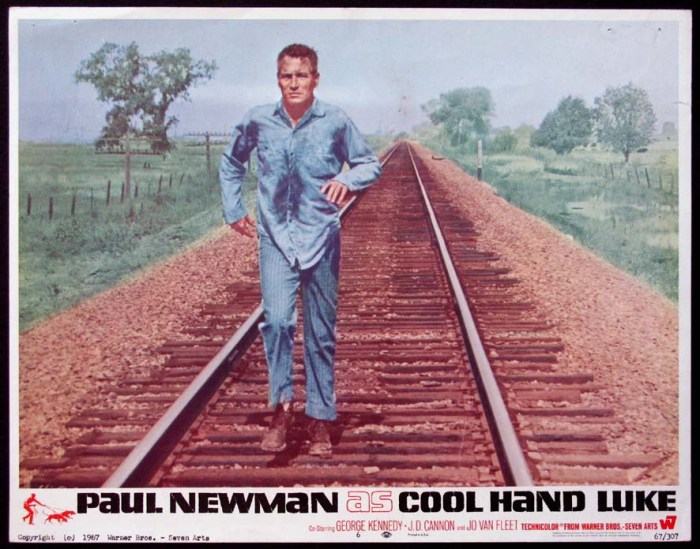
Cool Hand Luke,  1967, MOVIE POSTERCool Hand Luke, 1967
Movie Reviews

Directed by: Stuart Rosenberg

Cast: Paul Newman, George Kennedy, Strother Martin, J.D. Cannon, Morgan Woodward
Review by Jarred Thomas


SYNOPSIS:

A man refuses to conform to life in a rural prison and becomes a legend among the prisoners while a nuisance to the authority officials.


REVIEW:

One of the coolest characters ever in cinema history, Lucas Jackson (Newman) later dubbed Cool Hand Luke, refuses to bow to those who intend to restrain him from being free, or living his life the way he chooses. The 60’s were a time when adolescents challenged conformity, unwilling to submit to the corrupt oppressive adult world. Cool Hand Luke epitomized that notion of the rebellious youth.

After getting arrested, Luke in thrown in prison for two years where he has trouble adapting to the pecking order of the prisoners or even the rules established by officials. He gets into a scuffle with the head prisoner Dragline (Kennedy) and despite getting beaten severely; he continues to stand his ground, unwilling to submit. Impressed, Dragline and the rest of the inmates develop a mutual respect for the veteran war hero, and his new nickname Cool Hand Luke is donned after he wins a card game on a bluff.

Luke is charismatic, charming, and an opportunist. He looks at every moment as an opportunity to escape and he capitalizes on it, and his determination inspires others to follow. Dragline becomes a dependable and loyal ally, working with Luke in getting out of prison, despite his numerous failed attempts.

There’s a great scene that has been parodied in pop culture since the film; the boiled egg contest. Luke tries to inspire his inmates by performing a bet that requires him to eat 50 eggs in one hour, and he does. It’s a classic moment that has left a mark in pop culture.

 Newman gives an excellent performance one that has become one of his many iconic characters that the renowned actor has established in his long career. His strong performance is enhanced with the solid supporting cast who provide some interesting characters particularly George Kennedy who creates a tough convict with a compassionate and loyal side towards Luke. Both actors are giving some their best performances of their careers.

In 2005, the film was included in the United States National Film Registry considered to be culturally, historically, or aesthetically significant. Luke is similar other characters refusing to conform. Randle McMurphy from One Flew Over the Cuckoo’s Nest and Number Six from The Prisoner, each one a representation of individuality. These are iconic characters with Luke now included in the litter.

While the prisoner guards came off a little too cartoony in which they were all one dimensional, director Rosenberg creates a terrific story with distinct characters that are fun to watch. Cool Hand Luke has become a popular film for its message and remarkable protagonist who inspires people to be free and independent. Luke reminds us that it’s cool to be different.

cool hand luke.jpg

1967 Movie Review: BONNIE AND CLYDE, 1967

BONNIE AND CLYDE, 1967
Movie Reviews

Directed by Arthur Penn

Cast: Warren Beatty, Faye Dunaway, Gene Hackman, Michael J. Pollard, Estelle Parsons, Gene Wilder
Review by Martyn Warren

SYNOPSIS:

Based on the true story on the famed bank robbers during the great depression, we see the life of Bonnie (Faye Dunaway) and Clyde (Warren Beatty) as they rob banks and become iconic in the newspapers. However, even with their exciting lifestyle, there’s always an obstacle to test the famed duo around every corner.


REVIEW:

Being recognised as one of the first films to inspire the ‘New Hollywood’ film movement that would change the industry drastically, Bonnie and Clyde (dir. Arthur Penn) still stands as being one of the best American films of all time and having one of Warren Beatty’s finest performances.

Based on the true story of the famed duo who robbed banks during the great depression, the film opens up with Bonnie Parker (Faye Dunaway) and Clyde Barrow (Warren Beatty) having an encounter outside Bonnie’s family house and quickly become attached to one another. Their interests for one another deepens when Clyde reveals himself to be a robber, while Bonnie is tired of her boring job as a waitress.

The two young adults soon decide to both rob banks and lead an exciting life as people against the law, encountering new characters to be involved in their gang, including the innocent C.W. Moss (Michael J. Pollard) and Clyde’s older brother, Buck Barrow (Gene Hackman).

During the course of the story, we see how all these characters become highly recognised within the newspapers, how they each suffer with the different consequences of their actions and the police force getting closer in stopping their crime spree.

   With the cast being made up of actors and actresses who were famous and non-famous before the film’s release, they manage to bring together brilliant performances that reflect on each other.


Both Gene Hackman and Warren Beatty were very well known for the types of roles that they played during the time, with Hackman playing secondary characters while Beatty played the handsome leading man. Their performances both offer great characters that are very interesting to watch since they are equally great with the less familiar cast members show how this film managed to expand their horizons, especially with Hackman’s career in particular.

The remaining key cast members who were unfamiliar for audience members before this film all did a brilliant job in playing very human and individual characters. Faye Dunaway’s portrayal as the leading lady is absolutely superb in exploring the different challenges and emotions that she’s faced with, while Michel J. Pollard does a great job in playing the innocent-yet-unintelligent Moss. Also, look out for an early cameo by legendary comedic actor Gene Wilder!

Directed by Arthur Penn, his direction over everyone involved within the crew is done very interestingly to bring an original perspective on the screenplay.

Penn often refers to the guns used in the film as power and one very iconic scene is where Clyde shows Bonnie his gun secretly, which happens to be placed near his crotch area and Bonnie stares at it with such excitement and seduction towards such a dangerous object. Another key scene involving a gun is when Clyde actually uses it for the first time on a man that was trying to stop him and we see Clyde struggling with the fact that he actually used his weapon to kill rather then showing it off when doing a robbery.

The director also uses colour as a way to show off the emotions and the lifestyle of America during that time, as well as being used on the two main characters. For example, there’s a scene where Bonnie meets up with her family again after spending sometime doing crimes and it’s shown as a montage with a bronze filter over the shot to make it look like an old fashioned photo and preserve this precious moment for the troubled female character.

As one of the key films that started a new and exciting Hollywood movement, Bonnie and Clyde is one of the most important films in American history and one of the best films that is based on a true story. Creatively made with lovable characters, this is a film that everyone should really see if they truly appreciate American cinema.

BONNIE AND CLYDE

1967 Movie Review: BAREFOOT IN THE PARK, 1967

BAREFOOT IN THE PARK MOVIE POSTERBAREFOOT IN THE PARK, 1967
Movie Reviews

directed by Gene Saks

Starring: Robert Redford, Jane Fonda, Mildred Natwick, Charles Boyer
Review by Virginia DeWitt

Paul and Corie Bratter are newlyweds in mid-’60s New York, who have just moved into a walk up in Greenwich Village and are trying to cope with all the problems that come with living in an old building in New York City, including the eccentric neighbors. Their biggest problem, though, is their distinctly different outlooks on life. Paul is a buttoned down attorney who insists that every problem must have a logical solution. Corie is a free spirit who insists that Paul has to learn to walk “barefoot in the park”.

REVIEW:

“Barefoot In The Park” was the first Neil Simon play to be made into a movie. It was a major success on Broadway in 1963 and Simon adapted the play for the screen himself. He worked with Gene Saks, who was better known as a television actor, and who made his feature film debut as a director with “Barefoot”. Saks would go on to direct other Simon adaptations such as “The Odd Couple” (1968), “The Last of the Red Hot Lovers” (1972) and “Brighton Beach Memoirs” (1986). Saks’ television background shows through in this film. His direction of the actors and the staging of the action are straightforward, with nothing original added to the concept of a filmed play. The look of the movie, its use of colour and lighting, is just marginally better than a TV show of the era.

 Saks is good at directing his actors for comedy, however. Pacing and timing is everything in delivering Simon’s dialogue. The repartee requires rapid fire delivery because, funny and sharp as he is, Simon’s effects are all on the surface. This exchange between Paul and Corie is a good example, beginning with Paul saying to her:

“You want me to be rich and famous don’t you?”

“During the day. At night, I want you here and sexy.

“I tell you what, tomorrow night – your night – we’ll do whatever you want.”

“Something wild and crazy and insane?”

“Fine”

“Like what?”

“I’ll come home early. We’ll wallpaper each other.”

Or, a later argument where Corie gets to air her feelings about Paul’s inability to loosen up:

“You’re always dressed right. You always look right. You always say the right thing. You’re very nearly perfect!”

“That’s a rotten thing to say.”

“Before we were married I thought you slept with a tie.”

“No, just for very formal sleeps.”

Over forty years later, the film still works well and it is largely due to the terrific chemistry between its two stars. A very young Robert Redford and Jane Fonda each exhibit a wonderful naturalness in their performances. Given their later, much more serious work, both Redford and Fonda are surprisingly funny and relaxed here and their handling of the verbal and physical comedy is expert. Redford makes the uptight, anxiety ridden Paul sympathetic. In the early scenes where he spars with Corie, his exasperated reactions to her often impossible demands are perfect. In the final scenes, where he is drunk and wandering barefoot through Washington Square Park, Redford matches Fonda’s earlier exuberance with ease. For her part, Fonda is fun, sexy and spontaneous as Corie. She makes Corie’s capriciousness and emotional immaturity attractive, which is no small feat.

The cast is completed by two well known character actors. Charles Boyer, a big star in an earlier era of the movies, makes for a charming eccentric as the upstairs neighbour, Victor Velasco. Mildred Natwick, as Ethel Banks, is endearing as Corie’s slightly confused mother, subject to the same kinds of anxieties which Paul suffers from. In fact, in the scene that is the centre piece of the film – a double date at an Albanian restaurant – Simon gets a lot mileage, and laughs, from pairing off Paul with his middle aged mother-in-law. Paul, born middle aged, and Ethel commiserate with each other over the crazy night they have had to endure at the hands of Corie and Victor, both maddening in their unpredictability. Nothing comes from any of this, of course, as the couples inevitably realign, each paired off appropriately and happily once again.

“Barefoot In The Park” is still a fun movie largely due to the highly successful casting of its two young stars and Neil Simon’s writing, which is both light hearted and sharp at the same time.


Film Review: OUTRAGE (USA 1950) ***

Deadlines to Submit your Screenplay, Novel, Story, or Poem to the festival: http://www.wildsound.ca

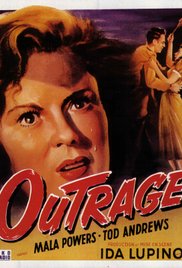
outrage.jpgA young woman who has just become engaged has her life completely shattered when she is raped while on her way home from work.

Director: Ida Lupino
Writers: Collier Young (written for the screen by), Malvin Wald (written for the screen by)
Stars: Mala Powers, Tod Andrews, Robert Clarke

 Though dated as the film may seem, OUTRAGE was controversial at the time of release being only the second film dealing with the subject of rape – thigh the word was never used and the rape implied and never spoken of in detail. The first film was JOHNNY BELINDA that earned Jane Wyman the Best Actress Oscar.

OUTRAGE deals with a single young lady, Ann (Mala Powers) about to be married. But when she is raped one night by a man with a scar on his neck, Anne leaves home, totally traumatized and unable to function properly in a social setting. She meets a sympathetic Rev. Bruce Ferguson (Tod Andrews) who helps her recover. At a party, she almost kills a man who make advances towards her, she imagining him to be her attacker.

Lupino’s film clearly has a strong feminine presence as observed in many scenes, the story and characters. Ann’s office is made up of a larger female than male staff. The males often perform more tedious tasks compared to the females, perhaps Lupino’s preferred take on an alternative universe. For example, Ann’s male colleague neighbour is given the arduous monotonous job of stamping a pile of pages, one after another non-stop. Ann’s father is a Geometry teacher, bogged down by a boring teaching job teaching what is widely well known as a boring subject – Mathematics, and down to an even more boring branch of it, Geometry. Ann’s mother is the more sympathetic one and shown to be the stronger of the two parents n terms of making in impact on Ann’s happiness.

Lupino, who co-wrote the script with two other writers is a simple enough story that traces the traumatic effects of a night assault on an innocent young woman, how her life is affected by it, and how she slowly but finally recovers with the help of kind human beings. No mention of the details of the assault are given, the nastiness just put aside, leaving the audience to imagine the worst, as observed by Ann’s after-attack behaviour.

Lupino builds up suspense and audience anticipation whenever she can. The scar of the coffee seller is shown on camera close-up early in the film, implying the man to be of questionable character. He is later revealed to be Ann’s attacker. Ann agrees to work late one night, which prompts the audience to fear for her.
Ann’s after assault behaviour is drastically different undergoing changes such as visions of her attacker, denial of her engagement and paranoia that everyone around her is looking at her and judging her. This is drastic behavioural change that almost results in Ann killing a man at a party who has made advances towards her. Lupino shows the aftermath of a sexual assault in all its fury and unpleasantness.

OUTRAGE ends with the attacker getting caught as informed casually to Anne, though nothing is shown of the incident.

OUTRAGE is an ok film, solid for its time, but a bit dated considering how films have progressed since with censorship now relaxed.

OUTRAGE will be screened on August 24th at the Bell Lightbox in its 35mm archive print as part of the TIFF Cinematheque Retrospective on Ida Lupino entitled INDEPENDENT WOMEN that runs from August 4, 2017. Watch for the Lupino article that will include capsule reviews of selected films from this retrospective.

Film Clip: https://www.youtube.com/watch?v=YBzfd0yqFY4

Also, Free logline submissions. The Writing Festival network averages over 95,000 unique visitors a day.
Great way to get your story out: http://www.wildsound.ca/logline.html

Deadlines to Submit your Screenplay, Novel, Story, or Poem to the festival:http://www.wildsound.ca

Watch recent Writing Festival Videos. At least 15 winning videos a month:http://www.wildsoundfestival.com