1987 Movie Review: FULL METAL JACKET, 1987

FULL METAL JACKET MOVIEFULL METAL JACKET, 1987
Movie Reviews

Directed by Stanley Kubrick

Starring: Matthew Modine, R. Lee Ermey, Vincent D’Onofrio, Adam Baldwin, Vincent D’Onofrio, Ed O’Ross, Arliss Howard, Kevyn Major Howard, John Terry

Review by Surinder Singh

SYNOPSIS:

A two-segment look at the effect of the military mindset and war itself on Vietnam era Marines. The first half follows a group of recruits in basic training under the command of the punishing Sgt. Hartman. The second half shows one of those recruits, Joker, covering the war as a correspondent for Stars and Stripes, focusing on the Tet offensive.

REVIEW:

There have been many classic movies made about the Vietnam War: The Deer Hunter (1978) and Apocalypse Now (1979). And when Stanley Kubrick decided to take on the challenge of adding to this already impressive milieu, it was clear that cinema audiences were in for a real treat! Full Metal Jacket was not made during the powerhouse decade of cinema (also known as the 1970s) and when the war itself was most prominent in popular culture. This allowed Kubrick adequate time to reflect on the subject, the themes and the ideas he wanted to explore. His legendary pre-productions always ensured that he never made a rash film and that every one of his films was flawlessly designed in style and substance.

The structure of the movie is quite brilliant. Like a documentary we follow in perfect chronology the journey of these young Americans. Kubrick shows us the intensive training and conditioning that transforms boys into Marines or rather “killing machines”. The training sequences in Full Metal Jacket are now amongst the top all-time classic scenes in modern American cinema. Kubrick has never forgotten the importance of acting in his movies. He has never fallen prey to the tendency that some directors have of being distracted by the practical side of production, forgetting the need for believable performances.

A prime example is the powerhouse performance of Drill Sergeant Hartman delivered with perfection by R. Lee Ermey. Even though Hartman is not the central character he commands your attention and pulls you into the movie with his unrelenting barrage of sadistic yet hilarious jibes to instate his authority over the young boys: “I bet you’re the kind of guy that would fuck a person in the ass and not even have the goddamn common courtesy to give him a reach-around!” Kubrick uses the performance to entertain, thrill and inform us with total believability that this man can turn mere boys into the toughest soldiers in the world. How could they not be ready for war if they can endure him?

Private Joker is quick to make a name for himself and is promoted to squad leader after impressively showing he was brave enough to reject the Virgin Mary directly to his deeply Christian Drill Sergeant. Joker is from the very start following his own moral compass and isn’t afraid to stand by it. Many directors would not be brave enough to have such a seemingly amoral central character in their movie (out of fear of loosing the audience). But the effect Joker has on the audience is one of wonder. He isn’t the usual boring, all-American son going into the savagery of war, rather he’s a complex character with an interest in killing. While we may not agree with Joker we still want to see what happens to him when he does end up in the thick of war and this keeps us immersed: “I wanted to see exotic Vietnam, the crown jewel of Southeast Asia. I wanted to meet interesting and stimulating people of an ancient culture… and kill them.”

The other outstanding performance is that given by Vincent D’Onofrio as the unforgettable Private Pyle! Never before or since has there been such a harrowing portrait of the demoralizing nature of war. Pyle never even makes it into the conflict but in his eyes is a war, a war within himself. Private Pyle enters training as nothing more than just a big, innocent baby. But he finishes training as a terrifying tower of insanity! With the grueling training, the Drill Sergeant constantly on his back and his lack of focus, Pyle eventually cracks and becomes a completely different person. In the US Marine Core’s strive to create Killing Machines they were bound to be some unfortunate accidents. While many of the other notable Vietnam movies were all to eager to get straight into the war, with the training section Kubrick hit upon an area of exploration that other filmmakers tackling the subject missed.

While it’s important to show the horrific acts of violence Americans bestowed on the Vietcong and Vietnamese people, it is also important to show the violence that Americans bestowed upon other Americans. Private Pyle symbolizes the failure of the US Vietnam War effort on the American people and while films like Born on the Fourth of July (1989) also tackled this, the idea was best realized in that final training sequence when Private Pyle (sat on the toilet) loads the full metal jacket. There are many harrowing images in pop culture about Vietnam, so creating something memorable in any medium is a tall order. Alas, the sight of Private Pyle reciting the US Marine Corp’s Rifle Creed and then shooting both himself and his Drill Sergeant is definitely one of the most important and lasting Vietnam War images in any medium.

After this the movie changes gears and starts to resemble some of the other Vietnam War movies of the past. The most notable similarity is the way the director balances humor, exhilaration and tragedy within each scene. While Kubrick cares about people on both sides of the conflict, he does realize that some things about the experience of war are funny. The truth is that even in the face of death young men will continue to goof around, indulge themselves in playful banter and whatever entertainment is available. In war you can be larking around one minute and be shot dead the next so… why not have a laugh?

In all the praise showered over Kubrick’s directing, his skill in directing comedy is always left out. While Full Metal Jacket is no M*A*S*H (1970) it does have some brilliant comedy sequences in it. Take the scene with the Vietnamese hooker (Leanne Hong) trying to entice Private Joker: “Me love you long time!” Another classic movie quote, providing the perfect distraction for thief (Nguyen Hue Phong) to steal Joker’s camera and make a getaway, not before performing a hilarious martial arts routine to rub his nose in it! The scene is funny even on repeat viewings thanks to Kubrick’s great understanding of comedy.

The climax of Full Metal Jacket is perhaps the greatest action set piece in any War movie. Kubrick subtly conducts a symphony of shockingly sudden impacts of violence with beautifully staged slow motion shots that show the effect of this violence. The scene is loaded to the brim with nail biting suspense that pushes you to the edge of the edge of your seat for every second of its duration. Kubrick shows us everything: the pain, the excitement, the loss and the beauty of warfare. And like all great filmmakers how does he end the sequence? With a revelation that raises the film to an even higher artist level! We see that the deadly sniper (Ngoc Le) is just a lonely, scared, young girl trying to protect herself from danger.

Full Metal Jacket is one of the best war movies ever made and is compulsive viewing for anyone interested in the Vietnam War and the fine works of modern cinema.

By Surinder Singh – Apr 2010


CLICK and WATCH MOVIES ONLINE!

MOVIE KILLSEE 1000s of PICTURES
Best of photos, images and pics
NEW MOVIE REVIEWSNEW MOVIE REVIEWS
Read Today’s POSTED REVIEWS
SCREENPLAY CONTESTSUBMIT your SCRIPT
Voted #1 screenplay contest in the world! with FULL FEEDBACK
FREE EVENTSFREE MONTHLY FILM FESTIVAL
RSVP to watch the best of new films and screenplays!

FULL METAL JACKET, 1987

1987 Movie Review: EMPIRE OF THE SUN, 1987

EMPIRE OF THE SUN MOVIE POSTER
EMPIRE OF THE SUN, 1987
Movie Reviews

Directed by Steven Spielberg
Starring: Christian Bale, John Malkovich, Miranda Richardson, Nigel Havers, Joe Pantoliano
Review by Matthew Lohr

SYNOPSIS:

A young English boy struggles to survive under Japanese occupation during World War II.

Nominated for 6 OSCARS – Best Cinematography, Best Sound, Best Art Direction, Best Editing, Best Music, Best Costume Design

REVIEW:

After years of being pigeonholed as simply an entertainer, a populist producer of popcorn frivolity, Steven Spielberg has finally won acceptance as a serious filmmaker. His “Schindler’s List” won awards and acclaim and was cited as a milestone in historical cinema, while “Saving Private Ryan” has grown in the public mind into much more than a mere film; indeed, it more or less served the role of a de facto World War II veterans’ monument until the federal government actually got around to building a real one. Even when the public does not embrace his forays into serious cinema quite so fervently, as with the acclaimed but financially underperforming “Amistad” and “Munich”, Spielberg no longer has to fight for respect and the right to be regarded as a cinematic “artiste”.

Such was not the case when “Empire of the Sun” was first released in 1987. Though Spielberg’s previous film, 1985’s deep-Southern drama “The Color Purple”, had won him some acclaim and a Director’s Guild award, many critics charged that the picture prettified human suffering, turning true experience into mere pageantry. It was still hard for audiences to find the artist inside the entertainer, and they responded to “Empire of the Sun” in kind, greeting it with both mixed reviews and lukewarm box office. It would take a few more crowd-pleasers (another Indiana Jones picture, “Jurassic Park”) before Spielberg finally got his due with “Schindler’s List”. “Empire of the Sun” provides an interesting contrast to that film, presenting a vaguely similar subject with all of the Hollywood gloss and glamour that the later film eschews…and ultimately suffering for it.

Adapted from J.G. Ballard’s semi-autobiographical best-seller, “Empire” tells the story of young Jim Graham (a pre-teen Christian Bale), a pampered son of wealthy English parents living in 1940s Shanghai. Jim is obsessed with planes, and dreams of someday joining the mighty Japanese air force. One day, however, the dreams stop when the Japanese take the city and Jim is separated from his parents. Drifting through a series of increasingly harrowing adventures, he eventually finds himself in a Japanese internment camp, where the once-arrogant son of privilege is forced to get down in the muck and learn how to survive.

It’s grand material for a cinematic treatment, but Tom Stoppard’s screenplay does not take it far enough. We never really get a clear sense of exactly what Jim learns from his experiences. Sure, he finds out that life’s not as easy as he thought it was, and that the Japanese army he so idolized is indeed vulnerable, but these lessons are never clearly articulated by the script’s events, and we’re left to piece it together later in our heads (I think this is where the playwright in Stoppard comes through; film scripts often don’t bear up to such abstraction). Jim’s plane fixation likewise seems meant to hold a metaphorical weight that it never truly assumes. What’s more, when Jim is finally delivered from his predicament, we get no scenes showing us his life after his ordeal. How can we really know how he’s changed, what he’s learned, if we don’t get to see the new Jim in action? Spielberg and Stoppard don’t bother to provide any answers, and the film becomes too remote as a result.

Bale, admittedly, makes even this truncated Jim a compelling and fascinating character. The actor holds the screen with utter command; it’s not a stretch for us to follow him anywhere. He’s equally convincing as the snobby, snide boy of early scenes and as the haggard, battle-hardened survivor of the later camp sequences. Spielberg has always been one of our best directors of children, and Bale’s performance here is some of the best work he’s ever solicited from a young actor.

The supporting cast, while impressive, is unfortunately hamstrung by insufficiently defined roles. Miranda Richardson and Peter Gale have some nice moments as Jim’s surrogate prison-camp parents, and Nigel Havers makes us wish we saw more of his dedicated camp doctor. Masato Ibu is also commanding as the cold-eyed Japanese commandant, and Emily Richard has a few moments of chilling power as Jim’s mom. Still, these characters are never given much to do by the story, and merely seem to be around to react to Jim’s actions. The only truly vividly drawn supporting player is Basie (John Malkovich), a former merchant sailor and full-time survivor who teaches Jim the hard facts of camp living while plotting an escape and a new life as a river pirate. He’s a complex and interesting character, both a pragmatist and a dreamer, and Malkovich invests him with hard-bitten smarts and a surprising soulfulness that makes his every scene compelling.

This being a Steven Spielberg picture, naturally, everything looks just great. The cinematography by Allen Daviau is gorgeous, and the production designers craft an always-convincing facsimile of World War II China. John Williams’ score is undistinguished, but the soundtrack makes use of a haunting Welsh lullaby that stayed in my head for days. And, of course, there’s plenty of Spielbergian set pieces: the harrowing moment where Jim loses his mother, a tense sequence where a Japanese gunman stalks the boy through a field of weeds, Jim saluting a band of Japanese kamikaze pilots, and a well-staged air attack on the camp, with Jim cheering wildly for the planes about to destroy him.

Still, should a film like this even HAVE set pieces? “Schindler’s List” had memorable moments, to be sure, but none of them seemed to be there just so the director could show off; everything emerged naturally from the events of the story, and thus became organic parts of a whole, not “big scenes”. “Empire of the Sun” gave Spielberg a serious subject matter and a broad canvas to explore, but the populist was still too much at play. It would take a few years and a few more films, but Spielberg finally got it right, proving that even the most financially successful director of all time can learn a few new tricks every now and again.This film won Best Director and Best Cinematography, and was nominated for five other categories. The screenwriter was nominated, and rightly so. Taken from a short story that first appeared in the Saturday Evening Post in 1933 by Maurice Walsh, Green Rushes, Frank Nugent was able to weave a story rich in subtext and conflict.

The collector’s edition of the DVD includes an interview with Maureen O’Hara where she reminisces about filming The Quiet Man, and is well worth watching.

SCREENPLAY CONTESTSUBMIT your SCREENPLAY
Voted #1 screenplay contest in the world!
NEW MOVIE REVIEWSNEW MOVIE REVIEWS
Read Today’s POSTED REVIEWS
MOVIE KILLSEE 1000s of PICTURES
Best of photos, images and pics
MOVIE YEARMOVIES YEAR BY YEAR
Pages from 1900 to present


EMPIRE OF THE SUN, 1987

1987 Movie Review: DOLLS, 1987

DOLLS MOVIE POSTER
DOLLS, 1987
Movie Reviews

Directed by Stuart Gordon
Starring: Ian Patrick Williams, Carolyn Purdy-Gordon, Carrie Lorraine, Stephen Lee
Review by Melissa R. Mendelson

SYNOPSIS:

A group of people stop by a mansion during a storm and discover two magical toy makers, and their haunted collection of dolls

REVIEW:

As the night closes in, lights dim, glowing from corners of the room. Bedtime stories are read before a kiss good-night. There is nothing to fear in the dark is gently assured, and there are no monsters hiding under the bed or in the closet. But do we tell the children this, so we can sleep in peace? Are we too afraid of what lies within the dark?

As a child, I never feared the creatures lying in wait under my bed. I worried more about what hid within the closet. As my eyes began to close, I could have sworn that my dolls were now facing me, and their eyes watched my every breath. Would they play at night when I was fast asleep? Would they tiptoe down the stairs and wreak havoc on anyone that crossed their path? Will they return to their shelves before the sunrise?

As I grew older, I packed my toys, my dolls, and stuffed animals into boxes and carted them off to the basement. Over time, they moved to the donation bin for another child to find and cherish them. Only one or two boxes remain now, and a child I am no longer. But I never forgot them, and I wonder if they never forgot me.

Our fascination with dolls and toys has led to movies such as Child’s Play, Puppet Master, and Dolls. Carved into life, their eyes open to the world, but does something live beneath its surface? If we stay a child, would the doll remain loyal, protecting us from those with cruelty in their hearts, or would they betray us to become alive?

In the movie, Dolls, a child’s summer vacation is derailed in the midst of a wicked storm. Her father and step-mother struggle to free their car from the mud, but it’s no use. They’re stuck, and the only shelter from the wailing winds and rain is an old house nearby. But as they make their way inside, they have no idea what they are about to find.

And as the storm continues to grow fierce, three more strangers enter the house, seeking shelter and are welcomed in by a seemingly innocent elderly couple. They are led through the house, passing by rooms and rooms filled with dolls. Once shown to their bedrooms, they settle in for the longest night of their lives.

Through the eyes and heart of a child, we journey to the center of fascination and fear. Curiosity will open doors that may lead to salvation, but stains of murder will paint the floor. And in the darkest of night will terror reign and the dolls run wild, and the wicked will fall. Dolls is a classic tale of terror, one warning to never give up the child that lies within.

DOLLS, 1987

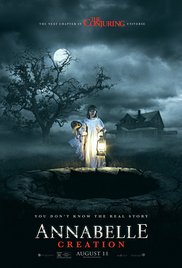
Film Review: ANNABELLE: CREATION

 ANNABELLE CREATION.jpgSeveral years after the tragic death of their little girl, a dollmaker and his wife welcome a nun and several girls from a shuttered orphanage into their home, soon becoming the target of the dollmaker’s possessed creation, Annabelle.

Director: David F. Sandberg
Writer: Gary Dauberman
Stars: Stephanie Sigman, Miranda Otto, Lulu Wilson

Review by Gilbert Seah 

 The ANNABELLE, CONJURING prequels, sequels are already so many that it is difficult to keep track what is going on. The truth is, it does not real matter. ANNABELLE CREATION is advertised as the prequel to ANNABELLE which is connected to the four CONJURING films. ANNABELLE CREATION can stand on its own, that is all that matters. The connecting object in all the film is the possessed white Annabelle doll.

The film suffers from a weak narrative. The simple story involves a couple losing their daughter in an accident. They allow orphans to make use of their big home but the spirit of their dead daughter who possesses a doll is not happy with the orphans. On the plus side, the scary set-ups are meticulously crafted, which should provide horror fans lots of jump out of the seat scares. But it does matter that the film is less the sum of its whole, as it does not hold well together at all. It also suffers from a proper ending with the doll appearing halfway through the closing credits for no real reason. One member of the audiences remarked that she expected the doll to at least blink. Still, all these bad continuity segments do not add up cohesively. One moment one member of the orphans is chased by the killer doll, the next has the film intercutting to another in trouble. Why the demon does not kill off the parents earlier on before the arrival of the orphans is also a point to question. And when the demon finally gets the soul of the crippled Janice, why doesn’t the demon stay satisfied. Of course, logic is never a strong point in horror films as in this one.

The film assembles a series of shock effects, false alarms and real ones. False alarms include for example, the father, Samuel Mullins suddenly scaring his daughter or the sudden appearance of a character and a real scare being the running over of a child by a car. The other scary effects like the moving doll, the repeated playing of the song: “You are my Sunshine” et al. are all old stuff already done in other horror films. But director Sandberg seems to have picked the best of these from past movies and included them here. But one horror set-up after another still gets monotonous after a while.

The orphans are played by a cast of relative unknowns cutting production costs for the film. However, Samuel Mullins and wife Esther are played by well-known Australian actors Anthony LaPaglia and Miranda Otto.

The first ANNABELLE film cost $6.5 million to make and grossed Warner Brothers close to $256 million. This sequel cost double to make at around $15 million, but should make the studio a handsome bundle, aided by the fact that the only main big opening this weekend is the animated NUT JOB sequel.

People love to be scared. People love to pay big bucks to be scared. Films like ANNABELLE CREATION will always do well at the box-office despite reviews good or bad, so go figure!

Trailer: https://www.youtube.com/watch?v=KisPhy7T__Q

Also, Free logline submissions. The Writing Festival network averages over 95,000 unique visitors a day.
Great way to get your story out: http://www.wildsound.ca/logline.html

Deadlines to Submit your Screenplay, Novel, Story, or Poem to the festival:http://www.wildsound.ca

Watch recent Writing Festival Videos. At least 15 winning videos a month:http://www.wildsoundfestival.com

Film Review: THE HITMAN’S BODYGUARD (USA 2017) ****

 THE HITMAN_S BODYGUARDThe world’s top bodyguard gets a new client, a hit man who must testify at the International Court of Justice. They must put their differences aside and work together to make it to the trial on time.

Director: Patrick Hughes
Writer: Tom O’Connor
Stars: Ryan Reynolds, Samuel L. Jackson, Gary Oldman, Elodie Yung

Review by Gilbert Seah
 
Actor Samuel L. Jackson is one bad ass mother f***er. When ever he appears in a film, even when playing the President of the United States, he has never failed to use his favourite catch phrase ‘mother f***er’, which he gets to use multiple times in this movie. Jackson is one of my favourite actors in films currently as he can always be counted on to deliver a solid, spirited performance, no matter what. In THE HITMAN’S BODYGUARD, he also gets to utter the film’s best joke: “If life deals you shit, you go out and make kool-aid.” to which Ryan Reynolds remarks: “That is not how the saying goes.” Jackson also gets a lot of laughs doing his HOME ALONE expression. Another good joke (though this one belongs to Reynolds) is the one regarding the pen-knife. But the best thing in the film, is a segment where the two leads discuss the usage of the ‘mother f***er’ phrase. Priceless!

The story involves a bodyguard, Michael Bryce (Reynolds) assigned to keep a previous Hitman, Darius Kincaid (Jackson) alive so that he can be transported to Hague, to testify against a corrupt Russian warlord Vladislav Dukhovich (Gary Oldman). The film plays the two against each other. The chemistry works, the laughs come fast and furious and the action segments are expertly executed.

The climax of the film includes a spectacular car chase that appear to take on the recent BABY DRIVER. Jackson takes off in a speedboat on the canals around Amsterdam pursued by the bad guys speeding on the streets around the canals. The sequence is well shot with good continuity that also includes another boat contains merrymakers split right into two. The camp factor is increased several notches with screaming prostitutes running around the streets. There is also n funny window-eye view of the chase as if seen by one of them through the glass.

As if this was not exciting enough, the car/boat chase is intercut with a foot case with Reynolds under pursuit. The two chases are brilliantly brought together with the fire of an exploding vehicle from which the camera pulls back now only to show the fire now from the grill in the kitchen in a restaurant which Reynolds breaks into.

Though the script is occasionally lazily written, with details left out, for example why Jackson landed in a Manchester prison, the jokes and punch lines are perfectly timed.
The camera placement is also excellent throughout the film, often with images to show Jackson’s expressions through the car front window or to see Reynolds somersault through the front windscreen to land standing up in front of the car after.

The main plus of THE HITMAN’S BODYGUARD is that the absolute unexpected can and actually always occurs at any time. The two for example, end up at one point, hitching a ride in a van full of nuns with Jackson joining them in a singalong.
The film’s speed and spirit matches its message on life, that things happen but you got to do your ‘thang’. They just do not make enough films like this one.

Trailer: https://www.youtube.com/watch?v=F4Afusxc2SM
 

Also, Free logline submissions. The Writing Festival network averages over 95,000 unique visitors a day.
Great way to get your story out: http://www.wildsound.ca/logline.html

Deadlines to Submit your Screenplay, Novel, Story, or Poem to the festival:http://www.wildsound.ca

Watch recent Writing Festival Videos. At least 15 winning videos a month:http://www.wildsoundfestival.com

August 2017 – Interview with Film Festival Directors

WILDsound Festival's avatarWILDsound Festival

Read 13 interviews with festival directors from around the world: 

Interviews by Matthew Toffolo

Interview with Festival Director Stephanie Dadet (OUR CITY FILM PROJECT)
https://festivalreviews.org/2017/08/09/interview-with-festival-director-stephanie-dadet-our-city-film-project/

Interview with Co-Festival Director Mia Davis (Queen City Cinephiles)
https://festivalreviews.org/2017/08/09/interview-with-co-festival-director-mia-davis-queen-city-cinephiles/

Interview with Festival Directors Roger and Shelley Gillespie (COPA SHORTS FILM FESTIVAL)
https://festivalreviews.org/2017/08/01/interview-with-festival-directors-roger-and-shelley-gillespie-copa-shorts-film-festival/

Interview with Festival Director Michael Kamel (DC Palestinian Film and Arts Festival)
https://festivalreviews.org/2017/08/01/interview-with-festival-director-michael-kamel-dc-palestinian-film-and-arts-festival/

Interview with Festival Director Sina Dolati (TORONTO NEW WAVE)
https://festivalreviews.org/2017/07/25/interview-with-festival-director-sina-dolati-toronto-new-wave/

Interview with Festival Directors Lee Marohn & Paul Salzer (NORTHEAST WISCONSIN HORROR FILM FESTIVAL)
https://festivalreviews.org/2017/07/25/interview-with-festival-directors-lee-marohn-paul-salzer-northeast-wisconsin-horror-film-festival/

Interview with Gustavo Coletti (ROSARITO INTERNATIONAL FILM FESTIVAL)
https://festivalreviews.org/2017/07/25/interview-with-gustavo-coletti-rosarito-international-film-festival/

Interview with Festival Director José Claudio Silva (PORTUGAL INTERNATIONAL FILM FESTIVAL)
https://festivalreviews.org/2017/07/25/interview-with-festival-director-jose-claudio-silva-portugal-international-film-festival/

Interview with Festival Director Kirill Proskura (MIND THE INDIE FILM FESTIVAL (MTIFF))
https://festivalreviews.org/2017/07/25/interview-with-festival-director-kirill-proskura-mind-the-indie-film-festival-mtiff/

Interview with Festival Director Jonny Mancini (FROSTBITE International Film Festival)
https://festivalreviews.org/2017/07/25/interview-with-festival-director-jonny-mancini-frostbite-international-film-festival/

Interview with Mariah Mathew (Little Wing Film Festival)
https://festivalreviews.org/2017/07/25/interview-with-mariah-mathew-little-wing-film-festival/

Interview with Festival Director Alex P. Michaels (Prelude2Cinemas)
https://festivalreviews.org/2017/07/25/interview-with-festival-director-alex-p-michaels-prelude2cinemas/

Interview…

View original post 9 more words

August 2017 – Interviews with Award Winning Short Filmmakers

WILDsound Festival's avatarWILDsound Festival

Read this month’s interviews with filmmakers from around the world. Their short films have played at multiple festivals and have won multiple awards. 

Interviews by Matthew Toffolo

Interview with Director Jeremy Garcia (STAR WARS: TRIALS)
https://matthewtoffolo.com/2017/08/04/interview-with-director-jeremy-garcia-star-wars-trials/


Interview with Director Richard Paris Wilson (A MONSTER CALLED CHARLES)
https://matthewtoffolo.com/2017/08/04/interview-with-director-richard-paris-wilson-a-monster-called-charles/


Interview with Director Holy Fatma (PLEASE LOVE ME FOREVER)
https://matthewtoffolo.com/2017/08/04/interview-with-director-holy-fatma-please-love-me-forever/


Interview with Director Liv Mari Ulla Mortensen (65.5)
https://matthewtoffolo.com/2017/08/03/interview-with-director-liv-mari-ulla-mortensen-65-5/


Interview with Director Knútur Haukstein Ólafsson (HOPE)
https://matthewtoffolo.com/2017/07/31/interview-with-director-knutur-haukstein-olafsson-hope/


Interview with Director Camille Laloux (NOVEMBER UNDER ASHES)
https://matthewtoffolo.com/2017/07/31/interview-with-director-camille-laloux-november-under-ashes/


Interview with Director Carla Shah (ICARO)
https://matthewtoffolo.com/2017/07/31/interview-with-director-carla-shah-icaro/


View original post

August 2017 – Read best of NEW POETRY from around the world.

WILDsound Festival's avatarWILDsound Festival

Read the best of new poets and their poetry for August 2017: 

I AM AFRAID, by Pam Lewis
https://festivalforpoetry.com/2017/08/03/read-poetry-i-am-afraid-by-pam-lewis/

ARE THE STILL THE SAME, by Sunil Sharma
https://festivalforpoetry.com/2017/08/03/read-poetry-are-they-still-the-same-by-sunil-sharma/

I EDIT MY LIFE, by Michael Lee Johnson
https://festivalforpoetry.com/2017/08/03/read-poetry-i-edit-my-life-by-michael-lee-johnson/

GRAIN OF CHOICE, by Patrick Turner Lee
https://festivalforpoetry.com/2017/08/03/read-poetry-grain-of-choice-by-patrick-turner-lee/

HEROIN, by Aylana St. Luce
https://festivalforpoetry.com/2017/08/03/read-poetry-heroin-by-aylana-st-luce/

SPELLBOOK, by Man of Action.
https://festivalforpoetry.com/2017/08/03/read-poetry-charmcasters-spellbook-by-man-of-action/

PUT ME TO SLEEP BEFORE IT COMES, by Sarah Francisco
https://festivalforpoetry.com/2017/08/03/read-poetry-put-me-to-sleep-before-it-comes-by-sarah-francisco/

DESERTS WATERMELON, by Kate Rauner
https://festivalforpoetry.com/2017/08/03/read-poetry-deserts-watermelon-by-kate-rauner/

THE TALE OF JIMMY NEVERBEE, by Michael Medlen
https://festivalforpoetry.com/2017/08/03/read-poetry-the-tale-of-jimmy-neverbee-by-michael-medlen/

AFTER THE END, by Samantha K. Collinson
https://festivalforpoetry.com/2017/08/03/read-poetry-after-the-end-by-samantha-k-collinson/

APEX, by David Samuel Neuer
https://festivalforpoetry.com/2017/08/03/read-poetry-apex-by-david-samuel-neuer/

FEEL WITH YOUR HEART, by Chasity McClellan
https://festivalforpoetry.com/2017/08/03/read-poetry-feel-with-your-heart-by-chasity-mcclellan/

MASTER OF DISGUISE, by Pino Hova
https://festivalforpoetry.com/2017/08/03/read-poetry-master-of-disguise-by-pino-hova/

AT NIGHT I PRAY, by Fabrian Christopher
https://festivalforpoetry.com/2017/08/03/read-poetry-at-night-i-pray-by-fabian-christopher/

BLOODSTREAM, by Chrystal Jumonville
https://festivalforpoetry.com/2017/08/03/read-poetry-bloodstream-by-chrystal-jumonville/

View original post

Interview with Composer/Musician Michael Abels (GET OUT)

matthewtoffolo's avatarMatthew Toffolo's Summary

michaelabels.jpgMichael Abels is an African-American composer known for his orchestra works Global Warming, Delights & Dances, and Urban Legend, and choral pieces such as Be The Change and Limitless. “GET OUT” was his first foray as a composer in the film industry, and it definitely won’t be his last. It was great interviewing this extremely talented musician.

Matthew Toffolo: Where were you born and raised? Was music something you always wanted to do as your career?

Michael Abels: I was born in Phoenix AZ, although I lived on a farm outside Aberdeen, SD with my grandparents from infancy through age 6. My earliest memories are of music — seriously, I can remember my grandmother’s recording of Edvard Grieg’s In The Hall Of The Mountain King terrifying me in the crib. Ironically, that’s now my job.

MT: How did you get the job composing the film “Get Out”?

MA: Writer/director Jordan…

View original post 591 more words