May 2025 WILDsound Festival Testimonials: Top 100 Festival in world!

Submit to the WILDsound Festival Today:

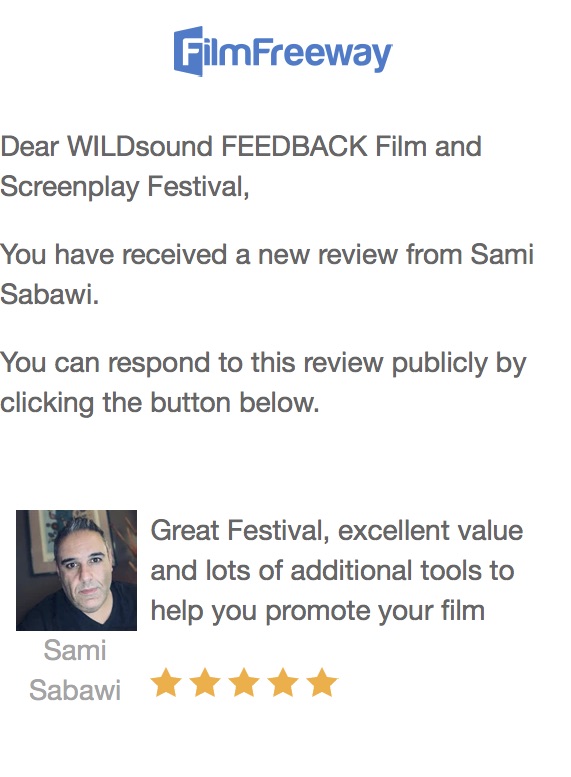
Note today from FilmFreeway:

Dear WILDsound FEEDBACK Film and Screenplay Festival,

Congratulations! Your festival has ranked as one of the Top 100 Best Reviewed Festivals on FilmFreeway for the month of March!

According to reviews from real FilmFreeway users, your festival ranks in the top 1% of more than 14,000 film festivals and creative contests around the world. No doubt, this ranking is a testament to the countless hours of hard work and care that you and your staff have devoted to creating such a wonderful event.

We’re especially proud to be partnered with amazing events like yours that help independent film continue to thrive.

This festival was amazing. Wildsound is full of surprises is the best place to go if you want your script reviewed. They will even get actors to do a script read! Who does that! You rock WILDsound!!!! until next time:)
Best!
NLKimmel (Kimmel Screen Productions)


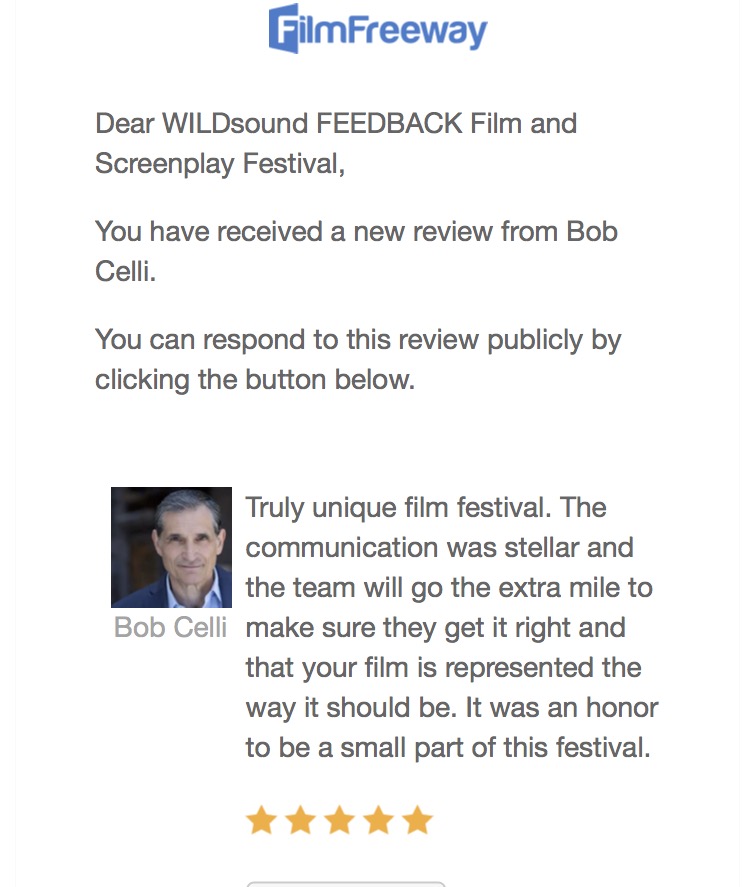
This is my second time screening a film with Matt and his team. They have been wonderful to work with, and they clearly have a heart for supporting and empowering filmmakers. They go above and beyond to provide us a platform for our work!


This is a great festival. The audience feedback is first rate and all the folks involved in putting it on are professional, timely and go the extra mile.


I really enjoyed being a part of this festival! The feedback was amazing, they were very responsive and doing everything in their power to help the filmmakers shine!


Loved the feedback scenario – comments from unrelated parties is especially interesting. Thanks!


Quality feedback and personalized communications. I highly recommend this festival format


Today’s Writing Deadlines: May 18, 2025

Submit to these exciting festivals today. Festivals that offer feedback from the industry, plus performance videos.

HISTORICAL FICTION Short Story Festival (everyone wins):
https://festivalfordrama.com/historical-fiction-short-story-festival/

Submit your HISTORICAL FICTION Short Story to the Festival here and we will automatically have it performed by a professional actor and turned into a promotional video for yourself.

A historical fiction story is a fictional story that takes place in the past and incorporates details about the time period to achieve authenticity. These details can include social norms, customs, traditions, and manners. Historical fiction stories can include actual historical figures or events, but the people and their actions are invented by the author.


CRIME/MYSTERY Novel Festival:
https://crimemysteryfestival.com/crimemystery-novel-festival/

Garner FULL FEEDBACK on your crime/mystery novel by our committee of industry professionals. Get a transcript reading of your book performed by professional actors at the Crime/Mystery Festival and made into a promotional video for your novel.


1st SCENE Screenplay Contest:
https://firstscenescreenplay.com/

This festival has a guaranteed 4-tier set up for each accepted script. (No matter what, all screenplays submitted receive FULL FEEDBACK on their work.)
1) Full Feedback on your script
2) Actors performance video reading of your script
3) Blog interview promotion.
4) Podcast interview on the Film Festival ITunes show.


WILDsound Film & Screenplay Festival:


Filmmaker Zi Yin (AS LUNA SEES….)

As Luna sees…, 5min, Australia
Directed by Zi Yin
Each individual will fills in their own way to fill the void created by death. I try to use the form of animation to tell the story of a girl saying her final goodbye to her kitten. With joy as a passing scene, smiling and waving goodbye.

https://www.instagram.com/elaine_yin_art

Get to know the filmmaker;

What motivated you to make this film?
I considered for a long time when I decided on this theme, and I also considered doing a more positive and lively subject, but some of my past experiences attracted my attention like a spot of light at night every time when I moved onto a different topic. This theme was also an outlet to liberate myself from the impact of the past, to express these feelings and realizations. In 2021, my grandfather went progressively paralysed by a cerebral infarction, and eventually became bed-ridden and died within a year. I took part in all the stages of his remaining life time,being at the hospital,at the funeral and in the crematorium to collect his ashes. During that time, I was filled with the strongest feelings and the most peaceful moods at the same time, and it made me feel as if I had passed through that time without caring about it. However, when I look back on it now, my heart is still filled with complex and unclear feelings. My family members who accompanied me also changed a lot during this period, and the routine at home was also different in one way or another. But we all stayed strong through that time and remembered the deceased in our own way. That’s why I wanted to make an animation to show the meaning of death to different individuals: people use their own way to go through this time of grief. No matter what else people do to fill the gap, it is not as much consolation as what the individual finds on his own. What fills the gap is the individual’s remembrance of the deceased, the memories that have been washed away by the time, and the growth of a finite life that has to be accepted in the river of time.

2. From the idea to the finished product, how long did it take for you to make this film?

Actually it is a school project, my master degree graduation project. The whole production time is only 3 months

3. How would you describe your film in two words!?

Dreamy/happy

4. What was the biggest obstacle you faced in completing this film?

Actually it is my first time making a 2D animation. I didn’t have animation training/experience with completed animation project before this course. I learn the animation software 4 months ago just before this animation project. Although I’ve changed the story a lot from my original version, I couldn’t make the graphics look great because of my limited animation skills. It’s a shame that I like my story so much, but I couldn’t express it better.

5. What were your initial reactions when watching the audience talking about your film in the feedback video?

I’m glad there are a lot of people that can accept my narrative style! And I’ve seen people in tears because of my animation at some offline animation shows. I’m glad that my stories can touch some people. This makes me feel happy that my purpose of storytelling has been achieved.

6. When did you realize that you wanted to make films?

I’ve always had a desire to tell stories, I guess. Because I’m very introverted, socializing isn’t my strong suit, but I love taking notes and observing. I was originally an illustrator, and I had strong ideas about writing my own stories when I was an undergraduate, and then I expressed those ideas by making them into games and drawing them as illustrations.After being exposed to more things at school, I also started experimenting with more dynamic narrative expressions. This time it was with the intention of wanting to tell a story of my own that I came to this current major.

7. What film have you seen the most in your life?

Harry Potter, the Lord of the Rings trilogy and the Hobbit. 🙂

8. What other elements of the festival experience can we and other festivals implement to satisfy you and help you further your filmmaking career?

Probably posting more artwork and updates on Instagram. Right now it feels like the instsgram account for this festival isn’t very well developed.You can also add some live FESTIVAL photos.

9 .You submitted to the festival via FilmFreeway. How has your experiences been working on the festival platform site?

It’s clean, it’s fast. But because there are so many festivals, it takes careful discernment as to which of those are appropriate for my work and which I need to be apprehensive about.

10. What is your favorite meal?

Sushi, Hotpot…

11. What is next for you? A new film?

Yes. I want to create another story of mine using 2D animation. I think it’s surprising that my current narrative has been accepted. There will be more creative work to be done after optimising my narrative.

Filmmaker Malcolm Sparrow-Crawford (STAKAYA)

Stakaya, 12min., Canada
Directed by Bruce Crawford, Malcolm Sparrow-Crawford
In the heart of a corrupt city, David, a young Indigenous man trapped in the criminal underworld, encounters Raven, a mystical guide who awakens his inner strength and leads him on a transformative journey to become Stakaya, the wolf. With newfound power, Stakaya must navigate world of mystical beings, balancing the fight against corruption with the threat from those who seek to exploit their abilities.

Get to know filmmaker Malcolm Sparrow-Crawford:

1. What motivated you to make this film?

As an Indigenous filmmaker and actor, writing and telling our stories has always been very important to me. Both my father and I have been in the film industry for many years. My dad’s been a stunt performer/coordinator for nearly 30 years and I’ve been an actor for 11. At a certain point we started writing together. Being an Indigenous man, I want to see our stories be brought to life. Stakaya was heavily influenced by my culture. A lot of elements were inspired by my culture. Stakaya was a name given to me by my great grandfather when I was 7 years old. It means Wolf in our language. I’ve always loved that and it inspired me to make something fun and heartfelt. Filmmaking is scary. It can leave you feeling very vulnerable because you’re putting yourself out there. But my father and I combined what we knew through our individual experiences to make this film and we’re both extremely proud of the final result.

2. From the idea to the finished product, how long did it take for you to make this film?

It actually took a lot longer than expected. We did this film with almost no budget. It was just a bunch of friends that got together to make something fun. The idea came about when the strikes were going on and we were all itching to get back on set in some way. But then things picked back up slowly and shooting days were fewer and farther in between. Overall I’d say it took about 6 months to finish filming.

3. How would you describe your film in two words!?

Spiritual Awakening

4. What was the biggest obstacle you faced in completing this film?

The biggest obstacle was simply time and getting everyone together to film. After writing the script with my Dad, we decided to just film it. We were fortunate enough to be able to use free locations on my reserve as sets and they were absolutely stunning to shoot in. But we started the shoot during the writers strike. Everyone had more open schedules, but shortly after we started, the industry started to pick up again. Fortunately for us there were little to no constraints on the filming locations we chose because it was all free. So we were able to take our time and get the shots right rather than rushing to get the finished product.

5. What were your initial reactions when watching the audience talking about your film in the feedback video?

I’m just glad people were able to enjoy something that was so fun to make. Any time you put your ideas onto the screen there’s a bit of fear as to whether people actually enjoy it. Fortunately we had an amazing cast and crew full of extremely talented stunt performers to bring some of that action we were aiming for into the film. The story itself is one of finding your own voice and it made me really happy to see that people enjoyed that and wanted to see more.

6. When did you realize that you wanted to make films?

Like most other actors there’s always been that thought in the back of my mind wanting to make films and for me it was always about timing. I wanted to do something fun that was enjoyable to show up to perform every day we were on set and I think we did that.

7. What film have you seen the most in your life?

This may sound funny, but it’s the Lion King. If we’re talking about sheer numbers that wins by a landslide. I was addicted to it as a child to the point where my parents started calling me Simba. It’s still one of my favourite movies of all time. The older I got the more I realized that it was inspired by Hamlet, which definitely lead to my love of Shakespeare and pushed me towards getting an English Literature degree in university.

8. What other elements of the festival experience can we and other festivals implement to satisfy you and help you further your filmmaking career?

Nothing. It’s really been an amazing experience as a first time filmmaker. I will definitely be recommending it to filmmaking friends in the future.

9. What is your favorite meal?

Well I grew up in a Native fishing community. Anything prawn related, you have my heart.

11. What is next for you? A new film?

My father and I are looking to continue developing the Stakaya story. We have a lot more written, but as of right now it’s just a timing thing for everyone who was involved.

Filmmaker Denisse Guerrero Amador (OASIS)

Oasis, 9min., Mexico
Directed by Hugo Hernández Jiménez
An immersive and vibrant journey into the heart of Mexican lucha libre, where Arena Querétaro emerges as a living protagonist, welcoming its spectators and inviting them to delve into the essence of the fight. Through the accounts of local wrestlers, the magic and myth of pancracio intertwine with the culture and emotions of a community that gathers around the ring, rejoicing, cheering, and raging alongside the protagonists of the fight.

Get to know producer Denisse Guerrero Amador:

1. What motivated you to make this film?
For starters, this student film worked as the final project for our Documentary Narrative course within our communications degree. Our teachers wanted us to represent certain neighborhoods of Queretaro. We decided to think out of the box and choose Queretaro’s Arena as the main character, instead of focusing on a personal story.

2. From the idea to the finished product, how long did it take for you to make this film?
About 8 weeks

3. How would you describe your film in two words!?
Excitement and adrenaline.

4. What was the biggest obstacle you faced in completing this film?
We had a creative block during post-production, mainly because we lost material due to a technical error.

5. What were your initial reactions when watching the audience talking about your film in the feedback video?
Pride and happiness; we never expected to generate such an impression.

6. When did you realize that you wanted to make films?
Since I was a conscientious human being, I have loved cinema. When I was younger, I used to draw the scenes that I saw on TV on a sheet. Eventually, I learned that I was doing storyboards sketches, plus I enjoyed watching the behind-the-scenes exclusive content on the DVDs.

7. What film have you seen the most in your life?
Probably Mean Girls (2004). I believe that is a satire that reflects certain issues of American society and how liberal feminism responds to them.

8. What other elements of the festival experience can we and other festivals implement to satisfy you and help you further your filmmaking career?
Probably more presence on social media like Instagram, Facebook, TikTok, etcetera.

9. You submitted to the festival via FilmFreeway. How has your experiences been working on the festival platform site?
Great, it was easy and practical.

10. What is your favorite meal?
Shrimp tacos.

11. What is next for you? A new film?
The Oasis team is currently working on a dramatic short film. The final cut is estimated to be released by mid-June.

Filmmaker Hanne Schillemans & Ralph Timmermans (HOME)

Home, 11min., Belgium
Directed by Hanne Schillemans, Ralph Timmermans
Home is a short film about the fragility of life and the virtue of solitude. A faceless figure attempting not to resist the endless waves of pointlessness.

Get to know the filmmaker:

  1. What motivated you to make this film?

Home grew out of a shared fascination with the fragile, often uncomfortable terrain of solitude. We were both navigating a kind of existential tension: the absurdity of life, and the strange peace that can arise when one stops resisting it. The idea that everything is ultimately out of one’s control and perhaps even pointless and the realization that this, paradoxically, can be liberating. That thought, oddly enough, gave us comfort. The film became a way to give form to that feeling.

2. From the idea to the finished product, how long did it take for you to make this film?

It’s hard to say exactly when the idea began. We think Home found us during a hike through desolate nature, when we unexpectedly came upon an empty house. It felt like stumbling into the middle of a concept. We didn’t plan it, we just recognized it. From that moment to the final cut, the process took about 18 months. Much of that time was spent letting the idea unfold, allowing it to simmer before taking shape.

3. How would you describe your film in two words?

Existential surrender

4. What was the biggest obstacle you faced in completing this film?

The most significant challenge was trusting enough emptiness into the film. We are often conditioned, especially in film, to fill gaps, explain, dramatize, entertain. But Home demanded restraint. We felt that allowing the film to breathe, and not over-directing it, was both difficult and essential.

5. What were your initial reactions when watching the audience talking about your film in the feedback video?

It was moving to hearing how the different viewer had a personal, often emotional responses and interpretations. We come from dance and music, so it was rewarding to see how those languages translated to the screen and how they resonated with an audience across the world, in Toronto.

6. When did you realize that you wanted to make films?

There wasn’t a single moment, it was more like a slow unfolding. With our backgrounds in dance and music, we’ve always worked with time, space, rhythm, and emotion. Film felt like a natural evolution, a vast canvas that could hold all our interests and sensibilities in one place.

7. What film have you seen the most in your life?

Honestly… for Hanne it’s probably Dumbo. As a child, she watched it so often that it had to be banned at some point. Every time she saw it, she cried uncontrollably, moved by the unjust treatment of the little elephant and his mother. And yet, she kept watching it again and again, perhaps needing to feel those emotions repeatedly. As a child, me (Ralph) and my friends would often get lost in the adventures of Marty McFly and Luke Skywalker. I’m not sure which of the two films I watched more, Back to the Future or Return of the Jedi, but I’ve easily seen each of them over ten times. I’m still working on that time machine…and practicing my Jedi skills, mostly so I can go back and rescue Dumbo and his mother. 😉

8. What other elements of the festival experience can we and other festivals implement to satisfy you and help you further your filmmaking career?

We’d love to see more opportunities for interdisciplinary conversations. Events that foster artistic exchange between filmmakers, performers, musicians, philosophers, scientists. Less about networking, more about community and curiosity. Also, support for experimental work through residencies or labs would be valuable, especially for those of us working outside conventional formats.

9. You submitted to the festival via FilmFreeway. How has your experience been working on the festival platform site?

It’s been straightforward and convenient. The platform makes it fairly easy to discover festivals aligned with our artistic values.

10. What is your favorite meal?

Something slow-cooked and with an aftertaste

11. What is next for you? A new film?

Between the two of us, creativity is always in motion. Ralph is working on a new music album, and I (Hanne) am performing and creating in various formats. Together, we’re dreaming up a new project where video and live performance intertwine. We’re not entirely sure what it will become yet, but the wave is moving, and we’re riding it.

Filmmaker Kelly Ann Buckley (MED SELKIES)

Med Selkies, 11min., UK
Directed by Kelly Ann Buckley
Med Selkies is a poetic film exploring a near-future climate crisis where land is ravaged, and a lone human drifts at sea. Succumbing to the depths, the human encounters an ancestral, aquatic force – beings who once diverged from humanity to adapt to life beneath the waves.

https://www.instagram.com/k_a_b_art_n_sound

Get to know the filmmaker:

1. What motivated you to make this film?

~ This was an expansion of a project I did for Focal Point Gallery – a wonderful contemporary arts gallery in SouthendonSea, UK. I was lucky enough to be commissioned to create an exhibition for their FPG Sounds programme. My project – Echoes in the Fossils – was a sound-led audiovisual 5 part piece – focused on rising sea levels and lost past & imagined future soundscapes, ranging from Mesolithic to Anthropocene epochs, which touched upon futuristic polymer-human hybrids. Med Selkies was a continuation of that exploration, after Echoes in the Fossils had finished. I am interested in the Aquatic Ape theory and the idea that there may be some human cousin out there in parts of the ocean we don’t know about. Med Selkies evolved from my thinking about that, and what may happen if we are forced to return to the ocean, living with them, because of climate change. This was combined with the thinking about humans carrying micro plastics in their bodies vs the plastic eating microbes scientists are now working with. What if these grow huge, and we become the food? It’s all very mixed up thinking and dreamlike and I suppose this vibe was carried through to the film.

2. From the idea to the finished product, how long did it take for you to make this film?

It’s hard to be precise because I suppose the idea was growing alongside the Echoes in the Fossils project although it wasn’t fully formed. It may have been something like 6 months to a year or just over.

3. How would you describe your film in two words!?

Fantastical truth

4. What was the biggest obstacle you faced in completing this film?

I had a very small but very powerful underwater camera that I was initially using to film some underwater scenes in the North Sea, which is where I also filmed some underwater footage for Echoes in the Fossils. Unfortunately one of my teenage sons then lost it in the sea. I was very distraught at the time but he’s forgiven now. 😊 I ended up licensing footage, which I’m sure is much better to watch anyway, than the very mirky and silty underwater views of the Thames/Estuary North Sea.

5. What were your initial reactions when watching the audience talking about your film in the feedback video?

I had a big smile on my face. It was so lovely to listen to – I think as an experimental film, you don’t expect people to immediately ‘get it’, but they did, and that felt good, like I achieved my goal. It was funny to hear someone say they thought I worked with AI. There was no AI in this film! Also someone said about the music/sound filter. I’m not sure what they meant, but there wasn’t one filter I used. The underwater sound was a result of lots and lots and lots of hours of sounddesign and many many layered tracks; the majority being hydrophone recordings of myself underwater screaming and swooshing around plastic crisp bags and suchlike.

6. When did you realize that you wanted to make films?

I mainly make sounddesign or sound-art/compose music and write. For many years I have documented a lot of these processes with video or moving art/imagery/visuals, so I suppose it has been a natural evolution that has run alongside. I’ve always been interested in filmmaking – I did an A level in film studies and did multimedia studies at college, but I didn’t really think of myself as a filmmaker in the obvious sense as I know so many brilliant filmmakers in the traditional sense – amazing knowledge, and tech, and camera skills and whatnot. I suppose I would say I’ve become more of a filmmaker (actually feels imposter-ish even saying that now) in an experimental/art sense.

7. What film have you seen the most in your life?

Oooh. Lots. Ummm… a few faves I’ve watched multiple times are Withnail and I, Couscous, Caramel, Betty Blue. The whole Godfather series too.

8. What other elements of the festival experience can we and other festivals implement to satisfy you and help you further your filmmaking career?

I think you guys are doing a wonderful job, which seems to go way beyond the norm (judging by the limited film festival experience I have), in helping get people’s names out there and help raise profiles, with your feedback, blog and podcasts etc.

9. You submitted to the festival via FilmFreeway. How has your experiences been working on the festival platform site?

Really good so far! I am quite new to it!

10. What is your favorite meal?

Sunday roast dinner with all the trimmings.

11. What is next for you? A new film?

I have just finished co-writing a screenplay with Tom Keenan for a feature film. I have been a journalist of 30 years and so was partly brought on board for those transferable skills – the film is inspired by the true story of Steve Camps – but also my passion for Cornwall and it’s rich heritage, for story, and ecological issues. Steve Camps is an artist based in Cornwall who had never picked up a paintbrush in his life until recently when he retired, and then was very quickly catapulted into fame and fortune because these paintings are so special and enchanting – buyers have been coming in from all over the world! His story started appearing across national newspapers and TV. My partner Tom read one of these stories in a British National newspaper called The Observer (The Gaurdian’s Sunday paper), and secured the life rights of the story towards the end of last year. We then received early development investment. We also formed a partnership with the Sound/Image Cinema Lab in Cornwall. So we have been working together on it since around October/November 2024. I’m co-producing the film too, and at the time of answering these questions, we are currently in Cannes to form partnerships and push it forward. It’s title is The Prince Of Whales and people can find out more at powfilm.net if they’d like to.

Filmmaker Lena Glikson (La Ghostification)

La Ghostification, USA, Musical
Directed by Lena Glikson
A surreal and symbolic journey through the inner world of a girl processing abandonment and emotional distress. Through haunting imagery — from mirrored selves red to threads like tears and disturbed dancing — the video explores the psychological aftermath of being ghosted. Set to a dark, emotionally charged track, the visuals blur the line between dream and nightmare, revealing a desperate attempt to communicate with someone who has vanished without a trace.

https://www.instagram.com/lena_glikson_mx/?hl=en

Get to know the filmmaker:

1. What motivated you to make this film?

I was going through a very dark and isolating period in my life, where I felt completely abandoned. As a musician, creating music has always been a natural form of healing for me. I wrote, produced, and recorded the song as a way to process those emotions—but it didn’t feel complete. Since I spend most of my professional life shaping music for films as a film and TV music editor, it felt instinctive to add a visual layer to the storytelling. That’s how the music video for La Ghostification was born.

2. From the idea to the finished product, how long did it take for you to make this film?

It took around two and a half months to complete the project, with most of that time spent in pre-production. I initially planned for just one shoot day in a photo studio, but during the editing process I realized we needed more footage to fully support the visual story—so we went back and shot additional material.
Since I normally edit music to picture, it was exciting (and intense) to work the other way around—editing picture to music. I’m incredibly grateful to my editor and cinematographer, Eduard Asaturov, who trusted me and gave me the space to be as detailed and specific as I needed to be.


3. How would you describe your film in two words!?

Expressive madness.

4. What was the biggest obstacle you faced in completing this film?

There weren’t any major obstacles—just a lot of responsibility. As the driving force behind this personal project, I had to think through every detail: from writing the music and lyrics to finding the crew, designing the visuals, and sourcing all the props. It was creatively fulfilling, but also very demanding.

5. What were your initial reactions when watching the audience talking about your film in the feedback video?

I was truly amazed by the depth of the responses. People picked up on nuances I hadn’t expected and connected with layers of meaning I had only subtly hinted at. It was incredibly rewarding to see the audience so engaged and thoughtful.

6. When did you realize that you wanted to make films?

My entry point was through music. I studied at Berklee College of Music, where I focused on film scoring. I was drawn to film because it brings together so many artistic disciplines—music, storytelling, visuals. I’ve been working as a film music editor for nine years, but when I wrote a song that felt deeply personal, I felt compelled to tell the story visually as well. Making this video felt like a very natural extension of my creative process.

7. What film have you seen the most in your life?

Probably A Star Is Born or Joker, both of which I worked on for many months as a music editor.

8. What other elements of the festival experience can we and other festivals implement to satisfy you and help you further your filmmaking career?

I truly love your format—especially the audience feedback video. It offers rare and valuable insight for filmmakers. The only addition I’d suggest would be finding ways to help filmmakers connect more directly with one another, perhaps through a community platform or virtual meetups.

9. You submitted to the festival via FilmFreeway. How has your experience been working on the festival platform site?

Very smooth. The platform is convenient, well-organized, and makes the submission process easy to navigate.

10. What is your favorite meal?
Anything my mom or grandma used to cook when I was little. It was pure love in the food form

11. What is next for you? A new film?
Right now I’m working as a music editor on Stranger Things Season 5, but I’ve started writing a new song—and who knows, maybe it will turn into another experimental music video.

Filmmaker Cindy Goldberg (BEAT KEEPERS: THE NEXT CHAPTER)

Beat Keepers: The Next Chapter, 43min., Canada
Directed by Cindy Goldberg
A powerful and inspiring documentary that follows a group of talented female drummers as they unite for a life-changing three-day retreat in Dallas, Texas. Through the raw energy of rhythm, unwavering mutual support, and a shared passion for music, these women forge deep, lasting connections and celebrate the transformative power of music to heal, empower, and unite.

Get to know the filmmaker;

1. What motivated you to make this film?
I wanted to spotlight female drummers—many of whom are breast cancer survivors—who lift each other up through rhythm and resilience. Their stories deserved a stage, and I wanted to give them one.

2. From the idea to the finished product, how long did it take for you to make this film?
Just under a year. It’s a sequel to my 2019 film, building on that foundation with a new chapter, new faces, and a deeper focus on community.

3. How would you describe your film in two words!?
Bold. Uplifting.

4. What was the biggest obstacle you faced in completing this film?
Staying true to a tight indie budget.

5. What were your initial reactions when watching the audience talking about your film in the feedback video?
It was emotional and validating. Hearing that the film resonated so strongly with people I’ve never met was incredibly rewarding.

6. When did you realize that you wanted to make films?
After making the first Beat Keepers film in 2019. The response lit a fire in me to keep telling these stories through documentary.

7. What film have you seen the most in your life?
Rocky. I never get tired of the underdog spirit and determination.

8. What other elements of the festival experience can we and other festivals implement to satisfy you and help you further your filmmaking career?
Offer filmmaker showcases to distributors or streaming platforms.

9. You submitted to the festival via FilmFreeway. How has your experience been working on the festival platform site?
Smooth and accessible. I like how centralized it is, but it can be tough to judge a festival’s real-world impact before applying.

10. What is your favorite meal?
A hearty vegan lasagna—comfort food done cruelty-free.

11. What is next for you? A new film?
For now, I’m focused on promoting Beat Keepers: The Next Chapter and bringing it to live audiences, such as the UK Drum Show in October. But yes, the wheels are already turning for what’s next.

Filmmaker Tiffany Laveka Lacy (EVIL INTENTIONS)

EVIL INTENTIONS, 12min,. USA
Directed by Tiffany Laveka Lacy
“After the untimely demise of both her mother and father, a young woman finds herself entangled in a web of deceit when her stepmother manipulates and alters their will. As the stepmother’s actions come to light, the spirits of the girl’s parents return from beyond the grave, seeking justice and retribution for the injustice done to their daughter.”
ti.lacy@student.nyfa.edu

https://www.instagram.com/t.lacy_

Get to know the filmmaker:

1. What motivated you to make this film?

My motivation stemmed from a profound fascination with the complexities of human emotions and moral dilemmas. “Evil Intentions” explores the darkest aspects of human nature, prompting viewers to question their own values and beliefs regarding the spiritual realm.

2. From the idea to the finished product, how long did it take for you to make this film?

The journey from brainstorming the script to production and editing unfolded over two semesters. I wrote the script during my first semester, then shot the film in the following semester, completing the editing process within the same timeframe. This project served as my graduating thesis.

3. How would you describe your film in two words?

I would describe my movie as a “psychological thriller.”

4. What was the biggest obstacle you faced in completing this film?

The hardest part was obtaining the green light to shoot the stunt scenes involving weapons. Although we didn’t manage to accomplish that particular scene, the film turned out well from a directorial standpoint, allowing me to make crucial decisions about cutting and manipulating the storyline during editing.

5. What were your initial reactions when watching the audience talking about your film in the feedback video?

My initial reaction to the audience’s responses to “Evil Intentions” was one of amazement. They truly grasped the salaciousness and thrill of the film, appreciating my lighting techniques and the way I introduced horror without resorting to excessive gore. When an audience can understand the story without needing explanations, it’s a great sign—they were able to relate on a deeper level.

6. When did you realize that you wanted to make films?

I realized my passion for filmmaking in elementary school, where creativity was a significant part of my education. My school engaged in plays and musicals, and I often took part as a performer. As I grew older, my church’s vacation Bible school allowed us to write and produce plays, which I found fascinating. From ages eight to thirteen, I was actively involved in performing, dancing, and writing stories for my siblings to act out.

7. What film have you seen the most in your life?

I would have to say that the films I’ve seen the most are “Mommie Dearest” and “Lady Sings the Blues.” They are kind of a tie for me.

8. What other elements of the festival experience can we and other festivals implement to satisfy you and help you further your filmmaking career?

I believe that providing more networking opportunities and connecting emerging talent with industry veterans would be invaluable for filmmakers.

9. You submitted to the festival via FilmFreeway. How has your experience been working on the festival platform site?

My experience with FilmFreeway has been positive. The platform is user-friendly, making it easy to submit my film to multiple festivals and track its progress. It has significantly streamlined the entire process.

10. What is your favorite meal?

I enjoy stir-fried rice and vegetables with any style of poultry or fish.

11. What is next for you? A new film?

Yes! I’m currently working on a new project that delves into psychological horror. It explores the fine line between reality and perception, and I’m excited to see where this journey takes me.

Tags