Conversation with Brazilian filmmaker Gabriel Milessis Braga on making his horror film and deciding to make it a Black & White film. Gabriel chats about the perspective of the audience seeing a film not in colour and the context of that choice.
After collapsing at the altar, Elise awakens inside an old church, and something inside her has changed. Guided by a mysterious man who seems to understand her condition, she begins to confront a new, terrifying hunger. The First Night is a gothic meditation on becoming, resistance, and the quiet seduction of darkness in our lifes.
Terrence and Aisha hesitate to forfeit aspects of their relationship after a recent breakup. As their continued bond begins to threaten new relationships, they are forced to confront their willingness to move forward.
What motivated you to make this film? I originally wrote and directed the first edition of “When It’s Over” in 2019. While that short film was semi-autobiographical, I was intrigued by the idea of a narrative that focuses on how the characters deal with the aftermath of a relationship. With that central idea in mind, I crafted this version of the film to explore what happens when two exes refuse to cut ties completely and the different ways their decision could affect both them and the people around them.
From the idea to the finished product, how long did it take for you to make this film? I began plotting out the idea and characters in late 2018, and the film premiered in 2022.
How would you describe your film in two words!? Sneaky Familiarity…
What was the biggest obstacle you faced in completing this film? During post-production, I almost lost the entire film when the drive holding all of my files suddenly crashed. I was on the verge of a panic attack, as I was worried that all of the work I had done over the course of 4 years was swirling down the drain (not to mention all of the amazing contributions from the actors!). Luckily, I was able to salvage all of the files with the gracious support of the good folks at Best Buy’s Geek Squad! In general, post-production and editing was by far the biggest challenge. The writing came naturally, and directing was fun because I already had a pretty clear vision in mind. Putting all the pieces together in post was taxing not only because it’s tedious work, but because I felt a lot of pressure to get it right for the sake of all the work I’d already invested in making the film. In the end, though, a valuable lesson was learned: make sure you back up every file!
A woman who loves eggs but one day, she is haunted by an egg monster.
1. What motivated you to make this film?
My name is Bao and Eggsecution is a film born out of my love for eggs and eating eggs. My grandmother has always berated me for eating way too many eggs a human being could handle and often chided me for doing so, warning that one day i would gain an allergy from doing so. When i moved here to the states from Singapore, i was given free liberty to eat all the eggs i wanted since i was no longer living with my family. in that way, i was unleashed. But there was always a nagging feeling at the back of my head telling me that maybe theres some wrong in eating so many eggs a day. Hence, this film was born from that fear that was ingrained in me since young. And because I love horror and genre so much, i decided to put a fun twist into both the visuals and story of this film.
2. From the idea to the finished product, how long did it take for you to make this film?
The film roughly had a timeline of 6 to 8 months. Because of the support from American Film Institute., I was allowed access to shoot on 35mm film – the Panavision Millennium xl2, 3 perf and in addition, with the support and generous donation from Kodak, we shot on 50D celluloid film – which was an amazing opportunity. My facility head and mentors, Stephen Lighthill, Sandra Valde-Handsen and Sara Ross Samko were very supportive of the original pitch for my visual essay and we eventually had to tailor it down to smaller ideas and smaller spaces due to budgetary and location restraints. But i am still extremely proud of the team that managed to make this happen! Thank you for selecting Eggsecution as part of your line up in the Experimental Film Festival!
3. How would you describe your film in two words!?
Disgusting and Delicious!
4. What was the biggest obstacle you faced in completing this film?
One of the biggest obstacles i faced was budgetary restraints. Because this film was self funded and i knew i was not working at that time, i had to save and set aside a workable budget for my film. Though equipment was provided by AFI, it was still a big project considering that i wanted to use SFX and practical effects and costume changes, along with the build of the monster in the film. My costume designer – Kai Burns and my SFX artist – Daniel Sukara were the MVPs, coming down to AFI to do countless tests to make sure the colours of the wigs, gooey, eggs and monsters were of the right shades of colour and effects could work seamlessly.
5. There are 5 stages of the filmmaking process: Development. Pre-Production. Production. Post-Production. Distribution.
What is your favorite stage of the filmmaking process? Being a DP, the favourite part of filmmaking definitely has to be the production phase of it . “egg-secution” of it. get it. hah. but yea preproduction also comes really close but nothing beats the adrenaline rush of making things come alive after you have painfully prepped for a long time!
6. When did you realize that you wanted to make films?
I initially started photography as a passion. my dad passed me my first camera when i was 6 years old. It was only in university where i made a shitty Blair Witch Project copy trailer with my friends that i had discovered the thrill and fun of collaborating with people to make something together! ever since then, 8 or 10 years have passed and here i am, still making films! haha.
7. What film have you seen the most times in your life?
I’ve probably seen Hereditary as well as Ratatouille an unhealthy amount of times. haha.
8. In a perfect world: Who would you like to work with/collaborate with on a film?
In a perfect world, i would really like to collaborate with Ari Aster, one of my all time favourite directors. I would also love to work on an animated film because i feel there is such a strong amount of craft in visual storytelling there that is unsaid and yet to be uncovered!
9. You submitted to the festival via FilmFreeway. How has your experiences been working on the festival platform site?
The experience so far has been really really smooth!
10. What is your favorite meal?
My favourite meal is without a doubt- anything with eggs. haha.
11. What is next for you? A new film?
I’m currently writing a short and applying for a grant in Singapore. I’m also in talks with a few directors about shooting a short or two 🙂 excited to explore more in LA and gain more great experiences and collaborators in filmmaking!
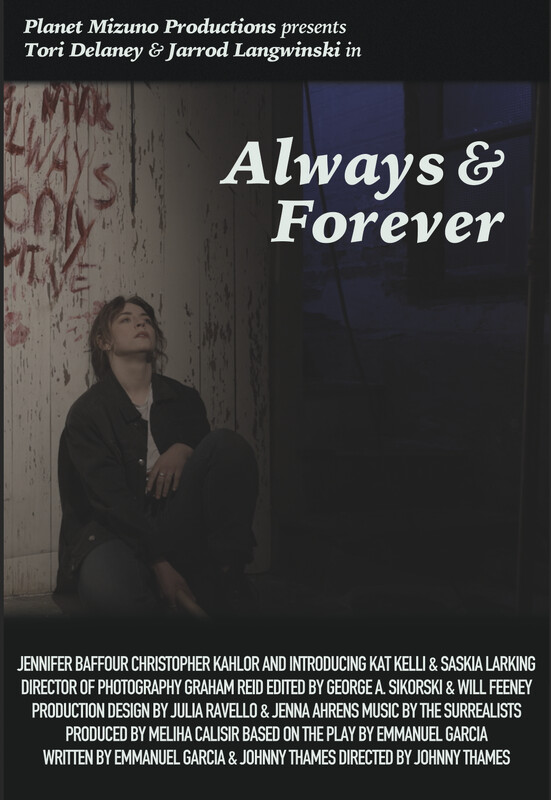
Always and Forever, 22min., USA Directed by Johnny Thames An obsessive, controlling teenager kidnaps her boyfriend to play a bizarre, self destructive game. But things become complicated when the boy demands a stop. The film comments on how trauma if not confronted and resolved will lead to co-dependent and potentially destructive results, while providing enough empathy toward accountability.
In all honesty, it was a couple of things: the main reason was the way we perceive trauma survivors and the way media depicts these types of stories. We either view them as calm and composed or emotional messes.
Additionally, many stories often depict survivors as infantilized victims needing help or as inherent monsters. The point of the film was to show it’s not black and white, it’s usually somewhere in the middle of all of this.
2. From the idea to the finished product, how long did it take for you to make this film?
From development to post-production, about a year and a half on and off.
3. How would you describe your film in two words!?
Empathetic critique
4. What was the biggest obstacle you faced in completing this film?
The biggest obstacle was the casting of Jennifer Baufour as Janice: When I first saw her tape, it stood out to me; I thought she understood the character, so I opted to cast her. The only issue was that the role wasn’t fully realized.
In response, I wrote the epilogue that plays over the credits, leaning into the nuance the film was going for. Writing the monologue was almost instantaneous, showcasing a woman who had gone through the effects of unresolved trauma and was now trying to make up for the consequences while being the parent she should’ve been years ago.
5. What were your initial reactions when watching the audience talking about your film in the feedback video?
I was ecstatic to see people recognize the themes of the film, yet also surprised that people didn’t realize that Sarah had taken the first step toward breaking the cycle of abuse. When she breaks the mirror, she makes a conscious choice to not be like her mother and accept how her actions impact others. While she won’t have any children, she has the chance to heal after years of holding on to her trauma while simultaneously denying its impact on her.
6. When did you realize that you wanted to make films?
When I was a kid. I was obsessed with movies, specifically Spielberg and old Disney films. Instantaneously, I wanted to be a director, though I did diversify into theatre (and take a break from filmmaking) after realizing how strenuous it could be. However, it always stuck with me: In middle school, I was writing scripts and wanting to direct plays. As a teenager, I would spend hours writing (thankfully) unrealized materials for film and theatre.
7. What film have you seen the most in your life?
Blazing Saddles, The Producers, Hundreds of Beavers, The End of Evangelion, Man of La Mancha, and Peter Pan
8. What other elements of the festival experience can we and other festivals implement to satisfy you and help you further your filmmaking career?
Following the screenings, I think it would be interesting to have the filmmakers answer any questions audience members have in a follow-up video. This would show how each filmmaker interacts with their audience and build camaraderie and community.
9. You submitted to the festival via FilmFreeway. How has your experiences been working on the festival platform site?
Pretty easy, I’ve been using the site both as a former programmer for The Syracuse International Film Festival (shout out to Michelle DiBernardo for being an amazing boss!) and as a filmmaker for about seven months now. There was a bit of a learning curve from a programming perspective, but overall, using the site has been like shopping on Amazon.
10. What is your favorite meal?
Pad Thai, Porkchops, Salmon.
11. What is next for you? A new film?
Quite a lot! I’m currently a casting director for a feature film and two MFA Thesis Films for my producer, Luisa Bott.
I’m also founding a film studio with Luisa, Anthony Cuomo, and Ying Su, in preproduction on a fantasy short about a young girl who finds herself in a magical world of discourse and in development on a surreal satirical dark comedy-drama feature.
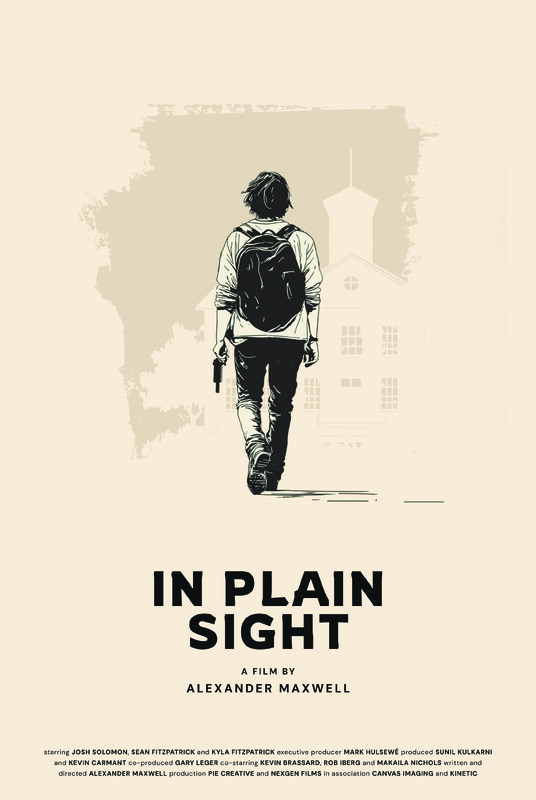
Two intertwined stories of cause, and effect. A story highlighting the deep-rooted issues of silence, complicity, negligence, and unchecked cruelty that lead to a vicious cycle of violence doomed to repeat itself.
Get to know Producer Mark Hulsewe:
1. What motivated you to make this film?
I am tired of witnessing endless school shootings with leaders and politicians not acknowledging why this is happening. Kids and teenagers brutally humiliate and abuse each other with it being dismissed as kids being kids or boys will be boys.
2. From the idea to the finished product, how long did it take for you to make this film?
Five years
3. How would you describe your film in two words!?
Inconvenient truth
4. What was the biggest obstacle you faced in completing this film?
Finding a school that would allow us to replicate a shooting on property
5. There are 5 stages of the filmmaking process: Development.
What is your favorite stage of the filmmaking process?
Right now seeking distribution because I am seeing the impact it has having on audiences.
6. When did you realize that you wanted to make films?
When Covid shut the world down
7. What film have you seen the most times in your life?
Inception
8. In a perfect world: Who would you like to work with/collaborate with on a film?
Selena Gomez due to her stance on mental health advocacy
9. You submitted to the festival via FilmFreeway. How has your experiences been working on the festival platform site?
Positive
10. What is your favorite meal?
Baked potato soup
11. What is next for you? A new film?
Turning this short into a feature or TV series. Also creating a documentary exposing Columbine High School for it’s brutal environment that created the conditions for the most infamous school shooting in history.
A delightful blend of adventure and emotional depth, reminiscent of films like “Finding Nemo,” where the bond between characters drives the narrative through perilous waters. I thought of “The Shape of Water” as well, with its unique exploration of relationships between humans and extraordinary creatures, creating a sense of wonder and connection. Additionally, “A Monster Calls” came to mind, as it beautifully intertwines fantastical elements
Get to know the writer:
1. What is your screenplay about?
The screenplay is about Gilly, a decades old, extremely intelligent Giant Pacific Octopus who lives in the Mermaid’s Cave in Oahu where she has been gifted an information hub by her marine biologist friend. As time passes, Gilly enhances her ability to shape shift and learns how to communicate. In present day, she saves a government agent who is drowning in the ocean. Their relationship is at the center of the character driven story which unfolds like a chaotic, humorous, fast paced rollercoaster. It climaxes with Gilly and her new found friends saving the Arizona Memorial from attack from North Korea’s marine biology program.
2. What genres does your screenplay fall under?
My story fits the following genres: Sci-Fi, Fantasy, Thriller, Comedy, with slight traces of Horror. It is suitable for all ages. It can be animated, use live actors, or be a combination of both.
3. Why should this screenplay be made into a movie?
I have received extremely positive feedback from multiple industry evaluators. I will use the review by the International Screenwriters’ Association to answer this question. “The project presents a distinctive blend of science fiction and emotional drama, anchored by the unlikely relationship between Slip, a disillusioned former agent, and an intelligent, shapeshifting octopus named Gilly. Their connection provides both the narrative’s emotional center and its conceptual novelty, exploring trust, survival, and empathy in an unconventional yet interesting context.
The tone operates in a deliberately hybrid register, merging high-concept science fiction with a light, often self-aware humor. In its best moments, this tonal elasticity creates a sense of discovery and curiosity, it allows for levity in scenes that might otherwise risk melodrama. The concept itself, an intelligent, shapeshifting octopus that engages with humanity, is imaginative and commercially distinctive, particularly in a cinematic landscape with familiar properties. What makes it notable is not simply its novelty but its potential for visual and tonal contrast, the serene oceanic imagery juxtaposed with covert operations, and the organic intelligence of a sea creature contrasted with human technology.
Overall, this screenplay’s originality and emotional core position it as a distinctive and engaging piece with strong cinematic potential.”
4. How would you describe this script in two words?
Summer Blockbuster.
5. What movie have you seen the most times in your life?
Three Amigos or Jesus Christ Superstar.
6. How long have you been working on this screenplay?
I began in the fall of 2024 and have made some changes based on feedback that has strengthened my product in the areas of formatting, character depth and a more complete and satisfying ending, the last of which I just recently included. I visited Hawaii in December of 2024 to help me with creativity and authenticity. In late December, I completed and copyrighted my screenplay.
7. How many stories have you written?
In university, I wrote two plays, I Meet My Creator and The Man Who Hated Everything, both comedies, both sellouts. The Man Who hated Everything received an award for best play. Over the past five years, I have written The Octopus’s Garden and The Dreamcatcher of Rehoboth Beach, a character driven historical fantasy. Both are in screenplay and novel format. The Dreamcatcher was number 3 in Fantasy on Coverfly’s Red List in October of 2022.
8. What motivated you to write this screenplay?
I watched My Octopus Teacher and a National Geographic documentary on octopuses. I then imagined an octopus who is decades old and highly intelligent. My original concept was to write a horror screenplay based on a scene where the octopus visits a sushi bar and destroys the place after seeing octopus sushi being served. I was telling my golf friends about the idea since they loved The Dreamcatcher, and they sent me some pictures that motivated the characters Slip and Admiral Hess. The picture of Admiral Hess changed my approach to a fast-paced comedy. Adding a baby to the sushi scene and a bug riddled robot dog provided tools for comedic moments. I also wanted to leverage some of Leo Gorcey’s, aka Slip Mahoney’s, creative use of language, which I instilled in Alana. There are other references to comedies of the past scattered through. That is how I settled on the name Gilly. I made her clumsy enough to earn that name. It is funny and warm that she loves those old comedy shows.
9. What obstacles did you face to finish this screenplay?
Proof reading is hard work.
10. Apart from writing, what else are you passionate about?
I like nature, golf, sports, delicious food and trying to find the humor in everything.
11. What influenced you to enter the festival? What were your feelings on the initial feedback you received?
. I enjoyed the YouTube reading and would like to explore that some more, perhaps picking a more robust scene and developing a visual for Gilly.
When a troubled teen’s wish to make everyone disappear comes true, she risks losing them permanently and must rely on an unlikely ally to save her town – the school bully.
Get to know the writer:
1. What is your screenplay about?
It’s about a teenage girl who gets bullied at school and is in a very dark place at the beginning of the story. She gets in a fight with her mother and in the heat of the moment, she wishes everyone would disappear. Little does she know that her wish instantly becomes true. She has to navigate through her new world and come to terms with herself and the other people in her life before she can move on.
2. What genres does your screenplay fall under?
coming of age, fantasy, drama
3. Why should this screenplay be made into a movie?
I think a lot of young people can relate to the feelings of isolationism, grief, and trauma early in life that this movie presents. The lead character also deals with a lot of loneliness. Sometimes that loneliness is desired and wanted and sometimes it makes her wish for someone to be with her. It shows that our feelings are changing on a daily basis and don’t evolve in a neat linear pattern. I think ultimately what this movie expresses is that having these feelings is normal and takes time to sort out. Hope is around the corner even in our darkest hour.
4. How would you describe this script in two words?
resilience, perseverance
5. What movie have you seen the most times in your life?
In recent history, I’ve seen “Whiplash” the most. It’s a master class in the writing and performing of an antagonist who is dynamic and rich in character. And the way that the protagonist meets the moment at the end of the movie is chef’s kiss.
6. How long have you been working on this screenplay?
I’ve been working on it since the end of June 2025
7. How many stories have you written?
Besides this one, I’ve written a TV pilot for a sci-fi medical comedy, I’ve also written a couple horror features, and I just finished a Christmas rom com feature that I hope to either sell or produce one day.
8. What motivated you to write this screenplay?
For me, this story represents the feelings of being lonely and isolated when you’re surrounded by lots of people. It’s about the duality of wanting to be alone and wishing you weren’t so isolated from others. That’s something I’ve felt a lot when I was at college away from home. I didn’t go through the same traumas and loss as the protagonist, but the feelings were very similar.
9. What obstacles did you face to finish this screenplay?
I think writing in the tone of a younger generation was a challenge. I haven’t been a teenager for quite some time, so writing like one is not easy. Also, I don’t want to get caught up in the latest lingo because when that lingo goes out of style, so too will my dialogue become dated.
10. Apart from writing, what else are you passionate about?
I’ve recently got into improv acting and I absolutely love it. I’ve been fortunate to meet a lot of people who are passionate about it. I used to act in plays as a teen, but I find improv to be very unique and different than scripted acting. I’m sharing a moment with someone else on stage that I will never replicate again, and I find that to be very special. And if I’m not performing well, I have someone else with me who can help me out. And if we both don’t do well, then maybe we can laugh about it afterwards. No matter anyone’s skill level, you can always find something to enjoy when you’re doing improv.
11. What influenced you to enter the festival? What were your feelings on the initial feedback you received?
I just liked the ability to have a professional recording of one of my scenes. I think the feedback was helpful and I appreciate it.
Inspired by the Great Fire of Chicago 1871 following the investigation of Mrs O’Leary, a woman the newspapers blamed for starting the fire that spread all the way to Lincoln Park.
Get to know the writer:
1. What is your screenplay about?
My screenplay is about Catherine O’Leary, the Irish milkmaid unjustly accused of starting Chicago’s “Great Fire” of 1871. As she fights to clear her name, she discovers the true culprit of the fire and faces an agonizing choice.
2. What genres does your screenplay fall under?
Historical fiction; thriller.
3. Why should this screenplay be made into a movie?
“Mrs. O’Leary” should be made into a movie because it’s about a 19th-century “cancel culture” that 21st-century audiences would recognize. The story transcends region and period. “Mrs. O’Leary” is set 155 years ago, and yet the Chicago world of 1871 isn’t so diffrent from our own — a world where vulnerable people are “othered” due to their homeland or accent and where they can wither under stronger forces that are determined to cast blame for a social problem.
4. How would you describe this script in two words?
Hot Time.
5. What movie have you seen the most times in your life?
“It’s A Wonderful Life”
6. How long have you been working on this screenplay?
Shy of a year.
7. How many stories have you written?
About 20; features, pilots, and shorts.
8. What motivated you to write this screenplay?
Over the phone in early 2025, my mother read a brief selection about Catherine O’Leary in a book about “bad days in history” (Oct. 8, 1871, real bad day in Chicago). Without sounding too dramatic, my imagination ignited immediately, and I saw Mrs. O’Leary as a cinematic protagonist. I saw drama: a woman who suffers through no fault of her own. As I researched and then reimagined her story, I added a thriller element: Mrs. O’Leary didn’t start the fire… but somebody did! In my screenplay, I give Catherine O’Leary voice that she never had in life.
9. What obstacles did you face to finish this screenplay?
I faced the challenge of sifting through volumes of contemporary and modern texts about Mrs. O’Leary, and the fire, to locate gems that I would use for a 100-page script.
10. Apart from writing, what else are you passionate about?
Animal welfare. My cat.
11. What influenced you to enter the festival? What were your feelings on the initial feedback you received?
I was influenced to enter because the festival offered feedback and then a promotional best-scene video. The feedback I received for “Mrs. O’Leary” was excellent: specific and actionable. The promotional best-scene video is terrific, a compelling read by talented voiceover actors against a backdrop of visually engaging graphics.
A single mother and her teenage daughter living on the south shore of Long Island. Fighting each other to be seen. Living in the conflict of oppression and dominance. Both fighting to win, both will end up losing.
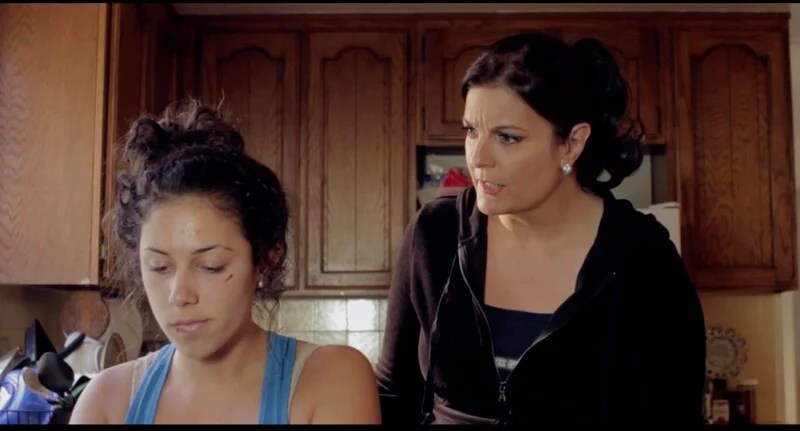
This 30 minute dramatic television pilot explores the dysfunctionality between families and the unhealthy cycle of narcissistic abuse which can cause psychopathy. It follows Danielle, portrayed by April Audia, a single mother raising her teenage daughter Melody, portrayed by Chelsea Mart, on the south shore of Long Island, New York.
Writers and directors, Cat Torres and April Audia give us an inside look into several interpersonally unhealthy relationships and the difficulty it is to navigate them. The concept for this pilot is a strong one but it is also a slippery slope when dealing with these issues not to take things too far. You want to be able to empathize with these characters and I really wish there was a “save the cat” moment to be able to do that. I have to admit, April Audia not only did a wonderful job acting but she also has a great singing voice. She was the lead vocalist on the opening song with music written by Michael Haddad. Michelle Debellis who portrays Hailey also had a very organic, believable presence on camera.
Cinematographer Danilo Hernandez gave us a gorgeous TV pilot, with several creative camera angles and stellar lighting. Sound wise, I really wish the filmmakers recorded the priest’s voice over in the same room as the actors to have everything consistent. The original music for this was chosen exceedingly well, Daniel Barrera and Michael Haddad did a wonderful job on that.
Of all people exotic dancers understand money can’t buy happiness. So where does it come from? This question sets Robin on a personal journey that takes her deep inside her desires and across the country; encountering hurricanes and personal loss of people she thought were just clients and coworkers. These events cause her to accept some hard truths not only about herself, but also about her industry.
Get to know the filmmaker:
What motivated you to make this film?
This story needed to be told to help remove the stigma from exotic dancing. Not everyone who dances is doing it as a side hustle to prostitution or to scam men out of thousands of dollars. We are performers in every sense of the word; we are here to entertain people in our magical world where problems and inhibitions are left at the door. Strippers are perfectly capable sales professionals who capitalize on gender roles while exploiting society’s natural appetite for the female body and attention. Because of our job we are comfortable with nakedness and naturally shy away from honesty for the safety of ourselves and our families. This is out of the norm and incredibly intriguing to the outsiders, therefore my goal was to bring in outsiders and help them understand exotic dancers because I feel that if we all just took the time to listen to one another we would be able to grow closer and stronger.
From the idea to the finished product, how long did it take for you to make this film?
I started pre-production in May of 2020 and finished post-production June of 2025; 5 years and 1 month.
How would you describe your film in two words!?
Unhinged….Raw
What was the biggest obstacle you faced in completing this film?
I might be my biggest obstacle. Being a post production crew of 1 there was no one to be accountable to, no one was waiting on me to finish my part so they could do theirs. No investors asking for an update or pressuring me to provide a return on their investment. There was just me and the commitment I made to myself that everyday I’d do something to progress my film forward, one step everyday toward my goal.

 Festival Reviews