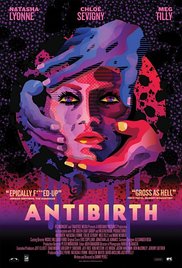
Film Review: ANTIBIRTH (USA/Canada 2016) ***1/2

antibirth_movie_posterDirected by Danny Perez

Starring: Natasha Lyonne, Chloë Sevigny, Meg Tilly

Review by Gilbert Seah

As nasty pictures go, ANTIBIRTH is one hell of a nasty piece. Halfway throughout the film, the lead character, Lou (Natasha Lyonne) remarks: “I am not pregnant. I am infected!” But writer/director Danny Perez infuses an accurate stoner humour into the proceedings. Unlike films like SAW and HOSTEL, which are nasty beyond watchable, ANTIBIRTH is very watchable and entertaining in a nasty way. In the words of director Perez, “I wanted to show the other side of pregnancy besides the feel-good and the glow; i.e. the more gruesome aspects of pregnancy and what it does to the body.” He ties the film with UFO Youtube conspiracy theories, which does not always work. Needless to say, the film should be avoided by any woman in the expectancy period.

In a small Michigan town, hard-partying stoner Lou (Lyonne) awakens one morning and finds herself experiencing bizarre symptoms. Her friend, Sadie (Oscar nominee Chloë Sevigny from BOYS DON’T CRY) believes she is pregnant and not telling her about it, despite Lou’s claims that she has not had sex with anyone in nearly a year. A mysterious stranger, Lorna (Meg Tilly), however, believes Lou. As conspiracies and stories of bizarre kidnappings around town begin to spread, Lou’s visions and grip on reality become more distorted.

Perez wrote his film with lead actress Lyonne in mind. It shows! Lyonne is perfect for the part as the stoner do-not-want-to-be-mother. “I cannot be pregnant. It is not my style.” She says. Her character, Lou smokes from a bong with the mouthpiece so large that it fits her entire mouth. She survives on donuts and cigarettes. Meg Tilly, not seen for a while on screen returns in a role as a frumpy weirdo who sees flashes of light and visions, like someone switching on and off a TV channel.

Be warned that Perez is fond of including very gross scenes. One has Lou peeling off a scar tissue at the back of her neck before extracting one of her molars with her fingers, blood and all. But the best (grossest) scene has her using a knife to break open a huge blister on the sole of one foot, followed by all the blood and pus running out. She then wobbles around with a cane, limping around until she delivers. One can appreciate if not feel her pain during the pregnancy – or infection, if one wants to call it that.

The winter setting with the ice and snow as well as the dirty mud aids in the film’s gloomy atmosphere. Her trailer home looks even more dismal in the wintry setting.
The best scene? Meg Tilly’s face covered in blood smiling after delivery of the monster baby remarking: “Oh my goodness!”

ANTIBIRTH works as a horror film with major stoner attitude. One of the best horror films of the year! See it with caution!

Trailer: https://www.youtube.com/watch?v=Gx1K4yZW5Ds

TV CONTESTSUBMIT your TV PILOT or TV SPEC Script
Voted #1 TV Contest in North America.
FILM CONTESTSUBMIT your SHORT Film
Get it showcased at the FEEDBACK Festival
writing CONTEST1st CHAPTER or FULL NOVEL CONTEST
Get full feedback! Winners get their novel made into a video!
SCREENPLAY CONTESTSUBMIT your FEATURE Script
FULL FEEDBACK on all entries. Get your script performed

Film Review: CAMERAPERSON (USA 2016)

cameraperson_movie_poster.jpgDirected by Kirsten Johnson

Writers: Doris Baizley (consulting writer), Lisa Freedman (consulting writer)

Star: Kirsten Johnson

The director’s vision is seen through the lens of the cinematographer’s camera. Oscar winning cinematographers? Who can forget Freddie Young’s sandstorm in LAWRENCE OF ARABIA, Haskell Wexler’s locust invasion in BOUND FOR GLORY or Gordon Willis’ city silhouette in Woody Alllen’s MANHATTAN? In the new documentary CAMERAPERSON that premiered at Sundance this year, female cinematographer Kirsten Johnson delivers a uniquely insightful memoir-cum-critical-treatise on the nature and ethics of her craft.

At the film’s start, Johnson declares that she is a documentary cinematographer who for the past 25 years has shot footage for other films. She declares that this film is her memoir – images that have marked for life and many that have still kept her wondering. These are strong words – and sets up the audience for a documentary that will hopefully astound and mesmerize.

As for Johnson’s credit, she has worked behind the camera for well-known films like FAHRENHEIT 9/11- there is one shot of Michael Moore making a comment, DARFUR NOW and CITIZENFOUR among others. She has travelled around the globe in different continents uncovering hidden truths.

A boxing match in Brooklyn; life in postwar Bosnia and Herzegovina; the daily routine of a Nigerian midwife; an intimate family moment at home: these scenes and others are woven into the film, a tapestry of footage captured over the twenty-five-year career of documentary cinematographer Kirsten Johnson. Through a series of episodic juxtapositions, Johnson explores the relationships between image makers and their subjects, the tension between the objectivity and intervention of the camera, and the complex interaction of unfiltered reality and crafted narrative.

Her documentary uses images to tell the story. There is little voiceover to put the audience into any perspective of the images or places or people on display. By looking at her images on screen, the audience is to make up their own minds on what is perceived. But each snippet is preceded with a title, mostly the name of the place where the images to be seen are taken – from as diverse locations as Foca, Bosnia, to Westport, New York. Certain placers are re-visited again in the film. Some snippets last no more than a minute while others longer.

There are plusses and negatives for this approach. The plusses include the audiences having a less biased opinion of the activities that take place – and some of these are political. A few teases the audience’s curiosity. One snippet for example traces a boxer’s activities just before he enters the ring and then ends. Other images are plain stunning and need no commentary. On the negative side, some feel out of place and difficult to follow – especially the reason for Johnson’s inclusion into her film. The short snippet of the outside of an airline as shot from inside that lasts about minute is a puzzling one. One would also like to know more about Johnson’s background, her influences and who she respects working for in the past or who she would like to wok with in the future. Her take on cinematography for fiction films would also be an insightful inclusion for this film. The closing credits list the details of all the films Kirsten has used in this doc.

Regardless, CAMERAPERSON is still a fascinating film for all those who love cinema. It is these pioneers that capture the stuff of dreams and translate it into celluloid for everyone’s benefit and pleasure.

CAMERAPERSON will have a limited run at Toronto’s Hot Docs Ted Rogers Cinema.

Trailer: https://vimeo.com/179496166

TV CONTESTSUBMIT your TV PILOT or TV SPEC Script
Voted #1 TV Contest in North America.
FILM CONTESTSUBMIT your SHORT Film
Get it showcased at the FEEDBACK Festival
writing CONTEST1st CHAPTER or FULL NOVEL CONTEST
Get full feedback! Winners get their novel made into a video!
SCREENPLAY CONTESTSUBMIT your FEATURE Script
FULL FEEDBACK on all entries. Get your script performed

Film Review: LION (Australia 2016)

lion_movie_posterLION (Australia 2016) **
Directed by Garth Davis

Starring: Nicole Kidman, Rooney Mara, Dev Patel

Review by Gilbert Seah

When a feel-good story as in LION is made into a film, filmmakers often still feel the need to add on additional sweetness. PLAY IT LIKE BECKAM, BILLY ELLIOT and the more recent QUEEN OF KATWE are examples of films that fall into this trap.

Audiences do not seem to mind as observed in the box-office success of the first two aforementioned films though QUEEN OF KATWE bombed. Critics, however are never impressed with sugar-coated feel-good films. Unfortunately, LIONS falls into this category. Director Davis is still not ashamed to show a tear or two dripping from the face of the main protagonist, Saroo (Dev Patel), not once but twice.
Dev Patel (THE BEST EXOTIC MARIGOLD HOTEL, SLUMDOG MILLIONAIRE), Rooney Mara and Nicole Kidman star in the true story of Saroo Brierley, who was adopted by an Australian couple after being separated from his family in India at the age of five, and then located his original home using Google Earth 25 years later.

The film begins with overhead shot of Tasmania, Australia before settling, oddly in India. Here, the audience sees precocious five-year-old Saroo Khan (Sunny Pawar) in a very poor family. Over-eager to help his older brother Guddu with any odd job that will provide their family with much-needed money, Saroo follows Guddu everywhere he goes. One night the two boys are separated on a train platform in their native Madhya Pradesh, and Saroo winds up nearly a thousand miles away in Calcutta where he is fortunately taken in by a government orphanage. When an Australian couple (Kidman and David Wenham) adopts him, he is taken to live with them in Hobart, Tasmania. It’s not until Saroo leaves that island as a young Australian man (Dev Patel) that he begins to wonder what became of his first home and the family he so adored. Saroo falls into romaine with an Australian (Rooney Mara) in an awkward romance. It does not take a genius to figure out that Saroo will eventually be united with his mother in India through the help with Google earth.

Adapting Brierley’s own book, A Long Way Home, screenwriter Luke Davies and first-time director Garth Davis infuse the story with just too much heartbreak. Nothing is gained or learnt from this predictable true tale made worse with its tear jerking at every possibility. This is an example of the worst of a based on a true story, tear at your heart-strings film.

The reason the film is called LION is revealed at the very end of the film. Not that it matters any. The film LION arrives with much less than a roar.

Trailer: https://www.youtube.com/watch?v=s3ns9XjWKws&t=7s

TV CONTESTSUBMIT your TV PILOT or TV SPEC Script
Voted #1 TV Contest in North America.
FILM CONTESTSUBMIT your SHORT Film
Get it showcased at the FEEDBACK Festival
writing CONTEST1st CHAPTER or FULL NOVEL CONTEST
Get full feedback! Winners get their novel made into a video!
SCREENPLAY CONTESTSUBMIT your FEATURE Script
FULL FEEDBACK on all entries. Get your script performed

Film Review: ALLIED (UK/USA 2016) ****

allied_movie_poster.jpgDirector: Robert Zemeckis

Writer: Steven Knight

Stars: Brad Pitt, Vincent Ebrahim, Xavier De Guillebon, Marion Cotillard

Review by Gilbert Seah

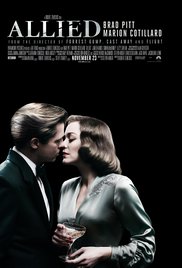
The World War II romance thriller, ALLIED feels like the old Hollywood war romances like CASABLANCA, the kind that featured top Hollywood stars like Humphrey Bogart and Ingrid Bergman. Part of the reason is at the film’s start, the hero, Max Vatan (Brad Pitt) parachutes down to the Moroccan desert only to land make way to Casablanca where he meets his mission-assigned wife, Mairanne Beausejour (Marion Cotillard).

The story is set in 1942 North Africa. Canadian intelligence officer Max Vatan (Brad Pitt) meets French Resistance fighter Marianne Beausejour (Marion Cotillard) on a secret mission behind enemy lines. The couple reunites in London and get married, eventually having a daughter together. Their relationship is strong and normal but becomes threatened by the brink of war, as Vatan is presented with the possibility that Beausejour is a sleeper spy working for the Germans. Vatan is then placed under considerable pressure to kill Beausejour himself or to be executed for failing to obey orders. Convinced of her innocence, he sets out on a very dangerous mission to clear her name.

Zemeckis creates and maintains a solid tense atmosphere throughout the film. The few action sequences (the assassination of the German ambassador; the prison break) are executed efficiently without much ado, keeping in line that ALLIED is a suspense thriller and not an action flick. The romance between Pitt and Cotillard works. The love scene is executed with finesse and taste with the sexiness intact. The couple make love in the car, the scene ending with the sand storm outside the vehicle blurring the windows of the vehicle.

ALLIED is a star movie, no doubt about that. The film would be so much less effective if Brad Pitt and Marion Cotillard were replaced with lesser known actors, just as CASABLANCA cannot be envisioned without Bogart and Bergman. British actor, handsome Matthew Goode is hardly recognizable in the role of Guy Sangster, whose face is scarred by the war. The film has a gay slant with the addition of Max’s lesbian sister, Bridget (Lizzy Caplan) who in one ironic scene is asked by soldiers as a request to kiss her female companion.

For all the film’s seriousness, Zemeckis adds in some very wry humour, especially in the scene where Max is confronted with orders to kill Beausejour.

Zemickis makes sure these questions remains on the mind of every member of the audience: Is Beausejour really a German spy? If she is, would Max complete his duty and kill her? Despite the obvious answers to the two questions, Zemeckis pulls a good twist to the story at the end.

ALLIED proves once again the talent of director Zemeckis. He has proven his mettle with films of different genres like the BACK TO THE FUTURE films, THE POLAR EXPRESS, WHO FARMED ROGER RABBIT and of course, FORREST GUMP. Allied adds another success to his list.

Trailer: https://www.youtube.com/watch?v=HSCQWX-pUSg
 

Free logline submissions. The Writing Festival network averages over 95,000 unique visitors a day.

Great way to get your story out: http://www.wildsound.ca/logline.html

Deadlines to Submit your Screenplay, Novel, Story, or Poem to the festival:http://www.wildsound.ca

Watch recent Writing Festival Videos. At least 15 winning videos a month: http://www.wildsoundfestival.com

Special Film Review: THE BIRTH OF A NATION (USA 2016)

birth_of_a_nation_poster.jpgDirected by Nate Parker

Starring: Nate Parker, Armie Hammer, Penelope Ann Miller

Review by Gilbert Seah

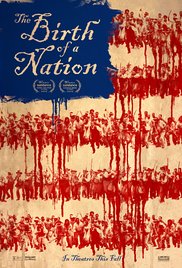
Writer/director Nate Parker debut drama uses the same title of one of the most instrumental films in early cinema history. D.W. Griffith’s THE BIRTH OF A NATION was considered one of the best films in early cinema and one that would influence filmmakers everywhere and at any time. But Griffith’s film was racist against the African American and boosted white supremacy and the KKK Ku-Klax clan. Parker uses the same film title hoping it to be a corrective reclamation of cinematic history. This is all very ambitious, especially for a young filmmaker, and even more so for one that has been accused, though acquitted of the rape of a fellow student.

Whether one can argue that an artist should be separated from his work and real life, it is difficult to care for the words of an accused rapist – guilty or not. The result is that the film will likely be ignored by the Academy during Oscar season.

Born into slavery in Virginia’s Southampton County, young Nat (Nate Parker) is given to dreams in which his African ancestors anoint him a prophet. He is favoured by his masters, learns to read, and is given a Bible. By the time he is an adult, Turner has become a preacher capable of rousing oratory. He convinces his master Samuel Turner (a barely recognizable bearded Armie Hammer) to purchase Cherry (Aja Naomi King), whom Turner eventually weds. Their romance proves a fleeting idyll, however. Turner is rented out to preach at other plantations where, after years of relatively humane treatment, he becomes fully aware of the depravity and torture wreaked upon slaves — and decides that sermons are no longer a sufficient response to such appalling injustice.

Finally Nat leads a slave revolt. It lasts 48 hours but the result is disastrous. The Whites retaliate by hanging 200 innocent slaves. Nat turns himself in, and is hung.

Earnest as Parker’s film may be, its is an ambitious fone – and too ambitious to a fault. At times, Parker does not know where to go, just as his main character is lost after his initial revolt. The character Nat Parker has failed to realize the consequences of his actions – how much more firepower and strength the Whites have. Even if successful, where are all the freed salves going to go? And where to work and live and survive in a blackless commercial world. There is also one scene with a slave cutting the beard of Samuel Turner with a pair of very sharp scissors with Nat looking on. A puzzling scene which appears to be a nod to the Oprah Winfrey shaving scene in Steven Spielberg’s A COLOUR PURPLE.

The transition from one period to another in a character’s is often difficult. The transition of young Nat to Nat the adult is observed in the fade out and in of a cotton plantation where Nat re-appears as an adult.

The film though jolting at times (Nat’s lashing after baptizing a White; the violent slave uprising; the hanging), Parker’s film is a
conventional told tale, chronologically laid out and inevitably offering audiences what is expected from such a film (wealthy white folk living in a big white mansion in a plantation; cruel slave hunters;
insufferable slave living condition et al.). One would expect more from a film with an ambitious a title like THE BIRTH OF A NATION. Still, it is a story, well told and challenging enough transmitted through Parker’s craft.

Trailer: https://www.youtube.com/watch?v=ezWiUTXB11A


TV CONTESTSUBMIT your TV PILOT or TV SPEC Script
Voted #1 TV Contest in North America.
FILM CONTESTSUBMIT your SHORT Film
Get it showcased at the FEEDBACK Festival
writing CONTEST1st CHAPTER or FULL NOVEL CONTEST
Get full feedback! Winners get their novel made into a video!
SCREENPLAY CONTESTSUBMIT your FEATURE Script
FULL FEEDBACK on all entries. Get your script performed

Film Review: QUAND ON A 17 ANS (BEING 17) (France 2016) ****

being_17QUAND ON A 17 ANS (BEING 17) (France 2016) ****
Directed by Andre Téchiné

Starring: Sandrine Kiberlain, Kacey Mottet Klein, Corentin Fila

Review by Gilbert Seah

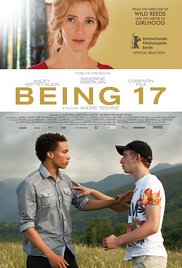
Directed by Téchiné with a script he wrote in collaboration with Céline Sciamma, the film follows the romantic and sexual awakening of two seventeen year old boys as their initial animosity, expressed in violence, morphs into love. For the not-so French literate, Being 17 borrows its title from the second half-line of the first verse of Roman, (1870) by Arthur Rimbaud: On n’est pas sérieux quand on a dix-sept ans.

This is not their first collaboration. Téchiné and Sciamma have worked on several films before including the quite similar and excellent LES ROSEAUX SAUVAGES (WILD REEDS) in 1994 also about young gay love.

The film unfolds in 3 trimesters (three French school terms in a year). The first occurs in winter and the final after summer. The protagonist is 17-year old Damien, a smart (good in math) and sensitive (good in poetry) who lives with his doctor mother and absent father, Nathan a fighter pilot abroad. They lead a relatively comfortable life in a small town located in a valley among the mountains of the Hautes-Pyrénées. Mother and son miss Nathan who comes home occasionally when the military allows.

In high school, Damien gets picked on by Thomas, a classmate, who trips him in the middle of class for no apparent reason. From then on there are constant altercations between them while playing sports and in the schoolyard. Both are outsiders at school chosen last for sports teams. In order to protect himself, Damien takes self-defense classes with Paulo, an ex-military family friend. The film goes from there with the story turning into young love – with raging hormones expected of youth at the age of 17.

The main story is supported by significantly moving subplots about Thomas’ adoptive mother bearing a child and Damien’s father’s death, the catastrophe that eventually brings the two boys together.

The change of seasons reflect the sexual awakening of the boys. When the boys are in school the first trimester is set in winter, their sexual desires are as if, hidden in the cold. As spring approaches, Damien’s sexual attraction towards Thomas awakens. An excellent segment also occurs later in the film when the two study Latin and discuss the difference between desire and need. Desire is natural but superfluous and pretentious, the reason Thomas tripped Damien in the classroom as he deemed Damien’s poem as open pretentiousness.

The shooting of the film in the winter in the mountains of the Hautes-Pyrénées makes stunning scenery. And the sight of the small town from the mountain top, as shown by Thomas to Damien’s mother is breathtaking.

For a director over 70, Téchiné captures the vibrance of youth. This can be observed best in the scenes in Damien’s school as the kids goof around, take part in sports or take lessons in the classroom. It is also rare in films that both adults and youth are treated as intelligent. In fact, every character is intelligent enough to have a valid say in the story. BEING 17 is both a moving and enlightening entertainment that marks once again another superior work from Téchiné.

Trailer: https://www.youtube.com/watch?v=YOSPninRQwI


Also, Free logline submissions. The Writing Festival network averages over 95,000 unique visitors a day.
Great way to get your story out: http://www.wildsound.ca/logline.html

Deadlines to Submit your Screenplay, Novel, Story, or Poem to the festival:http://www.wildsound.ca

Watch recent Writing Festival Videos. At least 15 winning videos a month:http://www.wildsoundfestival.com

Film Review: FANTASTIC BEASTS AND WHERE TO FIND THEM

fantastic_beasts_movie_poster.jpgDirector: David Yates

Writer: J.K. Rowling

Stars: Eddie Redmayne, Katherine Waterston, Alison Sudol

 Review by Gilbert Seah

The spin-off of the HARRY POTTER films that began as one of Harry Potter’s text books in HARRY POTTER AND THE SORCERER’S STONE, FANTASTIC BEASTS is a Harry Potter film without Harry Potter. Directed by David Yates who did a number of the Potter films, FANTASTIC BEASTS looks just like a J.K. Rowling film (she wrote the screenplay) despite the fact that it is set in New York City. Perhaps the fact that the film was shot in Liverpool to stand in for NYC could be a reason.

The book contains the history of Magizoology and describes 85 magical species found around the world. To get into the spirit of Harry Potter, Albus Dumbledore, headmaster of Hogwarts (not shown in the film), provides the Foreword and explains the purpose of the special edition of this book (the Comic Relief charity). At the end, he tells the reader, “…The amusing creatures described hereafter are fictional and cannot hurt you.” He repeats the Hogwarts motto: “Draco dormiens nunquam titillandus”, Latin for “Never tickle a sleeping dragon”.

Harry Potter is replaced in FANTASTIC BEASTS by a new protagonist, a magizoologist called Newt Scamander, who at the start of the film arrives at Customs in NYC from a boat. He carries a suitcase that contains mythical creatures from his travels – creatures that predictably escape with Newt chasing them all around the city. The creatures are undoubtedly cute and weird, but the chase sequence at the film’s start runs too long. It feels like Peter Jackson’s KING KONG when the gorilla runs amok in NYC.
But Newt (Oscar Winner Eddie Redmayne) makes a good Rowland hero – a welcome difference from the alpha-male superhero that has graced cinema screens much too often. Newt is shy, wary of romance and bumbling without being too clumsy. Redmayne does well with his mannerisms often whispering instead of shouting his lines.

If there is an Oscar winner in any department, my bet would be another Oscar in the wardrobe department for Colleen Atwood. Her costumes are nothing short of magnificent.

The plot of the film can be briefly summed up as “the adventures of writer Newt Scamander in New York’s secret community of witches and wizards seventy years before Harry Potter reads his book in school.” It is quite clear that the film has a narrative as weak as the hero’s personality. The story also suffers from the lack of a true villain. The villain in this piece, in the form of Percival Graves (Colin Farrell) pops up not often enough. The sequel which is reported to have Johnny Depp in the starring role as the evil wizard Gellert Grindelwald should add the necessary spice into the magic formula. Depp has a small cameo in FANTASTIC BEASTS.

But for a whopping $180 million production cost, Yates’ film dazzles the audience well enough though one might complain that the film is too full of special effects. In fact the film lacks a better story. An example is the first Harry Potter in the franchise, which is not the best but survived as the most watchable because it traces the beginning of Harry with a good solid storyline of him being an orphan and first sent to wizard school. FANTASTIC BEASTS AND WHERE TO FIND THEM should break all box-office records regardless and prepare audiences for the next four in the new franchise.

Trailer: https://www.youtube.com/watch?v=Vso5o11LuGU


SUBMIT your Short Screenplay or TV SPEC Script
Voted #1 TV Contest in North America.
SCREENPLAY CONTESTSUBMIT your Short Screenplay or FEATURE Script
FULL FEEDBACK on all entries. Get your script performed
SCREENPLAY CONTESTFIRST SCENE (first 10pgs) SCREENPLAY CONTEST
Submit the first stages of your film and get full feedback!

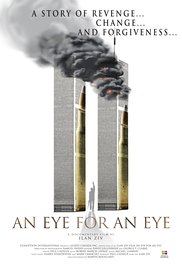
Film Review: AN EYE FOR AN EYE (Documentary)

an_eye_for_an_eye_poster.jpgAN EYE FOR AN EYE (USA/Canada 2016) **
Directed by Ilan Ziv

Review by Gilbert Seah

Israeli filmmaker Ilan Ziv’s (SIX DAYS IN JUNE) documentary tells the story of death row inmate Mark Stroman and the friendship he forges with one of his surviving victims Rais Bhuiyan, who set about to save Stroman from death row as part of his Muslim faith beliefs.

From 2004 and for the next 7 years, filmmaker Ilan Ziv met and befriended Mark Stroman on Texas’ infamous Death Row, where he had been since his capital murder conviction in 2002. At trial Stroman was described by the prosecutor as a “monster, a cancer to society”, yet Ilan was perplexed to meet a complex man full of contradictions, who shared the same troubled soul as the most recent “lone wolves” who used Jihad as a cover for their personal failings and justification for their crimes. By then, Stroman had become a man in search of meaning and redemption. So Ziv set out to document what he called “the enigma of Mark Stroman.”

Unfortunately the film concentrates on Stroman. The interviews conducted by Ziv’s visits in prison depict Stroman as not a very bright person. A film is often as interesting as its subject – and Stroman is simple minded fellow. Stroman declared himself a ‘lone wolf’ and began killing random Arabs in retaliation for the 9/11 town towers attacks. But Stroman believed his victims were Muslims from the Middle East – but they were actually immigrants from Pakistan, Bangladesh and a Hindu from India who had absolutely nothing to do with the 9/11 attacks. He killed two and partially blinded a young man from Bangladesh. Arrested and sentenced to death in the state of Texas, this man’s life is just one big mistake that few can feel sorry for.

Ziv spends too much time in the film trying to convince the audience that Stroman is not a bad guy. When the film begins, Ziv says in voiceover, that when he first visited Stroman he expected to see the eyes of a killer but did not. Ziv also shows the explosions of the twin towers in all their horror not once but twice in the film to convince the audience the reason for Stroman’s motive. He further explains Stroman’s childhood background – how he was always beaten by his step-father and arrested at the early age of 12. Despite the horrors of Stroman’s crime, Stroman is not a very interesting person, so investing so much interview time on him drags the film. Stroman’s former boss/employer’s description of Stroman sheds more light on him.

When Stroman asked for forgiveness from his victims, one of his surviving victims Bhuiyan publicly forgave him, in the name of his religion and its notion of mercy. The film shifts to the two months before Mark’s execution when Rais waged a legal and public relations campaign against the State of Texas and Governor Rick Perry, to have his attacker spared from the death penalty.

The film has one moving part when director Ziv is invited by Stroman to witness his execution. Ziv says that this is the time he crossed the line from a reporter to being Stroman’s friend.

What does not work in the film is Ziv attempts to create some excitement in the film by counting down of the days before Stroman’s execution while showing the desperate legal tactics used one by one by the lawyers till there were none left.

Ziv’s film has a strong message of peace and redemption. He uses the wrong devices to deliver the message ending up sentimentalizing and muddling up the film’s power.

Please note that in a special appearance, the inspiring and hopeful Rais Bhuiyan will engage in discussion at screenings of AN EYE FOR AN EYE on Monday, November 14th at 5:20 p.m. and 7:50 p.m. at Canada Square Cinemas, 2190 Yonge St, Toronto.

Trailer: https://vimeo.com/177747964


SUBMIT your TV PILOT or TV SPEC Script
Voted #1 TV Contest in North America.
FILM CONTESTSUBMIT your SHORT Film
Get it showcased at the FEEDBACK Festival
writing CONTEST1st CHAPTER or FULL NOVEL CONTEST
Get full feedback! Winners get their novel made into a video!
SCREENPLAY CONTESTSUBMIT your FEATURE Script
FULL FEEDBACK on all entries. Get your script performed

Film Review: NOCTURNAL ANIMALS. Starring: Amy Adams, Jake Gyllenhaal

nocturnal_animals_poster.jpgNOCTURNAL ANIMALS (USA/UK 2016) ***1/2
Director: Tom Ford

Writers: Tom Ford (screenplay), Austin Wright (based on the novel “Tony and Susan” by)

Stars: Amy Adams, Jake Gyllenhaal, Michael Shannon

Review by Gilbert Seah

Fashion designer Tom Ford’s second film after his successful acclaimed A SINGLE MAN is by no means a perfect film, but Ford is a director who can command an audience’s attention. Made up of a number of serious set-pieces, NOCTURNAL ANIMALS is a handsome mounted production, sleek and chic like Tom Ford’s designs.

The protagonist of the piece is a successful Los Angeles arts gallery owner and designer by the name of Susan (Amy Adams). Susan often has sleepless nights and could thus be classified as a nocturnal animal. Her ex-husband Tony (Jake Gyllenhaal) has recently completed a book titled NOCTURNAL ANIMALS, about three redneck thugs who prey on a family after carjacking them. Tony sends Susan a copy of his manuscript to read as a privileged reader.

There are dual narratives in the film as there are dual universes – the real and the art worlds. The art world is the one Susan is successful in and the real is comprised of her failed marriages – the first to her ex-husband Tony who she never supported and the second being her present marriage. Susan is currently in a loveless relationship with a prick of a doctor husband (Armie Hammer) – as handsome as he is deceitful. As Susan reads Tony’s manuscript the film shifts to the terrorized family of a teacher (also portrayed by Gyllenhaal) whose wife (Isla Fisher) and daughter have been raped and murdered by three thugs. As the story reaches different shock pieces, Susan is jolted from reading of the book as the audience is shifted between Susan’s and the teacher’s world.
Ford’s film has the feel of a David Lynch film – like MULHOLLAND DRIVE and BLUE VELVET, though it never reaches those mesmerizing levels. As in Lynch’s two films, the protagonist is landed in a strange new world of darkness. The blackness of night and the grainy lights, as seen from the headlights of the vehicles in NOCTURNAL ANIMALS effectively create the atmosphere of unknown menace.

In NOCTURNAL ANIMALS, the topic of redemption takes centre stage. First is Susan’s redemption, as she tries her best to make her present marriage work despite her husband’s non-effort. Secondly, the teacher feels guilty when his wife and daughter are murdered and desires revenge. Ford shows the audience right away the man’s thought in a painting in Susan’s gallery with the word REVENGE painted boldly on canvas – a rare scene in which both worlds merge. The revenge is finally exacted when the teacher finally loses it, as demonstrated in the only scene with Gyllenhaal screaming his guts out. The best performance in the film belongs to Michael Shannon who plays the disgruntled police officer assigned to the case. Suffering from lung cancer, he has nothing to lose in wanting to bring the criminals to justice regardless the consequences. The film picks up whenever his character is on screen with him coughing up the scenery.

But the story in the manuscript turns out more exciting and absorbing than Susan’s story, thus eclipsing the more important narrative. But Ford’s film is not without his indulgent pleasures, like his stunning opening sequence in Susan’s art gallery where four older obese women dance in the nude with sparklers. The sequence emphasizes the irrelevance of the art world on the real world and vice versa.

The company formed for the film’s production is called “Fade to Black”, the camera technique that closes the film. Intriguing but not always as clever as it ought to be, NOCTURNAL ANIMALS is still a pleasurable and absorbing watch, by any standard.

Trailer: https://www.youtube.com/watch?v=-H1Ii1LjyFU


SUBMIT your TV PILOT or TV SPEC Script
Voted #1 TV Contest in North America.
FILM CONTESTSUBMIT your SHORT Film
Get it showcased at the FEEDBACK Festival
writing CONTEST1st CHAPTER or FULL NOVEL CONTEST
Get full feedback! Winners get their novel made into a video!
SCREENPLAY CONTESTSUBMIT your FEATURE Script
FULL FEEDBACK on all entries. Get your script performed

Film Review: BLEED FOR THIS (USA 2014) ***1/2

bleed_for_this_movie_posterDirector: Ben Younger
Writers: Pippa Bianco (story), Angelo Pizzo (story), Ben Younger (Screenplay)
Stars: Miles Teller, Christine Evangelista, Katey Sagal, Aaron Eckhart, Ciarán Hinds, Ted Levine

 As the title of the film suggests, the success of a boxer depends also on how well he can receive hard punishment in the ring. For real-life Rhode Island boxer Vinnie Paz, the biggest hit he was dealt with was not in the ring, but in life, getting into a car accident that left him almost paralysed.

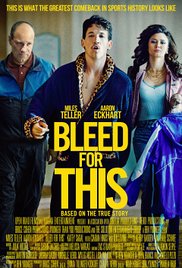
BLEED FOR THIS is a boxing drama/action film which lies somewhere between David O. Russell’s THE FIGHTER and Stallone’s ROCKY films in terms of action and drama. The film is so called because the boxer, Vinny Paz (Miles Teller) is able to receive bloody punishment in the ring with almost no bounds. Audiences beware! There is a lot of brutal an bloody fight scenes in BLEED FOR THIS.

The film is a true story of boxer Vinnie Paz. The boxer’s ring name is the Pazmanian Devil. Paz is one of few American boxers to hold world titles (encouraged by his coach) in three different weight categories, had his ascent interrupted by a cataclysmic accident. Family is everything to young Vinny. There’s his father, Angelo (Ciarán Hinds), his religious mother, Louise (Katey Sagal), who avoids her son’s televised fights by hiding in a hallway-closet Catholic shrine, and several fractious siblings. They are all trying to make their way in working-class Rhode Island, and their hopes are pinned on Vinny’s boxing. He has every intention of fulfilling everyone’s dreams, but he just can’t seem to find the edge he needs to get ahead. That changes when he meets Kevin Rooney (Aaron Eckhart), a coach whose problems with alcohol have led to the destruction of his own career. Each finds in the other a second chance. The two bond, they train hard, and Vinny’s success seems assured — until a terrible car accident leaves him with a broken neck. The prognosis is that he will never walk again, let alone enter the ring. This is a story of a comeback, and part of it is a redemption story. Director Younger succeeds in showing both the painful but rewarding sides of the story.

Despite the serious nature of the film, director Younger (BOILER ROOM), who also wrote the film, is smart enough to inject humour at various parts of his storytelling. Most of the moments are provided by Eckhart, hamming it ip as Vinnie’s trainer.

There are three excellent performances that deserve mention. The first, of course is the lead performance by Miles Teller. Teller was then pudgy and played the pudgy, obnoxious male friend trying to get a date in THAT AWKWARD MOVEMENT. Teller proved his acting ability in WHIPLASH, showing he was just as good as Oscar Winner J.K. Simmons. In BLEED FOR THIS, Teller has also bulked up to the physique of a boxer.

He captures the drama with both the pain and exhilarance of fighting in the ring. The other two are the supporting actors. The handsome Aaron Eckhart has done the opposite, putting on weight to be a pudgy alcoholic trainer while Ciaran Hinds plays Vinnie’s fiery and domineering father. All three are deserving of an Oscar nomination in the acting category.

Trailer: https://www.youtube.com/watch?v=zQ6ny-fROX8

SUBMIT your TV PILOT or TV SPEC Script
Voted #1 TV Contest in North America.
FILM CONTESTSUBMIT your SHORT Film
Get it showcased at the FEEDBACK Festival
writing CONTEST1st CHAPTER or FULL NOVEL CONTEST
Get full feedback! Winners get their novel made into a video!
SCREENPLAY CONTESTSUBMIT your FEATURE Script
FULL FEEDBACK on all entries. Get your script performed