Movie Review: DARK HORSE (UK 2014) ***1/2

Deadlines to Submit your Screenplay, Novel, Story, or Poem to the festival: http://www.wildsound.ca

darkhorse.jpgDARK HORSE (UK 2014) ***1/2
Directed by Louise Osmond

Review by Gilbert Seah

If one is to check imdb the internet film database, there has been no less than 4 films since 1992 that have the identical title of DARK HORSE. But this 2014 documentary by Louise Osmond is the only one that is actually about a horse – and a dark horse, not destined to win any race. DARK HORSE is the inspirational true story of a Welsh group of friends from a working men’s club who decide to take on the elite ‘sport of kings’ and breed themselves a racehorse. And one that went on to win Britain’s Grand National, enriching a lot of lives.

Director Osmond plays it safe for her documentary. The doc traces the beginning to end of the life of Dream Alliance (the horse’s name) with various highlights of him winning many races. There is also an obstacle portion near the end when Dream Alliance runs into trouble with a serious accident. “It is the end”, everyone thinks but miraculously, thanks to stem cell surgery, the horse emerges recovered and ready to race again. Will he continue to win?

The film is made up mostly of interviews by the owners of Dream Alliance oddly called the syndicate, made up of a good number of common Welsh folk. The rest is made up of archive footage of races. One wonders about the footage of the surgery of the horse undergoing stem cell surgery as it seems that it is something just put together like a re-enactment. But one can forgive Osmond for trying.

Osmond proves to be an expert at pushing all the right buttons. She primes the audiences at the very start of the film to get their hearts pumping. The narrative voiceover goes: the greatest race in the world; we were there; can be something, given the chance. She goes on to show, comically how it all got started, in a pub. It is hard not to root for common decent folk like this tight Welsh mining community coming up with a tenner a week to breed a race horse. It is wonderful to see a pub full of beer drinkers watching the television, cheering for their favourite horse at a race.

Osmond’s sense of humour works though odd at times. The funniest is her revelation of a subjects’s teeth (the subject shown at various points in the film with only two front teeth) at the end of the film.

DARK HORSE has been wowing audiences wherever it has been played. It has won the British Independent Film Award for Best Documentary and the Audience Award at Sundance for World Cinema Documentary. Everyone loves an underdog story, or in this case an underhorse story and the best thing about all this is that the story is a true life fairy tale come true.


Also, Free logline submissions. The Writing Festival network averages over 95,000 unique visitors a day.
Great way to get your story out: http://www.wildsound.ca/logline.html

Deadlines to Submit your Screenplay, Novel, Story, or Poem to the festival:http://www.wildsound.ca

Watch recent Writing Festival Videos. At least 15 winning videos a month:http://www.wildsoundfestival.com

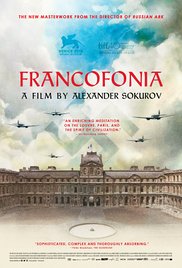
Movie Review: FRANCOFONIA (France/Germany/Netherlands 2015) ****

Deadlines to Submit your Screenplay, Novel, Story, or Poem to the festival:http://www.wildsound.ca

francofonia.jpgFRANCOFONIA (France/Germany/Netherlands 2015) ****
Directed by Alexandre Sukorov

Review by Gilbert Seah

Is the Louvre worth more than all of France?

Alexandre Sukorov made a name for himself directing the excellent documentary on Leningrad Museum years back, the entire exercise shot in one single take. FRANCOFONIA is a mixed documentary/re-enacted drama on the Louvre in Paris, arguably the most visited museum in the world, a museum that made Paris. And in the words of director, Sukorov who voices the film’s narrative, museums make the cities of the world.

The approach taken in this film is different as the idea of the two above mentioned films are different. What is the subject here is the restoration of the art pieces of the Louvre – especially during World War II during the German Occupation. As Germany invaded France, the government, citizens and Louvre officials all escaped south, for safety and stability. All but one, the Louvre Director Jacques Joujart who remained to prevent the treasures of the Louvre from becoming the spoils of the war and from landing in the hands of art lovers like Hitler and his consorts.

FRANCOFONIA is a complex and meditative film. It erases the barriers of time. Napoleon Buonaparte (played by Vincent Nemeth) frequently waltzes into the halls of the Louvre as the boat that transports the museum travels tosses among the strong waves of the ocean. The past and present are drawn together and at the film’s climax the two lead characters are advised of their death in the future.

Though the film delves on several issues, the main one is set in the June of 1940. German troops march into Paris. The two lead characters are Jacques Jaujard, Louvre director and German Count Franziskus Wolff Metternich (played in the film by Louis-Do de Lencquesaing and Benjamin Utzerath). It would seem that they are enemies, but it gradually becomes clear that they are not and that they have a lot in common. The period of their meeting, their confrontation and their cooperation during the Second World War to protect and preserve the treasures of the Louvre forms the bulk of FRANCOFONIA. By telling their story, Sokurov explores the relationship between art and power, and asks what art tells us about ourselves, at the very heart of one of the most devastating conflicts the world has ever known.

As Sukorov is Russian, it is only natural that he brings a Russian slant into his film. The Hermitage in Leningrad is more often than not tied in with the film’s narrative. WWII is also compared to the Russian war with the Bolsheviks. There are some chilling scenes added such as the image of a little girl lying dead on the steps of a building. As the narrative goes… no one to bury them, too tired to bury them. And if you think things cannot get any worse, a frozen child and mother on the street are the next subjects. The child is then taken, probably eaten, and the mother’s leg is missing.

Like RUSSIAN ARK, FRANCOFONIA is a profoundly beautiful film. Sukorov’s love for art is evident from the first to the last frame of his film. At the end audiences around the world will be grateful to Sukorov, who like the great two men in the film, has preserved art, in this case of the Louvre and its treasures, forever on film. Highly recommended to anyone who owns at least one painting.

The film is shot largely in Russian and French with a little English.


Also, Free logline submissions. The Writing Festival network averages over 95,000 unique visitors a day.
Great way to get your story out: http://www.wildsound.ca/logline.html

Deadlines to Submit your Screenplay, Novel, Story, or Poem to the festival:http://www.wildsound.ca

Watch recent Writing Festival Videos. At least 15 winning videos a month:http://www.wildsoundfestival.com

Short Film Movie Review: LIKE IN THE MOVIES (5min, Italy, Documentary)

LIKE IN THE MOVIES played to rave reviews at the WILDsound FEEDBACK Film Festival in January 2016.

  MOVIE POSTER

LIKE IN THE MOVIES, 5min, Italy, Documentary

Directed by Francesco Faralli

Following his cinephile passion, Daniele Bonarini (from the Association “Il Cenacolo Francescano”), realizes digital feature films shot with the enthusiastic support of friends and volunteers using disabled persons as actors.

Movie Review by Amanda Lomonaco:

This is the second of Francesco Faralli’s films that I’ve seen, and the second with Tiziano Barbini’s participation, and I can’t help but smile every time. There is something truly wonderful in the work that Faralli does by making films with the disabled. He creates true masterpieces, and, in pretending, provides us with a deep look into who these people really are.

There is a split second where you’re watching Faralli’s films where I noticed myself laughing at a disabled person, a concept that I had always imagined appauling. Nevertheless, it’s impossible to not laugh while watching Faralli’s work. Him and his actors create wonderfully heartwarming stories that demonstrate just what the disabled are truly capable of, and I can truly say it’s a hell of a lot more than I can do.

Tiziano Barbini is one Faralli’s most popular leading men, and together the pair have won several awards in film festivals world wide. Tiziano, at least in Faralli’s films, is a very positive, loving, and emotional person, who seems to experience every detail of the world with the intensity most of us reserve for more extreme achievements. He truly exemplifies the concept of living life to the fullest, and appreciating every moment, smiling at the smallest of details, and pointing out beauty everywhere he goes.

Perhaps it’s just because I’m a sentimental ball of mush, but I could watch Faralli’s films a million times and never get bored of them. Tiziano stole my heart in the very first of his documentaries that I watched, and without ever even meeting him, I know he’ll always be able to bring a smile to my face. I don’t know if everyone would enjoy this film as much as I did. The audience at Wild Sound certainly seemed to give it a very positive reception. In any case I urge you to look in to some of Faralli’s work. What he is doing both for the independent film industry and for the disabled community in Italy is amazing, and it deserves more attention from all of us.

Watch the Audience FEEDBACK Video of the short film

Movie Review: WHERE TO INVADE NEXT. (USA 2015) ***

Deadlines to Submit your Screenplay, Novel, Story, or Poem to the festival: http://www.wildsound.ca

where_to_invade_nextWHERE TO INVADE NEXT. (USA 2015) ***
Directed by Michael Moore

Review by Gilbert Seah

When the title of Michael Moore’s new movie WHERE TO INVADE NEXT. was announced at the Toronto International Film Festival, it was followed by an auditorium of laughter. What would s***-disturber Michael Moore come up next to enrage his new film subject(s)? His then new film was totally hush-hush till it premeired at TIFF. Surprisingly, WHERE TO INVADE NEXT. offends no one. It is a crowd-pleaser with Moore even praising the United States, though only at the film’s very end. Moore must be getting soft in his old age.

The premise is a neat one. Moore travels to different countries, steals the ideas that work and returns with them to the United States. Moore plants the American flag wherever he travels in victory after stealing the ideas, though many countries would gladly have the U.S. adopt them. Italy is first visited first. Th idea of paid vacations, extended holidays and happy workers is the norm of the Italians. In France, it is the wonders of a different public school cafeteria food that makes the difference in healthy kids. Other countries visited include Germany, Portugal, Norway, Iceland and the highly surprising Slovenia and finally Tunisia. It is a fun trip. But the film runs long at close to 2 hours and like any vacation, no matter how entertaining, can grow a bit tiresome.

But what Moore clearly misses out on are the reasons the United States can never follow the ‘stolen’ policies of Moore’s invaded countries. One cannot just take one working concept from one country and implement it into another. Culture, upbringing of the people all come into play. Americans are known to be taught to be individualistic, and one against all, quite unlike for example the asians where, respect for oneself comes last.

Unlike Moore’s other films like ROGER AND ME and BOWLING FOR COLUMBINE in which the subjects were very focussed like GM’s auto factory and gun availablity, this film is scattered and is all over the place like the countries he hops to, one after another. Why did Moore pick most of the countries in Europe, one from Africa and none from Asia? There is also no reason for the order of his countries in terms of the importance of policies.

But Moore captures the film’s idea in one brilliant segment in which he asks a Tunisian woman to give a two-minute advice to the American people. “If you have to minutes of advice to give to the American people, what would it be?” And what she says hits the nail right on the head. This is the common theme tying in all of the film’s ideas of what makes a country work. The film contains many other moving moments like the one in which a Norwegian father of a dead son (the 2011 Norway summer camp massacre) confesses that getting revenge on his son’s killer solves nothing.

Moore’s film is nicely concluded, like a textbook with an ending to please the U.S. Moore says all the success stories from the countries have all originated from ideas in the United States. All the Americans need to do is to follow. But easier said than done. In this way, Moore tries the other way, (compared to using anger as, in his other films) i.e using niceness to get his point across.

The result is a crowd-pleasing, very entertaining film that somehow will have the same difficulty of getting Moore’s point or points implemented. The question is whether audiences like the nastier old Moore or the nicer new Moore.

Also, Free logline submissions. The Writing Festival network averages over 95,000 unique visitors a day.
Great way to get your story out: http://www.wildsound.ca/logline.html

Deadlines to Submit your Screenplay, Novel, Story, or Poem to the festival:http://www.wildsound.ca

Watch recent Writing Festival Videos. At least 15 winning videos a month:http://www.wildsoundfestival.com

Movie Review: FLORENCE AND THE UFFIZI GALLERY 3D/4K (Italy 2016)

Deadlines to Submit your Screenplay, Novel, Story, or Poem to the festival:http://www.wildsound.ca

FLORENCE AND THE UFFIZI GALLERY 3D/4K (Italy 2015) ***1/2
Directed by Luca Viotto

One of the world’s greatest attractions in Florence, Italy is the Uffizi Gallery and the central dome.  It is Renaissance art at its finest.  Cineplex’s Third Season of ‘In The Gallery’– A Spectacular Cinematic Tour of Exhibits From Around The World features this attraction.

The documentary both explores and discovers the city of Florence, artistic home to legendary figures like Michelangelo, Brunelleschi, Raphael, Leonardo and Botticelli with a detailed, central chapter dedicated to the very treasure house containing their masterpieces: the Uffizi Gallery.  The ‘secret story’ of each of the timeless works of art in the gallery is disclosed in all its beauty, including the breathtaking “Adoration of the Magi” by Leonardo Da Vinci, which will be brought back to life in 2016, after several years of restoration, and here unveiled in worldwide exclusive premiere on the big screen.  Also, a fascinating, Gothic-flavoured interlude will display much darker, more monstrous and frightening paintings, such as those by Caravaggio.

Several other selected paintings are also displayed on the screen with great 3D detail and with voiceover interpretation.  Who could ask for anything more?  The audience is given full access to proximity of greatness without having to fight with the crowds for a viewing.  

Among my favourites shown in the film is the painting: The Birth of Venus (Italian: Nascita di Venere [ˈnaʃʃita di ˈvɛːnere]) by Sandro Botticelli (mid 1480’s).   Voiceover informs the history that Botticelli was commissioned to paint the work by the Medici family of Florence, specifically Lorenzo di Pierfrancesco de’ Medici under the influence of his cousin Lorenzo de’ Medici, close patron to Botticelli.   The painting depicts the goddess Venus, having emerged from the sea as an adult woman, arriving at the shore on a shell.  Zepher blows accompanied by Chloris.

A fair portion of the film features actor Simon Merrells portraying Lorenzo Il Magnifico talking abut his art as if his character is alive.  This is not really credible nor does anything above a normal voiceover.  Moreover, Merrells is not a particularly good actor either.   These segments be best edited out of the film.

The Gallery attracts about 2 million visitors annually.  This is the chance for filmgoers to experience a unique experience without having to travel to Florence or weave through the crowded halls in a gallery not originally designed to be a visitor’s museum.  The film, a multidimensional and multi-sensory journey in the Florentine Renaissance through its most representative beauties, where the latest-generation 3D and 4K technology and the most advanced techniques of modelling and dimensionalization are put at the service of the national artistic heritage to valorise it and to export it all over the world is a definite must-see!  The film took the Italian box-office by storm scoring first place in its first two days of initial release.

This is a special presentation with limited screenings.  Showtimes are: 3D presentation on Jan 21 and the 2D presentation on Feb 21.


Also, Free logline submissions. The Writing Festival network averages over 95,000 unique visitors a day.
Great way to get your story out: http://www.wildsound.ca/logline.html

Deadlines to Submit your Screenplay, Novel, Story, or Poem to the festival:http://www.wildsound.ca

Watch recent Writing Festival Videos. At least 15 winning videos a month:http://www.wildsoundfestival.com