Movie Review: UNTIL DEATH DO US PART, (USA, LGBT, Documentary)

Played at the August 2017 DOCUMENTARY Short Film Festival

by Kierston Drier

Directed by Kristine Kirchmeier, Until Death Do Us Part, is a remarkable short documentary hailing from the USA chronicling the harrowing story of newlyweds Megan and Danielle and their battle with cancer. Only two days before their wedding, Megan is diagnosed with stage four cancer.

What follows in story about two incredibly brave people- made brave by the power of love. Faced with a world of uncertainty, turmoil and potential tragedy, Megan and Danielle show startlingly level-headed composure. Perhaps nothing captures their spirits better than Danielle’s confession to Megan,  “I love you, you idiot. You’re my person.”

What makes Until Death Do Us Part a special piece, is that as a documentary film, it  acknowledges the struggle, concern and desperation of dealing with illness while still showcasing the remarkable resilience of both these women. We see examples of their humanism, their moments of weakness, their fear of the future- while also never once doubting their devotion to one another.

A remarkable film about the lengths we go for love, Until Death Do Us Part is worth the journey. It reminds us all of the things that are worth fighting for.

UNTIL DEATH DO US PART, 8min, USA, LGBT, Documentary
Directed by Kristine Kirchmeier

Young newlyweds Megan and Danielle Love immediately have their wedding vows put to the test after Megan is diagnosed with stage 4 liver cancer a few weeks after they’re married.

CLICK HERE – and see full info and more pics of the film!

MOVIE REVIEW: GRACE & GRIT (Thriller/Drama)

Played at the August 2017 FEMALE FEEDBACK Film Festival to rave reviews.

by Kierston Drier

A dramatic and emotional roller coaster of a film, Grace and Grit directed by Olivia Applegate and Blair Bomar, is a strong cinematic endeavour. Following one woman who battles with two different personas inside her, we see the passionate internal battle of torn emotional soul. Our heroine stands at the crossroads of a broken and abusive relationship, fighting within herself as to stay or leave. Stay, and attempt to turn something broken into something beautiful, or leave fueled with anger and fury. A detailed portrait of human complexity, this piece will make you feel and think.


The actresses who play Grace (Blair Bomar), Grit  (Olivia Grace Applegate) and the “Woman” (Kelly Frye) are to be commended for their strong, tense and compelling performances. Superbly cast, the performances alone make this film a must-see.


Grace and Grit is an emotional gut-punch, because the real struggle of the film is not the relationship the woman has with her abusive partner, but the relationship she has with herself. Her equally torn sides each speak with their own twisted but compelling logic. It is hard to choose a side, and hard to look away as our heroine is swept up in the emotional chaos within her. Striking, bold and emotionally ambitious, Grace and Grit is not to be missed.

GRACE & GRIT, 3min, USA, Thriller/Drama
Directed by Olivia ApplegateA twisted celebration of me, myself and I.

CLICK HERE – and see full info and more pics of the film!

MOVIE REVIEW: MAGIC RADIO (Family/Comedy)

Played at the August 2017 FEMALE FEEDBACK Film Festival to rave reviews.

by Kierston Drier

Bright, colorful and full of youthful wish fulfillment, Magic Radio is a true delight. Directed by Meng Yu, this nine minute short film captures the tale of a lovesick high school student who discovers a radio that can transport him ten seconds back in time- giving him the ability to replay immediate events with a different outcome. Charmingly honest and authentic with its comedy, Magic Radio boasts a lot of heart. From first frame to last we root for our Hero, even as he blunders through his mistakes over and over (and over and over) again.


There is a nod to films like Groundhog Day or Naked where the comedy comes from the repetition of events, but there is also an element of control, where our Hero is able to relive his moments at his own command. Pride comes before the fall, however, and he often gets himself in trouble by being able to change the future. While the comedy is fast, witty and endearing, it also has no lack of emotional depth. When he tries to use his radio to test the waters with his dream girl, it doesn’t go as planned.


Magic Radio is skillfully cast and the performances are solid and moving, even if the plot requires a suspension of disbelief. What is particularly notable about the work is the instantaneous attraction to our hero, who plays the loveable and awkward every-man that anyone teenager can resonate with.


Magic Radio is a quirky loveable comedy that anyone will enjoy, with a great message at the end. You don’t need a time-traveling radio when you listen to your heart.

MAGIC RADIO, 9min, USA, Family/Comedy 
Directed by Meng YuA magic radio gives a high school student ability to experience the future within 10 seconds, however nothing can change his life but himself.

CLICK HERE – and see full info and more pics of the film!

Film Word Of The Week: Cheater-cut

Cheater-cut.jpgby Kierston Drier

If you have ever tuned in to your favorite serialized show airing on Prime-Time, you have seen a cheater cut. You may not have heard the term, but the chances are high you’ve relied on it if you’ve ever missed an episode, in the era before you could download it.


A Cheater-cut is the small series of shots that break down the basic plot points in the previous episode, and often air just before the episode about to come up. It is, metaphorically, an information booster-shot, so that you’ll be able to generally keep up with what is going on in the current episode, if you missed last weeks’.


Orphan Black, is one of many shows that employs Cheater’s Cuts, the introductory footage that will recap the previous episode. Cheater Cuts can also serve other purposes- they can shine a spotlight on essential plot points, or even create red-herrings. In serialized dramas boasting multiple plots, Cheater Cuts’ are helpful, simply in helping jog the memory of a viewer, who is watching the episodes a week apart. Think of a Cheater Cut as reading the chapter summary at the back of a textbook, right before you have to take the test- except the test is your favorite TV show- and the summary is master editing.


Cheater Cuts’ are far more common in serialized drama. In serialized drama, the narrative carries over all season long, and more times than not, the entire series. As such, what happened in the previous episode will directly effect what will be happening in the current episode. However, we do see Cheater Cut’s in comedy. Far more rare, they usually occur in a special circumstance, like a season finale, where the comic story fails to wrap up at the end of the episode, and ends of a nail-biting cliff hanger…only to return next week for a sweet and heartwarming resolution. In this cases, cheater cuts’ often make a noticeable appearance, usually opening with something like “Last time on…”  whereas the opening of a serialized cheater cut would likely be more subtle.


Cheater Cuts are very effective and often crucial to the story. They allow the audience to get a refresher on the arch and be ready to jump directly into the action from frame one. The eliminate the need for expositional dialogue and allow the piece to continue its’ flow with an unbroken fluidity. So the next time you miss your favorite episode of a Sunday night drama, thank an editor- a Cheater Cut may save you next week.

Cheater-cut1.jpg

Film Word Of The Week: Archetype

Archetype1.jpgby Kierston Drier

We have an anecdote to start off today’s Word of the Week. In a grade 11 high school english class, this columnist asked what the difference was between an Archetype and a Stereotype- and it stumped the English teacher. Eventually, the teacher explained that an Archetype has a positive connotation and that Stereotype had a negative one- and while that is an arguable point, it isn’t exactly accurate. So today, we aim to clear these definitions up. And yes, through the lense of film and television.


An Archetype, a term coined by Carl Jung, student of the infamous Freud (of the “sometimes a cigar is just a cigar”) describes a figure-type of trope that recurs throughout history in various cultures. The definition becomes increasingly dense when examined through the lense of psychology, philosophy, cultural politics and literature, but suffice to say it relates to the concept that all humans, (regardless of their era, culture or walk of life) share similar collectives fears and aspirations (such as being afraid of the unknown, or needing a singular hero for their community) and that those concepts get revisited as explored again, and again…and again.


And Archetype, as defined by the Merriam-webster dictionary, is described as “…The original pattern or model of which all things of the same type are representations or copies of,” or “A perfect example”


In film and cinema, we will take a look at some classic examples. The 1997 film, Titanic, has an archetypal love story in Jack and Rose- two star-crossed lovers that are unable to be together by some inescapable force of nature (ex. Their social class… or a sinking boat in the middle of an ocean). The concept of these two lovers-that-can-never-be is found over and over again in stories branching across geographic locations, time periods and various media- from books, plays, songs, for time in memorium. (Ex. Romeo and Juliet, Inez and Pedro).


Or the trope of the Trickster, a mischievous character, often with morally ambiguous undertones and some supernatural qualities, that creates conflict within a narrative. Think Bart Simpson (The Simpsons), Stewie Griffin (Family guy), Louise Belcher (Bob’s Burgers), or Jim (The Office).


Why do these Archetypes keep coming up in our collective media? Well, for starters, because they work. They tap into some little-understood level of our social consciousness. In a large sense, Archetypes are free of social judgements. That is not the same with Stereotypes.


A Stereotype, by definition, is “To repeat without variation” or to “give something a fixed form.” To open that definition up a bit more, it means to take elements from the individual and apply it to the general. Ex- This this man loves sports, so ALL men must love sports. Many men may like sports, but certainly not all of them.


There are numerous examples of Stereotypes in film and television and they can quickly become concerning. But let’s talk about when a stereotype can be used effectively.


  1. When you want to convey information very quickly.

Ex. A guy who hates sports walks through a stadium FULL of sports fans. The sports fans here will likely be presented as stereotypical sports fans. This is used to pull focus to our main character. In a day-to-day situation you may not be able to tell if a person is a sports fan, but in the context of a stadium, (a room full of people likely dressed in team-colors and wearing facepaint) will hammer-home that “fish-out-water” focus on the main character not being a sports fan.


From a writing perspective it is astute to tread carefully when working with stereotypes, as they often distil an entire group down to an (often) incorrect essence.  It is prudent to avoid contributing to a cliche or negative stereotype as they can be ineffective, inaccurate and often offensive.


  1. Inversion of the Stereotype, for comedic purposes.This concept plays off the establishment of an expectation and then subverts it, for the sake of comedy.


An example is Cerie on 30 Rock. Her character is set up as a stunningly beautiful and relaxed assistant to Liz Lemon, and who frequently wears revealing clothing at her job. Cerie will occasionally make extremely intelligent comments, often about mathematics or physics, shocking the room. The comedy here comes from the expectation that the beautiful assistant may not be intellectual, but she is. The stereotype is broken, and comedy ensues. Without the additional break, the character would be a flat stereotype, but with the inclusion, she becomes a fuller, more well-rounded character.


Let’s pull back into this writer’s’ grade 11 english class and refocus. What exactly are Archetypes and Stereotypes? How are they different?


Archetype- Is a concept that recurs in human consciousness. In media, often a general character than can inhabit many forms, (the trickster/prankster, the wise elder, the underdog hero) They can be flawed, rich, well-rounded and deep. The essence of the character may be familiar, but as individual characters, they are unique.


Stereotypeis a reduction, or gross over-simplification of reality. It often distills the depth and diversity of a community down into one tired cliche. Humor can be derived from satirizing it, or pointing out its’ flaws in a subverted way.


So for all those going into high school this september, take a note on these two- you may even impress you english teacher.


RESOURCES

Merriam-webster.com (Definiton of Archetype and Stereotype)


Dictionary.com (Definition of Archetype and Stereotype)

Archetype.jpg

Indigogo Campaign Interview: Dana Fradkin and Karen Knox on their film The Case of the Massey Bodice Ripper

the_case.jpgInterview by Kierston Drier

The Case of the Massey Bodice Ripper Indiegogo Campaign

Are you searching for groundbreaking cinema? The untold stories given voice by trailblazers? Concepts ambitiously challenged by unique craftsmanship? Also comedy? This reporter is.


It is true that excellent stories come in all forms- from the smallest micro-budget indie to the grandest blockbuster- but more times than not, an audience is subtly led towards the tropes and stereotypes that society is unconsciously comfortable with. But not this time.


This time I was connected with two fearless and talented Toronto-based content creators, Dana Fradkin and Karen Knox. Fradkin, a writer/producer/performer has worked all over Canada, the United States and Europe and has teamed up with Knox, writer/director and creator of her own production company Boss & Co to bring startling fresh life to an overused industry trope in their new short film The Case of the Massey Bodice Ripping.


What trope are they aiming to break down? An ambitious and intense one- the issue of Rape, as convention in film. I dive in with these two talented creators to dissect their motives behind making their piece The Case of the Massey Bodice Ripping, a piece that tackles the tropes of violence against women through the lense of satirized murder mystery comedy.


  1. To begin, tell me a bit about the synopsis of the piece.

Dana: The Case of the Massey Bodice Ripping, written in the style of the murder mystery genre, takes a look at our uneven portrayal of murder vs. rape in contemporary media. While we freely satirize murder to the extent of writing Broadway musicals on the subject, the issue of rape has been relegated to stories of broken women, sensational crime drama or hackneyed plot device excused as historical accuracy.


The Case of the Massey Bodice Ripping is a parody/satire on the classic murder mystery genre.  It’s 1932, the Massey family has gathered together at Helen Massey’s estate up north for their annual hunting weekend.  But the whole weekend goes awry, when, on the first night, Lara Massey (Helen’s daughter), is raped.  Female Detective Tracy Halt zooms in to solve the case.  With an array of neurotic characters including Helen’s drunk brother, her French lover, the young polish gardener, the British butler and the flirty maid; Detective Tracy uncovers many family secrets before finding the sexual predator.  The film is both quirky like the movie Clue while also focusing genuinely on Lara’s traumatic event, her experience and the after effects.  


  1. What sparked the genesis of your project? What was the initial inspiration or motivation behind this piece?


Karen:  The idea of creating this film was born of a conversation Dana and I had while discussing society’s treatment of murder vs. rape. How we are able to freely satirize murder and violence, but not rape. Even saying the word full volume in a coffee shop is difficult to do. Why is this? Does our inability to explore the subject matter except from a limited artistic milieu contribute to the perpetuation of rehashed tropes and bad stereotypes furthering ideas propping up rape culture? These are questions we are trying to answer through the making of this film. By working closely with the Toronto Rape Crisis Centre, and speaking with survivors we are attempting to create a film that is insightful, sensitive, and above all else a paradigm shift in our thinking with regards to how we tell stories of sexual assault.


After years of watching primetime drama consistently churn out half baked stories, romanticizing, sexualizing, helping to promote hateful stereotypes, and adding to the perpetuation of rape culture I along with co-writer Dana Fradkin created a script dealing with the rape of a young woman that:


  1. Doesn’t romanticize/sexualize rape


  1. Does not credit rape as a “backstory” for female revenge


  1. Doesn’t use rape to further the development of a male character


  1. Does not use rape to turn a female character into a superhero


  1. Is told from the survivor’s perspective


  1. Does not use rape as an excuse for a woman to be “broken”


  1. Is a comedy. Highlighting the absurdity/ubiquitousness of sexual assault in “Period Pieces” especially in the particularly grim rape factories of primetime dramas.


  The kind of film we are making has never been made before. We want to change the conversation. While acknowledging that one cannot change the world with a short film, we do hope to help the slow reconstruction of how the media deals with the story of sexual assault and violence. We are a team made up almost entirely of women. With more women telling stories, and more female directors translating those stories into images that impact viewers’ emotions and attitudes, we can at least convey one giant truth: That rape culture – founded on the belief that women are less valuable, less deserving, less believable – is based on a lie.


  1. Tell me a little more about the piece itself. It sounds like you are tackling a difficult subject matter with deep sensitivity and also a bit of humor, as you mentioned your short is also a comedy.


Karen: I am a firm believer in the ability of satire to change the world. I can acknowledge the difficult nature of watching media about the subject of rape. It is one of the most horrific acts of human violence and unlike murder, leaves us with survivor, a human being who can speak to the experience, the trauma and its effects. It then seems perhaps counterintuitive to try to create a film on the subject that includes elements of comedy. The satire in Case of the Massey Bodice Ripping is more a commentary on our oft too passive acceptance of rape culture. Truth though satire is piercingly clear in that in allows us to be self critical without turning us off with a too violent or vitriolic reprimand.


4.Tell me about the process of building your film right now?


We have an incredible team behind us, cast, creative, and an amazing team of producers. Everyone who has come onto this project has generously donated their time to the cause. With the philanthropic help of the Kellet foundation we have been able to secure a lot of our filming essentials, including the incredible location, a 1930’s Tudor period mansion, we will be filming at. After about two years of on again off again script development, we are ready to bring this film into the world, but we need the community’s help to make it happen!


  1. You are currently running an Indiegogo Campaign. Can you elaborate on exactly what the funds are being raised for?


– Equipment rentals (some of these have been donated, but there a few vital pieces we still need to cover the cost of).

– A fair wage for essential crew members

– Post production (editing, composition, sound mixing, colouring,)

– Festival submissions and publicity

– Craft services! We will have a team of 30 for three days on set working ten to twelve hour days! In order to keep everyone happy it is so vital to keep them well fed and well caffeinated!


  1. You film aims to do some incredible things, both on a small and large scale in media. Talk to me about how helping you with this Indiegogo Campaign creates meaningful change, on a small and large scale. (For the record, this reporter is already sold!)


On a small scale you’re helping a team of Canadian artists create meaningful content that can contribute to changing the way we deal with the rape trope in TV and Cinema. On a larger scale, we’re taking on nearly a century of cinema and TV that has refused to tell survivors’ stories in a way that offers ownership of perspective.


  1. If you had one message to send out to people are passionate about this industry, what would it be?


We are making something that no one has ever seen before. This story is vital, this message is vital, let’s bury the rape trope ONCE AND FOR ALL!


  1. Anything you’d like to add?


While we do need to raise $6000 in order to cover basic filming costs, there are other ways in which you can easily donate to this project other than with financial support. Do you have experience working in the film industry? Is this a project you can get behind? The donation of your time as a member of our crew is HUGELY valuable. Join us for one day, or join us for all three! Get in touch with us and we can most likely find a position for you on this shoot!


If you have any other ideas/skills you feel might be able to contribute to this project, we would love to hear from you. Maybe you run a catering business and would like to donate catering to our project? Maybe you run a costume rental house and would like to help us out with rentals?


  1. Please link me to your campaign! (and basic campaign details, rewards, etc)


The Case of the Massey Bodice Ripper Indiegogo Campaign


How utterly refreshing? How exceptionally brave and admirable? How badly do you want to see a comedy like this get made?  I do. I want to see this piece succeed because what is film if it does not take on a challenge? What is film if it doesn’t make us ask ourselves (and our society) hard questions? Tired tropes must be retired, and creators must rise to the challenge of retiring them. Knox and Fradkin are two of these creators- challenging the status quo, making a difference and making us laugh. For that alone, I tip my hat and head on over to their amazing Campaign. (And when you do check out their Campaign, watch the video! It’s a comedy in and of itself!)

Film Word Of The Week: Decoupage (and Montage)

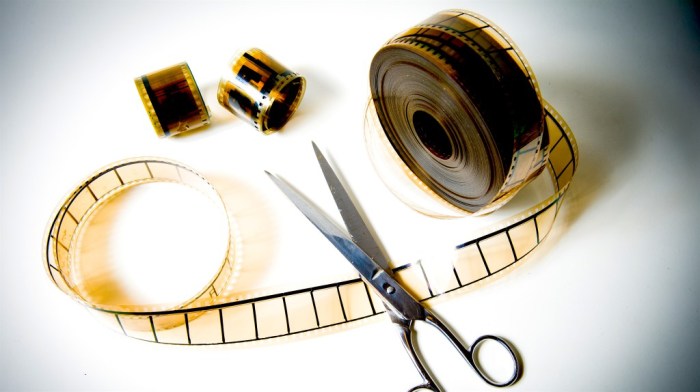
Decoupageby Kierston Drier

What exactly is Decoupage, or, further, Decoupage Technique? How is it different from Montage? In colloquial English the word Decoupage has been used less frequently, and Montage has come to refer to its basic concept. Montage, Decoupage and Decoupage technique, however, are different things.

Decoupage, translated from French, means “to cut up”. To fully understand its meaning though, we must first take a brief look concepts surrounding Montage. Montage translates as “assembly”, and in film refers to the specific choices made in placing one shot directly next to another to create a desired effect. A montage refers to an arrangement of visuals constructed to create a specific emotional effect and produce a certain emotional response. A Decoupage, is slightly harder to pin down. At its origin, in French, Decoupage indicates that the set of images captured are to be edited together to help convey the story’s narrative, and in English, it is often simply considered editing. The term also indicates that the images that are being assembled together will convey the movement of the storyline, even if the scenes being cut together are scenes taking place with physical spacial difference. Decoupage technique is roughly defined as translating a narrative script into a detailed outline of visuals for a camera to capture, and the process of editing within those images. Confused? I was too.

Confusion on the terms appears to have stemmed from a multitude of factors, including the translation and interpretation of the words from one language to another. For the purpose of this column though, we will use an example and interpreted it through all three terms. Our example will be the narrative tale of a couple that find themselves in danger of falling while walking on an old bridge.

A Montage of this would refer to a cut of images, presented in a way that elicits an emotional response. In our example- a close up shot of our couple walking on an old bridge, followed by a shot of a bridge beam fracturing. This will create the illusion that the couple could be in immediate danger. A host of emotional responses can be felt by the audience, simply by placing these two visuals next to each other.

Decoupage Technique, using the same example, is the process of reading the script, understanding the conflict will be the couple escaping a collapsing bridge, and breaking down that narrative into a series of visuals that will convey the story.

And;

Decoupage (for an English reader) would be an editing term that umbrellas the aforementioned terms together; it would signify the physical act of cutting the images together, while also understanding the emotional and cinematic story being told through those visuals.

Decoupage, therefore, indicates a highly nuanced and collaborative construct, that encompasses editing, narrative storytelling, camera functions and often includes the use of montage.

In short, Decoupage “cuts up” the script and establishes that scripts’ visuals, and Montage “assembles” them into an emotional story.

The breakdown of the language and terminology may at first glance seem dry, but the subtle and significant differences between the words fascinate this column writer ( and, as a side note, make me very boring at parties…unless they are film related ones!)

REFERENCES AND RESOURCES

Montage and Decoupage Research Questions by Axel Debenhamledon (article dated April 24th 2015) Mediafactory.org
Montage, Decoupage, Mise en Scene; Essays on Film form by Laurent le Forestier, Timothy Barnard, frank Kessler
Reel Rundown: How To Talk Like A Film Critic; Glossary, by Jane Bovary, April 20 2016

Film Review: SWISS ARMY MAN (2016) “Gems you may have missed!”

SWISS ARMY MANA hopeless man stranded on a deserted island befriends a dead body and together they go on a surreal journey to get home.

Directors: Dan Kwan, Daniel Scheinert
Writers: Daniel Scheinert, Dan Kwan
Stars: Paul Dano, Daniel Radcliffe, Mary Elizabeth Winstead

by Kierston Drier

This issue of Gems You May Have Missed is all about unlikely heroes, psychological breakdowns and dead bodies with magical boners. Yes. I said that.

SWISS ARMY MAN is a rare beast of a film. Written and directed by Daniel Kwan and Daniel Scheinert, and released in early July 2016, this piece requires commitment to your distension of disbelief. But if you can jump that hurdle, the film pays off big in the realm of emotional dividends and offbeat humor. Really offbeat.

Hank (Paul Dano), a nondescript everyman with a healthy dose of melancholia acts as our unlikely hero, when we find him at the opening of the film, stranded and starving on a desert island. He is about to hang himself when Manny (Daniel Radcliff) washes up on shore. Desperate for human contact of any kind, Hank forms an emotional and slightly creepy attachment to our dead friend. Believing that the appearance of Manny must be a sign, Hank drags the corpse off the beach and begins the long trek to seeks help and a way home.

The film starts on a dark note but quickly spirals through dark comedy and into a strange, but loveable hybrid of genre all its own, when Radcliff’s character Manny begins to talk. Not only talk, but also perform life saving tricks for Hank- like gush fresh water from his mouth, use his erection as a north-pointing compass, and, wait for it, fart so powerfully that he can work as a human motor boat. Hank and Manny form a bizarre bond of friendship, compassion and an utterly fresh take on instrumental friendship, as they must work together to get back to civilization.

It is hard to explain what makes SWISS ARMY MAN such an incredible cinematic experience. It boasts gorgeous, lush cinematic visuals, beautiful art direction and breathtaking cinematography. It is also largely a two-hander which means huge applause must go out to both Dano and Radcliff for engaging and grabbing performances. While both actors do a fantastic job in their roles, a special nod must be given to Radcliff who, has the added challenge of conveying a depth of character while still managing to pull of character that is, well, dead. The script is quirky, emotional and vibrantly original. But what makes SWISS ARMY MAN a real gem, is how startling unique it is. There is simply no film quite like it.

A viewer can watch this movie and feel a vast array of feelings- confusion, absurdity, hilarity, sorrow, compassion, concern and disbelief all within an hour and half. We never really know if we are watching a metaphor, one man’s delusion, or a strange world where anything-can-happen. But we feel something. The feeling may be complex and confusing but it is undeniably authentic. You may need to let go of logic and reason and strap yourself in for this roller-coaster of a film, but it is worth every minute of the ride.

Inside the Chaos: How To: Shift Careers within your field

shift careersby Kierston Drier

Are you in your desired profession, but not in your desired career? Maybe you want to be a Director of Photography one day, but you are stuck as a set P.A. Maybe you want to be a food stylist but you are toiling away at a Craft job to pay the bills. Maybe you want to be a writer, but all you’ve managed to get is a few self-produced pieces while you wait tables part time? Or perhaps you’ve had a happy and fulfilling career in one area of the industry you love already, but it’s time to move on- you’ve worked in distribution for years and now you want to be a producer. Or you’ve had a successful career as an editor, but you want to try your hand at writing? How do you make the shift from working that job that pays the bills, to working the job that pays the bills and fuels your passion?

It is not always easy and smooth to change career paths, and it doesn’t always happen over night. But with research, patience, and planning, you can maximize your efficiency in the transition. Below are a few steps to get started.

Know Your Goal. And What It Takes To Get There.

Take some time to envision exactly what you want. It might already be crystal clear, or it could still be very nebulous. Figure out if what you desire is a single goal (Ex: I want to be a writer on a Comedy Show) or something more fluid (Ex. I want to be working in content-creation, in a leadership capacity.)

Next, figure out what skills you need to achieve this goal. What soft skills and hard skills do you already have? What do you need? Can you get these skills through your own research, or will you need more professional training?

Engage Your Network.

There is nothing wrong with learning from your network. Attend events, mixers and social gatherings that are centered around your main goal. Be friendly, kind and polite and read the room. Be curious about other people and their roles in the industry and ask them about their experiences. Even if they are not in the career path you are interested in, there is always something to learn from someone else. People can be invaluable sources of both insight and inspiration. Clubs, online groups, forums, organizations and committees are all great places to begin expanding your sphere of contact as your change careers.

On the topic of engaging your network, be active in the community you are interested in. Are their volunteer or part-time gigs that you can engage in that will help build your skill set or make connecting? Are there industry-related communities that offer networking, mentorships or internships in your desired field? Tapping into these areas may be time-consuming, but a slow-and-steady approach to changing careers can pay dividends as it allows your your network and contact base to grow.

Innovate And Market Yourself.

You have skills. And you probably have some very good ones. How can you turn those skills into marketable products to get you closer to your desired goal? It may take an afternoon (or several) to come up with some unique ways to get yourself out there, but may be the most beneficial tool you have. Make a reel, or a demo, or a strong pilot piece and put it up on your own social media. Host or livestream a reading of your work (or a mixture of your work and others), contact companies you want to work for and inquire about their hiring process or if they have any freelance opportunities. It may be highly subjective, depending on what goals you are aiming for, but marketing yourself is a crucial step.

Plan For It To Take Time.

Sometimes an opportunity knocks and we simply cannot say no. Be prepared to take the opportunity when it comes! Until it does, however, have a plan to help sustain and support yourself while you tackle your new dream. It may feel like having two jobs- the job you work at, and the job you are aiming to work at. It is important to be practical; as the saying goes, Empires are not built overnight. Yet, all dreams that are worth having are worth working for!

It may be hard to get out of a stagnant career rut. In contract-based industries it can be very hard to shift gears, and move yourself forward. It is our dreams and aspirations that fuel or best creative moments. It is rare that the path to our perfect job goes smoothly- but it is all the more wonderful when that goal is achieved.

Inside The Chaos: How To Make The Most of Your Time As A Freelancer

freelancerby Kierston Drier

Film and television production is a freelance industry. And freelance industries are complicated for the people they employ. In one corner, we have making your own working hours, as much free time as you desire, and the potential to make a lot of money when you do work. In the other corner we long stretches without work, the stress of a feast-or-famine work frame and FOMO when multiple jobs come our way at once. And worse still, if we are looking to advance our careers while still getting calls for the same type of work. How do we manage in the high-octane, fast-paced world that is freelance?

As a freelancer who has made a good living in an expensive city I’m here today to share a few tips with anyone is struggling or juggling to find balance in this intense industry.

The 80/20 Rule

This is my golden rule. You see it in lifestyle-diets : eat eighty percent healthy and twenty percent whatever you want. I correlate this to my working life. Eighty percent of the time I spend work that keeps my lights on. I like all the jobs I take but these jobs have a primary purpose- they pay my bills.

The other twenty percent of my working time is spent on passion projects. These passion projects fall under a number of headings- work I do on a friends’ project, work I do for free as a favor, or work I do for lower than a normal rate in order to gain a new skill of polish an old one. Some of them go on my resume and some I do just be help out a buddy. But all together- these are professional or semi-professional jobs I do, that I do purply because I want to. What has been wonderful about this twenty percent rule, is that every so often, this jobs or favors, lead me to a lucrative gig that I also enjoy doing, that can bleed over into the eighty percent of my jobs that pay my bills. That is a wonderful place to be in!

2. Utilize your weekends. Mostly.

The traditional Monday-Friday 9-5 is quickly disappearing. And while some people mourn that, freelancers may embrace it. You may not have a traditional 5 day, 40 hours work-week. You may be working 12 hour days, or you may have shifting schedules that don’t give you two days off in a row. No matter how crazy or unpredictable your schedule can be, you can still utilize these tools. I use this strategy when I’m working a standard set-based 12 hour day with two days off.

Pick two days where you can carve out free time. Even if it is only for a few hours.
On one of these days, plan to do nothing related to work. Seriously. Go out, see your friends, read a book, watch TV, take a bubble bath, go for a run. Live your life.
On the other day, divide the free time in half. Spend one half cleaning up your life, in whatever form you may need- manage your meal prep, check your emails, do your laundry. Whatever you have to do that you can’t find time for when you are working night-shoot crazy hours and have barely had time to wash the sweat off.
In the other half of the last day, do a work related thing that matters to your personal development. Work on a script you’ve been developing. Edit a reel you’ve been working on. Coordinate with creative partners on creative projects.

The bottom line here, is use maximum efficiency with the free time that you do have while still being able to live your life. If you have an off season, where you can potentially have weeks at a time free, have a plan of attack to devote more time to your creative projects.

3. Build Yourself A Float

Another vital rule I utilized early on in my career and reaped benefits from later. I did whatever I could when I had an influx of jobs to live below my means. I put aside a small stipend of liquid assets to utilize when lean months came. This helped me out by cutting down on the stress and panic that comes with the mindset of “I need a job, any job! I have to pay rent!” It allowed me to carefully weigh my options when jobs came my way, and gave me the freedom to choose to the best professional option for myself.

Understandably, this isn’t always an option everyone has access too. Sometimes jobs are scarce and you need to take whatever comes your way. Take the jobs you need, and set aside whatever you can for a rainy day. A good plan in freelance is have two to three months of basic living expenses saved up for when jobs are harder to find.

4. Find An Inspiring Side Gig.

Get a hobby for those dry spells. And make it something you love. Whether you blog about your favorite TV shows, write reviews for a local paper or online magazine, do freelance editing or script covering on the side, whatever helps keep your creative passions sharp and inspired. If it adds a little money to your pocket book as well, all the better. Freelance is all about versatility. Not just in taking on different jobs with different people, but with your ability to be hired for your many professional facets. What starts as a hobby today, can become a marketable and valuable professional skill later.

The freelance game isn’t always easy, but it can be hugely rewarding! For better or worse, our society is moving more and more towards a freelance and contract-based economy. It is a system, but with a little work and strategic planning, you can make it work for you in a very effective way.

Do you have any freelance tips? We’d love to hear about them!