Movie Review: LOREN THE ROBOT BUTLER: TEACH ME HOW TO DOUGIE! (2016)

festival posterLOREN THE ROBOT BUTLER: TEACH ME HOW TO DOUGIE!

Seen at the July 2016 Under 5min. FEEDBACK Film Festival in Toronto.

Directed by Paul McGinnis

Loren, a proper British robot and formally the head butler for a very wealthy family, has been replaced with a Roomba and stored in the basement. Now the kids program him to teach them stuff.

Movie Review by Kierston Drier

Light, bright and whimsical, Loren The Robot Butler, written, directed and creatively lead by  Paul McGinnis, entices the inner child of us all. The film’s premise is established in just a few quick moments, and with the help of a charming opening tune, explaining that an outdated robotic butler sits unused in a family’s basement, and spends his retired life teaching children. Perpetually upbeat and sporting the quintessential British Accent, our friendly butler protagonist speaks directly to the audience as though they are the very children of the household where he is kept. At the children’s request, he takes on the mission to teach them how to “Dougie”, from the well known 80’s rapper Doug E. Fresh.

The humor comes easily on several level- most liminally, from the contrast of a British robot butler, attempting to recreate hip-hop music. The upper-crust British sound and robotic movement parodying the relaxed sway of the music beat and hip-hop/rap dialect. Further, there is humor in the form of breaking of the fourth wall with the audience, and from the shock that our robot friend not only executes the dance- but does so exceptionally well!

This piece is a delightful romp through the whimsical world of song and dance as seen through the eyes of a child, but there is a level deeper. It does speak to the element of old technology trying to keep up with the new, modern and current.

The most astonishing, staggering and interesting part of Loren The Robot Butler, however, is not it’s comedy or its use of social commentary. It is it’s artistry. At first glance, this piece could be mistaken as a completely CGI 3D animation. In reality, the entire piece is performed by three puppeteers, manning the upper bottle and each leg independently. The amazing truth is, this exceptionally complicated dance move is performed in perfect execution by highly trained professionals  (Lead by McGinnis) manning one doll behind a green screen, resulting in seamless and flawless dance that passes as computer generated. This is a feat of puppeteer mastery and specialized skill rarely seen in Cinema since Dark Crystal, (Let’s not talk about Team America) and at the very least should be applauded.

Whether Lorne The Robot Butler  is a proof of concept for a delightful children’s TV show, or a demo reel for some exceptional puppeteers, it is regardless a lovely, light comedy sure to entertain.

Watch the Audience FEEDBACK Video of the short film:

Movie Review: #UNITED WE WIN. Directed by Henrik Friis

  MOVIE POSTER#UNITED WE WIN, UK

Played at the May 2016 FEEDBACK Film Festival


MOVIE REVIEW:

Half dangerous, hald brave and wholly compelling, #UnitedWeWin, directed by Henrik Fiirs, is a documentary turned passionate love letter about the issues surrounding war-torn Iraq. Fiirs and a handful of other early twenty-somethings’ set out to the country with limited assistance from Global Security, to make a film about the middle eastern conflict, after a traumatic video witnessed by the director propelled him to act. The forty minute partial gorilla shooting endeavor is an interesting approach to cinematic filmmaking.


#UnitedWeWin has much to be commended on. The director, Fiirs, is a natural born leader, with charisma, charm and a clear thirst to make a social and political difference in the world around him. There is daring, drive and determination in his work, and it is no small feat to arrange a film crew and create a film, halfway around the world, not accounting for age, cost and resources.


However, there is a fine line between bravery and foolishness and Fiirs’ piece is not without heavy scrutiny. The film undeniably lacks focus and direction. Bold, emotive, larger-than-life statements litter the piece, such as “what is happening here is evil” and “we all know this isn’t right”. And yet, the social, political, religious and economic issues fueling the Middle-Eastern conflicts are never discussed. As such, the filmmaker glosses over the reason the fuel the film in the first place. The film has the feeling of a director looking for the answer, when he has no idea what the question is.


As a result, the goal of the film appears far too abstract and the stakes far too outrageously dangerous to be bought by the audience as a form of consciously planned, well thought-out activism. The film has no clear vision, no clear villains, no clear answers, no focused purpose and, most terrifying to the audience, no sense that the filmmaker and the team really understand how much danger they have put themselves in while making it.


Moving towards the film’s natural style creates some other notes for discussion. The continuity of the piece is rather shady, with whole days of the trip cut out and unaccounted for, and a series of unanswered cliff hangers. There is one scene that focuses on the team touching down in the Middle East and the transportation they arranged to pick them up from the airport is not there. The next major scene shows the team three days later, with no explanation of how the previous situation rectified itself. One section of the film, shot in a refugee camp, was very stylistically shot and edited- a choice that was not consistent with the rest of the film. The team clearly had the skills and the means to produce a film, but they did not produce a film with clear meaning.


Fiirs is a young, idealistic filmmaker, producing a heartfelt piece that displays empathy to the struggles of a population he clearly cares deeply for. On that note, he must be commended. He has a strong moral code, strong ideals and passionate desire to tell a story. But his cinematic journey did not hold up a mirror to the crisis in the Middle East, as much as it did hold up a mirror to young filmmakers’ everywhere, asking them to thoroughly understand that questions they are asking, before they risk their lives in finding the answers.


by Kierston Drier
Founder of The Bathroom Stall Project
Consultant at TheKayWorks.com
Freelance Film and Television
www.thekayworks.com

Watch the Audience FEEDBACK Video:

Movie Review: 1Minute Nature. Directed by Stefanie Visjager & Katinka Baehr

  MOVIE POSTER1Minute Nature

Played at the May 2016 FEEDBACK Film Festival

MOVIE REVIEW:

In a world where words paint wonderful pictures, 1 Minute Nature follows three children as they individually recount memories from the world around them. Animated based on the story each child narrates, 1 Minute Nature is a creative reimagining of the natural world told through the eyes of a child. Both immersive and engaging, and wonderfully whimsical, each story contains cartoon animations elements moving within a real life background.

Each story narrated story recounts a child’s single isolated memory of an interaction with the world around them, but the visual spectacle is meant to shape both the children, and the viewers’ perceptions of the natural world and they way they interact with it. With the animated moving cartoon images overlaid against a stationary real-life background, there is a charming element of fantasy to the piece that is both engaging and delightful. Our three stories capture the tales of first encounters of underwater exploration, favorite animals and even school-age romance, each one weaving a wonderful portrait of childhood experiences with beautiful images.

Short, entertaining, charming and occasionally laughably honest, these three stories offer a break from the everyday world and invite us into a world of color, creativity, imagination and wonder.

by Kierston Drier
Founder of The Bathroom Stall Project
Consultant at TheKayWorks.com
Freelance Film and Television
www.thekayworks.com

Watch the Audience FEEDBACK Video:

Movie Review: LIKE A STAR. Directed by Daniele Bonarini

  MOVIE POSTERLIKE A STAR, 10min, Italy, Documentary/Comedy

Played at the May 2016 FEEDBACK Film Festival

Read interview with the director

MOVIE REVIEW:

Like A Star, directed by Daniele Bonarini, follows a special needs actor on his journey from Italy to Texas to receive an award for his recent role in a film. A classic fish-out-of-water story of a European exploring the exociticism of the deep southern United States, this tale is as heartwarming as it is humorous.


Within the span of a modest 10 minutes, Like A Star follows a our Hero on a journey that is very much one in a lifetime. From the plane take off in Italy, to landing in Texas, to the discoveries of Cowboy boots, 10-gallon hats, American steaks, Famous sites and culminating with his Award ceremony.. Our hero takes on the world with a sense of childlike wonderment blended with the bravery of an adult jumping into a pool for the first time.


Deeply moving with it’s tale, Like A Star’s beauty is that is breaks down the boundaries of otherness that often surround people of special needs from the rest of the world. It tells a story about a human being with the very human wish that bridges together people of all kinds- the wish to be recognized.


by Kierston Drier
Founder of The Bathroom Stall Project
Consultant at TheKayWorks.com
Freelance Film and Television
www.thekayworks.com

Watch the Audience FEEDBACK Video:

Movie Review: EVERYBODY FALLS DOWN. Directed by Chris Hale

festival posterEVERYBODY FALLS DOWN

Played at the May 2016 FEEDBACK Film Festival

Read Interview with the Director

MOVIE REVIEW:

Directed by Chris Hale, Everybody Falls Down steps into “ a day in the life” of Syrian Refugees living in a fenced in compound outside of Kurdistan after the mass displacement of Syrians due to social and political unrest in Syria. Shot in 2015 the piece is highly current and resonant with the issues populating north american as well as global media today. What is the fate of the displaced Syrian people? Everybody Falls Down is a deeply emotive tapestry evoking empathy, solidarity and hope for the Syrian refugees. The documentary follows the lives of families, couples and children, showing their working lives and living conditions. The film focuses on how the people manage to keep their culture, hope and joy in a facility stripped of any luxuries. At the same time film explores what many of the Syrians left have had to leave behind, their homes, livelihoods and in many cases their other family members. Heart Wrenching in some places, and joyous in others, Hale’s Work is successful at providing a glimpse into a world many of us cannot fathom, and the layers of the struggle and hope that transform displaced families into communities.

Everybody Falls Down is not omitted of scrutiny in its approach. Covering snippets of the lives of several people, and various families, Hale’s piece is highly condensed for 15 minutes. It can be argued that is is not able to provide a well rounded view of the lives of it’s subjects. Not without criticism, Hale’s piece shows only one side of the struggles of Syrian displacement. It has a clear angle for the refugee community, but does not touch on the many social, political or economic issues that displaced the population in the first place. It only briefly glosses over the politics and economic issues faced by the countries that house refugees currently. As a result, only a partial story is ever told. Everybody Falls Down is a piece worth seeing, if for no other reason than that it shows a side of life many of us have the good fortunate to never have to know. It is clear labour of love with a message that the displace people of Syria want to go home, as Hale explains, “I …try and show at least some of the people who deserve better.”

by Kierston Drier
Founder of The Bathroom Stall Project
Consultant at TheKayWorks.com
Freelance Film and Television
www.thekayworks.com

Watch the Audience FEEDBACK Video:

Movie Review: CHAMPION. Directed by Andrés Passoni

champion_movie_posterCHAMPION was the winner of best film at May 2016 FEEDBACK Short Documentary Film Festival.
Directed by Andrés Passoni

Genres: Documentary | Short

Read Interview with the Director

MOVIE REVIEW:

Astonishingly beautiful and stunningly shot, Champion follows the world of competitive Racing Dogs in Argentina. Shot with a focus on the animals (not their owners) the film utilizes silence, space and spectacular imagery, downplaying the natural noise and eliminating all scripted dialogue. A powerful stylistic choice that pulls the viewer’s focus to the real story of the racers. Instead of the money or bets of the people owning dogs, we focus on the dogs themselves.

One may imagine that Passoni’s film is an exercise in Voyeurism, as it emphasis lies in the spectacle of the race without any blatant insight into the mind of the racer. Conversely, it can be said that Champion does the exact opposite – showing the mind of the racing dog by focusing on the event as a dog might see it- a flurry of color, the garble of indistinguishable human noise and a pulsating energy of a run waiting to happen. Andreas Passoni defines the luminous visual aspects with respect to a lifelong appreciation for the aesthetics, “All my life I felt attracted by image and sound.”

As a filmmaker, Passoni’s Instincts for the visual spectacle of cinema are seamless and lush, both riveting and gorgeous. In regards to a short that can propel the audience into emotion via image alone- Passoni is ahead of the pack.

by Kierston Drier
Founder of The Bathroom Stall Project
Consultant at TheKayWorks.com
Freelance Film and Television
www.thekayworks.com

Watch the Audience FEEDBACK Video:

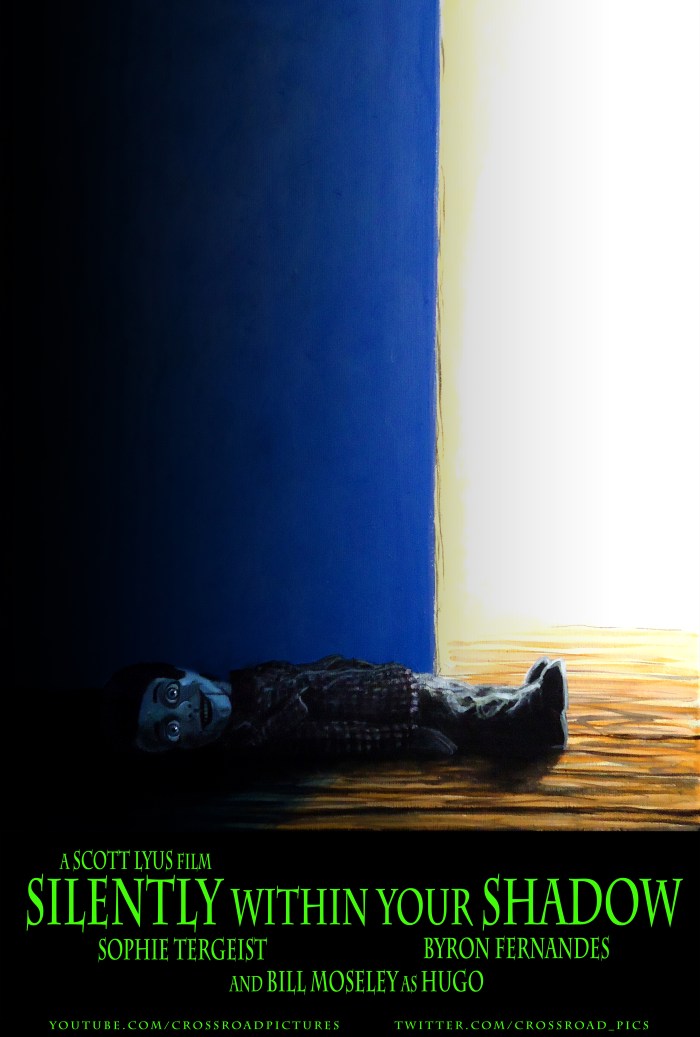
Movie Review: SILENTLY WITHIN YOUR SHADOW (short film) Directed by Scott Lyus

SILENTLY WITHIN YOUR SHADOW, 14min, UK, Horror/Thriller
Directed by Scott Lyus

As their relationship grows, Lucette’s obsession for ventriloquism and her dummy Hugo starts to strain her relationship with Jace. To Lucette Hugo is more than just a dummy, he’s her best friend and represents her ambition as an artist, to her, he’s very much real.

Read review by Amanda Lomonaco:

I have to admit to having a lot of mixed feeling about Scott Lyus’ imaginative short. Like a lot of other films in the February lineup for WILDSound, Silently Within Your Shadow played on an already familiar storyline, and added its own interesting twist to the tale. Nevertheless, I had a difficult time immersing myself into the story of the film, for a number of reasons.

First and foremost, I have a slight bias against ventriloquist doll or other doll related horror films. For one nothing, in my mind, will ever beat R. L. Stine’s brilliant stories, aside from the hilarity that is the entire Chucky series. Moreover, whenever I see a horror movie doll my heart feels immediately torn between a slight feeling of distaste and an anjoyment of all cinematic things that compel me to squirm in my seat.

The performances in Silently Within Your Shadow also threw me off a little. I wouldn’t go so far as to criticise any of the actors too harshly for their work, but there were definite points in this short where I wasn’t quite buying what was going on. My uncertainty, however, stems from the fact that I couldn’t quite tell if my disbelief was based purely on the acting, or from the written dialogue itself. While the storyline for Lyus’ film twisted a well-known story in a refreshing way, the dialogue itself felt like it could have used a little more polished to seem more natural.

From personal experience doll-based horror films are something people have quite strong feelings about. Or perhaps that’s just me projecting. In any case, Lyus’ short was one of the few independently produced doll-horrors that have pleasantly surprised me. Regardless of how you might feel about these films there is one valuable lesson we can get from them; be wary of ventriloquist dummies and the people who play with them.

silently_within_your_shadow_movie_poster.jpg

Movie Review: BALLERINA (short film) Directed by Marc Thomas

ballerina_movie_poster.jpgBALLERINA
WATCH Audience FEEDBACK

5min, USA, Horror/Thriller

A woman at home alone encounters a malevolent presence in the form of a… music box?

Read review by Amanda Lomonaco:

At first glance, Marc Thomas’ Ballerina seems like your typical, every day, predictable horror film, but don’t get too comfortable. Through very subtle nuances, fantastic special effects, a great musical score, and excellent timing, Thomas has made an excellent short film guaranteed to make your skin crawl.

This is definitely one of those short films that I’m at risk of spoiling by saying too much about it. At just 5 minutes, there isn’t much you could reveal about Ballerina that wouldn’t ruin Thomas’ excellently plotted suspense. What I can say is that as a horror lover I rarely find myself crawling with goosebumps when I watch a film, but Thomas’ short had me at the edge of my seat.

One of the great things about this short is what Marc Thomas has managed to do with an already familiar, and almost cliché storyline. Though it’s a difficult art to master, the advantage of using these kinds of stories is the ease with which you can surprise the audience by veering from it even if slightly. Ballerina has achieved this in such a discrete but impactful way, that it’s impossible not to commend it.

The reactions to this film were all intense and infectious. It speaks a lot about any film when it can provoke such a strong reaction from a large group of strangers. If you don’t like horror films, beware; Ballerina will almost certainly give you nightmares. Then again, if you’re anything like me, that might be exactly what you’re looking for.

Watch the Audience FEEDBACK Video of BALLERINA:

Movie Review: TIME TO EAT (short film) Directed by Luke Guidici

  MOVIE POSTERTIME TO EAT, 4min, USA, Horror/Comedy
Directed by Luke Guidici

After being sent to timeout, a mischievous boy’s trip to the basement leads to a monstrous revelation.

WEBSITES

www.timetoeatfilm.com
www.facebook.com/timetoeatfilm/

Read review by Amanda Lomonaco:

Super clever, great cinematography, excellent special effects, Director Luke Guidici has truly achieved so much with so little. Time to Eat is really among one of the more unconventional horror films our there, but it’s certain to please even the most critical of horror film buffs.

To begin with, Guidici chooses an incredibly bright and cheerful colour scheme. Nevertheless he definitely proves the importance of musical score in any film, by superimposing his bright images with the perfect eery tune to leave us just suspicious enough about what might happen. Likewise, the lack of dialogue itself helps to add to this sense of unease.

At first glance Time to Eat seems like an innocent enough film. You pretty much expect it to be your typical, cliché, basement horror. Then it gives us a wonderful reminder to never underestimate what can be done with just a couple of minutes of time and an incredibly talented crew. In fact, credit must be granted to all the cast and crew of Time to Eat. Every piece of this film was extremely well executed and the care with which each cast and crew member performed their individual roles is palpable.

I was very pleasantly surprised by Luke Guidici’s work. While I have repeatedly admitted my bias towards the horror genre, I like to think it makes me more discerning as oppose to an unquestioning follower. In light of this, Time to Eat must be praised for its outstanding execution, uniqueness, and cleverness. Whether you’re a lover of the horror genre or not, this film can be appreciated by a variety of audiences and is certainly a very well spent 4 minutes of time.

 Watch the Audience FEEDBACK Video of TIME TO EAT:

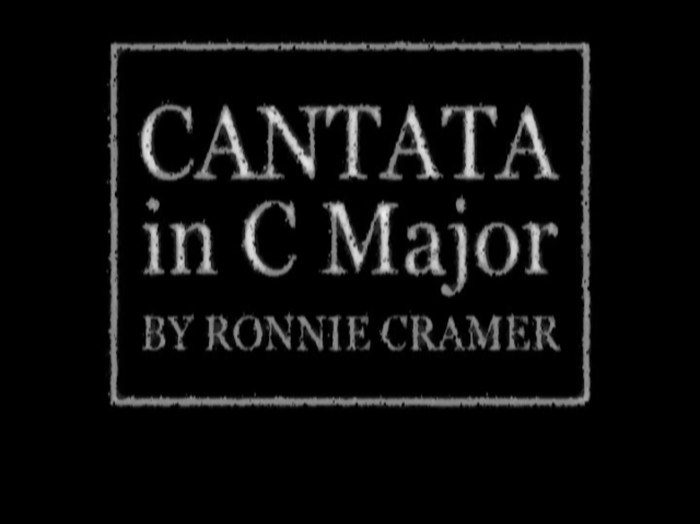
Movie Review: CANTATA IN C MAJOR (short film) Directed by Ronnie Cramer

CANTATA IN C MAJOR, 7min, USA, Horror/Musical
Directed by Ronnie Cramer

Six-hundred-five film clips are assembled and used to create a piece of electronic music. As the visual component appears in the center of the screen, the original analog audio is sent to the left channel while it is simultaneously converted into digital music data and sent to the right channel.

Read review by Amanda Lomonaco:

Definitely not your average night out at the movies. Cantata in C Major is a shock to the system in more than one way. From the very beginning the film jars you with its unconventional structure; introducing itself and its composition from the very start. Even so, director Ronnie Cramer, manages to maintain a sense of intrigue by never quite explaining the purpose of such a rigidly constructed film.

There are definite moments of despair in this film, and not for the reasons you might imagine. Though I will admit, about a minute or so into Cantata I found myself wondering when it would end. Still as the jolting mixture of images and sounds continued something clicked in me.

You suddenly become incredibly immersed in the patterns and tropes you never would have otherwise noticed. Cantata almost seems to cancel out your other thoughts, feelings, and sense, until all you can see, hear, think about and experience is what’s right in front of you. It’s almost as if Cramer’s intention was to invoke some sort of disturbing meditative experience, an intention that seems almost implied by the film’s closing titles.

Cantata in C Major isn’t really the kind of movie you watch to experience a storyline, or to submerge yourself into someone else’s life for a short while. Cantata is a film about sound, patterns, and noise. It’s a film about films, how we watch them, how we make them, how they construct and provoke different emotions. It’s certainly not the kind of film everyone will enjoy equally, but it seems to be an introspective piece that might provide you with some interesting food for thought.

 Watch the Audience FEEDBACK Video of CANTATA IN C MAJOR:


cantata_in_c_major_movie_poster.jpg