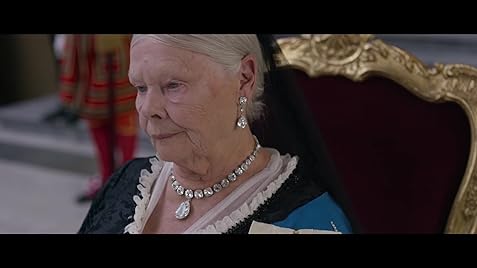
Full Review: VICTORIA AND ABDUL (UK 2017) ***

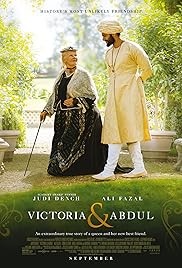
Victoria and Abdul Poster
Trailer

Queen Victoria strikes up an unlikely friendship with a young Indian clerk named Abdul Karim.

Director:

Stephen Frears

Writers:

Lee Hall (screenplay), Shrabani Basu (based on the book by)

Stars:

Judi Dench, Olivia Williams, Michael Gambon

Director Stephen Frears has made great controversial films like SAMMY AND ROSIE GET LAID, THE SNAPPER and MY BEAUTIFUL LAUNDRETTE.  He has also made films about royalty before, like THE QUEEN and also sentimental slush like PHILOMENA, with Judi Dench.  VICTORIA AND ABDUL a film about Queen Victoria (Oscar Winner Judi Dench) and her Indian servant Abdul Karim (Ali Fazal) contains a cocktail of all the elements of the films mentioned above.  The result, as expected as a mediocre Jack of all Trades Master of None film, which shines but only occasionally.


The film chronicles with humour and insight the friendship between Queen Victoria and a decades-younger Indian clerk named Abdul Karim.  Karim has been summoned because of his height to present in England all the way from Agar, India the colonized homeland, a present.   The present is satirically, a ceremonial coin on behalf of British India to the Queen as a part of her Golden Jubilee in 1887,  Abdul with another travel for the intimidating task. 


Abdul has done what is forbidden during the ceremony.  He makes eye contact with the Queen who finds him handsome.  In no time he is cooking her curries, talking to her about his culture, and being elevated to the post of official clerk, or Munshi, becoming an indispensable part of the household — and state.


This is where trouble boils.  The Queen’s son, Bertie and the household take offence that this ‘coloured’ lowly servant is treated royally.  The ultimatum comes when the Queen decides to knight Abdul in order to have her household respect him.  The opposite occur.  The household threaten to resign if Karim is knighted.  This is where the Queen uses her brain and oratory to win the day.  Frears uses the incident to make a statement about the refugee crisis and racial prejudice.  The film’s best segment occurs here when the Queen chides her entire household with a speech that put them to shame.  This is a Dench’s award winning performance.


Frears’ assessment of Britain and royalty remains respectful.  The Queen at one point remarks: “A lot of people around the world hate me.”  Abdul says of the British as uncivilized on the ship en-route to England for the first time: “They put it’s blood in their sausages and eat sheep’s brains.”  The first words heard by Abdul on landing: “Welcome to Civilization!”


Queen Victoria is revealed in the film with all her grandeur (her robe and servants) but also with all her faults and her ageing process.  When she is first seen in the film, her face is not shown, but her body covered in white (like a shroud) in bed with snoring heard.  She also claims herself to be and shown as well as cankerous, ill-tempered, fat but also one that has held five generations of household and mother of many children and grandchildren.  “I am the Queen of England and the Emperor of India,” she claims proudly.


VICTORIA AND ABDUL is Frears’ mediocre film which is tolerant of everything and offends no one.  These kind of films are often humorous, handsomely mounted, well acted but unfortunately forgetful. 
 

Trailer: https://www.youtube.com/watch?v=BT2Ph_9bGPs

Full Review: STRONGER (USA 2016)

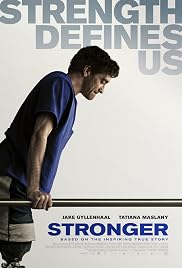
Stronger Poster
Trailer

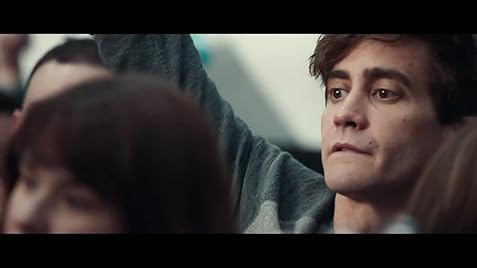
Stronger is the inspiring real life story of Jeff Bauman, an ordinary man who captured the hearts of his city and the world to become a symbol of hope following the infamous 2013 Boston Marathon bombing.

Director:

David Gordon Green

Writers:

John Pollono (screenplay), Jeff Bauman (based on the book “Stronger” by)

Stars:

Jake Gyllenhaal, Tatiana Maslany, Miranda Richardson

The Boston marathon.  PATRIOT’S DAY saw Mark Wahlberg star in the film that hunted down the terrorists responsible for the bombings.  STRONGER, on the other hand, looks at the Boston marathon from the point of view of a victim.  And a really bad victim at that – one that has lost both his legs in the middle of the bomb explosion.


To the film’s credit, the film is an adaptation of the memoir by Jeff Bauman, recounting his struggles to adjust after losing his legs in the Boston Marathon bombing.  So, it is a true story, rather than one based on true events.  But unfortunately the film wallows in self pity.


The film tells the story of Jeff’s tragedy and rebirth. 


Runner Erin Hurley (Tatiana Maslany) was still a mile away from the finish line when the bombs went off.  Her boyfriend, Jeff (Jake Gyllenhaal), however, was right there.  He is rushed into surgery, but his legs must be amputated.  The bombing’s immediate aftermath provides Jeff with an unexpected sense of purpose as he had seen one of the terrorists responsible for the blasts.  He gives information to the FBI that proves instrumental in their investigation.  But this is not seen in detail in the film.  So one wonders, whether Jeff really saw the bomber or imagined it.  Once that very public drama quietened down,  Jeff’s personal drama, a challenge as much for his morale as his body, is begins.  With Erin by his side, Jeff slowly recovers, one arduous step at a time.


Green’s film centres on the travails and sufferings of Jeff.  But it opts out for cheap shots – like showing the parts where Jeff has trouble in the toilet trying to shit or urinate. 


Jeff is shown in the film on the road of self destruction.  Erin scarifies her all for him.  But he is shown as unrepentant, unhealed by his mother who want him to get all the glory and money for his mishap. 


The film shows Jeff’s change in outlook.  Unfortunately, this change is shown coming from just one event instead of a gradual progression – the meeting of the Mexican who attended to him during the bombing.  Though this might be true, this one event that apparently changed Jeff’s outlook on life seems quite incredible.


Jake Gyllenhaal, Tatiana Malsany and Miranda Richardson (as Jeff’s mother) deliver excellent performances despite the film’s flaws.  If the film turned out better, they might be up for acting Oscars.


The film ends, expectedly during the closing credits with shots of the real Jeff and Erin.  It is revealed  that that the film is based on the book written by Jeff which is not mentioned at all in the film.


One can only wish the film would have been a better one that would show more of the triumph of the human spirit instead of one that showed a man wallowing is self pity.


Trailer: https://www.youtube.com/watch?v=I6MN0QfQx7I

TIFF 2017 Movie Review: VISAGES, VILLAGES (Faces Places)(France 2017) ***** Top 10


Movie Reviews of films that will be playing at TIFF (Toronto International Film Festival) in 2017. Go to TIFF 2017 Movie Reviews and read reviews of films showing at the festival.

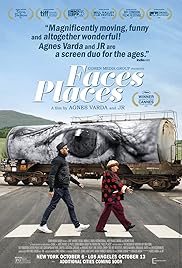
Faces Places Poster
Director Agnes Varda and photographer/muralist J.R. journey through rural France and form an unlikely friendship.

Directors:

JR, Agnès Varda

Stars:

Jean-Luc Godard, JR, Laurent Levesque

Faces Places have received high critical praise from critics at Cannes, many calling it a masterpiece. That might be too big a term to use for this little personal film but VISAGES VILLAGES is simply the most delightful and personal film at the festival.

Director Agnes Varda (wife of the late Jacques Demy), now 89 is famous for her films, photographs, and art installations that focus on documentary realism, feminist issues, and social commentary with a distinct experimental style.

In this latest and perhaps her last doc (she is losing her vision), she and fellow friend and artist known as JR travel around France, particularly the North in their photo camion to take pictures of the people they visit. At Le Havre, for example they photograph the images of three wives of the dockworker and paste them on stacked containers.

In a deserted mining town, they paste the photograph of the last woman (wife of a miner) still staying in the old house district. When asked the reason she does this, she replies it is too demonstrate the power of imagination.

No doubt about that, this film is personal, inspiring, powerful, sad and happy and perhaps ‘masterpiece’ might be really an accurate term to describe this film.

Trailer: https://www.youtube.com/watch?v=dmHG5HXYc9w
 

VISAGES, VILLAGES 1

Best Scene STAGE PLAY Reading of LOOKING FOR REDFEATHER, by Linda Collison

WILDsound Festival's avatarWILDsound Festival

Genre: Coming of Stage, Drama

Three troubled runaways meet up by chance on the road — but it ain’t Jack Kerouac’s road trip!

CAST LIST:

Narrator: Val Cole
Ramie: Nick Wicht
Chas: Mike Ruderman

Get to know the writer:

What is your play about? 

Looking for Redfeather is about coming of age on the road in America in the 21st century.  A boy on a father quest meets up by chance with two other runaway teens on the road to Denver. He has two weeks to find his father, an Apache named Redfeather.

What genres does your play fall under?

Drama/coming-of-age/humor/musical

Why should this play be made into a show? 


Looking for Redfeather is about growing up in America in the 21st century. It encompasses contemporary issues such as functionally dysfunctional families, friendship, American myths and legends, substance use and abuse, learning disabilities, the fictionalized past and present of Native Americans…

View original post 468 more words

Winning THRILLER Feature Screenplay: WORD GAMES, by Joel Stern

WILDsound Festival's avatarWILDsound Festival

Genre: Thriller, Horror, Drama

A commercial airliner flying to Paris explodes off the U.S. East Coast killing sixteen members of a high school French Club and a young pianist destined for greatness; a pair of deranged teens go on a terrifying high school shooting spree ending the life of a young girl devoted to serving God and mankind. If there is a master plan, how could these horrific events be allowed to happen?

CAST LIST:

Narrator: Val Cole
Sal: Kris Hagen
Dave: Peter Nelson
Monica: Shania Belton
Julie: Katelyn Varadi
Tanya/Shannon: Carina Cojeen
Lassen: Mike Ruderman
Bill: Nick Wicht

 Get to know the writer:

What is your screenplay about?

“Word Games” is about two strangers in a nursing home who are isolated because of the “Blizzard of the Millennium” . One man – Sal Genesinni – is the janitor. The other is Dave Phillips, an old man, wheelchair bound…

View original post 387 more words

Winning 1st Scene of SERAPHINA, by Joe “Tuffy” Tofuri

WILDsound Festival's avatarWILDsound Festival


 A beautiful, kindly Irish woman – bestowed a special gift at birth – comes to the aid of a 1950’s New England family-in-crisis unaware she is being hunted by a revenge-seeking, depression-era zealot.

Genre: Family, Thriller, Drama

CAST LIST:

Narrator: Laura Kyswaty
The Doctor: Brandon Knox
The Vicar: Rob Notman
Joshua: Luke Robinson
The Midwife: Julie McCarthy
Seraphina: Lindsay Rolland Mills

Get to know the writer:

What is your screenplay about?

SERAPHINA is about a heartwarming, beautiful Irish woman who was graced at birth with a special gift from God.

What genres does your screenplay fall under?

Drama.

Why should this screenplay be made into a movie?

I firmly believe that SERAPHINA would tug at the heartstrings of people around the world. This is the story of a wonderful, kind woman whose only mission in life is helping people in need, and finally has the chance to see her…

View original post 417 more words

1987 Movie Review: WALLSTREET, 1987


WALLSTREET MOVIE POSTER
WALLSTREET, 1987
Movie Reviews

Directed by Oliver Stone
Starring: Michael Douglas, Charlie Sheen, Martin Sheen
Review by Mike Peters

SYNOPSIS:

In 1985, an ambitious young broker, Bud Fox (Charlie Sheen) is lured into the illegal, lucrative world of corporate espionage when he is seduced by the power, status and financial wizardry of Wall Street legend Gordon Gekko (Michael Douglas).

Review:

Janwillem Van De Weterling once said that: “greed is a fat demon with a small mouth and whatever you feed it is never enough”. Greed is good according to Gordon Gekko. It is the template of society. Without greed, there would be no progression, no desire, no nothing.

Michael Douglas’s portrayal of Gordon Gekko is masterly. The slick and calculating financier who uses and abuses the people around him is perhaps one of the most vile and despicable characters in film history. However, for as much as the audience hates him, they can never take their eyes off of him. He controls the gaze and manipulates and twists the emotions of the people he is trying to convince. As he notes to Bud Fox, there are no friends in the business world: “If you want a friend, buy a dog”.

Gekko’s name has clearly been inspired by the insect that feeds off insects less powerful. Scaly and slithery, the gecko is a creature that is quite innocent from a physical perspective but is driven by a desire to live and survive in the jungles of the land from all adversaries. Gordon Gekko is exactly the same. He is not content with merely surviving in the jungles of the business world but rather is determined to destroy all of his competition with a vengeance. He is a greedy, self absorbed mongrel but people attach themselves to him as if they were moths to a flame. Bud Fox fits this analogy to a tee and is definitely burned by it.

The 1980s was a decade in search of an identity. The 1960s and 1970s had been tumultuous years for America and great change was thus needed in the 80s in order to instill some sort of defined leadership to appease society. When Ronald Reagan entered the White House in 1980, he demanded alterations in hopes of witnessing the revival of The United States of America. He pushed forward the prospect of individual freedom and the idea that the individual could accomplish anything on the strength of himself rather then through a reliance on government institutions. In connection with this, Reagan also wanted to reinvigorate the United States economy. As a result, the 1980s became more about the self rather then the country for many individuals. Driven by the idea that dreams could be accomplished through capitalistic practices, America became a self-absorbed culture of excess.

Bud Fox is a man driven by these very needs. A broker who frantically must sell himself to clients all day long finally begins to become disillusioned with his current status. At one point, he notes that he wonders when he will be on the other end of the line. Instead of selling, he wants to be buying. His desire is to be like Gordon Gekko. He is passionate and determined and after 40 days of constant harassment, Gekko finally agrees to see Fox. But he is in over his head from the get go. When he enters Gekko’s luxurious office (which is ten times the size of his apartment on the upper west side of New York), he stares in amazed wonderment. Gekko is such an imposing figure that he intimidates the young Fox. Being slightly coy with him, he demands that Bud tell him something worthwhile. He is playing and toying with him the entire time and is setting him up for the kill. That is until Fox surprises him with a tip. Gekko no longer feels the need to kill him off (figuratively) and cast him back out in the harsh world of bureaucratic business. Gekko understands that he can now use him and mold him into someone who can help him become even richer.

Fox is so enamored by the chance to alter his present situation of financial strain that he quickly is enveloped into the lecherous world of Gekko. Immediately, Fox begins to change both externally and internally. His suits become darker, his hair becomes slicker rather then frazzled, his ideals begin to change and arrogance begins to manifest itself from within (which has never been transparent before). In one instance, his desire to become someone has corrupted his ideals and has transformed him into the man Gekko wants him to be.

Oliver Stone provides an interesting sub-story at this point of the film. Fox’s father, Carl (Martin Sheen), is an honorable working class man who fixes airplanes. He is a morally centered man. He dreams that his son will make something of his life and desires the best for him. He truly cares for his son whereas Gekko merely uses him. In a sense, Carl Fox and Gordon Gekko are vying for the soul of Bud. He must choose between the ideals emphasized by the character traits of these two men. Bud’s desire has always been to become successful and rich and he is easily manipulated by the temptation of what Gekko has to offer him. Gekko not only blackens the soul of Bud but he also becomes a new father figure to him by lavishing gifts and women on him (which Carl never had the ability to do). Bud turns his back on his father because success has tainted him. Money has become his life; his new family. Wall Street is not a perfect film in any way. In fact, it is not one of Stone’s masterpieces. But it does capture a time period with magnificent clarity as a result of Oliver Stone’s ability to capture greed at its finest. With this being said, there are some elements that take away from the overall impact of the film. For instance, Darryl Hannah’s performance is forgettable, Sean Young’s turn as Gekko’s wife is small and unmentionable (she is barely in the film although I assume that this is the point-the business world and personal world do not mix and Gekko has clearly chosen the professional world as his family), the music is typical cheesy 80’s fare and the self reflecting dialogue by Fox is sometimes forced and illogical.

Though the story follows a familiar trajectory with rise, fall and redemption elements, there is still something truly intoxicating about the film. As we journey with Fox, we realize what he is becoming. He is no longer in control of his destiny. He has sold his soul to the devil in order to feel superficially happy. It is a morality tale that can speak to the likes of everyone. How much is too much? Is financial success the true meaning of happiness? Gekko is happy but he never truly lives in this film. He lives for the money but for nothing else. Is this the symbol of what life should be? Only you, the individual, can decide for yourself.

wallstreet.jpg

Also, Free logline submissions. The Writing Festival network averages over 95,000 unique visitors a day.
Great way to get your story out: http://www.wildsound.ca/logline.html

Deadlines to Submit your Screenplay, Novel, Story, or Poem to the festival:http://www.wildsound.ca

Watch recent Writing Festival Videos. At least 15 winning videos a month:http://www.wildsoundfestival.com

1987 Movie Review: ROBOCOP, 1987


Robocop (1987)
Directed by: Paul Verhoeven
Classic Movie Review
Starring: Peter Weller, Nancy Allen, Kurtwood Smith
by Mike Peters

Synopsis:

After being murdered by a ruthless gang of criminals, Alex Murphy (Peter Weller) is resurrected as a crime-fighting cyborg named ‘Robocop’.

Review:

Albert Einstein once said that: “It has become appallingly obvious that our technology has exceeded our humanity”. It is a very true fact indeed that technology has become an unstoppable entity. It is ever-growing and constantly on the move. It has strived to make our lives easier but has managed to gain the reputation as a slave master. We, as society, have become enslaved to the very idea of technology. It has taken us over and has rendered us vulnerable to its’ utopian ideals. Some of have said that it has stripped us of what many hold dear to them; our humanity.

Robocop is a film that does much more than entertain. It strives to understand the relationship man has with technology/machine. The fact that Robocop is a man controlled by technology is a statement unto itself. Even the title of the film is a hybrid of two opposing factors; man and machine. After being systematically slaughtered, it is only through the power of technology that Murphy is allowed to live once again. However, as a result, technology has rendered him a thoughtless and emotional free being. He is mundane and computer like in his speech and his suit is highly symbolic of the cold/sterile and colorless world that technology represents.

The film, on the surface, is about his role as a crime fighter, striving to uphold the law no matter the cost. On a much deeper level however, the film is about his fight against the technology that now controls his body. Throughout the course of the film, Robocop attempts to retrieve some evidence of his once prevalent humanity. When he first became Robocop, all his memories and emotional content were erased, thus making him an invalid without the proper guidance of human beings. It is only through a relapse and his quest to regain his old self that the audience begins to realize that man cannot always control technology. It now has the ability to control us.

Robocop soon begins to act irrationally as he begins to have dreams, memories and thoughts (He is now beginning to retrieve some of the individual characteristics that made him human in the first place). The scientists governing him have no idea what has happened as they are no longer able to control him. In one telling scene near the end of the film, Robocop removes his mask and fights without it, revealing the face of Murphy. It is a very shocking sight since Murphy’s human face is fused with the mechanical properties of a machine. The very fact that he begins to speak, think and feel as a human once again during this sequence represents his quest to separate himself from the machine that is now in control of him.

Paul Verhoeven, in his second American film, presents an idea that technology can be understood as a major threat to our very own civilization. In the film, many scenes, in which Robocop or Ed-209 (Robocop’s nemesis) appear, strongly depicts the failures that technology is capable of. In one particular scene, Dick Jones (Ronny Cox) is presenting the new and improved machine crime fighter, Ed-209. In a demonstration, one of the business men present, is told to point a gun at Ed. He does so and the machine tells him to drop it. The man relinquishes the weapon but the machine continues to warn him. In the background, scientists scramble to fix the problem but it is too late. Ed-209 opens fire and massacres the man to death with automatic weapons. It is an undeniable statement that technology which cannot be controlled by man is capable of eventually decimating mankind to the point of extinction.

The film is very strongly-opinionated. It not only critiques technology but, as well, society, politics and commercialism. With that being said, the film is also a solid form of entertainment. It is a must see for action buffs. The film is very violent and unrelenting in it’s’ brutality but it does manage to tell a cohesive story while simultaneously critiquing many things. The next time one watches this film however, try to understand how undermining it truly is. There is a lot more going on then mere action filled sequences. It is a highly subversive piece of work and manages to illicit many reactions as a result.

*Humanity is acquiring all the right technology for all the wrong reasons. ~R. Buckminster Fuller


Also, Free logline submissions. The Writing Festival network averages over 95,000 unique visitors a day.
Great way to get your story out: http://www.wildsound.ca/logline.html

Deadlines to Submit your Screenplay, Novel, Story, or Poem to the festival:http://www.wildsound.ca

Watch recent Writing Festival Videos. At least 15 winning videos a month:http://www.wildsoundfestival.com

1987 Movie Review: RAISING ARIZONA, 1987


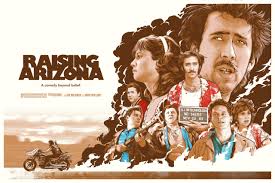
RAISING ARIZONA
Movie Reviews

Directed by Joel and Ethan Coen
Starring: Nicolas Cage, Holly Hunter
Review by Andrew Rowe

SYNOPSIS:

When a childless couple of an ex-con and an ex-cop decide to help themselves to one of another family’s quintupelets, their lives get more complicated than they anticipated.

REVIEW:

10 minutes, that’s how long Raising Arizona rolls until the title card hits. If this sounds odd it is, but so is everything else about the Coen Brothers’ second film. As they’ve often done throughout their career, the brothers normally follow-up a serious film with a comedy. Fargo led to The Big Lebowski, No Country for Old Men led to Burn After Reading. With Raising Arizona the brothers had just come from the neo-noir Blood Simple, their first ever film. Where as that film dealt with deception and murder in the shadows of Texas, Raising Arizona basks in the sun with non-stop slapstick, silly fun.

Nicholas Cage stars as Hi, or H.I. if you’re talking to his friends. He’s a petty criminal who has a thing for robbing convenience stores with ammo-less guns. Because he doesn’t use armed weapons his jail sentences are always small in length, which allows for multiple visits. During these multiple visits he meets Ed, a policewoman played by Holly Hunter. Ed’s fiance leaves her, which opens up the door for Hi to reform and win her heart. This is when the Raising Arizona title card hits.

The unlikely couple moves into a trailer in the desert and realize they need something more in their life because they have too much love to give. After multiple attempts of conception, they learn that Ed is unable to bare children and due to Hi’s criminal record, unable to adopt. Devastated, hope arrives in the form of the ‘Arizona Quints’, 5 boys that are born to a locally famous unpainted furniture storeowner, Nathan Arizona.

Hi and Ed decide that abducting one of the boys for themselves is a good idea and do so. After welcoming the child into their home, Hi and Ed are greeted by two of Hi’s friends from prison, Gale and Evelle, John Goodman, and William Forsythe. The two inmates have broken out of prison because the institution no longer had anything to offer them. Against Ed’s wishes, the two fugitives stay at their home where they begin to influence Hi.

At this same time a heavily armed bounty hunter by the name of Leonard Smalls, “My friends call me Lenny… only I ain’t got no friends”, is on the hunt for the child. Blowing up bunny rabbits with grenades, Leonard is fear itself. Gale and Evelle eventually learn of the child’s actual identity and decide to turn him in for the reward money. Everyone collides on a strip in the middle of the desert highway that involves a bank robbery, gunfire, hand-to-hand combat, screeching tires, and a large explosion.

The script, written by the Coens possesses their trademark tongue-in-cheek dialogue as well as an explosive climax and slow burn denouement. No one writes stupid characters like the Coens do. These people that inhabit the film aren’t very bright, and it’s hard to believe anyone in the world could be of this level of intelligence, but the Coens draw you in, first making the world they live in real, then the characters, then the silly things they do. Besides the charming dialogue, there are so many ridiculous sight gags that you may not even catch them all the first time around.

Raising Arizona is arguably the craziest movie the Coen Brother’s have made in their three-decade career, and that’s saying a lot. The film acts as a live-action Saturday morning cartoon. Working for the second time with cinematographer Barry Sonnenfeld who had shot their debut film Blood Simple, the visuals on screen are closer to a Dr. Seuss book than any of the current film adaptations. Using his trademark wide angles, everything remains in focus allowing the viewer to fully appreciate the immaculate Art Direction. The camera also moves with the action at the right time giving certain scenes a feeling that the camera is a character in the film, namely a chase scene through a house, and a fistfight between two characters.

The actors do a tremendous job of bringing these cartoon characters to life. John Goodman who would go on to work with the Coens several more times is perfect as Gale, the harder of the two brothers and number one bad influence on Hi. Nicholas Cage and Holly Hunter have great comedic chemistry and give weight to characters that otherwise wouldn’t have much soul. Hi may just be a dummy, but he’s a dummy with a large heart that wants nothing more than for his Ed to be happy. He is like Bugs Bunny mixed with Wilde Coyote, he’ll get away from Elmer Fudd only to celebrate and have an anvil fall on his head. Randall “Tex” Cobb is a towering inferno on wheels, and makes lighting a match look almost as cool as Clint Eastwood.

It’s of course the Coens that bring it all together. The characters all seem real in this colorful world they’ve created. The slapstick is done wonderfully and gives you a nostalgic feeling of when these Buster Keaton-style comedies were king. It’s just a really fun movie that’ll have you laughing and shaking your head in tandem. This film is also the Coen’s most family friendly; it is almost Disney-like in some aspects.

The film’s innocence is something rarely seen in today’s crop of comedies as well as in the Coen’s filmography. It doesn’t feature as dark of humor or the violence that comes with most Coen Brothers’ films, but here that’s a good thing. The film is a great little gem that shouldn’t be missed.

raising arizona

Also, Free logline submissions. The Writing Festival network averages over 95,000 unique visitors a day.
Great way to get your story out: http://www.wildsound.ca/logline.html

Deadlines to Submit your Screenplay, Novel, Story, or Poem to the festival:http://www.wildsound.ca

Watch recent Writing Festival Videos. At least 15 winning videos a month:http://www.wildsoundfestival.com

FULL LIST of the 2017 Emmy Winners