Film Review: ICE AGE: COLLISION COURSE

ice_age_collision_course
ICE AGE – COLLISION COURSE (USA 2016) **

Directed by Mike Thurmeier

Starring: Ray Romano, Denis Leary, John Leguizamo |

Review by Gilbert Seah

Saving the world is a common theme in action hero and animated movies these days. The same is applied in the latest and 5th instalment of the ICE AGE franchise, appropriately called ICE AGE – COLLISION COURSE as the planet is about to be destroyed by asteroids, according to the reading of the pillar by Buck (Simon Pegg).

The film has its signature ice age segment of Scrat (Chris Wedge) chasing his runaway acorn which somehow always gets away. It’s a mostly silent segment and has grown in popularity just as Beep Beep and the Coyote are now famous in the Looney Tunes world. Popular as they are, these antics grow tiresome. I am not a fan of either Beep Beep or Scrat’s acorn antics. In ICE AGE COLLISION, the antics lead to an almost destruction of the planet by an steroid, unless the hero can save the world.

The story goes on like this. While trying to bury his acorn, Scrat accidentally activates an abandoned alien ship that takes him into deep space, where he unwillingly sends several asteroids en route of collision with Earth. Not very original a premise of an alien ship hidden in the Arctic or Antarctic! Meanwhile on the planet Earth, Manny (Ray Romano) is worried about the upcoming marriage between Peaches (Keke Palmer) and her fiancé, Julian (Adam Devine), while Sid (Joh Leguizamo) is dumped by his girlfriend, Francine (Melissa Rauch), just as he is about to propose to her. During Manny and Ellie’s (Queen Latifah) wedding anniversary party, some of the asteroids strike the place and the herd barely escape with their lives. Meanwhile at the underground cavern, after stealing a dinosaur egg from a trio of Dromaeosaurs, Buck discovers an ancient stone pillar, which he takes to the surface, where he meets Manny and the others.

The story is nothing really original nor does it contain a lot of comedic potential. What follows is a rather lame series of mildly funny at best, incidents that lead to a climax that is also not particularly exciting.

Actors from the other ICE AGES movies, Ray Romano, John Leguizamo, Denis Leary, Queen Latifah, Keke Palmer, Jennifer Lopez, Simon Pegg and Chris Wedge all reprise their roles while new additions Jesse Tyler Ferguson, Adam DeVine, Nick Offerman, Max Greenfield, Stephanie Beatriz, Melissa Rauch, Carlos Ponce, Michael Strahan, Jessie J and Neil deGrasse attempt to breathe new life into the franchise.

The film is again directed by Canadian Mike Thurmeier of Blue Sky Studios, who did a few of the other ICE AGES films.

The ICE AGE series were never that funny or inventive compared to other animated series like SHREK, TOY STORY or MONSTERS INC. But they somehow found themselves into the hearts of many, which has resulted in a total of 5 films. I am hoping this will be the last as the series. Scrat chasing his and his acorn has become terribly tedious.

Costing a frugal $50 million to make compared to other more expensive animated features, there should be enough ICE AGE followers for Fox Studios to make their money back. Hopefully, Blue Sky Studios will come up with more original animation as their next project.

Also, Free logline submissions. The Writing Festival network averages over 95,000 unique visitors a day.
Great way to get your story out: http://www.wildsound.ca/logline.html

Deadlines to Submit your Screenplay, Novel, Story, or Poem to the festival:http://www.wildsound.ca

Watch recent Writing Festival Videos. At least 15 winning videos a month:http://www.wildsoundfestival.com

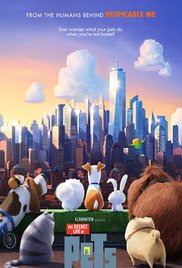
Movie Review: THE SECRET LIFE OF PETS (USA 2016) ****

Deadlines to Submit your Screenplay, Novel, Story, or Poem to the festival: http://www.wildsound.ca

the_secret_life_of_petsTHE SECRET LIFE OF PETS (USA 2016) ****
Directed by Chris Renaud, Yarrow Cheney

Starring: Louis C.K., Eric Stonestreet, Kevin Hart, Jenny Slate, Ellie Kemper, Albert Brooks, Lake Bell, Dana Carvey

Review by Gilbert Seah

What do pets do after their human owners leave for work? The imagination of the writers Cinco Paul , Ken Daurio and Brian Lynch entertain audiences with the notion. The story follows the adventures of one male pup, Max (Louis C.K.) who leads a sheltered and spoilt life with his owner Katie (Ellie Kemper). Max hangs out with other pets like Chloe (Lake Bell), Mel (Bobby Moynihan), Buddy (Hannibal Buress), and Sweet Pea (Tara Strong). Trouble soon arrives in paradise. One day, Katie adopts a giant dog called Duke (Eric Stonestreet) who Max does not get along with. But when they get lost and encounter both animal control and an evil rabbit, Snowball (Kevin Hart), they are forced to join forces. Animated features usually have a story involving saving the world like the DESPICABLE ME movies. This one has the pets trying to return home.

It is half way through watching THE SECRET LIFE OF PETS that it suddenly dawns that a good chunk of the storyline is derived from Pixar’s TOY STORY. Just as Andy has his favourite toy, cowboy Woody, Katie has her favourite pet dog Max. Just as Woody finds his toy universe shaken by the arrival of new toy Buzz Lighyear, Max finds his comfortable world undermined by the rival dog, Duke that Katie brings home. But that is not all. The toys speak and move when the humans are away just as the pets speak in their secret life of their own. But the filmmakers are clever enough not to call their film PET STORY and to take the storyline on step further. The toys can never match the antics of pets. The fact that millions watch cat antics on youtube is proof of the fact.

The cuteness factor is high and the cuteness can get a bit annoying at times. The trailer displayed lots of it. But most of what is seen in the trailer is finished off in the film’s first 10 minutes. But the cuteness antics are occasionally very funny and work well, when used more sparingly.

The voice characterizations are lively, working well with the creatures created. Standing out is Steve Coogan’s Oz, the alley cat and Kevin Hart’s Snowball. The name Snowball was likely taken from the name of the pig that led the revolt against human beings in George Orwell’s ANIMAL FARM.

The music by Oscar winning French composer Alexandre Desplat (THE GRAND BUDAPeST HOTEL) is a big bonus. Two catchy songs “Welcome to New York” by Taylor Swift and “Lovely Day” by Bill Withers can heard at the beginning and end of the film respectively.

As the film is made by Illumination Enetertainment, responsible for the DESPICABLE ME films, the studio is quick to remind audiences of the fact. A Minion animated short Minions is featured before the film. The Pharrell Williams Oscar winning song “Happy” is heard as a cameo song on the radio of a cab that passes by the pets. One of the pets wears a Minion outfit to a costume party. But one of the funniest sequences has Duke and Max in heaven in a sausage factory where the hundreds of sausages have faces, all the animated sausages looking like orange Minions.

One might compare and the animation of THE SECRET LIFE OF PETS to Disney’s Pixar films. Still SECRET LIFE has enough merits for it to stand on its own as excellent family entertainment and fun. If SECRET LIFE spins out a few sequels, no one will complain.


Also, Free logline submissions. The Writing Festival network averages over 95,000 unique visitors a day.
Great way to get your story out: http://www.wildsound.ca/logline.html

Deadlines to Submit your Screenplay, Novel, Story, or Poem to the festival:http://www.wildsound.ca

Watch recent Writing Festival Videos. At least 15 winning videos a month:http://www.wildsoundfestival.com

TIFF Cinematheque presents Hitchcock/Truffaut

Deadlines to Submit your Screenplay, Novel, Story, or Poem to the festival: http://www.wildsound.ca

By Gilbert Seah

Alfred Hitchcock and Francois Truffaut are my two favourite directors of all time.  Truffaut is the reason I studied French so that I could understand his films in French.  The recent documentary by Kent Jones on Truffaut’s interview with Hitchcock is every cinephile’s dream documentary.

TIFF Cinematheque presents the films by Hitchcock and Truffaut.  It is an exhaustive retrospective with many little not so well known gems like SHOOT THE PIANO PLAYER, THE SOFT SKIN perennial favourites like THE BIRDS and NORTH BY NORTHWEST, the latter being my personal best film of all time.

Many films like THE BRIDE WORE BLACK, I have seen 5 times or more times and should be seen on the big screen.  Others should be enjoyed time and again.

Below are capsule reviews of selected film, films by Hitchcock followed by those of Truffaut – all listed in alphabetical order.  Mots of them are rated 5-stars – yes, because they are that superb.

For more information on the venue,program and date and time of screenings,click on the link to the Cinematheque website below:

http://tiff.net/summer2016-cinematheque/hitchcock-truffaut-magnificent-obsessions

FILM REVIEWS:

HITCHCOCK:

THE BIRDS (USA 1962) ***** Top 10 

Directed by Alfred Hitchcock 

Tippi Hedren could very well be Hithcock’s favourite blonde.  She is the one of the few that is the lead protagonist in the Hitchcock’s film world dominated by male protagonists.  And not only in one but in two movies, THE BIRDS and MARNIE.  In THE BIRDS, Hitchcock gives her the perfect compliment when he has her steer an outboard motor across the bay waters wearing a mink coat.  How is that for fabulousness?

A wealthy San Francisco socialite, Melanie Daniels (Hedren) pursues a potential boyfriend, Mitch Brenner (Rid Taylor) to a small Northern California town that slowly takes a turn for the bizarre when birds of all kinds suddenly begin to attack people there in increasing numbers and with increasing viciousness.

As far as movie THE BIRDS go, based on the book by Daphne du Maurier, it is the best of the Master’s work.  The beginning credits with the winged creatures tearing away the credit to an electronic score peaks audience anticipation early.  The film contains no musical score except for the scene where the school children sing a repetitive song.  There is no attack of the birds during the entire the first half of the film except for a peck on the head on Melanie (Hedren) and a crashed seagull at a door.  Hitchcock uses the time to establish the characters and setting for the film.  The romance between Daniels and Brenner is given centre stage.  But the film’s second half comes fast and furious with brutal attacks of the birds.  The attack scenes are extremely well executed, courtesy of the Master of Suspense who injects his sinister brand of humour in many scenes – example: the young Cathy telling Daniels of the man Brenner is defending in court: “Did you know the killer stabbed his wife six times?” No explanation is given for the bird attacks, which makes all the proceedings scarier!

NORTH BY NORTHWEST (USA 1959) ***** Top 10

Directed by Alfred Hitchcock 

Before going on with the capsule review, I have to say that Alfred Hitchcock’s NORTH BY NORTHWEST, which I have seen at least 5 times, is my favourite movie of all time.  It is Hitchcock at his very best, with a film that includes suspense, action, comedy and romance.  And Hitchcock has infused a perfect villain in James Mason as the Phillips Vandamm out to kill hero, Roger Thornhill (Cary Grant).  In the story, no reason is given for the existence for Vandamm’s organization or what its purpose is.  Like Hitchcock’s Macguffin, the chase is all the importance and it propels the plot to its climax, the reason being of no consequence.  Hitchcock gives the villain a human touch in the scene where his right hand man, Leonard (Martin Landau) delivers the message that his girl Eve Kendall (Eva Marie Saint) has defected and fallen in love with the enemy, Roger Thornhill.  Vandamm punches the bearer of bad news with such force that he hurts his hand.  In the climatic scene, he jumps out at Thornhilll with a climatic fight at Mount Rushmore.  NORTH BY NORTHWEST contains many classic set pieces like the crop duster scene.  A film that should be seen many times for Hitchcock’s, author Ernest Lehman’s pure genius and Bernard Herrmann’s arresting score.

NOTORIOUS (USA 1946) ****

Directed by Alfred Hitchcock

One of the most suspenseful of Hitchcock’s spy films (TORN CURTAIN, TOPAZ), Ingrid Bergman plays the romantic lead and also the damsel in distress.  Alicia Huberman, (Bergman) a German expatriate whose father has just been convicted as a German spy is hired by the Americans.  Devlin (Cary Grant) brings Alicia to Brazil in hopes to arrange a meeting with Alex Sebastian (the fantastic Claude Rains); another German spy who just happens to have a history with Alicia insofar that he was in love with her.  The plan is to get them together so that she can spy on Sebastian and his colleagues so that the Americans can get a leg up on their mutual espionage.  Of course, love develops between Devlin and Alicia, which complicates their operation and of course, their lives.  Performances are top notch and special mention should be made of Rains who makes his villain a human one, with a mother obsession.  The key suspense scenes is the climax in which Devlin brings Alicia down the stairs with the villain, Alex accompanying them.  A full 10-minutes of nail-biting tension!  The overhead shot of Bergman collapsing on the living room floor after being poisoned is also classic Hitchcock.

PSYCHO (USA 1960) ***** Top 10

Directed by Alfred Hitchcock

With a new sound restored print Alfred Hitchcock’s PSYCHO sounds more chilling with Bernard Herrmann’s haunting score and the screams of Janet Leigh in the shower scene. The plot concerns Secretary Marion Crane (Janet Leigh) embezzling $40,000 and taking off from the town to drive to settle down with her boyfriend, Sam Loomis (John Gavin) in Fairvale.  A storm forces her off the road to take refuge at the Bates Motel where she is murdered in cinema’s most famous shower scene, a pleasure to watch for the umpteen time, ripping shower curtains, chocolate syrup down the tub hole and all with accompanying restored violin/cello screening soundtrack.  This sends Sam and her sister Lila (Vera Miles) with a private dick (Martin Balsam) on her trail after she has disappeared. The pleasure derived from watching PYSCHO will take different forms depending on the viewer.  The film contains many surprises from start to finish, with many of these being cinematic.  The most important is Hitchcock’s killing of, of Leigh – the film’s main character in the shower, a first at its time.  But with the full story known to audiences viewing PSYCHO for a repeat, myself for the 4th time, the film still holds many surprises, especially in shots or techniques not observed before.  PSYCHO contains lots of nudity and sex scenes without showing any private parts. For myself, one is a shot of Bates (Anthony Perkins) climbing up the stairs.  Perkins (gay, in real life) was allowed by Hitchcock to interpret his character so long as it did not involve camera movement.  His sexy shaking of his bum from side to side clearly stood out to me during this screening.  Others include his infusion of suspense in many segments, like the one with the blinding rain and bright lights hitting Marion’s car windscreen forcing her to stop at the Bates Motel.  Also, the details of the title credits – December 11th; 2.43 pm; Phoenix, Arizona implies the importance of details and puts the audience in a specific and not imaginary time and space.  To have the audience feel for sympathetic towards Marion who has stolen the $40,000, Hitchcock has the man paying her boss the money say: “I carry more than I can afford to lose!” Neat too is Hitchcock’s use of voiceover and irony.  Irony in the form that Marion’s boss actually sees her, as observed by Marion through her windscreen, leaving town.  Voiceover involves imagined conversations in the head of Marion that could have or could just be imagined by Marion.  What is really neat, is that it dos not matter to the plot whether the conversation did occur but that it serves to highlight Marion’s paranoia.  The ending explanation of Bates’ mental situation by a psychologist is a bit too talky but PSYCHO should be re-seen for its many masterly staged scenes like the ending parlour scene, the murder of the private investigator as he falls down the stairs and of course, the famous shower scene, just to name a few.

REAR WINDOW (USA 1954) **** 

Directed by Alfred Hitchcock 

Based on a shot story, REAR WINDOW feels at times that it is short of story.  But Hitchcock more than makes up for him with the banter between star photographer Jeffries (James Stewart) and his icy blonde girlfriend, Lisa (Grace Kelly).  The film is totally told from the point of Jeffries, apartment bound because of a broken leg, the cause of which is never brought up.  The Master would likely say that it would make no consequence to the suspense.  He spies on the courtyard and is convinced that the neighbour u the building across (Raymond Burr) has murdered his invalid wife.  He gets Lisa and his nurse (Thelma Ritter) to aid him in his quest to out the killer.  Hitchcock generates lots of suspense moments from the set-up, the best one being Jeffries watching though his binoculars Lisa getting caught breaking into the killer’s apartment by the killer, unable to do anything being bound to his wheelchair.  The two lovers are at logger heads throughout the film’s first half but Jeffries admires her once she aids him – also bringing out the film’s charm.  Nurse Stella says it right (Hitchcock steals a message here to the audience) when she tells Jeffries that most people look out at other people’s lives instead of their own.

STRANGERS ON A TRAIN (USA 1951) ***** Top 10

Directed by Alfred Hitchcock

In this flawless film adaptation the Patricia Highsmith novel, two strangers on a train, tennis player Guy Haines (Farley Granger) and Bruno Anthony (Robert Walker) talk about swapping murders when Bruno actually carries out his part of the bargain.  Guy’s trampy wife is murdered so that he can wed Anne (Roth Ronan) the one he really loves.  When Guy realizes what has happened, he becomes the prime suspect, while Bruno pressures him to carry out his part of the bargain.  STRANGERS ON A TRAIN is typical and perfect Hitchcock, an innocent hero caught up in intrigue with a smashing climax at the end of the film with hero and villain battling out on a runaway merry-go-round.  There are many classic scenes in this film – like the villain popping a kid’s balloon at a fair with his cigar; the villain entertaining gossipy old ladies with the notion of murder; a suspense laded tennis match and a strangling viewed through the lens of fallen glasses.  There is also the additional bonus of a prize performance by Hitchcock’s daughter, Patricia Hitchcock as Anne’s spritely sister who steals every scene she is in

TO CATCH A THIEF (USA 1955) **** 

Directed by Alfred Hitchcock 

There is hardly any suspense in this lightweight romantic comedy thriller but the sinister Hitchcock touches are still present – the stubbing of a cigarette butt on an egg; the dropping of a casino chip into a lady’s bosom.  The story concerns a reformed thief John Robie (Cary Grant) aiding Lloyds Insurance finding the real burglar and clearing his name of recent jewel thefts.  In the meantime, he meets France Stevens (Grace Kelly) who falls in love with him and his past, and who believes him to be the real thief.  Hitchcock’s foray into sophisticated comedy is interesting enough with sufficient humour scattered evenly during the film.  Shot in the Riviera, the scenery is stunning, matched only by the gorgeous costumes worn by Kelly.  The costume ball at the film’s climax outdoes any real life fashion show.  The extended car chase scene blends suspense and humour as the Master had redone in his later movies NORTH BY NORTHWEST and FAMILY PLOT.

TRUFFAUT:

L’ENFANT SAUVAGE (THE WILD CHILD) (France 1969) ***** Top 10
Directed by Francois Truffaut

Shot in black and white, this apparently simple looking period film is a masterful look at the behaviour of human beings.  The true story of a boy discovered in the wild and educated by a professor played by director Truffaut himself.  Truffaut is well known as a kind director and this film shows off this trait off at its best.  The boy is taught manners, the alphabet and finally the difference between right and wrong.  The climatic scene in which the boy is punished for doing right is one of the most brilliant and moving segments ever captured on film.  Also in the picture is the professor’s housekeeper, Madame Guerine who shows exceptional kindness to the boy.  An altogether most wonderful experience at the movies, THE WILD CHILD is one of the best films of all all time about kindness.

JULES ET JIM (France 1962) **** 

Directed by Francois Truffaut 

Based on the semi-autobiographical novel by Henri-Pierre Roche, JULES ET JIM (JULES AND JIM) is the definitive best film ever (before till even the present) of a ménage a trios.  Jules (Oscar Werner) is married to Catherine (the informidable Jeanne Moreau) but carries on a friendship with Jim (Henry Serre).  Catherine also loves Jim.  Jules is willing to allow Catherine to divorce him and marry Jim so that he will not lose her, as he cannot satisfy all of her needs.  The villagers call the 3 of them lunatics but these are the happiest lunatics one will ever see on screen.  And this makes one of the happiest films Truffaut has ever made.  Despite the relationship problems, when things are right, the three have a really good time.  Catherine is spontaneous to a fault – sporting a moustache and pretending to be a man; jumping into the river but everyone (audience included) cannot help it from fall in love with her.  The film tracks their relationship from the first meeting, through the Second World War, through the marriage and after.  The soundtrack by George Delerue is also amazing and has been named 10 Best soundtracks of all time by TIME Magazine. 

LA MARIEE ETAIT EN NOIR (THE BRIDE WORE BLACK) (France 1967) ***** Top 10

Directed by Francois Truffaut 

My personal favourite Truffaut movie and French film of all time sees sultry siren Jeanne Moreau do away with the 5 killers who accidentally shot her bridegroom on her wedding day.  Julie methodically tracks them down one by one and kills them without remorse.  Truffaut gives her femme fatale more human feelings than necessary as she almost falls in love with one of them.  Five of France’s most popular actors of the time (Claude Rich, Charles Denner, Jean-Claude Brialy, Michel Lonsdale) play 4 of Julie’s victims, and to me a delight to watch all of them on the screen again.  This film is Truffaut’s tribute to Hitchcock after he interviewed and the Master of Suspense wrote the book Hitchcock.  Using Hitchcock’s frequent composer Bernard Hermann, the film has the complete Hitchcock feel.  Truffaut has been described as the kindest of film directors and this film illustrates why.  He does not let the innocent characters die.  The cleaner who steals and drink from the bottle that holds the poisoned liquor is emptied by Julie.  When the school teacher Julie impersonates to do away with a victim is arrested, she calls the police to prove her innocence.  THE BRIDE WORE BLACK is unfortunately Truffaut’s least favourite film as he had a big argument with his cinematographer on the look of this movie, but to this critic the film is still near perfection! 

TIREZ SUR LE PIANIST (SHOOT THE PIANO PLAYER) (France 19  ) ****
Directed by Francois Truffaut

One of Truffaut’ more obscure but no less impressive feature, SHOOT THE PIANO PLAYER follows the adventures of a bar’s pianist, Charlie played by French singer Charles Aznavour after his bother runs to him for hiding.  The film is part thriller part romance but i is the little details of the film that creates the charm and magic f his sensitive film.  One scene has Charlie contemplating whether to ask Lena (Marie Dubois) to have a drink r to be more subtile by asking her if she was thirsty.  When he immediately turns to her to utter by mistake, “Let’s go for a drink,” she has already walked off.  The execution of musical numbers like the rendering of “Framboise” also does the trick.  Aznavour is no great actor, by Truffaut milks the charm that has made this singer so famous.   Again, the are lots of shot of women’s sex long legs here as in his oner films.  I saw the film only once 20 years ago and was not really impressed then, but am now.


Also, Free logline submissions. The Writing Festival network averages over 95,000 unique visitors a day.
Great way to get your story out: http://www.wildsound.ca/logline.html

Deadlines to Submit your Screenplay, Novel, Story, or Poem to the festival:http://www.wildsound.ca

Watch recent Writing Festival Videos. At least 15 winning videos a month:http://www.wildsoundfestival.com

THE BFG (USA 2016). Directed by Steven Spielberg

Deadlines to Submit your Screenplay, Novel, Story, or Poem to the festival:http://www.wildsound.ca

the_bfg.jpgTHE BFG (USA 2016) **
Directed by Steven Spielberg

Starring: Mark Rylance, Ruby Barnhill, Penelope Wilton, Jemaine Clement, Rebecca Hall, Bill Hader

Review by Gilbert Seah

THE BFG (big friendly giant) premiered at Cannes this year in the out-of-competition category to rave reviews. So expecting a lot from Spielberg, the director who is reputed to be a creator of dreams, I went into the BFG film (a film with a story of a giant collecting dreams in a bottle) expecting a lot but was duly disappointed.

The film based on the Roald Dahl children’s novel, deals with an orphan named Sophie (Ruby Barnhill) who lost her parents when she was a baby. Sophie is kidnapped from the orphanage one night by the BFG (Oscar Winner Mark Rylance from Spielberg’s NEST OF SPIES) and brought to Giant Land. There, Sophie befriends the BFG. The book and film fail to give a satisfactory reason of Sophie being kidnapped. The BFG turns out to be one who captures dreams and delivers them to children in the human world. In Giant Land, Sophie meets the other nasty evil human-eating giants. Going back to London, she convinces the Queen (Penelope Wilton) to capture the evil giants. That is the story, a simpler one compared to other Dahl’s stories.

Spielberg opts to leave out Sophie’s orphanage life. Nothing is shown about her life there, except of a mention by her to the BFG that the matron Mrs. Conkers is nasty and gives out lots of punishments such as locking children in the cellar which is rat infested. Not one other child is shown in the film leaving out a key element in the film – the human element. Other characters like the Queen’s Head of Army and Air Force, the King of Sweden and Sultan of Bagdad are largely left out. There are no ‘real’ human beings in the film except for Sophie. Everyone else like the queen and her men are shown as clowns and just pawns for the story’s movement.

At least the special effects animation and Janusz Kaminski’s cinematography are nothing short of stunning. The look of Mark Rylance as the BFG looks very close to Quentin Blake’s illustration in the Dahl book. From the very first frame to the last, there is always the feeling of awe. But the basic human story is lost. Special effects have undermined the simple pleasure of a Roald Dahl book. There can always be too much of a good thing. After being in Giant Land for an hour, the special effects animation begin to look normal.

Spielberg keeps his film in family mode. There is not gore or any scene in which a giant gobbles a human being. When Sophie is eaten by a giant in her dream, she is seen thrown into a dark black hole. Spielberg also resorts to cheap laughs like fart jokes The BFG offers Sophie a fizzy drink called frobscottle that causes noisy green-coloured flatulence. The flatulent humour is revisited when the Queen herself drinks the frobscottle.

The film is dedicated to Melissa Mathison, the scriptwriter (she also wrote E.T.) who passed away during the film’s production.

Also, Free logline submissions. The Writing Festival network averages over 95,000 unique visitors a day.
Great way to get your story out: http://www.wildsound.ca/logline.html

Deadlines to Submit your Screenplay, Novel, Story, or Poem to the festival:http://www.wildsound.ca

Watch recent Writing Festival Videos. At least 15 winning videos a month:http://www.wildsoundfestival.com

THE DAUGHTER (Australia 2015) ***

Deadlines to Submit your Screenplay, Novel, Story, or Poem to the festival:http://www.wildsound.ca

the_daughter.jpgTHE DAUGHTER (Australia 2015) ***
Directed by Simon Stone

Starring: Geoffrey Rush, Sam Neill, Anna Torv

Review by Gilbert Seah

Based on the Henrik Ibsen’s 2-act play ‘The Wild Duck’, THE DAUGHTER is Simon Stone’s gut wrenching drama adapted to a small loving town in Australia. It stars Oscar winner Geoffrey Rush who plays an evil father with a fondness for younger women and with no redeeming qualities. About to be re-married, his son (Paul Schneider) visits, only to open dark skeletons in the closet. This leads to things getting from bad to worse, leading to a suicide.

The film was shot in New South Wales, in an area of abandoned factories and logging forests in a soft light, like what would be expected in Denmark. Written also by Stone, the film is a compelling watch despite its over serious content that might turn out to intense for certain audiences. The play is simplified a bit, with the removal of a few characters but with no reduction in the drama.

Rush is always a pleasure to watch, even in the role of a much displaced character.

THE DAUGHTER is Stone’s first film, a little difficult to watch because of its content and a bit slow moving, made slower with a lot of slow option sequences.

Also, Free logline submissions. The Writing Festival network averages over 95,000 unique visitors a day.
Great way to get your story out: http://www.wildsound.ca/logline.html

Deadlines to Submit your Screenplay, Novel, Story, or Poem to the festival:http://www.wildsound.ca

Watch recent Writing Festival Videos. At least 15 winning videos a month:http://www.wildsoundfestival.com

OUR KIND OF TRAITOR (UK/France 2016) ***

Deadlines to Submit your Screenplay, Novel, Story, or Poem to the festival:http://www.wildsound.ca

our_kind_of_traitor.jpgOUR KIND OF TRAITOR (UK/France 2016) ***

Directed by Susanna White

Starring: Carlos Acosta, Radivoje Bukvic, Stellan Skarsgård, Naomie Harris, Ewan McGregor

Review by Gilbert Seah

The new John Le Carre film scripted by Hossein Amini is a spy thriller quite different from what audiences have seen in the past. The main character is now an academic, Perry Makepeace, played by Ewan McGregor. McGregor appears in more relaxed Mode compared to Richard Burton, Alec Guinness or Gary Oldman in THE SPY WHO CAME IN FROM THE COLD and SOLDIER, TAILOR, TINKER, SPY respectively. This is not necessarily a bad thing as White’s treatment of Le Carre’s material has a more feminine – more human touch. This is a huge contrast to the last major Le Carre film adaptation by Tomas Alfredson, the chilling and excellent SOLDIER, TAILOR, TINKER SPY.

The story here is simple and much more straight forward compared to the extremely hard to follow SOLDIER, TAILER, TINKER, SPY. After Perry is offered a tennis game by Russian mafioso, Dima (Stellan Skarsgard), he is ‘recruited’ by him to help him and his family defect. A sort of mixed STRANGERS ON A TRAIN and TORN CURTAIN Hitchcockian story, White’s film plays well blending the cold blooded spy game with a more human aspect. With this main plot, the story weaves in some choice bits of political debate.

Director White is quick to point out that it is not only the Russian mob that are the bad guys in the movie. There is also something very nasty within the British Intelligence as there is in every character in the story. Even Perry is a philandering husband and not one to make his long suffering wife, Gail (Naomie Harris) happy as she is one to point out the faults of her partner. But surprisingly, both Perry and Gail have a change of heart to protect Dima at all costs. In the process their marriage is saved.
As in a Le Carre story, fans will not be disappointed with the plot twists, swift cold blooded killings, car chases and exotic locations, in this case Marrakech, the Alps and the cities of London and Moscow. The film has the look of the spy thrillers of the 60’s and 70’s. But the Carre story is updated with modern technology such as the downloading of key information (bank account numbers) into a usb memory stick.

The humour is also slick. When asked by Perry the reason he was picked, Dima’s reply was that he was the only one left in the restaurant. But a good pick Perry is. A lot of the humour is also derived from Dima’s behaviour – how he changes from kindness shown to his family to cold brutality.

The film contains a few outstanding performances that make the movie. Among them are Stellan Skarsgard’s flamboyant and hyper ex-Russian mafioso Dima and Damian Lewis’ Hector who starts off following British red tape and ends up fighting against it. Jeremy Northam (PRIEST, THE WINSLOW BOY) has a cameo as Aubrey Longriegg, a treacherous British politician.

OUR KIND OF TRAITOR is a milder but still entertaining Le Carre thriller.


Also, Free logline submissions. The Writing Festival network averages over 95,000 unique visitors a day.
Great way to get your story out: http://www.wildsound.ca/logline.html

Deadlines to Submit your Screenplay, Novel, Story, or Poem to the festival:http://www.wildsound.ca

Watch recent Writing Festival Videos. At least 15 winning videos a month:http://www.wildsoundfestival.com

Movie Review: THE WITNESS (USA 2016) ***1/2

Deadlines to Submit your Screenplay, Novel, Story, or Poem to the festival:http://www.wildsound.ca

the_witness.jpg
THE WITNESS (USA 2016) ***1/2
Directed by James Solomon

Starring: William Genovese, Shannon Beeby, Kitty Genovese

Review by Gilbert Seah

THE WITNESS, is a documentary about the 38 witnesses of the 1964 stabbing of Kitty Genovese. But it turns out that they all did nothing. Or so it seems. Could it be true that Americans are that soulless? The film goes on to probe how it is impossible for that many people to see everything and do nothing. As the film progresses, THE WITNESS covers many other stories. Though the stories are quite different, they are all linked to the stabbing. But the real story that stands out is the one of Bill Genovese, Kitty’s brother who is in almost every frame of the film.

The details of the case: Kitty was a bar waitress in Kew Gardens, Queens who was randomly stabbed by a stranger named Winston Moseley—who later told police he was just looking for a woman to kill—then raped and robbed by him after he returned to finish the job. The New York Times later reported that 38 witnesses heard and even saw some part of the attack but didn’t call police and failed to intervene or even call attention to it.

Solomon’s film is absorbing for many reasons. The most important of these is Bill’s fixation on finding the truth about his sister’s murder. Bill will not stop. He investigates the New York Times reporter, ironically nicknamed Honest Abe who twisted the story to make it one that made news around the whole country. The fact of 38 witnesses doing nothing became a sociology study in many colleges. Bill also goes through a checklist of all the witnesses and questions each of those who are still alive. He goes so far as to ask to speak with Winston Mosley, his sitter’s killer, now serving sentence. When Mosley declined to meet Bill, Bill met his son. This meeting (which does no appear to be a re-enactment) is the film’s tensest segment. Initially, Mosley’s son, who is a reverend appears detached and unhelpful. When he finally confesses how he also suffered, especially at school with kids calling him the murderer’s son, Bill and the audience begin to feel for him.

But he film finally looks at Bill. When will Bill give up and accept the facts and move on? The investigation also reveals Kitty’s character. It is also revealed that she is gay. Bill interviews some of her lesbian friends as well.

Solomon’s film is intriguing in that it goes many different directions just as Bill’s life has taken him. Bill has also lost two legs while serving in the marines during the Vietnam war.

In the end, it is up to the audience to determine what Bill has gained from his intensive search. And in the process, learn from the film a few valuable lessons in life.


Also, Free logline submissions. The Writing Festival network averages over 95,000 unique visitors a day.
Great way to get your story out: http://www.wildsound.ca/logline.html

Deadlines to Submit your Screenplay, Novel, Story, or Poem to the festival:http://www.wildsound.ca

Watch recent Writing Festival Videos. At least 15 winning videos a month:http://www.wildsoundfestival.com

Today’s NEWS: Friday June 24, 2016

Read Today’s Entertainment News for Friday June 24, 2016

Mackenzie Davis to Co-Star With Charlize Theron in Jason Reitman’s ‘Tully’

‘Independence Day’, ‘Shallows’ & ‘Free State of Jones’ Must Contend with ‘Finding Dory’

‘Chariots of Fire’ Conductor Harry Rabinowitz Dies at 100

‘Mr. Robot’ Gets More Season 2 Episodes, Live After-Show

Malcolm in the Middle Reunion May Be Happening, Says Bryan Cranston

PHOTO: New Transformer: SQUEEKS!

transformers_squeeks.jpg

Movie Review: THE NEON DEMON (Denmark/France/USA 2016) ***
Deadlines to Submit your Screenplay, Novel, Story, or Poem to the festival:http://www.wildsound.ca

the_neon_demon.jpgTHE NEON DEMON (Denmark/France/USA 2016) ***
Directed by Nicolas Winding Refn

Starring: Elle Fanning, Christina Hendricks, Keanu Reeves

Review by Gilbert Seah

The much anticipated film at Cannes that caused quite the sensation, Nicolas Winding Refn’s THE NEON DEMON will not disappoint in terms of gore and surrealism. Refn has already proven himself a director to watch, with remarkable features like his PUSHER trilogy, DRIVE and ONLY GOD FORGIVES.

While his earlier 5 films displayed speed and ultra-violence, THE NEON DEMON reveals a different side of Refn. THE NEON DEMON is an extremely slower paced film, full of pauses that allow the audience to sit back and figure what is actually going on. And most of the time, it is still hard to figure out what is going on.

But one must hand it to Refn that as slow paced as this film is – it is far from boring. The film for one, is meticulously shot with glittery lighting that mesmerizes as much as confuses. His images of the characters often blend one into another, like the corpse that looks like the heroine in the film, for the purpose of the lady making love to it imagining the corpse to be the girl she did not succeed in sleeping with.
The film shows Refn’s interpretation of the pretentious L.A. fashion industry. A young and aspiring model called Jesse (Elle Fanning) has just moved to Los Angeles. She is an orphan, very beautiful and impresses everyone she meets with her beauty. She meets make up artist Ruby and two of her rather nasty model friends Sarah and Gigi at a surrealistic dimly lit party. The rest of the plot is immaterial except to show that models will do everything to stay ahead.

Refn’s films seldom contain pleasant characters. There are none in THE NEON DEMON. Who initially appears a kindly soul, Ruby turns out to be another mean person with the ulterior motive of using Jesse for sexual satisfaction. And when Ruby cannot get what she wants, she turns incredibly vicious. Refn does to shy away from gore and violence. Where there is insufficient of these in the story, he more than makes it up in the dream sequences. Jesse has a nightmare of her motel manager (Keanu Reeves in nasty mode) inserting a knife down her throat only to be awakened by him banging at her door wanting to rape her. This unpleasant character is not crucial to the story of Jesse, but is there just for added unpleasantness. But the prized unpleasant segment is the one with necrophilia on full display.

Ref does not seem to care what audiences think of his work. With that attitude, Refn can come up with a few mighty fine films – the best of these being his PUSHER trilogy, which are all cutting edge, exciting and relevant. THE NEON DEMON is his most surreal film, reality turning into a nightmare with models morphing into flesh eating vampires in a world lit by neon and fluorescent lights where the sun seldom shines. Needless to say, THE NEON DEMON is not a film for everyone, but it is not without its merits, strange as they may come.


Also, Free logline submissions. The Writing Festival network averages over 95,000 unique visitors a day.
Great way to get your story out: http://www.wildsound.ca/logline.html

Deadlines to Submit your Screenplay, Novel, Story, or Poem to the festival:http://www.wildsound.ca

Watch recent Writing Festival Videos. At least 15 winning videos a month:http://www.wildsoundfestival.com

Interview with Festival Director Eric Quander (Joshua Tree International Film Festival)

The 2016 Joshua Tree International Film Festival’s mission is to provide a platform for independent and noteworthy films and filmmakers to connect with industry professionals and the diverse audience that recognizes Joshua Tree as an oasis of creativity, art and culture throughout the international arts community. With special focus and support for projects that encompass the diverse vision of the urban and LBGTQ communities and bring to light the perspectives of indigenous cultures from around the world, we hope to cast the widest possible net to grow future generations of filmmakers and movie goers in Joshua Tree and beyond.

http://www.jtiff.org/

Interview with Eric Quander: 

Matthew Toffolo: What is your Film Festival succeeding at doing for filmmakers?

Eric Quander: The Joshua Tree International Film Festival offers filmmakers the opportunity to exhibit their work before an enthusiastic, curious and intelligent audience, in a community known for its creativity and mystic surroundings.

MT: What would you expect to experience if you attend the festival this year (2016)?

EQ: The theme for this year’s festival in “SACRED SPACE”, and will feature an eclectic mix of features and shorts that exhibit filmmakers and characters exploring their relationship to both their inner and exterior spaces.

MT: What are the qualifications for the selected films?

EQ: Submitted films are screened by a panel of judges, who are committed to the vision of the JTIFF. Films are distributed and are based on a set of criteria which are scored 1 (the lowest) to 10 (the highest). Films with the highest cumulative scores are submitted to the Programming Committee who make final determinations based on the festival’s theme and anticipated level of audience interest.

MT: Do you think that some films really don’t get a fair shake from film festivals? And if so, why?

EQ: I can’t really speak for other festivals, but JTIFF screeners and judges are trusted to view each submission with an open mind. We received over 100 submissions to this year’s festival, and undoubtedly among them, there were more than a few that simply don’t meet the standard of the type of films we want to screen before an audience. We don’t force screeners and judges to endure an obviously amateurish work, or those that lie far beyond the theme.

MT: What motivates you and your team to do this festival?

EQ: Our inaugural event last years was motivated by a challenge as to if a film festival in our community could attract an audience, in that we succeeded; however, admittedly, neither my staff or myself were not prepared for the technical difficulties that we experienced, which really threw the entire schedule off. We learned a lot from that experience, and this year, we are motivated to produce as professional event as possible. We have ½ as many films, a trained volunteer staff and venues that make it easier for attendees to see more films.

MT: How has the festival changed since its inception?

EQ: The JTIFF is much more organized this year. We have taken the time to really coordinate our efforts with venue owners, and we all recognize that he festival is a community effort, that will benefit all. We have been able to educate ourselves on how a festival should go, how to make seeing films easy for attendees and how to prepare technically, to ensure that every film on the schedule is screened. We’re proud of the work we have done, and know that returning attendees will see a big difference, while first time attendees will enjoy the experience.

MT: Where do you see the festival by 2020?

EQ: That will be our 6th festival, and honestly, I have no idea how the JTIFF will change in the intervening years. I do know that we will be around; between now and then, I would mid engaging in building a permanent space for the JTIFF, that shows films monthly. In the meantime, we will aim to exhibit independent films that challenge audiences, encourage introspection, and stimulate audiences to contribute to the positive growth of the local and global community.

MT: What film have you seen the most times in your life?

EQ: Night of the Living Dead (b&w version)

MT: In one sentence, what makes a great film?

EQ: A great film’s main character stimulates its viewer(s) to consider their life and environment.

MT: How is the film scene in your city?

EQ: Although there are a few sporadic screening throughout the year, the JTIFF is our community’s main platform to see independent films in the hi-desert.

joshua_tree.jpg

_____
Interviewer Matthew Toffolo is currently the CEO of the WILDsound FEEDBACK Film & Writing Festival. The festival that showcases 10-20 screenplay and story readings performed by professional actors every month. And the FEEDBACK Monthly Festival held in downtown Toronto on the last Thursday of every single month. Go towww.wildsound.ca for more information and to submit your work to the festival.