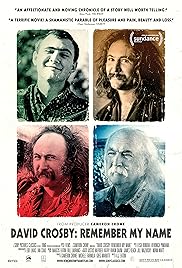
Film Review: DAVID CROSBY REMEMBER MY NAME (USA 2019) ***

David Crosby: Remember My Name Poster
Trailer

Meet David Crosby in this portrait of a man with everything but an easy retirement on his mind.

Director:

A.J. Eaton

Framed by core interviews conducted by Cameron Crowe (director of ALMOST FAMOUS who won an Oscar for the script of the film, and who did his first interview with him way back when he was a young teen of 16), this doc follows the life, aspirations, hopes and regrets of singer/songwriter/musician David Crosby.   Crosby now in his 70’s has performed solo as well as in super bands, The Byrds; Crosby, Stills & Nash; and Crosby, Stills, Nash & Young.
The doc is directed by Eaton, not Crowe, who steers his story of Crosby in chronological order unfolding it as if be a fiction film.  Crowe is never seen on screen though his voice heard.  Crowe does not appear to steer the film in any direction.  Instead he asks silly questions such as if he (Crosby) were to give up music or his family (wife and sons) what would his choice be.  The question is not only nonsensical as Crosby politely states as he would never come to a state where he would have to make this decision and if so, any musician would ultimate cost music as the answer.

Crosby, now in the 70’s has survived several heart attacks and drug overdoses and currently suffers from several ailments including diabetes He reminisces his life..

The film revisits David Crosby’s life, from the heady days in ’60s LA to the present time when he’s enjoying a rebirth of creativity, despite his past excesses and his estrangement
from ex-band members, including Graham Nash and Neil Young.  
This doc follows the typical path of a musician/rock star’s biopic.  As in ROCKETMAN (Elton John), BOHEMIAN RHAPSODY (Queen), the Asia Kapadia 2015 Oscar Winner AMY (on Amy Winehouse) all the biopics chart the protagonists rise to fame, their downfall, and if fortunate redemption back to fame.  Drug addiction and drink the number one factor for Crosby’s downfall is shared among his famed contemporaries.

Crosby does a lot of talking in Eaton’s film.  There should be more performances on film.  The result is a rather boring first two-thirds before it picks up and garbs the audience’s attention like a sock in the jaw.  This is when Crosby talks about his drunkenness and drug addiction.   Crosby states that members of his old bands refuse to talk to him as a result of his previous bad behaviour.  When Crower asks him the reason he does not initiate the reconciliation, Crosby dodges the question.

But every famous person accomplishes some good in life.  For Crosby, it is the use of his songs to do good, such as justice in the American system.  This film like the recent documentary WATERGATE enforces the evil that Presidents (in this case past President Richard Nixon) do.

The film’s most engrossing segment is the one showing Crosby’s lowest point in his life.  This is when his drug addiction got him arrested and jailed in the penitentiary with no money and nothing to his name.  But Crosby finally perseveres, comes out clean and does good in his life.

More that an examination of an artists’s talent, the doc is more interesting as a testament of the fallen star and how Crosby redeemed himself.

Trailer: https://www.youtube.com/watch?v=ln9dtQ8tuKk

Film Review: MASTER Z- THE IP MAN LEGACY (Hong Kong 2018) ***

Master Z: Ip Man Legacy Poster
Trailer

Director:

Woo-Ping Yuen

Writers:

Edmond Wong (screenplay by), Tai-lee Chan (screenplay by) (as Chan Tai Lee)

The fourth and spin-off of the 2015 IP MAN 3, MASTER Z- THE IP MAN LEGACY still has plenty of bite in the franchise.  The IP MAN films have been a hit, one after the other, because the filmmakers kept to the successful formula while keeping the action and its execution fresh.  Though the stories have been told before, they still come across as fresh and convincing.

MASTER Z can stand alone without anything known about the three IP films.  When the film opens, the protagonist, Cheung Tin Chi (Max Zhang) has lost a bout with IP MAN, not shown, just mentioned.  He retreats with his shy son to Hong Kong where he opens a grocery store, hoping to retire without notice and lead a normal non-fighting life.  A little romance is provided by Julia (Liu Yan) who Tin Chi rescues from a local thug, Kit (Kevin Cheng).  This is the typical story where a hit man wants to come clean or a boxer who wishes to stop fighting, but is then pushed past his limit so that he is forced to complete one final job.  The same in this film.  The local thugs will not leave him alone – burning down his grocery store and house while nearly killing his son.

The film has quite a few innovative action set pieces.  The fights on the scaffoldings and on the signs that cover the top the builds are impressive.

The film has a good cameo from Thai fighter Tony Jaa (those who love martial-arts movies will immediately recognize him) as the hired assassin.  Michelle Yeoh (CRAZY RICH ASIANS, former Bond girl and Martial-arts film regular in Martial-arts films like THE HEROIC TRIO) has a supporting but important role as the local gangster sister and boss who wishes to make all her activities legal despite objections.

The film pokes fun at the white man and the colonized Hong Kong by the British.  The police commissioner is a white man who take bribes from the local gangsters.  The scenes are played funny the way he accepts the bribes and how the Chinese under him are forced to obey his every command.  A scene in the bar that the protagonist works at also shows the way the Chinese kow-tows to white people – something they do outwardly but grudgingly.  Dave Bautista (AVENGERS, STUBER) has a role of Davidson, a bad drug dealer.  The film takes the issue one step further, though done in a cheesy way, with the Chinese subduing their corrupt white authorities.

The segment where the drugs are dealt in public is unrealistic.  Only reason this is likely done is so that Tin Chi can witness the drug deal.

For a Martial-arts film MASTER Z is above average – which is a good compliment considering the number of shitty Martial-Art films Hong Kong used to churn out in the past and also the present.  The fight sequences are expertly executed (director Yuen is martial-arts choreographer who has worked in the MATRIX films) and alone worth the price of the ticket.

The film is available on digital and on DVD/Blu-Ray Tuesday, July 23rd.

Trailer: https://www.youtube.com/watch?v=GqpmvER7a_E

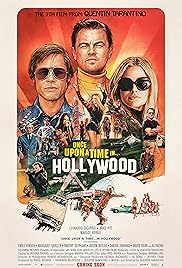
Film Review: ONCE UPON A TIME IN … HOLLYWOOD (USA 2019) ****

Once Upon a Time ... in Hollywood Poster
A faded television actor and his stunt double strive to achieve fame and success in the film industry during the final years of Hollywood’s Golden Age in 1969 Los Angeles.

One of the year’s most anticipated films, Quentin Tarantino’s 9th and latest film, ONCE UPON A TIME IN … HOLLYWOOD follows the misadventures of has-been star Rick Danton and his stunt double and best friend Cliff Booth set in 1969 Hollywood.  The action takes place in three separate days on February the 8th and 9th and August the 8th, the night of the Charles Manson murders.

To reveal more of the plot would spoil ones entertainment of the film.

Tarantino is so much loved by cineastes that he can get away with murder.    ONCE UPON A TIME also contains minor racist humour, regarding Mexicans, Germans and Indians.  “Don’t cry in front of the Mexicans”  “Fresh sauerkraut” “The only good Indian is a dead Indian” are three such lines uttered in the film.

There are just so many impressive plusses in the film.  Foremost are the performances from the two leads, Leonardo DiCaprio as the has-been Hollywood star Rick Danton and Brad Pitt as his stunt double Cliff Booth.  DiCaprio exhibits the paranoia and childishness of a spoilt star while in perfect contrast Pitt plays the super-cool macho stuntman that supports Dalton but at  the same time needs him for employment – a excellent irony of a relationship.  Apparently Tarantino noticed the relationship between an actor and his stunt double and their support for each other and based his script from that keen observation.  To make matters more interesting, their relationship unfolds in the background of the infamous Charles Manson murders which included the death of Roman Polanski’s wife, Sharon Tate.  Or so it seems.  Tarantino has played with History as in his best film INGLOURIOUS BASTERDS and he does the same (not to be detailed in this review as to reveal a spoiler) in this film.

The film contains lots of references to the late 60’s films (as the film is set in 1969) that those growing up during those times will find particularly nostalgic.  Seen in posters in the film or heard announced on the radio are films like Jack Smight’s 1969 THE ILLUSTRATED MAN, Gordon Douglas’ Tony Rome 1968 LADY IN CEMENT, Richard Wilson’s 1968 3 IN THE ATTIC, Mike Sarne’s 1968 JOANNA, Phil Karlson’s Matt Helm flick the 1968 THE WRECKING CREW and Alexander Mackendrick’s 1967 DON’T MAKE WAVES the latter two films also starring Sharon Tate. These are not classics but the typical type of films common that help mold many a cineaste, me included.  It is puzzling why Tarantino did not include the Roman Polanski’s 1967 film THE FEARLESS VAMPIRE KILLERS in the list.  Fans are also in for a treat with a scene in THE WRECKING CREW where Sharon Tate takes down Nancy Kwan.  If these films are not enough, Tarantino also creates fake films starring Rick Dalton and other stars at the time like Telly Savalas and Ann-Margaret.

Cliff Booth gets fired from a job on a Hollywood set.  Tarantino shows the incident that led to the firing in the film’s best and funniest scene where Cliff Booth kicks Bice Lee’s (an excellent Mike Moh) ass in a fight on the set of THE GREEN HORNET.

This film, Tarantino’s 9th and reportedly his lasting clearly displays the director’s indulgence in his passion for film within a certain period. There is nothing wrong with this.  Though a little overlong, there are details that can be observed (especially in the background) and tons of references.  No Tarantino film has failed to surprise and this film is no exception.  And with so much detail, ONCE UPON A TIME IN … HOLLYWOOD which premiered in Cannes to a 15-minute standing ovation deserves to be see a second time.

Trailer: https://www.youtube.com/watch?v=Scf8nIJCvs4

Film Review: KILLING PATIENT ZERO (Canada 2019) ***1/2

Killing Patient Zero Poster
Trailer

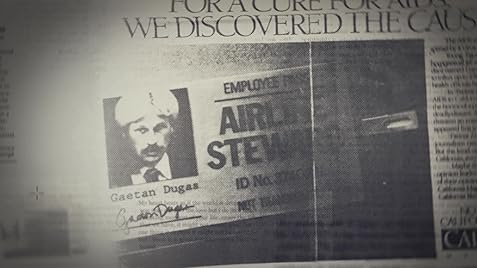
Gaetan Dugas was openly gay. In early 1980s he contracted what was termed “gay cancer”. He provided blood samples and 72 names of his former sex partners. Dugas was demonized for his promiscuity and wrongfully identified as patient zero.

Director:

Laurie Lynd

Writer:

Laurie Lynd

If you are a straight person reading this review, it would be unlikely that you would know who or what Patient Zero means.  The opposite can be said for any gay person, who is totally aware of the significance of Patient Zero.  Patient Zero is thought to be the man (an Air Canada flight steward) who brought  A.I.Ds to North America.

While Laurie Lynd’s entertaining and informative documentary educates both sexual orientations on Patent Zero, the film serves more as an account of the History of A.I.D.s.

This is the documentary about the origins of the A.I.DS epidemic and the story of Gaetan Dugas, the man who was incorrectly accused of starting it all.

Gaetan when sick was recorded in California as Patient 57, a patient Out of California.  Patient ‘O’ not ‘0’, but mistaken for a zero.  This he was then mistaken to be Patient Zero the first one to have propagated the A.I.Ds virus.  He actually did (but not the first one) as he was a handsome man who had promiscuous unprotected sex with strangers.  In Gaetan’s defence, no one knew at that time that the virus was passed on though unprotected sex.  And he cooperated with the authorities in re-tracing his 72 sex partners.  The most unforgettable words of one of the interviewees was: “after all this time, gay men can finally open up and enjoy sex and boom, the gay cancer occurs.  Everyone was scared as people were dying and no one knew how or what was happening.”  One interviewee includes gay Canadian filmmaker John Greyson who made the movie ZERO PATIENCE with an all-male cast.

The film has a definite impact on this reviewer.  This reviewer was a gay young man at the time in his early 30’s.  When I first came on the scene, A.I.D.s had just reared its ugly head.  When I first enjoyed the beauty of my youth, as I did sleep around with strangers, maybe twice a week, (not as promiscuous as Gaetan, but promiscuous nonetheless), news was already out that one has to use condoms to prevent  contacting the disease.  But having sex so often is difficult to be always safe and every year, I would have to be tested as I would have unprotected sex once or twice a year and then regretted it.  Anyway, yours truly has survived or you would not be reading this review.  It was hell of a good time then, being able to go to the clubs, get ‘high’ , dance, then take someone beautiful home.  Those were indeed the days.  The film captures those days. 

Most important of all is the fact that the film educates on the truth of Patient Zero.  The film attributes him a a scapegoat propagated in part by Randy Shilt’s book “And the Band Played on”.  But the film shows him a hero who cooperated with researchers.  It took 8000 gay men to die before Americans realize the A.I.D.s epidemic and for gays to be able to live, and alive to this day.

Though a doc, the film contains quite the few erotic scenes, like scantily clothed men rolling around on the floor and one scene set in the bath house (or sauna) that gay men go for casual sex.

Females are noticeably left out (except at the end) in this doc, but they are fortunate enough not to have suffered the effects of AIDs as much as their male counterparts.

KILLING PATIENT ZERO is a thorough History lesson on AIDs of the early 80’s that captures both the nostalgia and horror the times. Writer and director Laurie Lynd will be present for a Q&A  after the Friday, July 26, 6 PM screening at the Ted Rogers Cinema.

Trailer: https://www.imdb.com/title/tt9896252/videoplayer/vi176995353?ref_=tt_ov_vi

Film Review: ASTRONAUT (USA 2019)

Astronaut Poster
Trailer

A lonely widower battles his family, ill health and time to win a competition for a golden ticket to space.

Director:

Shelagh McLeod

ASTRONAUT belongs to the genre of old-fart films where the protagonist is a senior and has to come to terms with age and usually makes good, be it in romance or achieving ones final goal in life.  Thankfully, it is the latter.

The protagonist is 75-year old widower Angus (Richard Dreyfuss) who lives with his daughter’s family.  His son-in-law, Jim (Lyriq Bent) convinces the daughter, Molly (Krista Bridges) to move Angus into a retirement home.   His life seems over; he feels worthless and alone.  But Angus’s long extinguished dream is reignited when an exciting national competition is announced.  The prize is one golden ticket for a trip to space!   Way past the age limit at 65, he doesn’t have a chance.  But spurred on by his grandson, Barney (Richie Lawrence) Angus fudges his birthdate, and enters the competition.  Against all odds, he must battle against prejudice, ill health, and win the contest.  Angus discovers too that the rocket is not safe, being a civil engineer.  A subplot requires him to tell the organizers of the problem but no one would believe an old man.

The film’s best parts is surprisingly nothing to do with his space trip.  It is his realization that he has to move and adapt into a retirement home.  From the looks of the home, it is quite attractive, spacious and grand and I doubt that anyone including myself (when I am old, of course) would mind staying there.  One feels for Angus.

The film features a mixed raced family, husband (African American) and wife (white), something much more common in films these days.

The film’s subplot concerns Angus Stewart’s family. The son-in-law has loses his job for standing up for his principles.

ASTRONAUT is in part another Richard Dreyfuss vehicle.  For those who remember, Dreyfuss won an Academy Award for his role in THE GOODBYE GIRL primarily for the scene where he made audiences cry when he played an actor realizing in his dressing room how bad his performance was as a crippled Hamlet.   Dreyfuss plays a senior inches in ASTRONAUT and it was not that long ago when audiences saw him as a teen in AMERICAN GRAFFITI and in the other space film, Steven Spielberg’s CLOSE ENCOUNTERS OF THE THIRD KIND.  

The other performance worthy of mention belongs to Native Canadian (born on the Six Nation Reserve in Ontario, Canada) Graham Greene (best remembered in THUNDERHEART) who plays  a fellow resident  of the retirement home.  He is to given much to say but still makes a screen presence.

ASTRONAUT is McLeod’s first feature and it shows.  The film meanders from being a family conflict drama and a space adventure while not satisfying either.  The one thing going for the film is Dreyfuss’ performance.  Dreyfuss had at one time turned into the most annoying actor on the planet, but his controlled acting here shows the actor this best when he was in films like JAWS, CLOSE ENCOUNTERS OF THE THIRD KIND, THE GOODBYE GIRL and THE BIG FIX.

The film has a odd tacked on sort-of happy ending that could have been better though of.

Trailer: https://www.youtube.com/watch?v=bE1Nw5pEqL8

Film Review: THE STONE SPEAKERS (KAMENI GOVORNICI)(Canada/Bosnia/Herzegovina 2018)

The Stone Speakers Poster
The Stone Speakers examines the intersection between tourism and ideology in four post-war Bosnia and Herzegovinian towns.

Director:

Igor Drljaca

Writer:

Igor Drljaca

The old Yugoslavia and the new Yugoslavia.  The past and the present.  How anti-fascism was ridden of and the country that now enjoys the benefits from tourism.  THE STONE SPEAKERS is directed by Canadian based Igor Drljaca, examining the intersection between tourism and ideology in four post-war Bosnian and Herzegovinian towns.

In present-day Bosnia-Herzegovina is a country still reeling from the civil war in the early 90s. The Bosnian economy never recovered, and the country remains divided. In order to cope, many towns have transformed themselves into unique tourist destinations that bring together history, religion, politics and folklore.  The tourist sites promoted are not only a reflection of peopleʼs attempts to make a livelihood but are also a means to promote and establish competing narratives about the countryʼs past, present and future. The Stone Speakers explores four towns in Bosnia-Herzegovina through their tourism, slowly unravelling

these competing narratives.

The four towns are:

1. MEDJUGORJE in Eastern Herzegovina became a site of considerable interest in 1981 after six children, who are referred to as visionaries, began to see apparitions of the Virgin Mary.  Te film includes sites with tourists and pilgrims visiting the town.  The town now attracts upwards of one million pilgrims per year.  Despite the foreign crowds, like the rest of Bosnia-

Herzegovina, the local population in the region continues to decline.

2. TUZLA is located in what was once the industrial heartland of North-eastern Bosnia. Sitting on massive salt deposits, it has been historically well-known for its production of salt, which has continued nearly uninterrupted for over a thousand years. The cityʼs manufacturing sector, much like other industrial infrastructure throughout the country, was criminally privatized

and closed in the post-war period.  The city authorities have taken advantage of sinkholes caused by the over-extraction of salt to create salt lakes that have tourists.  The portion on TUZLA is the most interesting of the 4 cities.

3. VISOKO has only recently received more widespread attention, stemming from claims that a complex network of pyramids, older than the ones in Egypt, has existed at the site since at least 12 000 BCE. The claims, made by Semir Osmanagic, have not been supported by the scientific community, but the town has continued to enjoy a tourism boom as a result. A wide network of tunnels has been unearthed beneath the pyramids, which have been integrated into a

tourist attraction.  This segment is quite informative as many do not know pyramids existed here.

4. VIŠEGRAD – is at the crossroads of empires, and until recently, it was a predominantly a Bosniak town.  This part is primarily history and the director Drljaca trees it as such.  Prior to the civil war in the 1990s, Bosniaks accounted for over 60% of the townʼs population, but most were ethically cleansed during the fighting. The city has never been able to fully recover since the war, and its demographic decline continues, driven in part by the poor socio-economic conditions of the region.

THE STONE SPEAKERS plays like both a history and geography lesson.  Director Drljaca has 12  residents speak about the 4 towns.  They stand alone and then speak amidst a background that ranges from landscape to architecture.  He has them remain in silence for a minute before speaking.  They speak slowly but the English subtitles often run too fast for the audience to read.

As artful and informative this doc is, it would be difficult to recommend it to any commercial moviegoer. THE STONE SPEAKERS is not the run-of-the-mill documentary.  The majority would likely not connect wth the director’s aim and find the film a complete bore.  The one user review on imdb claimed that THE STONE SPEAKERS is a really bad movie.  Though not entirely true, it is easy to see the reason that writer felt that way.

Trailer: https://www.youtube.com/watch?v=6tcQ-dd-RJw

Film Review: ROADS IN FEBRUARY (LA RUTAS EN FEVRERO) (Canada/Uruguay 2017) ***

Roads in February Poster

The film opens with a fully blank and black screen.  A door opens, letting the light into a room, revealing the film’s protagonist and main character, Sarita or Sarah from Canada.   She is shown twice making a phone call to someone who does not pick up the telephone.  In another scene, a fly is shown landing on a glass double door before Sarita shoos it away.  It is noticed that Sarita is, speaking in Spanish on some bus trip or other, making a journey of great distance.  Director Jerkovic, who certainly takes her time to tell her story tells the tale of a young girl, Sarita who travels to a remote village in Uruguay to visit her grandmother.
The visit brings out an old skeleton in the closet.  The two have to come to terms with the loss of Sarita’s father, Magda’s son who left Uruguay for whatever reason and passed away.  Magda never saw him again and somehow puts the blame on Sarita.
Jerkovic’s camera often comes up close to the facial expressions of the characters to both reveal their emotions and amusements.  One instance has Magda companioning that Sarita bought the incorrect and more expensive bread.  Despite Sarita telling her that it was her who paid and wanted to give her grandmother a treat, Magda still fusses.  The look on Sarita’s face as a result is priceless.  Another instance is the visit of Magda’s old friend to the house, Olga.  Olga is losing it, Magda insists.  But the camera reveals Olga as a bright, always cheerful, inquisitive friend and not like what the audience would expect after first hearing Magda’s description of her.  One wishes there would be more scenes with the amusing Olga.
Sarita is no angel.  While visiting granny, she scores some weed from the local boys, trespasses into a rich family personal swimming pool and flirts around with a handsome hunk.  Girls will be girls!  Still director Jerkovic elicits the audience’s sympathy for the vulnerable heroine.  She has her camera stolen losing all the valuable photographs she had taken on her trip. She falls off her bike while riding away frustrated.  She incurs quite the nasty bruise on her one leg.

Jerkovic’s imprint is clearly stamped in her film, where one can feel the heat of village surroundings and the alienation of the two characters, enhanced by controlled performances by Arlen Aguayo Stewart and Gloria Demassi.
ROADS IN FEBRUARY premiered at TIFF and opens at the TIFF Bell Lightbox.  It won the jury prize for Best First Feature and shows Jerkovic as a new Canadian talent to watch.  Director Katherine Jerkovic will be present for an introduction and post-screening Q&A on Saturday, July 20 at 7:10pm!  There should be many interesting questions that can be asked such as how autobiographical the film is and how close is the director to the character in her film.

Trailer: https://www.youtube.com/watch?v=_aPumHbo2RQ

Film Review: PROPAGANDA: THE ART OF SELLING LIES (Canada/Germany 2019) ***

Propaganda: The Art of Selling Lies Poster
Academics, public relations experts, and satirists of various kinds describe the history and nature of propaganda.

Director:

Larry Weinstein

Writers:

David Mortin (Written by), Andrew Edmonds (Written by)

What is fascinating about the new doc on propaganda called PROPAGANDA: THE ART OF SELLING LIES which had its premiere at this year’s HOT DOCS, is the way director Larry Weinstein uses the concepts populated in his film to get his message across.  Weinstein is bold enough to also call his film a cautionary tale and a call to action.    

In a way, it is a sure safe way of making a doc on any subject.  The film opens with the letters of the word ‘Propaganda’ flashed on the screen – not once but a few times, as verbalized by President Trump in one scene in the film: “Repeat for the truth to sink in.”  It is intriguing to note that the word ‘truth’ is in the line implying that what is said is the truth, which is of course, might not be so.  Propaganda goes by various definitions as the film informs at the start.  The first definition given is ‘political brainwashing’ followed by others before Weinstein goes into the origin of the word – in Latin.

One wonders often at the odd choice of interviewees Weinstein has chosen, as it seems quite the eclectic assortment.  One is Paolo Granata, apparently a professor of Media Studies and another Alistair Pike an archaeologist.  There is a segment dealing with a ancient art carved in a Spanish cave which could be the reason the Spanish and the archaeologist being chosen.  But propaganda and entertainment come together with the segment of Jim Fitzpatrick an Irish artist who sketched an outline easy-to-copy figure of Che Guevara after Che visited him in a bar in Ireland where he was a barman.  Che was killed and his body gutted of blood like an animal.  As a result, Fitzpatrick popularized Che with the figure he designed and drew that is now famous all the world over.  This is another example of propaganda.  On the plus side, the most interesting interviewees include a staff at Charlie Hebdo (the French satirical newspaper targeted by Muslim terrorists)  and the photographer who took the controversial picture of Kathy Griffin holding President Trump’s severed head.

The film stresses that propaganda is most used in print, posters and cinema.  Weinstein provides lots of clips of old propaganda films like the most famous of all films – the Nazi propaganda 1935 film Leni Riefenstahl’s masterful TRIUMPH OF THE WILL to illustrate the fact.  My fav propaganda film of all is the the British 1942 entry Alberto Cavalcanti’s WENT THE DAY WELL? where British housewives during WWII did away with hysterical relish the German invaders of their village who were disguised as British soldiers.

Though entertaining, the doc sheds little light on what we do not already know.  The film does bring a lot of facts together, as emphasized during the film’s conclusion.  The film is also quick to point out the propaganda could also be sued for good, as in the British propaganda films to run up loyalty.    Ironically, the film is after all also propaganda about propaganda.

Trailer: https://www.youtube.com/watch?v=vZP2H00aOR0

Film Review: SWORD OF TRUST (USA 2019) ***

Sword of Trust Poster
Trailer

Cynthia and Mary show up to collect Cynthia’s inheritance from her deceased grandfather, but the only item she receives is an antique sword that was believed by her grandfather to be proof that the South won the Civil War.

Director:

Lynn Shelton

Writers:

Lynn SheltonMichael Patrick O’Brien (as Mike O’Brien)

WORD OF TRUST is a low budget American comedy co-written by director Lynn Shelton and Mike O’Brien that includes improvisation from the actors.  The premise is the SWORD OF TRUST of the film title, an actual sword.

When Cynthia (Jillian Bell) and Mary (Michaela Watkins) show up to collect Cynthia’s inheritance from her deceased grandfather, the only item she’s received is (no house) an antique sword that he believed to be proof that the South won the Civil War.  The sword comes with two items of authenticity, a certificate and a painting that stands for a photograph.  The script takes pains to make all this believable, as it is the reason that all incidents that follow that place.  

The two attempt to unload the object to a curmudgeonly pawnshop owner Mel (Marc Maron, “GLOW”) and his man-child sidekick Nathaniel (Jon Bass, Molly’s Game).  After it becomes clear that the film centres on these four, the film starts taking hold of the audience’s interest.

When Mel and Nathaniel discover there’s a black market for the relic, the two pairs reluctantly join forces to sell this rarefied ‘prover item’ to the highest bidder.  The adventure that ensues takes the four of them on a wild journey into the depths of conspiracy theory and Southern disillusionment.  

It is difficult to tell what is improvised and what is written in the script.  This is a good thing as the film and story flows smoothly throughout most the film.

The films starts running into trouble in the last third.  The chemistry among the four begin to wear off.  The singular jokes of Nathaniel being a man child, Mel being a radical grumpy codger made good and Cynthia and Mary having a same-sex relationship get tiresome.  Adding more story to the plot and the introduction of more characters in the third part signals Shelton’s desperation to get her film on track.

Director Shelton gives herself a cameo as Mel’s ex-lover, a dog addict who never quite get her act in life together.  She shows herself apt in dramatic comedy improvisation and is a pleasure to watch.

The best thing about SWORD OF TRUST are the individual personalities on display.  Each eccentric is ‘special’ in his and her  own way.  Each of the four actors are able to create uniques characters of distinct imperfections and strengths.  Their interaction with each other works well.  But by pitting them together in a plot that involves hitmen, con men and crooks ultimately destroys what has been carefully created.  Director Shelton has made similar small films like the YOUR SISTER’S SISTER and the more recent HUMPDAY.

SWORD OF TRUST works well for the most part but fizzles out of steam at the end, once the tired antics of the characters grow tiresome.  It is still encouraging to watch small films like SWORD OF TRUST given a chance in the market where blockbusters like THE LION KING which opens the same week dominate,

Trailer: https://www.youtube.com/watch?v=vWmQyBjrbfU

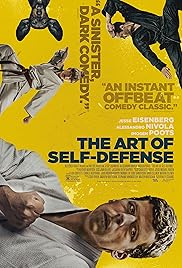
Film Review: THE ART OF SELF-DEFENSE (USA 2019) ***1/2

The Art of Self-Defense Poster
Trailer

A man is attacked at random on the street. He enlists at a local dojo, led by a charismatic and mysterious sensei, in an effort to learn how to defend himself.

Director:

Riley Stearns

Writer:

Riley Stearns

One must admire and give writer/director Riley Stearns credit for going against the natural flow of the typical movie.  Though described as a dark comedy, the film turns so dark towards the last third, that it can hardly be described as a comedy any longer but some psychological mind-blower.   The story turns completely unpredictable with a plot twist that is, when one looks back quite obvious, but director Stearns has steered his audience completely in a direction that they definitely will not see what is coming next.  At the same time, the hapless hero turns and changes into a selfless all-conquering hero, sacrificing everything he has for others, a selfless act while defeating his villain in a duel to the death.

The plot revolves around a mild-mannered accountant called Casey (Jesse Eisenberg).  One evening while returning home after buying dog food, he is beaten up by a motorcycle gang and left for dead.  In hospital recovering, his boss Grant gives him a few days off.  He comes across a Karate class and enrols in the day class while learning the art of Karate, eventually excelling in it.  But it is his character that is in question not his fighting ability.  He learns that the has to overcome his cowardly attitude. This he does, in what are the film’s most hilarious moments.

Jesse Eisenberg apparent took Karate classes a few weeks for preparation for this role, though he has said that he took it as child.  He is convincing enough.  Though Eisenberg usually takes roles where he speaks an incredible amount of words per minute as in THE SOCIAL NETWORK and THE HUMMMINGBIRD PROJECT, this is one film where he has little dialogue.  The film often plays its dark comedy dead-pan with as little words spoken as well.  Whenever a dramatic conversation comes along, director Stearn often turns off the music and background noise.  The effect is an uncomfortable silence punctuated by the script’s dialogue.

Stearn’s wife, actress Mary Elizabeth Winstead had signed on to star in the film in 2016.  But the couple separated in 2017 with the result that Winstead is no longer in the cast.  Making a film is a lot of work and one can assume that the work must have got into conflict with their relationship.  The film though appearing totally male-chauvinist is in reality pro-feminist.  Karate is described in the film as the art of achieving total masculine perfection with none of the other gender having to play any part.  Of course, the concept is wrong which the film thankfully proves at the end.  The film is also quite homo-erotic especially in two scenes, where the male karat students do cool-down exercises bare-bodied massaging each other or when practising certain moves also with little clothes on.

As such, THE ART OF SELF-DEFENSE might turn out a hard-sell.  Besides a few uncomfortable scenes, audiences will find it difficult in the film’s transition from comedy to psychological thriller but those willing to accept the change will find Stearn’s film a daring, bold and refreshing change from the norm.  The film is a winner!

Trailer: https://www.youtube.com/watch?v=7Bms6Hba-3A