1997 Movie Review: GOOD WILL HUNTING, 1997


GOOD WILL HUNTING MOVIE POSTER
GOOD WILL HUNTING, 1997
Movie Reviews

Directed by Gus Van Sant
Starring: Matt Damon, Ben Affleck and Robin Williams
Review by David D

SYNOPSIS:

Will Hunting, a janitor at MIT, has a gift for mathematics which is discovered, and a psychologist tries to help him with his gift and the rest of his life.

REVIEW:

If you can put aside the rumor that William Goldman doctored the Oscar winning script for Good Willing Hunting AND that it features funnyman Robin Williams in a serious role, you are in an excellent two hours of viewing.

Written by a young Matt Damon and Ben Affleck, the story focuses on a young prodigy named Will Hunting. Will (aptly played by Matt Damon and nominated for an Academy Award) is a genius foster kid that works as a janitor in a prestigious university (MIT) in South Boston. Ben Affleck plays his best friend, Chuckie.

The plot focuses on the discovery of Will’s genius and other people attempts to either use or save him from himself. Will Hunting, on the other hand, has plans of his own.

Robin William pulls in a great performance as Will’s therapist (Sean), pushing him past the anger and sarcasm, to discover what his life is really all about.

This film works on couple of levels. As a viewer, we admire Will’s photographic memory and his uncanny ability to solve incredibly complicated math problems with ease, but at the same time resent the fact that he takes these abilities for granted. The audience musters the requisite ‘If I had that kind of ability I would…’ rhetoric but the script and director ask a much harder question ‘How do we define happiness?’

Will wants a simple life; he doesn’t want the complications of his genius. His actions betray his words as he voluntarily studies late into the night on various subjects, espouses classic lines from English texts and solves mathematical problems on a university blackboard without being asked. Inside, there is a person wanting to break free.

The another level is questioning whether a person is chained to their past. Will was shuffled & abuse from foster home to foster home, and because of this, very wary of human closeness and contact. It is akin to the sting we feel when we fall in and out of love. He is chained to his past because of the anger he still feels towards these betrayals.

His session with Sean (Robin Williams) also belies his true desires. With Sean as his therapist, Will is critical, confrontational and always on the defensive. Fortunately, Sean never pushes too far and because of this understanding, a critical bound is formed between them. Will has a distrust of adults because of the abuse he suffered at the hands of a foster father – one of the many reasons he distances himself from figures of authority.

Will spends most of his time with his friends who would ‘lay down their life for him’. They provide the only human closeness that Will feels towards anyone. When a mathematician Gerald Lambeau (Stellan Skarsgard) saves Will from a stretch in prison, Will can only thank him with harsh words and scorn.

During Will’s sessions with Sean, he learns that it is ok to take a chance and falls in love with Skylar (Minnie Driver). This relationship has all the hallmarks of defeat as we learn that Will cannot deal with the closeness that comes from trusting someone.

This last plot point is truly what the film hinges on: Will’s inability to trust because of his past. The final reel is emotional and satisfying. We see the journey that Will takes both on an emotional and physical level; from a wounded, cornered animal to a person that realizes hurt is a part of life. As an audience we feel for Will and participate in his struggle to reconcile his past feelings with his chance at a better future and happiness.

GOOD WILL HUNTING.jpg

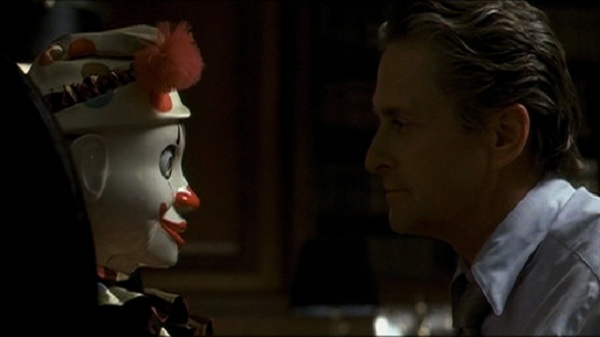
1997 Movie Review: THE GAME, 1997 (David Fincher, Michael Douglas, Sean Penn)

THE GAME, 1997
Movie Reviews

Directed by David Fincher
Starring: Michael Douglas, Sean Penn
Review by Mike Peters

SYNOPSIS:

Nicholas Van Orton (Douglas) is an investment banker who is always in control of the situation. He is cold, calculating and always on his game. Nicholas lives a well-ordered life-until an unexpected birthday gift from his brother, Conrad (Sean Penn), destroys it all.

Review:

David Fincher has once been quoted as saying “I don’t know how much movies should entertain. I’m interested in movies that scar”. Whether he is referring to the scarring of the characters within his films or of the audience voyeuristically partaking in his dark and twisted tales is unclear. What is definitely accurate about Fincher’s films is that they leave an undeniable mark on each and everyone involved.

It is hard to mistake a Fincher film. They usually contain very little natural light and the atmosphere will be extremely unsettling. This will then force the audience to share the protagonists’ feelings of unease and paranoia. As well, by the end of the film, Fincher’s “hero” has usually undergone some sort of life-changing trauma.

The Game is a film that may be the least known of Fincher’s. It arrived in between Seven (1995) and Fight Club (1999) and has seemed to have been overlooked as a great film. This is a great film. The manipulative control Fincher seems to possess over his audience is mastery in its calculation and concoction.

The story is simple. A man is given a present that will eventually drive him to the depths of depravity and despair by turning him into the character he has always deemed offensive and unimportant. It is a well known story cliché. He will then become a better person as a result of his journey which will be expressed through his change in character and his thoughts and actions towards others. However, Fincher beautifully makes this simple story his own. Fincher is a master of brooding and depressing atmospheres. There is no life in his films. Oh, there are people alive but his focus seems to be on reanimating the dead that exists within the body. Nicolas Van Orton is a character who lives alone. He is rich, powerful and most of all, successful. But yet, he is dead within. He rarely smiles and seems to have become who he is now as a result of witnessing his father’s suicide at a young age. Other than talking to his housekeeper and his lawyer (which he still does to a limited degree), he is a man who keeps to himself. He does not want to be bothered and will only bother another if there is progress to be made. He is sort of a 90’s version of Gordon Gekko from Wall Street (who Douglas played as well) who is more in touch with control and intimidation then he is with emotional contact.

The idea that Nicolas was unable to prevent his father’s suicide left him in a state of shock. He was unable to control the situation and thus he felt pain for the very first time. The film starts off with images of Nicolas as a child and his father and it is clear that this event was crucial in the shaping of Nicolas as a man. He lost a very important person in his life and as a result, he became a closed off and emotionally detached human being. He feels that being in control will prevent him from ever feeling pain again but yet (unaware to him until after the “game” begins) he yearns for closure in regards to his father’s death. It is only when the “game” begins that he slowly begins to exist once again and to reemerge as a living entity.

Douglas is masterful in his performance. He refuses to break character at any moment until it is deemed necessary by the script. Even when this “game” begins, Douglas portrays Nicolas as a character who still believes he is in control of the situation. He believes he has it all figured out until, of course, he doesn’t. When things do not go as planned, he panics as a result. He does not know how to control the situation which leaves him vulnerable and confused (feelings he has cut himself off from). He has never had to cope with change because he has never attempted to change himself. He must rediscover his inner self before there is any chance of redemption or rebirth.

Within moments of the films’ commencement, we come to identify with Nicolas. He may not be the most friendly and admirable protagonist in film history but yet we still attempt to identify with him. As a result, we form some sort of control over the narrative. We believe that we understand the simple structure of the story and will not be undermined by it in any manner (as Nicolas feels when the “game” begins). However, as this film progresses, we, the audience, become lost and confused. We, as Nicolas, are unaware of our surroundings and have become paranoid and fearful of the people within the narrative. Who do we trust? Where do we go from here? It is now the blind leading the blind.

This film may not be noted as one of Fincher’s more important pieces of work but yet it is a beautifully crafted piece of entertainment. The writing is taut and the acting is superb. Yes, many of the events are implausible and rely heavily on coincidence and chance but it is told and shot in such a high octane sort of way that the audience is quick to forgive the filmmakers for these insignificant and basically pointless quibbles.


the game.jpg

Film Review: UNARMED VERSES (Canada 2017) ***

Unarmed Verses Poster
This feature documentary presents a thoughtful and vivid portrait of a community facing imposed relocation. At the centre of the story is a remarkably astute and luminous 12-year-old black girl whose poignant observations about life, the soul, and the power of art give voice to those rarely heard in society. Unarmed Verses is a cinematic rendering of our universal need for self-expression and belonging.

Director:

Charles Officer

UNARMED VERSES arrives with all the critical and public raves after being named Best Canadian Feature Documentary at this year’s Hot Docs 2017.   It is a National Film Board of Canada production which means it is (as most NFB films are) a meticulously constructed arty small budget film. 

The centre of the film is 12-year old Francine Valentine, played by the real Francine Valentine.  So, the film is a documentary of sorts, a documentary of the present so that the film feels like a fiction piece.  Francine is a Jamaican Canadian (as seen from the country’s flags in her house) who has been to live with her old grandmother and father inToronto so that she can obtain a better education.  The film follows her throughout the entire film with her often speaking out loud so that the audience can relate not only to her thoughts but also with what is going on in the film.  Francine’s family in Toronto is not rich.

As the film opens, her community faces a difficult transition, when the largely low-income residents of a rental housing block in the city’s northeast end are threatened with imposed relocation due to the impending demolition of the place they call home.  They have to move out and given a chance to return.  They are unable to afford even renting the new condominiums that will be built.  They are informed, as expect from the typical government, that that any of their questions will be answered though this does not mean that their problems will be solved.  Francine’s grandmother, old but still bright a a light questions the schools that need to be changed for the children.

The film follows the thoughts of Francine, as she reads poems, writes her thoughts and composes her songs,  Through the activities, the audience sees Francine’s reflections on life, the self, and the soul.  

But Francine is not the only person on display.  Her rhythmic father also sings reggae in the film.  Another older black teen inner community class, raps and writes poetry.  

One wonders about the authenticity of the scene in which Francine is so shy at the recording studio, almost unable to go on.  If this is so, how come she could sing in front of the film’s camera earlier in the film?

A highlight of the film is Francine’s visit to the Basquiat exhibit at the Ago (Art Gallery of Ontario)in Toronto.  She gives her 12-year old view on art.

The film ends up a quietly insightful film that also serves as a coming-of-age drama of Francine Valentine.

UNARMED VERSES screens in Toronto at the Hot Docs Ted Rogers Cinema, 506 Bloor St. W., starting Friday, October 6. There will be a Q&A with producer Lea Marin and guests from the film on opening night, October 6; and with director Charles Officer and guests from the film following the 8:30 p.m. screening on Monday, October 9.

Trailer: https://vimeo.com/212776693

1997 Movie Review: FROM DUSK TILL DAWN (1997)


FROM DUSK TILL DAWN (1997)
Classic Movie Review
Directed by Robert Rodriguez
Starring George Clooney, Quentin Tarantino, Harvery Keitel, Juliette Lewis
Review by Jared Bratt

SYNOPSIS:

On the run from “Johnny law”, Seth (George Cloony) and Ritchie (Quentin Tarantino) Gecko, two newly escaped convicts, hot off the heels of their most recent bank heist, abduct a family of innocent commuters as they proceed to evade the authorities by fleeing across the U.S. border, into Mexico, so that they can rendezvous with their foreign criminal counterparts at a local dive bar known as the “Titty Twister”. Using their freshly acquired hostages as collateral, so as to ensure the stability of their otherwise expendable lives, the two ruthless brothers force the family’s father, Jacob, a faithless preacher, (Harvey Keitel) and his two kids, his son, Scott, and his daughter, Kate, (Julliette Lewis) to accompany them into the excited bar while they wait to meet up with their Mexican affiliates. Unbeknownst to them, however, is the fact that the seedy establishment actually serves as a well-disguised feeding ground for a bloodthirsty cult of famished vampires lead by their equally ferocious queen, (Salma Hayek) who slyly masquerades as the joint’s main attraction, a seductive stripper who opportunely diverts the club’s clientele from realizing the absurd, horrific horrors that lie ahead.

REVIEW:

From Dusk Till Dawn is one of those movies that appear to always be playing on T.V. throughout all hours of the night. Essentially two films for the price of one, the movie accounts for an extremely distinctive blend of the taught “70sesque” crime-caper, exploitation film meets the comically grounded, gratuitous gore fest of an Evil Dead picture. Both these genres are wrapped up even further in, what you could say, accounts for the film’s third genre known as “Tarantinoism”.

Director Robert Rodriguez makes sure to keep that well known brand of Tarantino madness in tact while he still keeps things fresh, bringing to the table, his own unique eye for a quick cut, spaghetti western, John Woo “shoot ‘em up” style of filmic execution. Essentially, Rodriguez applies the same acclaimed style that initially propelled him to become one of the most innovative filmmakers of his generation to the horror genre. Working from a screenplay written by Tarantino himself, Rodriguez creatively retains that “no-holds-barred” sense of horror movie-making aesthetic. Harkening back homage to the great, grotesque gore-fests of the 60s, 70s and 80s, From Dusk Till Dawn’s own 1996, release, unfortunately, didn’t quite generate nearly half as much the buzz as anyone of those eras, yet since then, it undoubtedly has gone on to be hailed as an innovative cult classic.

The film kicks off with a drop kick to the face that sets the viewer in check reminding us to acknowledge the fact that this is indeed a movie based on all things Tarantino. We are immediately introduced to the movie’s abundant amount of “badassery” from the second the actors start to retort Tarantino’s unique brand of unconventionally witty dialogue.

Michael Parks’ first screen incarnation of Texas Ranger Earl McGraw initially warms us up to the film’s crime-caper element while setting us up for the ridiculously cool, deadpan cast that is to follow directly after his own arrival into the picture. He enters a local convenient store, wandering into a classic Tarantino monologue ranting politically incorrect obscenities with his old-fashioned, raspy voice and squinting Dirty Harry mannerisms in the store clerk’s direction. Park’s screen time, here, is brief, nevertheless, he truly owns every second of it. He is magnetically charismatic in a John Wayne type of way while his poised delivery of Tarantino’s “talky” dialogue alone is enough to make you believe the film itself revolves around his character That is until he is shot dead, with a bullet through the head, by the cold-blooded Geckos. The brothers then proceed to shoot up, and burn down, the convenient store, adding more corpses to their rapidly escalating body count, while the film’s tone is deceivingly established as reflecting yet another exercise in post Pulp Fiction crime lore. Nevertheless, midway though what appears to be a predictable ride, Rodriguez brilliantly shifts his movie into Desperado horror movie mode as the film devilishly reveals its true identity; the local “barflys” populating the film’s sleazy bar setting unexpectedly reveal themselves to be well disguised vampires equipped to feast on anyone unlucky enough to be trapped within their horrific, evil domain.

Once this brilliant shift in genres occurs, From Dusk Till Dawn truly alters into something shockingly different. Not only does Cloony’s anti-hero protagonist become the guy the audience is ultimately rooting for but also the movie itself takes on an exceptionally absurd sense of style and filmic execution. Rodriguez uses the action spawned switch, within the story, as a well advised cue to up the stakes as he takes the opportunity to run creatively rampant shooting every type of gratuitous gore gag in the book. Gone is the downcast, moody, angst filled suspense pacing of the film’s first half and, while the tension is indeed still apparent, accompanying it, is a slyly comedic pastiche blend of “in your face” action and squirting blood and guts-carnage. All of this is eccentrically strung together by an underlining sense of campy hilarity that seems to get stronger as the film’s action scenes grow gorier and more graphically excessive in nature.

Starring in his first screen role post E.R. fame, George Cloony deserves major “cred” as the brothers’ hard-bitten, yet persistently professional, leader; enthusiastically playing the movie’s anti-hero as if he were the rejected reservoir dog cousin of Snake Plisken. Cloony’s Seth Gecko seems bound to leap off the screen, destined to shove a 357 magnum down the throats of the film’s collective viewers. Indeed Cloony stylishly brings a certain amount of suave charm and charisma to the role; however, he fuses these likable traits with such a towering level of contrasting toughness that his performance truly shines as this constant, indestructible force of brooding male machismo. Almost as equally impressive as Cloony’s unconventional acting is Tarantino’s own subdued portrayal of a sex addicted rapist. Atypically restraining his well-known flamboyantness, Tarantino opts to portray Ritchie Gecko as a disturbingly reserved individual with a clear sense of pent up sexual rage. Essentially, Tarantino makes his role work because he plays it straight while, for the most part, cleverly managing to avoid slipping into just another self-referential caricature of himself.

Also, adding to the list of actors playing against type, the great, and underused, Harvey Keitel is featured, here, as a swift speaking, holy man with a shattered belief in god and himself. Keitel humbly downplays his obvious command until it ‘s tonally time for him to digress the faithless preacher persona into a vampire slaying, scripture citing badass. Keitel plays his role with such prevailing and convincing delivery that even when the movie drastically transforms into a surrealistic horror-action-comedy, his performance, and ultimate unflinching dedication to the role, never once seems false.

From Dusk Till Dawn is a volatile burst of creative oomph. While, admittedly anyone looking for an award friendly crime picture will most likely leave with a bad taste in their mouths, Tarantino enthusiasts, action junkies, and horror freaks alike should rejoice in seeking this flick out … and grab a beer.
from dusk to dawn


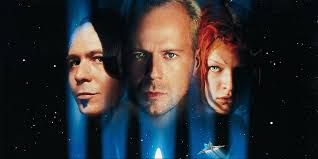
1997 Movie Review: THE FIFTH ELEMENT, 1997


THE FIFTH ELEMENT, 1997
Movie Reviews

Directed by Luc Besson
Starring: Bruce Willis, Gary Oldman, Ian Holm, Milla Jovovich, Chris Tucker, Luke Perry
Review by Emma Hutchings

SYNOPSIS:

A former government agent grudgingly sets out on a quest to save the world from an ancient evil after the only hope of thwarting destruction falls into the back seat of his cab.

OSCAR NOMINEE for Best Effects, Sound Effects Editing

REVIEW:

The Fifth Element is Luc Besson’s big budget futuristic blockbuster, which, at the time, was the most expensive film ever produced outside of Hollywood. Besson again called on the might of Gary Oldman to play the bad guy, following his fantastic performance in Léon (1994). Besson helped out as producer on Nil by Mouth (Oldman’s hard-hitting directorial debut), which was also released in 1997 and also starred Charlie Creed-Miles (Cornelius’ protégé David in The Fifth Element and Billy in Nil by Mouth).

This film is a visual extravaganza. The rich and vibrant colours ensure that the future is a bright and appealing one, not bleak and dystopian, as in so many futuristic films. Besson said that he wanted to show a vision of the future that wasn’t dark and dangerous. Mark Stetson, the Special Visual Effects Supervisor on the film, who had previously worked on Blade Runner, said “One of the most gratifying aspects of working with Luc on this picture is the fact that it’s not another Blade Runner. The look of this film is very different and fresh.” What comes across most about the visual effects is the amazing attention to detail. The shots of 23rd century New York are some of the highlights. Leeloo’s POV shot when she sees the skyline for the first time is remarkable. The skyscrapers, packed closely together, ascend high into the clouds, with subways zooming up and down their sides and the areas in between packed with flying cars. The quirky, original costumes were designed by Jean-Paul Gaultier, who even checked over the extras individually before scenes to make sure they were looking their best. Two famous French comic book artists, Jean Giraud and Jean-Claude Mézières developed the production design. They were responsible for much of the iconography of the film; the vehicles, spacecrafts, buildings, human characters and aliens.

There are references to other films in The Fifth Element. Although described as the Anti-Blade Runner, the cityscape with enormous advertising screens and the flying cars are definite similarities. Brion James (who plays General Munro, Korben’s former commanding officer) played the character of Leon in Blade Runner. The machine that regenerates Leeloo is very similar to the one used to create the robot in Metropolis (1927). The thermal bandages that are strapped to her are reminiscent of the metal bands covering Maria when the Man-Machine is converted into her.

The story boils down to a straightforward good vs. evil narrative. A huge, dark sphere of absolute evil attempts to destroy Earth every 5,000 years and five elements are used together to stop this happening. Earth, wind, fire and water, along with the Supreme Being; an ultimate warrior created to protect life. A simple but effective technique used a number of times throughout the film is cross-cutting. Used to switch between action taking place in different locations at the same time, it is cleverly used here because characters often finish each other’s sentences. For example, when Zorg meets with Aknot (leader of the Mangalores) to exchange crates of weapons for the case of stones, he shuts the lid and then states “This case…is empty.” The scene then cuts to Leeloo laughing and Cornelius asks “What do you mean, empty?” Cut back to Zorg, who tells his lackey “Empty. The opposite of full. This case is supposed to be full! Anyone care to explain?” Cut back to Leeloo, explaining in the divine language that they gave the stones to someone they could trust. Cornelius says “We’re saved” and then a final cut back to Zorg, who says “I’m screwed.” This is an intelligent use of dialogue and editing that is both interesting and efficient.

Korben Dallas is rather a reluctant hero. He was living a lonely, uneventful life before Leeloo crashed through the roof of his cab. At the beginning of the film he says he wants to meet the perfect woman. He hasn’t had very good experiences with women; his wife left him for his lawyer and his mother continuously calls him just to moan at him. He is laconic and very humourous at times. When sent in to negotiate with the Mangalores, he casually strolls in and shoots their leader in the head asking, “Anyone else wanna negotiate?” It is interesting that our hero Korben and the villain of the film, Zorg, never meet or communicate with each other. Usually there would be an epic battle at the end where they would fight until the villain was killed. However, they narrowly miss bumping into each other as Korben gets into an elevator and Zorg leaves the one next to it, ultimately getting himself blown up by the Mangalore’s bomb. There is a connection between hero and villain though; Zorg gets rid of 1 million people from one of his smaller companies, a cab company, and in a later scene Korben gets a message telling him he’s fired. The name ‘Zorg’ is clearly visible at the bottom of the message.

Leeloo is the heroine of the film. Beautiful and very strong, she is often referred to as ‘perfect’. She is a fast learner, able to absorb large quantities of information; she learns 5,000 years worth of Earth’s history from a computer in a very short amount of time. She is kooky and has lots of funny moments in the film, usually when she is trying to understand certain words in the English language (“Big ba-dah boom”, “Auto-wash”, “Mul-ti-pass”). The ‘divine language’ spoken by Leeloo has 400 words and was invented by the director and Milla Jovovich. Jovovich stated that she and Besson wrote letters to each other in the language as practice and by the end of filming they were able to have full conversations.

The number 5 is a recurring motif in this film. Apart from the obvious 5 elements there are also lots of other notable occurrences. Evil returns every 5,000 years, Korben has 5 points left on his licence, the Council asks Zorg to fire 500,000 people, and Korben says to General Munro “Nice to see you in the 5,000 block”. The bomb in Fhloston Paradise has around 5 minutes left when Ruby notices it, Zorg stops it with 5 seconds remaining and the Mangalore’s bomb counts down from 5 seconds. Ruby’s radio show starts at 5, Korben says “If we don’t get these stones open in 5 minutes, we’re all dead.” Ruby says “”Every 5 minutes there’s something, a bomb or something!” and right at the end the scientist says “They’re not ready. They need 5 more minutes.”

Any observant viewers (actually that should be listeners) may notice two occurrences of the infamous ‘Wilhelm Scream’, a distinctive sound effect that has found a following with many sound editors and movie fans. First used in Distant Drums, a 1951 film starring Gary Cooper, it was later adopted by sound designer Ben Burtt who named it after the character of Pvt. Wilhelm in The Charge at Feather River (1953) who screams when he is shot in the leg by an arrow. Burtt included it in many of the films he has worked on including the Star Wars and Indiana Jones films. It grew in familiarity and continues to be heard in new productions released every year. In The Fifth Element it can be heard when Zorg blows up Right Arm at the airport and during Leeloo’s fight with the Mangalores, as two are sent flying out of the Diva’s suite (turn the volume up for this one).

The film ends after the world is saved by the power of love. Leeloo finishes learning all about Earth on the computer and becomes particularly disturbed by W for War. She watches all of the images flash by of chaos and destruction and she despairs at how people could do such things to each other. She tells Korben, “Everything you create, you use to destroy” and he replies “Yeah, we call it human nature.” Her faith in humanity needs to be restored in order for her to save them, Korben must show her the world has some good and there are beautiful things worth saving, like love. She doesn’t know love, she says “I was built to protect, not to love”. She needs him to tell her that he loves her, this empowers her and she draws on the other four elements and destroys the ancient evil. Earth is rescued from annihilation and the two of them can live happily together (he’ll need to get another job though). I highly recommend this film. It has a great cast of actors all having a good time, the visuals are fantastic and it’s very enjoyable as long as you don’t take it too seriously.

THE FIFTH ELEMENT
 

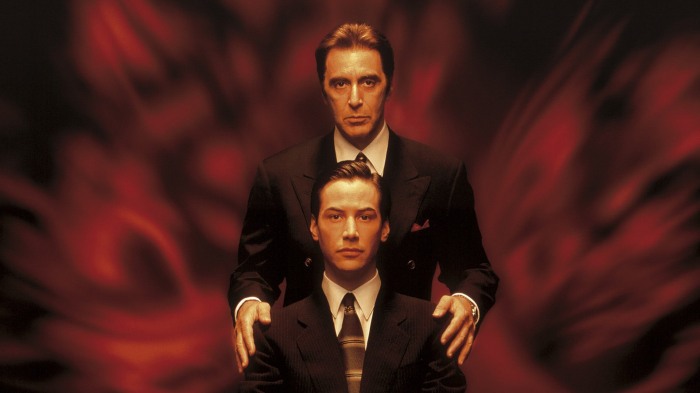
1997 Movie Review: THE DEVIL’S ADVOCATE, 1997

THE DEVIL’S ADVOCATE, 1997
Movie Reviews

Directed by Taylor Hackford

Cast: Al Pacino, Keanu Reeves, Charlize Theron, Connie Nielson, Jeffrey Jones, Craig T. Nelson,
Review by Surinder Singh

SYNOPSIS:

Hotshot lawyer Kevin Lomax (Keanu Reeves) accepts an invitation to join a prestigious New York law firm notorious for it’s track record of getting its guilty clients cleared of all charges. Lomax is drawn in by the money and power that comes with the job; a seduction cleverly orchestrated by the firm’s boss John Milton (Al Pacino). But as Lomax delves deeper into the firm’s legal dealings he discovers there’s more to Mr. Milton’s success than meets the eye…

REVIEW:

It’s fair to say that Pacino did his share of mentoring during the nineties. As well as winning his Oscar and churning out some great central performances, he also played a number of supporting roles aside the new generation of leading men. In Donnie Brasco (1997) he supported Johnny Depp and with Any Given Sunday (1999) he did the same for Jamie Foxx. It’s always important for a screen-acting veteran to take stock in the new generation because it gives them the chance to see how good they really are! Perhaps one of the greatest tests for any upcoming actor is: “can I hold my own against Al Pacino on screen?”

As Kevin Lomax, Keanu Reeves was offered the challenge! Reeves arrives on screen looking suitably sharp and suave, he oozes confidence as soon as he enters the courtroom. We are shown someone so ambitious that he’ll happily tear up a poor young girl on the witness stand to win his case. It’s not long until he attracts interest from like-minded people in his field. As the film’s title suggests we’re witnessing someone on a moral journey in a job that continuously puts morality up for question. Reeves plays Lomax brilliantly as a man who is quite comfortable with drawing a line of professionalism between himself and the case. At this point in his journey it’s not important whether his client is guilty or not, only that he wins!

The film really gets going once Lomax is in New York and poised to begin his case with the new law firm. Enter Al Pacino: in a wonderful scene on top of the huge sky-rise looking down at the world below, Milton acquaints himself with his new employee Lomax. Director Taylor Hackford does a great job of balancing a realistic drama set against a modern day New York with the supernatural and mythic elements at play. The scene is totally plausible but at the same time positions Pacino’s Milton as the Master of the Universe. He’s more than just a successful man; his power clearly reaches further than Lomax is presently aware of.

Many actors in the past have played the Prince of Darkness: Jack Nicholson in The Witches of Eastwick (1987), Robert De Niro in Angel Heart (1987) and of course Tim Curry in Legend (1985). By default, any actor who takes on such a notorious character will be compared to the previous incarnations. Pacino is charismatic and carries his character with a sense of cool that draws you in from the moment you meet him. Pacino may be a small guy but in The Devil’s Advocate he owns every space he walks into and everyone in it! Pacino’s Milton is by far the most contemporary and convincing incarnation of Satan for many years.

Like he did in Donnie Brasco, Pacino plays a mentor and takes Keanu Reeves’ Lomax under his wing. Milton explains his philosophy leaving his new apprentice in awe: “Look at me! Underestimated from day one. You’d never think I was a master of the universe, now would ya?” Rather than exert superhuman physical powers, Milton is the puppet master who prefers discretion: “I’m the hand up Mona Lisa’s skirt. I’m a surprise, Kevin. They don’t see me coming!” Lomax sees this simply as advice to help him progress as a lawyer. All the while his new mentor who is ten steps ahead is manipulating him!

The movie is full of devilishly splendid set pieces. Lomax is advised to seek out a man named Moyez (Delroy Lindo) a witchdoctor who’s on trial for the ritualistic butchering of animals. Moyez offers Lomax a helping hand (via a strange ritual with a decapitated tongue) and sure enough the prosecution cannot get a word out in the following trial. The scene gives supernatural depth to the power of Milton and his associates, showing the unsettled Lomax the extent to which his “unfaltering success” is being secured. Perhaps the greatest set piece is the killing of Eddie Barzoon (Jeffery Jones). As he jogs through Central Park we hear Pacino’s piercing voice off-screen, the feeling of an impending doom takes over until we see the poor Barzoon fall to his bloody fate.

Like most films about the Spirit of Evil (walking amongst us in modern times) The Devil’s Advocate is essentially a story about someone saving their soul from Evil. The idea that through all Evil’s temptations we eventually choose the path to light and salvation. On reflection this movie is unlike the others in the way it delivers the age-old story to you in a fresh, contemporary and engaging manner. The performances are strong and Pacino’s performance completely convinces you he’s the modern incarnation of the Prince of Darkness. Plus, on purely popcorn terms this movie is a solid thriller that doesn’t rest too heavily on religious fact and while the symbols of Christianity are ripe throughout they do not alienate the audience.

The Devil’s Advocate is a great movie to watch over and over. Not exactly ‘light-entertainment’ but a strong contemporary thriller that will satisfy. It also contains arguably the best portrayal of Satan on film…yet another testament to the awesome acting talent of Al Pacino!

 the devils advocate

Film Review: SAGE FEMME (THE MIDWIFE) (France 2017) ***

The Midwife Poster
Trailer

A midwife gets unexpected news from her father’s old mistress.

Director:

Martin Provost

Writers:

Martin Provost (dialogue), Martin Provost (screenplay)

Stars:

A film with babies being brought into the world?  One cannot imagine a more euphoric subject.

Martin Provost is a French film director not that well known in North America as his films, as is the case of many French films, do not get distribution.  It is a sad thing as his film SERAPHINE that won the Cesar for Best Film and for him sharing the Best Screenplay never got here either.  I was fortunate to catch it at the Toronto International Film Festival and it is good to see a film of his SAGE FEMME finally released.

It is nothing more than spectacular to see two of my favourite French actress together in the same film.  Both Catherine Frot and Catherine Deneuve (the great Catherines) – and I can watch them forever.  Frot (the younger one), allows Deneuve to take the spotlight whenever they appear on screen together as obvious in the restaurant scene where Deneuve freaks out while Frot remains composed.

Claire (Frot) is a midwife at a Paris hospital.  In her 40’s, her life has become monotonous  and routine even though she has the exciting task of delivering babies.  Into  her life suddenly arrives Beartrice (Deneuve) who is diagnosed with terminal cancer.  Though dying, she wants to live.  The two are complete opposites.  While Claire is a vegetarian and no-drinker, Beartrice downs bottles of wine while indulging in red meat.  Beatrice is the woman Claire’s father left her mother for.  Beatrice wants closure – to make things right.  Claire initially wants noting to do with her but eventually succumbs.  Frot and Deneuve exhibit good chemistry playing contrasting confrontational personalities.  It is this chemistry that makes the film work, despite the simple plot covered by lame subplots like Claire’s son (dropping out of school; his pregnant girlfriend), Beatrice’s gambling and other bad habits and the hospital affairs.

As the subject is the midwife who delvers babies at a hospital, the film necessarily shows several of the deliveries of the just born.  It is very obvious that director Provost always hides the side of the bay and mother so that the umbilical cord cannot be seen, or that would mean the delivery of a real baby.

Though Deneuve is in her senior years, Provost does not even for once fall into the trap of cliched films about old farts.  Deneuve’s old character is portrayed as a mother dying of a brain tumour.  There is no scene of her reliving her young days, or trying to have sex or fall in love again.

Provost succeeds in the balancing comedy and drama.  Deneuve provides most of the comedy and Frot the drama.

The film suffers from a predictable plot.  It does not take a genius to guess that Beartrice will teach Claire how to live life and that Claire will eventually succumb to the charms of her suitor (Olivier Gourmet).

SAGE FEMME is a pleasant enough melodrama that will not win any awards but still should be seen for its two stars Denueve and Frot.

Trailer: https://www.youtube.com/watch?v=S_FLOFTvqdQ

Film Review: WHITE NIGHT (Nuit Blanche) (Canada 2017) ***

White Night Poster
Set in the sleepless night of Nuit Blanche, White Night follows five different stories of people as they weave their way through various art installations tackling the issues of, love, losses, and the inevitability of getting old.

Directors:  Sonny AtkinsP.H. Bergeron (as Philippe H. Bergeron)


NUIT BLANCHE (Translated: White Night; originating from Paris and Nantes – an all night arts festival), the film traces a night in Toronto in fall beginning at sunset and going on till the early hours of dawn the next morning, where attendees can see, free of charge, art installations of various forms around the city centre.  A guide is available for choice picking.  Or one can do the random thing.  The art on display includes everything from film (like old films with piano accompaniment or French serial comedies) to paintings to music.  One can attend en seul or in a group.  In my experience it is best to decide what to visit before venturing out.  WHITE NIGHT the movie is based on this Toronto event. The film opens with a song with lyrics asking what the special night means to anyone.  It also comes with a forewarning of the unexpected and to expect the unexpected.

Set in the sleepless night of Nuit Blanche, White Night follows six different stories of people in transition. As they weave their way through various art installations they are forced to tackle the issues of, love, loss, aging, and the ever important question; is it art?

Emily is an artist. She has an installation. But does she have anything to say?  She is shown at the start of the film lugging her boxes, assuming containing her installation, to the right while the camera pans to the left.  Frank, a lawyer (with an uncanny resemblance to Ben Affleck) who initially is working late on unit blanche, he just fired. So he decides to take up a career in crime fighting. Violet and Sully are long time friends. Once young punk rockers fighting to take down the man they now face the idea of growing up.  Melanie needed change. So she uprooted her life in Quebec to start anew in Toronto. The language barrier is proving to be more difficult than she imagined.  Stacey likes to help people. While everybody else is transfixed by art she is out to find people in need.  Riley lives to capture life on his camera. He hides behind what he sees in everyone else.  The film intercuts the multiple stories in chronological order of the night as it transgresses, rather than playing them one after another.  It is not a new cinema concept but it is a suitable one for the subject.

Riley especially when on mushrooms is the funniest character.  Violet and Sully are the most boring, pretentious representing the worst of the art exhibits that are often on display.  No one wants to watch prissy, self-centred, unfunny, pretentious, people who do nothing that talk about themselves.   Characters also meet – like Riley and Emily.

The best thing about the film is the varied soundtrack from Stephen Joffe, Birds of Bellwoods and Beams also consisting of live performances.

The film has a one week (right after the 2017 Toronto event on September 30) limited engagement at the Carlton Cinemas, Toronto.  With a look! 

Trailer: https://www.youtube.com/watch?v=RjKEA4751iQ&utm_source=WHITE+NIGHT&utm_campaign=357e40b8fd-EMAIL_CAMPAIGN_2017_08_22&utm_medium=email&utm_term=0_d4877cdab0-357e40b8fd-450246757

Interview with Festival Director Auregan (ANIMATION STUDIO FESTIVAL)


Our selection is based on love, emotion, and great talent. The movies we chose to select are creative, sincere and powerful. They drive you somewhere else, or deep inside so you can feel, learn, be surprise, laugh, discover a new perspective.

Contact

Matthew Toffolo: What is your Film Festival succeeding at doing for filmmakers?

Auregan: We have exclusive categories such as Best Story and Best Design. This way we want to reward the most sensitive films even if they didn’t have the budget for specific animation, and we also want to pick some of the best animators and animation designers. On a general perspective I have always been in love with animated films and by making these festival I want to select the new generation of talented and passionate filmmakers.

What would you expect to experience if you attend the festival this year (2018)?

We are planning for high quality screening event involving the filmmakers by sharing and showing their craft and amazing expertise.

What are the qualifications for the selected films?

We have eight categories, for short and feature films, for 2D, 3D, traditional, digital animation and even stop motion. Shorts must be less than 30 minutes and features over 40 minutes. For the rest we are expected moving and entertaining and funny films from all over the world !

Do you think that some films really don’t get a fair shake from film festivals? And if so, why?

There is some truth in that. Sometimes the bigger festival becomes the more the selection goes to some kind of etablished names, talents and films. It is up to the filmmakers to carrefuly chose the festivals they submit to. At the Animation Studio Festival, we are fully transparent, you can check our website and we answer each and every email. We are looking for the most sincere and involved filmmakers regardless of their status.

What motivates you and your team to do this festival?

We really love animated films. We watch them all the time. We noticed that there is so much more originality in animated films than in other films’ genres. The imagination of the animators and the authors seems unlimited !

How has your FilmFreeway submission process been?

There is a fisrt selection made by our team, then the selection is sent to the jury members who decide who the winners will be for each category. Nowadays the submission process is made really easy thanks to the platforms. We are on FilmFreeway but also on WithoutaBox, Click for Festivals and Festhome. So far the response as been great from the filmmakers !

Where do you see the festival by 2020?

There are so many artists, animators, screenwriters we would love to have as jury members… Also I guess I want the festival to grow but I also want to keep it close to the audience and the submitters.

What film have you seen the most times in your life?

Probably The Lion King. I know all the dialogues and the songs by heart.

In one sentence, what makes a great film?

A great story. Definitively.

How is the film scene in your city?

You know, films are what Los Angeles is about. The city lives with movies, breathes films, everyday. There is a lot of competition but judging by the response we have to the Animation Studio Festival, we already are standing out.

 animation studio festival.jpg

*****

Interviewer Matthew Toffolo is currently the CEO of the WILDsound FEEDBACK Film & Writing Festival. The festival that showcases 20-50 screenplay and story readings performed by professional actors every month. And the FEEDBACK Monthly Festival held in downtown Toronto, and Los Angeles at least 2 times a month. Go to www.wildsound.ca for more information and to submit your work to the festival.

SUBMIT your TV PILOT Screenplay or TV SPEC Script
Voted #1 TV Contest in North America.
Screenplay CONTESTSUBMIT your Short Screenplay or FEATURE Script

FULL FEEDBACK on all entries. Get your script performed

Interview with Co-Founder Karl Rössel (AFRIKA FILM FESTIVAL)

AFRIKA FILM FESTIVAL KÖLN
1992 – 2015: 25 years of Films from Africa in Cologne/Germany

THE FESTIVAL:
FilmInitiativ Köln e.V has been organising the AFRIKA FILM FESTIVAL KÖLN since
1992 in Cologne/Germany. In 25 years more than 750 films from 40 African countries have been shown and the cinema-goers had the opportunity to get to know more than 160 filmmakers.

The AFRIKA FILM FESTIVAL KÖLN presents the most comprehensive range of
contemporary African cinema in Germany. As a result, the festival has grown in
national and international stature during the years.

In preparation for the Cologne festivals FilmInitiativ has regularly attended the panafrican film festival FESPACO in Ouagadougou, the capital of Burkina Faso. FilmInitiativ has also attended African film festivals in Durban, Tunis (Carthage), Rabat and Cairo, as well as those in Milan, Amsterdam, Leuven, Tarifa/Cordoba and Frankfurt a.M. Special programmes featuring films from Africa that are screened at international film festivals, such as Cannes, Berlin, Rotterdam, Venice, Locarno, Toronto and Innsbruck, are also reviewed and evaluated for the Cologne festival.

FilmInitiativ offers information about all films and guests that were presented at the festivals in Cologne via a database in three languages on the website:
http://www.films-from-africa.com

The 15th edition of the festival will be held from September 21 to October 3, 2017. It will mark the 25th anniversary of the festival.

Contact

Matthew Toffolo What is your Film Festival succeeding at doing for filmmakers?

Karl Rössel: The festival provides an opportunity for filmmakers from Africa and from the global African diaspora to present their films to the German audience. We promote those films not only by presenting them at our festival in Cologne, but also by recommanding them to cinemas and festivals in other German cites. We also subtitle some of the festival films as it makes it easier to distribute them in Germany.

For those filmmakers who come to visit the festival we organise meetings with the documentary and feature departments of the WDR. The WDR is Germanys biggest
public TV station and based in Cologne.

What would you expect to experience if you attend the festival this year
(2017)?

Given that we celebrate the 25th anniversary of the AFRIKA FILM FESTIVAL KÖLN,
people attending our festival can not only expect about 80 new films from more than 20 countries in Africa and from the diaspora, but also 30 guests, two exhibitions, four live music acts including an anniversary concert (with the Kasai Allstars from Kinshasa) and a party (with the Steven Ouma Band from Cologne).

What are the qualifications for the selected films?

The films for our festival are selected by the whole festivalteam. If the opinions in our team on certain films are inconsistent we also ask friends from African communities and others for their advise. We always try to present the best films from festivals in Africa, including those winning major awards.

The most important criteria for the selection is, that films should be directed by people from Africa or the African diaspora and not by Europeans or Americans. We deliberately present films from Africa, not about Africa. All genres and styles are welcome as long the content and form of the films are interesting and
inspiring. Given that we see cinema as a form of art we are not interested in
mainstream films, which are just shot for commercial reasons.

Do you think that some films really don’t get a fair shake from film festivals? And if so, why?

At festivals like the Berlinale (as well as other international A-festivals like Cannes, Venice and Rotterdam for example) films from Africa still are widely ignored. The few exceptions from this rule do not represent the great variety of genres, styles and contents of contemporary filmmaking in Africa. While films from Asia and Latin America are more regulary presented at international festivals, they still seem to be not interested or capable to do comprehensive research on new developments in African cinema.

What motivates you and your team to do this festival?

The association organising the festival, FilmInitiativ Köln e.V., was founded in 1988 when it set itself the objective of “arousing interest in cinematic art by screening films and giving lectures and seminars and also to stimulate and encourage political discussions”. In doing so, “primarily films that are not represented in the listings of commercial cinemas should be given a platform. These could be significant films in cinematic history or culture which document the cinematographic works of non-European filmmakers”. After presenting a first series of films from West Africa in 1992, the whole team of FilmInitiativ in 1993 traveled to Burkina Faso to attend the legendary panafrican film festival FESPACO. Overwhelmed by the amount of fascinating films from African directors, which we discoverd at this festival inOuagadougou, we decided soon after to concentrate on the presentation of films from Africa. By providing opportunities to watch those films and to discuss with African directors at eye level we also try to overcome sterotypes and racist prejudices, which are still widely spread in Germany when it come to Africa and its people.

How has your FilmFreeway submission process been?

We received more than 400 film submission via FilmFreeway. The problem is, that
even if you define certain criteria, many filmmakers submit their films without fulfilling the criteria.

Where do you see the festival by 2020?

We hope that we will be able to present (and finance!) a festival in 2020, which will be as comprehensive, diversified and ambitious as our anniversary festival this year.

What film have you seen the most times in your life?

„Hyènes“ by Djibril Diop Mambety from Senegal, because we have presented this
masterpiece several times in the last 25 year.

In one sentence, what makes a great film?

A great film moves and changes the audience watching it.

How is the film scene in your city?

There are not enough cinemas and screens in Cologne.

Film does not play the role it should. If people in Cologne still get a chance to watch important films from around the world, it is due to the efforts of independent film groups (like FilmInitiativ Köln e.V.) and a few art house cinemas.

afrika.jpg

*****

Interviewer Matthew Toffolo is currently the CEO of the WILDsound FEEDBACK Film & Writing Festival. The festival that showcases 20-50 screenplay and story readings performed by professional actors every month. And the FEEDBACK Monthly Festival held in downtown Toronto, and Los Angeles at least 2 times a month. Go to www.wildsound.ca for more information and to submit your work to the festival.

SUBMIT your TV PILOT Screenplay or TV SPEC Script
Voted #1 TV Contest in North America.
Screenplay CONTESTSUBMIT your Short Screenplay or FEATURE Script
FULL FEEDBACK on all entries. Get your script performed