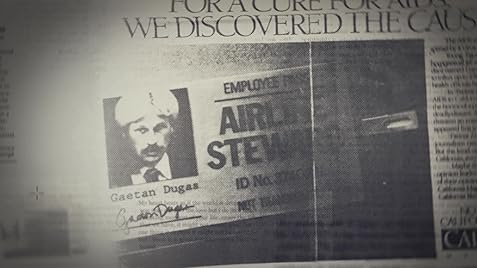
Film Review: KILLING PATIENT ZERO (Canada 2019) ***1/2

Killing Patient Zero Poster
Trailer

Gaetan Dugas was openly gay. In early 1980s he contracted what was termed “gay cancer”. He provided blood samples and 72 names of his former sex partners. Dugas was demonized for his promiscuity and wrongfully identified as patient zero.

Director:

Laurie Lynd

Writer:

Laurie Lynd

If you are a straight person reading this review, it would be unlikely that you would know who or what Patient Zero means.  The opposite can be said for any gay person, who is totally aware of the significance of Patient Zero.  Patient Zero is thought to be the man (an Air Canada flight steward) who brought  A.I.Ds to North America.

While Laurie Lynd’s entertaining and informative documentary educates both sexual orientations on Patent Zero, the film serves more as an account of the History of A.I.D.s.

This is the documentary about the origins of the A.I.DS epidemic and the story of Gaetan Dugas, the man who was incorrectly accused of starting it all.

Gaetan when sick was recorded in California as Patient 57, a patient Out of California.  Patient ‘O’ not ‘0’, but mistaken for a zero.  This he was then mistaken to be Patient Zero the first one to have propagated the A.I.Ds virus.  He actually did (but not the first one) as he was a handsome man who had promiscuous unprotected sex with strangers.  In Gaetan’s defence, no one knew at that time that the virus was passed on though unprotected sex.  And he cooperated with the authorities in re-tracing his 72 sex partners.  The most unforgettable words of one of the interviewees was: “after all this time, gay men can finally open up and enjoy sex and boom, the gay cancer occurs.  Everyone was scared as people were dying and no one knew how or what was happening.”  One interviewee includes gay Canadian filmmaker John Greyson who made the movie ZERO PATIENCE with an all-male cast.

The film has a definite impact on this reviewer.  This reviewer was a gay young man at the time in his early 30’s.  When I first came on the scene, A.I.D.s had just reared its ugly head.  When I first enjoyed the beauty of my youth, as I did sleep around with strangers, maybe twice a week, (not as promiscuous as Gaetan, but promiscuous nonetheless), news was already out that one has to use condoms to prevent  contacting the disease.  But having sex so often is difficult to be always safe and every year, I would have to be tested as I would have unprotected sex once or twice a year and then regretted it.  Anyway, yours truly has survived or you would not be reading this review.  It was hell of a good time then, being able to go to the clubs, get ‘high’ , dance, then take someone beautiful home.  Those were indeed the days.  The film captures those days. 

Most important of all is the fact that the film educates on the truth of Patient Zero.  The film attributes him a a scapegoat propagated in part by Randy Shilt’s book “And the Band Played on”.  But the film shows him a hero who cooperated with researchers.  It took 8000 gay men to die before Americans realize the A.I.D.s epidemic and for gays to be able to live, and alive to this day.

Though a doc, the film contains quite the few erotic scenes, like scantily clothed men rolling around on the floor and one scene set in the bath house (or sauna) that gay men go for casual sex.

Females are noticeably left out (except at the end) in this doc, but they are fortunate enough not to have suffered the effects of AIDs as much as their male counterparts.

KILLING PATIENT ZERO is a thorough History lesson on AIDs of the early 80’s that captures both the nostalgia and horror the times. Writer and director Laurie Lynd will be present for a Q&A  after the Friday, July 26, 6 PM screening at the Ted Rogers Cinema.

Trailer: https://www.imdb.com/title/tt9896252/videoplayer/vi176995353?ref_=tt_ov_vi

Film Review: ASTRONAUT (USA 2019)

Astronaut Poster
Trailer

A lonely widower battles his family, ill health and time to win a competition for a golden ticket to space.

Director:

Shelagh McLeod

ASTRONAUT belongs to the genre of old-fart films where the protagonist is a senior and has to come to terms with age and usually makes good, be it in romance or achieving ones final goal in life.  Thankfully, it is the latter.

The protagonist is 75-year old widower Angus (Richard Dreyfuss) who lives with his daughter’s family.  His son-in-law, Jim (Lyriq Bent) convinces the daughter, Molly (Krista Bridges) to move Angus into a retirement home.   His life seems over; he feels worthless and alone.  But Angus’s long extinguished dream is reignited when an exciting national competition is announced.  The prize is one golden ticket for a trip to space!   Way past the age limit at 65, he doesn’t have a chance.  But spurred on by his grandson, Barney (Richie Lawrence) Angus fudges his birthdate, and enters the competition.  Against all odds, he must battle against prejudice, ill health, and win the contest.  Angus discovers too that the rocket is not safe, being a civil engineer.  A subplot requires him to tell the organizers of the problem but no one would believe an old man.

The film’s best parts is surprisingly nothing to do with his space trip.  It is his realization that he has to move and adapt into a retirement home.  From the looks of the home, it is quite attractive, spacious and grand and I doubt that anyone including myself (when I am old, of course) would mind staying there.  One feels for Angus.

The film features a mixed raced family, husband (African American) and wife (white), something much more common in films these days.

The film’s subplot concerns Angus Stewart’s family. The son-in-law has loses his job for standing up for his principles.

ASTRONAUT is in part another Richard Dreyfuss vehicle.  For those who remember, Dreyfuss won an Academy Award for his role in THE GOODBYE GIRL primarily for the scene where he made audiences cry when he played an actor realizing in his dressing room how bad his performance was as a crippled Hamlet.   Dreyfuss plays a senior inches in ASTRONAUT and it was not that long ago when audiences saw him as a teen in AMERICAN GRAFFITI and in the other space film, Steven Spielberg’s CLOSE ENCOUNTERS OF THE THIRD KIND.  

The other performance worthy of mention belongs to Native Canadian (born on the Six Nation Reserve in Ontario, Canada) Graham Greene (best remembered in THUNDERHEART) who plays  a fellow resident  of the retirement home.  He is to given much to say but still makes a screen presence.

ASTRONAUT is McLeod’s first feature and it shows.  The film meanders from being a family conflict drama and a space adventure while not satisfying either.  The one thing going for the film is Dreyfuss’ performance.  Dreyfuss had at one time turned into the most annoying actor on the planet, but his controlled acting here shows the actor this best when he was in films like JAWS, CLOSE ENCOUNTERS OF THE THIRD KIND, THE GOODBYE GIRL and THE BIG FIX.

The film has a odd tacked on sort-of happy ending that could have been better though of.

Trailer: https://www.youtube.com/watch?v=bE1Nw5pEqL8

Film Review: THE STONE SPEAKERS (KAMENI GOVORNICI)(Canada/Bosnia/Herzegovina 2018)

The Stone Speakers Poster
The Stone Speakers examines the intersection between tourism and ideology in four post-war Bosnia and Herzegovinian towns.

Director:

Igor Drljaca

Writer:

Igor Drljaca

The old Yugoslavia and the new Yugoslavia.  The past and the present.  How anti-fascism was ridden of and the country that now enjoys the benefits from tourism.  THE STONE SPEAKERS is directed by Canadian based Igor Drljaca, examining the intersection between tourism and ideology in four post-war Bosnian and Herzegovinian towns.

In present-day Bosnia-Herzegovina is a country still reeling from the civil war in the early 90s. The Bosnian economy never recovered, and the country remains divided. In order to cope, many towns have transformed themselves into unique tourist destinations that bring together history, religion, politics and folklore.  The tourist sites promoted are not only a reflection of peopleʼs attempts to make a livelihood but are also a means to promote and establish competing narratives about the countryʼs past, present and future. The Stone Speakers explores four towns in Bosnia-Herzegovina through their tourism, slowly unravelling

these competing narratives.

The four towns are:

1. MEDJUGORJE in Eastern Herzegovina became a site of considerable interest in 1981 after six children, who are referred to as visionaries, began to see apparitions of the Virgin Mary.  Te film includes sites with tourists and pilgrims visiting the town.  The town now attracts upwards of one million pilgrims per year.  Despite the foreign crowds, like the rest of Bosnia-

Herzegovina, the local population in the region continues to decline.

2. TUZLA is located in what was once the industrial heartland of North-eastern Bosnia. Sitting on massive salt deposits, it has been historically well-known for its production of salt, which has continued nearly uninterrupted for over a thousand years. The cityʼs manufacturing sector, much like other industrial infrastructure throughout the country, was criminally privatized

and closed in the post-war period.  The city authorities have taken advantage of sinkholes caused by the over-extraction of salt to create salt lakes that have tourists.  The portion on TUZLA is the most interesting of the 4 cities.

3. VISOKO has only recently received more widespread attention, stemming from claims that a complex network of pyramids, older than the ones in Egypt, has existed at the site since at least 12 000 BCE. The claims, made by Semir Osmanagic, have not been supported by the scientific community, but the town has continued to enjoy a tourism boom as a result. A wide network of tunnels has been unearthed beneath the pyramids, which have been integrated into a

tourist attraction.  This segment is quite informative as many do not know pyramids existed here.

4. VIŠEGRAD – is at the crossroads of empires, and until recently, it was a predominantly a Bosniak town.  This part is primarily history and the director Drljaca trees it as such.  Prior to the civil war in the 1990s, Bosniaks accounted for over 60% of the townʼs population, but most were ethically cleansed during the fighting. The city has never been able to fully recover since the war, and its demographic decline continues, driven in part by the poor socio-economic conditions of the region.

THE STONE SPEAKERS plays like both a history and geography lesson.  Director Drljaca has 12  residents speak about the 4 towns.  They stand alone and then speak amidst a background that ranges from landscape to architecture.  He has them remain in silence for a minute before speaking.  They speak slowly but the English subtitles often run too fast for the audience to read.

As artful and informative this doc is, it would be difficult to recommend it to any commercial moviegoer. THE STONE SPEAKERS is not the run-of-the-mill documentary.  The majority would likely not connect wth the director’s aim and find the film a complete bore.  The one user review on imdb claimed that THE STONE SPEAKERS is a really bad movie.  Though not entirely true, it is easy to see the reason that writer felt that way.

Trailer: https://www.youtube.com/watch?v=6tcQ-dd-RJw

Film Review: ROADS IN FEBRUARY (LA RUTAS EN FEVRERO) (Canada/Uruguay 2017) ***

Roads in February Poster

The film opens with a fully blank and black screen.  A door opens, letting the light into a room, revealing the film’s protagonist and main character, Sarita or Sarah from Canada.   She is shown twice making a phone call to someone who does not pick up the telephone.  In another scene, a fly is shown landing on a glass double door before Sarita shoos it away.  It is noticed that Sarita is, speaking in Spanish on some bus trip or other, making a journey of great distance.  Director Jerkovic, who certainly takes her time to tell her story tells the tale of a young girl, Sarita who travels to a remote village in Uruguay to visit her grandmother.
The visit brings out an old skeleton in the closet.  The two have to come to terms with the loss of Sarita’s father, Magda’s son who left Uruguay for whatever reason and passed away.  Magda never saw him again and somehow puts the blame on Sarita.
Jerkovic’s camera often comes up close to the facial expressions of the characters to both reveal their emotions and amusements.  One instance has Magda companioning that Sarita bought the incorrect and more expensive bread.  Despite Sarita telling her that it was her who paid and wanted to give her grandmother a treat, Magda still fusses.  The look on Sarita’s face as a result is priceless.  Another instance is the visit of Magda’s old friend to the house, Olga.  Olga is losing it, Magda insists.  But the camera reveals Olga as a bright, always cheerful, inquisitive friend and not like what the audience would expect after first hearing Magda’s description of her.  One wishes there would be more scenes with the amusing Olga.
Sarita is no angel.  While visiting granny, she scores some weed from the local boys, trespasses into a rich family personal swimming pool and flirts around with a handsome hunk.  Girls will be girls!  Still director Jerkovic elicits the audience’s sympathy for the vulnerable heroine.  She has her camera stolen losing all the valuable photographs she had taken on her trip. She falls off her bike while riding away frustrated.  She incurs quite the nasty bruise on her one leg.

Jerkovic’s imprint is clearly stamped in her film, where one can feel the heat of village surroundings and the alienation of the two characters, enhanced by controlled performances by Arlen Aguayo Stewart and Gloria Demassi.
ROADS IN FEBRUARY premiered at TIFF and opens at the TIFF Bell Lightbox.  It won the jury prize for Best First Feature and shows Jerkovic as a new Canadian talent to watch.  Director Katherine Jerkovic will be present for an introduction and post-screening Q&A on Saturday, July 20 at 7:10pm!  There should be many interesting questions that can be asked such as how autobiographical the film is and how close is the director to the character in her film.

Trailer: https://www.youtube.com/watch?v=_aPumHbo2RQ

Film Review: PROPAGANDA: THE ART OF SELLING LIES (Canada/Germany 2019) ***

Propaganda: The Art of Selling Lies Poster
Academics, public relations experts, and satirists of various kinds describe the history and nature of propaganda.

Director:

Larry Weinstein

Writers:

David Mortin (Written by), Andrew Edmonds (Written by)

What is fascinating about the new doc on propaganda called PROPAGANDA: THE ART OF SELLING LIES which had its premiere at this year’s HOT DOCS, is the way director Larry Weinstein uses the concepts populated in his film to get his message across.  Weinstein is bold enough to also call his film a cautionary tale and a call to action.    

In a way, it is a sure safe way of making a doc on any subject.  The film opens with the letters of the word ‘Propaganda’ flashed on the screen – not once but a few times, as verbalized by President Trump in one scene in the film: “Repeat for the truth to sink in.”  It is intriguing to note that the word ‘truth’ is in the line implying that what is said is the truth, which is of course, might not be so.  Propaganda goes by various definitions as the film informs at the start.  The first definition given is ‘political brainwashing’ followed by others before Weinstein goes into the origin of the word – in Latin.

One wonders often at the odd choice of interviewees Weinstein has chosen, as it seems quite the eclectic assortment.  One is Paolo Granata, apparently a professor of Media Studies and another Alistair Pike an archaeologist.  There is a segment dealing with a ancient art carved in a Spanish cave which could be the reason the Spanish and the archaeologist being chosen.  But propaganda and entertainment come together with the segment of Jim Fitzpatrick an Irish artist who sketched an outline easy-to-copy figure of Che Guevara after Che visited him in a bar in Ireland where he was a barman.  Che was killed and his body gutted of blood like an animal.  As a result, Fitzpatrick popularized Che with the figure he designed and drew that is now famous all the world over.  This is another example of propaganda.  On the plus side, the most interesting interviewees include a staff at Charlie Hebdo (the French satirical newspaper targeted by Muslim terrorists)  and the photographer who took the controversial picture of Kathy Griffin holding President Trump’s severed head.

The film stresses that propaganda is most used in print, posters and cinema.  Weinstein provides lots of clips of old propaganda films like the most famous of all films – the Nazi propaganda 1935 film Leni Riefenstahl’s masterful TRIUMPH OF THE WILL to illustrate the fact.  My fav propaganda film of all is the the British 1942 entry Alberto Cavalcanti’s WENT THE DAY WELL? where British housewives during WWII did away with hysterical relish the German invaders of their village who were disguised as British soldiers.

Though entertaining, the doc sheds little light on what we do not already know.  The film does bring a lot of facts together, as emphasized during the film’s conclusion.  The film is also quick to point out the propaganda could also be sued for good, as in the British propaganda films to run up loyalty.    Ironically, the film is after all also propaganda about propaganda.

Trailer: https://www.youtube.com/watch?v=vZP2H00aOR0

Film Review: SWORD OF TRUST (USA 2019) ***

Sword of Trust Poster
Trailer

Cynthia and Mary show up to collect Cynthia’s inheritance from her deceased grandfather, but the only item she receives is an antique sword that was believed by her grandfather to be proof that the South won the Civil War.

Director:

Lynn Shelton

Writers:

Lynn SheltonMichael Patrick O’Brien (as Mike O’Brien)

WORD OF TRUST is a low budget American comedy co-written by director Lynn Shelton and Mike O’Brien that includes improvisation from the actors.  The premise is the SWORD OF TRUST of the film title, an actual sword.

When Cynthia (Jillian Bell) and Mary (Michaela Watkins) show up to collect Cynthia’s inheritance from her deceased grandfather, the only item she’s received is (no house) an antique sword that he believed to be proof that the South won the Civil War.  The sword comes with two items of authenticity, a certificate and a painting that stands for a photograph.  The script takes pains to make all this believable, as it is the reason that all incidents that follow that place.  

The two attempt to unload the object to a curmudgeonly pawnshop owner Mel (Marc Maron, “GLOW”) and his man-child sidekick Nathaniel (Jon Bass, Molly’s Game).  After it becomes clear that the film centres on these four, the film starts taking hold of the audience’s interest.

When Mel and Nathaniel discover there’s a black market for the relic, the two pairs reluctantly join forces to sell this rarefied ‘prover item’ to the highest bidder.  The adventure that ensues takes the four of them on a wild journey into the depths of conspiracy theory and Southern disillusionment.  

It is difficult to tell what is improvised and what is written in the script.  This is a good thing as the film and story flows smoothly throughout most the film.

The films starts running into trouble in the last third.  The chemistry among the four begin to wear off.  The singular jokes of Nathaniel being a man child, Mel being a radical grumpy codger made good and Cynthia and Mary having a same-sex relationship get tiresome.  Adding more story to the plot and the introduction of more characters in the third part signals Shelton’s desperation to get her film on track.

Director Shelton gives herself a cameo as Mel’s ex-lover, a dog addict who never quite get her act in life together.  She shows herself apt in dramatic comedy improvisation and is a pleasure to watch.

The best thing about SWORD OF TRUST are the individual personalities on display.  Each eccentric is ‘special’ in his and her  own way.  Each of the four actors are able to create uniques characters of distinct imperfections and strengths.  Their interaction with each other works well.  But by pitting them together in a plot that involves hitmen, con men and crooks ultimately destroys what has been carefully created.  Director Shelton has made similar small films like the YOUR SISTER’S SISTER and the more recent HUMPDAY.

SWORD OF TRUST works well for the most part but fizzles out of steam at the end, once the tired antics of the characters grow tiresome.  It is still encouraging to watch small films like SWORD OF TRUST given a chance in the market where blockbusters like THE LION KING which opens the same week dominate,

Trailer: https://www.youtube.com/watch?v=vWmQyBjrbfU

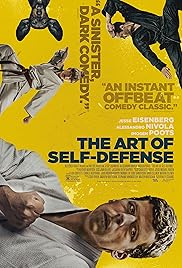
Film Review: THE ART OF SELF-DEFENSE (USA 2019) ***1/2

The Art of Self-Defense Poster
Trailer

A man is attacked at random on the street. He enlists at a local dojo, led by a charismatic and mysterious sensei, in an effort to learn how to defend himself.

Director:

Riley Stearns

Writer:

Riley Stearns

One must admire and give writer/director Riley Stearns credit for going against the natural flow of the typical movie.  Though described as a dark comedy, the film turns so dark towards the last third, that it can hardly be described as a comedy any longer but some psychological mind-blower.   The story turns completely unpredictable with a plot twist that is, when one looks back quite obvious, but director Stearns has steered his audience completely in a direction that they definitely will not see what is coming next.  At the same time, the hapless hero turns and changes into a selfless all-conquering hero, sacrificing everything he has for others, a selfless act while defeating his villain in a duel to the death.

The plot revolves around a mild-mannered accountant called Casey (Jesse Eisenberg).  One evening while returning home after buying dog food, he is beaten up by a motorcycle gang and left for dead.  In hospital recovering, his boss Grant gives him a few days off.  He comes across a Karate class and enrols in the day class while learning the art of Karate, eventually excelling in it.  But it is his character that is in question not his fighting ability.  He learns that the has to overcome his cowardly attitude. This he does, in what are the film’s most hilarious moments.

Jesse Eisenberg apparent took Karate classes a few weeks for preparation for this role, though he has said that he took it as child.  He is convincing enough.  Though Eisenberg usually takes roles where he speaks an incredible amount of words per minute as in THE SOCIAL NETWORK and THE HUMMMINGBIRD PROJECT, this is one film where he has little dialogue.  The film often plays its dark comedy dead-pan with as little words spoken as well.  Whenever a dramatic conversation comes along, director Stearn often turns off the music and background noise.  The effect is an uncomfortable silence punctuated by the script’s dialogue.

Stearn’s wife, actress Mary Elizabeth Winstead had signed on to star in the film in 2016.  But the couple separated in 2017 with the result that Winstead is no longer in the cast.  Making a film is a lot of work and one can assume that the work must have got into conflict with their relationship.  The film though appearing totally male-chauvinist is in reality pro-feminist.  Karate is described in the film as the art of achieving total masculine perfection with none of the other gender having to play any part.  Of course, the concept is wrong which the film thankfully proves at the end.  The film is also quite homo-erotic especially in two scenes, where the male karat students do cool-down exercises bare-bodied massaging each other or when practising certain moves also with little clothes on.

As such, THE ART OF SELF-DEFENSE might turn out a hard-sell.  Besides a few uncomfortable scenes, audiences will find it difficult in the film’s transition from comedy to psychological thriller but those willing to accept the change will find Stearn’s film a daring, bold and refreshing change from the norm.  The film is a winner!

Trailer: https://www.youtube.com/watch?v=7Bms6Hba-3A

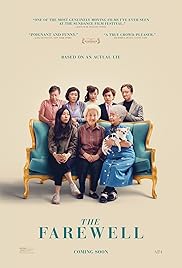
Film Review: THE FAREWELL (USA 2019) ***

The Farewell Poster
Trailer

A Chinese family discovers their grandmother has only a short while left to live and decide to keep her in the dark, scheduling a wedding to gather before she dies.

Director:

Lulu Wang

Writer:

Lulu Wang

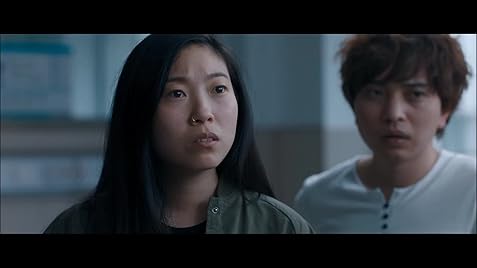
Awkwafina (last seen in CRAZY RICH ASIANS) gets a starring role as Billi, a Chinese American who learns that her beloved grandmother aka Nai Nai (Zhao Shuzhen) still living in China has three months to live after being diagnosed with cancer.  The family decide not to tell Nai Nai of her illness. Instead the family organize a wedding so that the entire family will travel back to China to spend time with her before she passes away.  Hence the film title THE FAREWELL. Billi was not invited to the wedding/farewell as the family fear that she cannot hide her feelings but she shows up in China unannounced from New York City.

The titles cleverly state at the start of the film; “Based on an actual lie.”  THE FAREWELL starts off a little humorously as director Wang introduces the somewhat dysfunctional family who aim to do good.  The idea is that the family takes on the emotional burden off the grandmother if she does not know.  Half way through the movie, it will hit (as it did me) whether what transpires is legal. i.e. will the doctors allow that illness be kept for the patient as requested by the family.  The answer is supplied right outwards – a good thing – in the middle of the movie.  It is not allowed in America but is allowed in China.

Director Wang is more serious that light in her treatment of the material.  Though there are always laughs on the horizon of every scene, the sombre mood is also pressing.  Despite the simple story which is suspense less, Wang keeps her film running at a good pace.  It is more the family interaction at play than the knowledge of whether Nai Nai will discover the truth at the end.  At the end of the matter, whether Nai Nai finds out or who tells her is immaterial to the plot.

Wang captures the behavioural  mores typical Chinese family.  Important are the big meals,  the obsessive ‘fussy’ care over the young and old, the need to keep a stiff upper lip among others.  Other issues the are also important include the relationship between mother and daughter-in-law.  Billi’s mother complains that Nai Nai was always boss in the home when she married her son, which implies the probable reason they left China for America.

The farewell is not the perfect drama as the film contains many glaring flaws including the tacked on happy ending.  Still THE FAREWELL is a sincere drama aided by a solid dramatic performance by Awkwafina who previously only has been seen in comedic roles.  The film is entertaining and sheds light on the difference of cultures, in a good way, and also of respect and the difficulty a family to get along. There is nothing forced in the film, and the story unfolds smoothly that should leave the audience not only satisfied but with a  warm fuzzy feeling.

Chinese American films have always done well and have been well made like this one (and with a strong feminine protagonist too), the recent Netflix original, ALWAYS BE MY MAYBE and of course, CRAZY RICH ASIANS.  There is a large target audience of North American Chinese and hopefully, there will be more films to cater towards this group.

Trailer:https://www.youtube.com/watch?v=RofpAjqwMa8

Film Review: MARIANNE & LEONARD: WORDS OF LOVE (USA 2019) ***

Marianne & Leonard: Words of Love Poster
Trailer

An in-depth look at the relationship between the late musician Leonard Cohen and his Norwegian muse Marianne Ihlen.

Director:

Nick Broomfield

MARIANNE & LEONARD is the in depth look of the stormy relationship between author/poet/singer/so writer Canadian Leonard Coen and his muse and love, Norwegian Marianne Ehlen.  Those who love Cohen’s music will be pleased to note that the doc is interspersed with hissings include g the famous one, So, Long Marianne which he wrote for her.

Documentarian Nick Broomfield is an award winning filmmaker well known for his serial killer docs and his most famous THE LEADER, HIS DRIVER AND THE DRIVER’S WIFE.  He is a filmmaker who knows how to capture the audience’s attention with his sect and he does the same with MARIANNE & LEONARD.  The segment of how Leonard competed one concerti  Jerusalem after shaving on acid illustrates this fact.  another part was the partaking of ‘desert dust’ with a tip of a needle dipped in it not he tongue to get high for a full 23 hours.

The first third of he film shows Cohen’s early life during the hippie ‘flower people’ days.  Marianne anthem experimented with LSD which serves as an inspiration for his work.  It is amazing the amount of archive footage that is available and on display on film.  It is a wonder why Cohen was not  filmmaker himself.

Broomfield’s most entertaining interviewee is the wife of Cohen’s contemporary, Aviva Layton.  Not only does she provide insight on Cohen’s genius, but she talks about other taboos like her husband perhaps having slept with Cohen’s mother.  Cohen’s Jewish roots are also discussed as well as its influence brought into the picture.

Director Broomfield also brings out the human side of the artist with all his faults.  Cohen went into depression mode after his novel “Beautiful Losers’ failed to sell.  Leonard’s downfall was his depression which was quite bad at one point.  As in the recent Ari Aster’s horror film MIDSOMMAR, MARIANNE & LEONARD is also a break-up film.  Broomfield illustrated that as much a muse and lover to Leonard Marianne was, they were not meant to be with each other.  Marianne had to make up her mind to break up.  One of them was always angry and destructive.  The film also looked at Marianne’s son, Axel from her first husband.  There were quite a lot of casualties.  Axel had to be institutionalized.  Marianne had an abortion when pregnant with Leonard’s child.  Another tragedy was the Johnsons, the family they stayed with at Hydra one of the Greek islands.  The parents both died and the children also died one by one from suicide, drugs and drink with only one of them surviving.  For all that is worth, tMarianne and Leonard’s relationship can be described as bittersweet while it lasted, with a last declaration of love t Marianne’s hospital death bedside.

The film also looks at the flower, hippie and acids culture.  Despite the peace and love the culture was supposed to propagate.  Just like the island of Hydra, people from there cannot function int he real world.

Broomfeld proves that there is much to be learnt from his doc on Leonard and Marianne providing an insight on life based on the experiences of failed humans.  Other lessons from the film include the need to solve ones problems besides being in love.  The film is shot in both English and Swedish.

Trailer: https://www.youtube.com/watch?v=LB6nIzPf9r8&feature=youtu.be

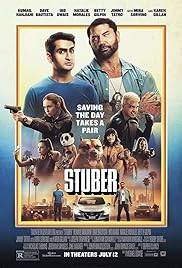
Film Review: STUBER (USA 2019) ***

Stuber Poster
Trailer

A detective recruits his Uber driver into an unexpected night of adventure.

Director:

Michael Dowse

STUBER is an action buddy comedy involving a blind cop and a Uber driver that the L.A. cop hijacked in order to take down some drug Kung-fu fighting villain.  It is not a high brow film project.  For the promo screening, I could not get anyone to come see the free movie because of its theme.  But if one goes with the lowest of expectations, STUBER will turn put to be surprisingly entertaining.

One would not think of filmmakers like Steven Spielberg or Martin Scorcese directing  STUBER.  But a good choice is London (London, Ontario that is) born Michael Dowse who made the Canadian cult-hit FUBAR and the impressive British feature about a DJ gone blind called IT’S ALL GONE PETE TONG.  Coincidentally, the L.A. cop, Vic (Dave Bautista, THE AVENGERS movies) is also going blind.  The Uber driver Stu (Kumail Nanjiani, THE BIG SICK) acts as his eyes.  If all this sounds pretty corny, it all is.  But the fact that this would pose a challenge to the scriptwriter, Tripper Clancy and director.  It would seem all to easy to dismiss the film as a wasted exercise, but given the fact, Dowse and his scriptwriter has risen above the dauntless task.

The film’s first 15 minutes is all edge of the seat excitement as Vic and his partner, Sara (Karen Gillan) attempt to take down an escaping Korean drug Lord, Oka Teijo (Indonesian Martial-Arts star, Iko Uwais, THE RAID, THE RAID 2, STAR WAR: THE FORCE AWAKENS)

On the negative side, the buddy buddy stuff has been seen before and done better in other buddy cop films.  The difference in characters – Stu is so mild mannered that he cannot express hi love towards his girlfriend while Vic is so stone-hearted cannot communicate with his artistic daughter.  The Ryan Gosling gay joke where Stu believes in brain over brawn is the typical homophobic shit that goes round in male chauvinistic films.  The film is also too male dominated, where females are given just a token nod.  Vic’s female partner is killed off in the film’s first 15 minute, the daughter has to struggle to become a sculptor while the chief villain turns out female.  Stu’s girlfriend is finally revealed as a real bitch who not only not now what she wants but a really floozy.

The buddy chemistry between Bautista and Nanjiani works well.  Their fight in the warehouse looks so similar to the Jonathan Winters garage destruction scene in Stanley Kramer’s IT’S A MAD MAD MAD MAD WORLD that I could almost be certain Dowse took his inspiration there. 

The film ends in the Christmas season where the film delivers a few neat surprises.  But the film has so far obtained mixed reviews from critics.  And understandably why as the film is a mixed bag of tricks.  Go see STUBER with as little expectations as possible and you won’t get disappointed.

Trailer: https://www.youtube.com/watch?v=i5l6a5RiR1E