LA TETE HAUTE (STANDING TALL) (France 2016) ****

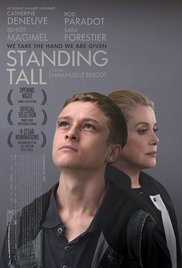
standingtall.jpgLA TETE HAUTE (STANDING TALL) (France 2016) ****
Directed by Emmanuelle Bercot

Starring: Catherine Deneuve, Rod Paradot, Benoît Magimel

Review by Gilbert Seah

LA TETE HAUTE follows, for a large portion, the same filming style as the Cannes winner Laurent Cantet’s ENTRE LES MURS (THE CLASSROOM) and the more recent Stephanie Brize’s LA LOI Du MARCHE (MEASURE OF A MAN). All three turn out to be fascinating films, real life dramas suited to this kind of filming technique. The filming often has the camera stationed in a set-up in which a confrontation occurs. The actors have their role plays and they go at it, ensemble-style. The result is a compelling watch, with a more realistic feel as the scene looks totally unscripted, though it may not be. The camera focuses primarily on the actors, often with closeups on the reactions of dialogue that take place. The Dardenne Brothers attain an identical realism with a different technique, often placing the camera at neck level of the actors and following them closely around. LA TETE HAUTE occasionally feels like a Dardennes film since the protagonist is a kid, as kids are frequently the subjects in a Dardennes film. It would to be surprising if Bercot herself got some inspiration from Dardennes’ LE FILS another film about a delinquent boy.

Bercot allows the audience to root for the hot-tempered delinquent called Malony(Rod Paradot). Who would not like to see someone progress through the system and improve to be a functional citizen? But Bercot shows that the process is long and difficult but not impossible. Bercot (who co-wrote the script) attributes more effort by those helping the boy than put in by the boy himself. As the adage goes: “It takes a village to rear a child.”

Besides the boy, the supporting characters are all equally interesting. The mother, who is herself a delinquent, loses her two younger boys to social services. The boy’s councillor was himself a delinquent, younger on and got this job believing in the system. And there is the judge, magnificently played by Deneuve with all her regality. The scene in which she stretches out her hand to the boy in both desperation and sympathy is the film’s most touching moment.

But director Bercot takes her film one step further. She inserts more incidents than are normally found in a family drama. Included is a car crash, expertly shot and a home abduction.

There is much change the boy goes through, but these changes must be observed by the viewer. Malony is shown for once in a very vulnerable state crying for his mother when placed in prison for the first time. The way he holds the pencil to sign his name at the judge’s office shows progress from the way he held a pen with his fist at the start of the film. It can also be observed that most of the characters, the councillor and judge are also victims of the system. They have to work the system, just like the boy to each’s own advantage. There is much to be observed and learnt from Bercot’s film. That is what makes it so outstanding. It is a film about life and hardship – and how everyone faces his or her own at one time or another.

It is seldom that we get good French films these days. Cinefranco is gone. The number of French films that are commercially released has been reduced. This winner, that was chosen to open Cannes this year (the last time a French film opened Cannes was in 2005, Dominik Moll’s LEMMING that never got released here). It is a surprise and indeed good news that LA TETE HAUTE is released and before TIFF. The film comes highly recommended.

HELL OR HIGH WATER (USA 2016) ****

hell_of_high_water.jpgHELL OR HIGH WATER (USA 2016) ****
Directed by David MacKenzie

Starring: Dale Dickey, Ben Foster, Chris Pine

Review by Gilbert Seah

The term HELL OR HIGH WATER is the phrase used in contracts that demand payment regardless. It is also the title of the new film directed by David MacKenzie (ASYLUM and his last excellent film STARRED UP) and brilliantly written by Taylor Sheridan (SICARIO), the script of which won the 2012 Black List of Screenplays.

The film begins with an exciting bank robbery. The bank is robbed by two brothers, Toby (Chris Pine) and the recently out-of-jail Tanner (Ben Foster). It is a case of Good Crook, Bad Crook variation of Good Cop, Bad Cop. Toby, the good crook needs the money for payments on the house his children has inherited from his recently deceased mother. Toby is separated from his wife and children. The payments must be made HELL OR HIGH WATER or Toby will lose much, much more as the property is spouting oil.

The film does not have one main protagonist but three. Toby appears to be the main one, but his volatile brother and the retiring sheriff after them are also given due attention. Sheriff Marcus (Jeff Bridges) is the most interesting of the three, a wise-cracking, gruff and smart veteran who constantly cracks racist jokes at his indian deputy Alberto (Gil Birmingham). The film could very well be another version of the Lone Ranger and Tonto.

The film is well performed by everyone especially Bridges who turns out an Oscar Winning performance. His mannerisms and drawl fit perfectly his character of an aging, fed-up law enforcer. Chris Pine proves he can do more than Captain Kirk in STAR TREK.

MacKenzie knows how to create excitement. The camera is placed, for example in the getaway car, all jittery but capturing the desperation of escaping the cops. The shootout scene at the end of the film is also meticulously staged. The film also contains a superb climax – a verbal showdown between Toby and Marcus. The music by Australian actor, singer song-writer Nick Cave is a pleasure, also adding atmosphere and mood to the film. The film is interspersed with his songs.

The film was originally titled Comancheria. The reason can be seen in one of the film’s best written and key scene when Tanner confronts a comanche in a casino. Comanche means ‘enemy of everyone’, the comanche tells Tanner. “Then I am one,” he retorts. “An enemy?” asks the comanche angrily. “No, a comanche.” The description of Tanner’s character is spot on, Tanner being a volatile man who cannot get along with anyone, less his brother and has been in prison in and out a couple of times. Another scene, which is so funny that has to be seen to be believed is the age old waitress who serves the sheriff and his deputy in a restaurant asking, “What can’t I get you?” The film and script is full of inventive surprises and smart humour, which adds on to the plot.

The story also bears a truth about human beings. If you ask most people what the main goal or aim in life of a man is, the ultimate answer is to see their children do at least as well or better than them. For Toby, whose only expert advice he can give his son is: “Do not be like me,” the one way he can be a good father and satisfy his goal in life is to provide for his two sons by making final payment on the house before disclosure by the bank.

Director MacKenzie has made an excellent film on a well written script with prized dialogue. It is good to see that he could do the same for a script without dialogue as in the case of his last film, STARRED UP, where the dialogue in heavy accent need not be understood for the film to be appreciated.

HELL OR HIGH WATER premiered at Cannes at Un Certain Regard. It is an excellent entertaining and rewarding film hat comes highly recommended. And the film gets my vote for Best Original Script this year.

Film Review: PETE’S DRAGON (USA 2016)

Deadlines to Submit your Screenplay, Novel, Story, or Poem to the festival: http://www.wildsound.ca

petes_dragon.jpgPETE’S DRAGON (USA 2016) **
Directed by David Lowery

Starring: Bryce Dallas Howard, Robert Redford, Oakes Fegley

Review by Gilbert Seah

Like Disney’s last flop THE BFG directed by Steven Spielberg, this reboot of the live action Helen Reddy PETE’S DRAGON is a strong on special effects blockbuster fantasy lost in its special effects.
From the very start of the film, the audience sees young Pete (Oakes Fegley) in a car with his parents on his first camping adventure. “What does ‘adventure’ mean”? Pete questions innocently – the perfect question in a family film. Then, there is the overdone dialogue like the boy being told that he is he bravest person his mother knows. Pete is an orphan who meets his protective dragon. Disney’s version of death is a hazy slow-motion flying of things in the car as it crashes and kills Pete’s parents.

Pete lives 6 years in the woods with Elliot the dragon till he is discovered by ranger Grace Meecham (Bryce Dallas Howard). Robert Redford plays Grace’s father who claims he has seen a dragon in the woods when he was young. The film is set in the 80’s for no reason except that the original film was made in 1977.

The 1977 version and this version is largely different. The fishing community that adopts Pete is replaced by a hostile timber community. While the original was playful with songs and oddities which is a good sign for Disney’s formulaic label, this reboot is sentimental brown stuff.

More unbearable cutesy bits follow. If the dragon doesn’t fall from the sky to make funny faces, Elliot the dragon has this amazing cute look upon seeing a butterfly for the first time. Actors Robert Redford and Bryce Dallas Howard have to constantly don astonished looks on their faces.

PETE’S DRAGON is fantasy given a realistic treatment. But the story is unimaginatively predictable and formulaic. From the very point Elliot, the dragon is captured, the audience can tell what is to happen next. Add in silly songs at all the inappropriate moments, unbearable cute bits and you have the perfect formulaic Disney movie – the sentimental feel-good film I always try to avoid.

PETE’S DARGON is director’s Lowery’s first big budget movie. Disney is good for recruiting talents like Lowery who will deliver their big beget formulaic and unimaginative films. Another example is Asian American Justin Lin who broke into the film scene with his breakthrough BETTER LUCK TOMORROW. Disney got him to make his biggest dud, ANNAPOLIS followed by the unimaginative FAST AND FURIOUS franchise.

But PETE’S DRAGON has its charm. That is if you are around the age of 6, the age of the kid and enamoured by fairy tales like befriending a giant dragon. Like the BFG where the girl has a big giant as her friend, the stories lead nowhere except to predictability land. At best, PETE’S DRAGON looks like a poor man’s version of E.T. At other times, it is cutesy Disney material aimed at the family and kids and ends up nothing more than a bore. There was a screening clash with this film. I should have gone to see SAUSAGE PARTY. At least that lewd film would have had more imagination.


Also, Free logline submissions. The Writing Festival network averages over 95,000 unique visitors a day.
Great way to get your story out: http://www.wildsound.ca/logline.html

Deadlines to Submit your Screenplay, Novel, Story, or Poem to the festival:http://www.wildsound.ca

Watch recent Writing Festival Videos. At least 15 winning videos a month:http://www.wildsoundfestival.com

THE INFILTRATOR (USA 2016) ***

Deadlines to Submit your Screenplay, Novel, Story, or Poem to the festival: http://www.wildsound.ca

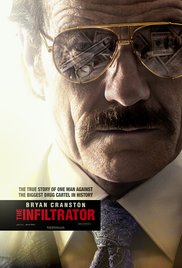
the_infiltrator.jpgTHE INFILTRATOR (USA 2016) ***
Directed by Brad Furman

Starring: Bryan Cranston, John Leguizamo, Diane Kruger

Review by Gilbert Seah

THE INFILTRATOR is a true-life crime thriller based on true events outlined in federal agent Robert “Bob” Mazur’s 2009 memoir The Infiltrator: My Secret Life Inside the Dirty Banks Behind Pablo Escobar’s Medellín Cartel. Directed by Brad Furman who also made the similar THE LINCOLN LAWYER, THE INFILTRATOR shares the identical gritty, ethereal style.

The film is set in the mid-1980s. Colombian kingpin Pablo Escobar’s cartel is flooding Florida with drugs and all the crime that comes with them. Mazur ( Bryan Cranston) is a mild family man working in U.S. Customs with a wife and two kids. But he begins leading a double life, going undercover as Bob Musella, a slick money-launderer with ties to legitimate business.

Furman takes his audience into a world of penthouses, private planes, stripper clubs, bespoke suits and dining so that a feel of the high life can be ‘appreciated’. Two fellow agents (John Leguizamo and Diane Kruger, the latter playing Musella’s fiancée) help Mazur while he as Musella deals with a variety of sordid characters including Escobar’s right-hand man (Benjamin Bratt).

In real life, Mazur’s sting operation led to the indictment of over 100 drug lords and the bankers who cleaned their money, and to the collapse of the Bank of Credit and Commerce International, one of the world’s largest money-laundering banks.

The main flaw of the film is Furman’s failure to provide the motive for Mazur’s dedication in the undercover operation. In the film, Mazur promises his wife that this will be his last operation. His unrelenting boss (Amy Ryan) expects a lot from her staff and from Mazur, demanding more and more, saying that her staff has not proven their worth. Why would Mazur or anyone for that matter risk their own lives or family for a job that provides no reward or a boss that shows no gratitude?

Despite good actors that Cranston (displaying another acting aspect from BREAKING BAD) and Leguizamo (proving he can play comedy and drama) are, the uneasiness and desperation of the story comes from Furman’s direction. The film is evenly spaced with edge-of-the-seat suspenseful segments. One such example is Musella’s briefcase bursting open to reveal a tape recorder during a key meeting with the bad guys and another has him and his wife suddenly met with a crime associate in a restaurant during their wedding anniversary. As the camera reveals details in other parts of the film like a clock ticking, Furman keeps the suspense strong. The action sequences like the bike/car shoot out are also excitingly executed.

Furman’s film is noticeably short on humour. A bit of relief is however, provided by Olympia Dukakis as Musella’s aunt who helps him along the way.
True to life as THE INFILTRATOR is, Furman’s film is a brutal watch, in fact too brutal to be classified as entertainment. Furman gets his point across in terms of the gruel drama that Musella had to go through.


Also, Free logline submissions. The Writing Festival network averages over 95,000 unique visitors a day.
Great way to get your story out: http://www.wildsound.ca/logline.html

Deadlines to Submit your Screenplay, Novel, Story, or Poem to the festival:http://www.wildsound.ca

Watch recent Writing Festival Videos. At least 15 winning videos a month:http://www.wildsoundfestival.com

FLORENCE FOSTER JENKINS (UK 2016) ***

Deadlines to Submit your Screenplay, Novel, Story, or Poem to the festival: http://www.wildsound.ca

florence_foster_jenkins.jpgFLORENCE FOSTER JENKINS (UK 2016) ***
Directed by Stephen Frears

Starring: Meryl Streep, Hugh Grant, Simon Helberg

Review by Gilbert Seah

As one magazine writer aptly put: Meryl Streep has added one more talent to her curriculum vitae – the ability to sing flat.

Based on true events, the film is based on the character Florence Foster Jenkins (Meryl Streep), an heiress and socialite in New York who owns a music club, the Verdi. She, though ill in health, lives for music, aspiring to become an opera singer with the help of her husband St. Clair Bayfield (Hugh Grant) and her pianist Cosmé McMoon (Simon Helberg). Florence’s first words in the film: “Music is my life!” But the truth is that unknown to her, she has generally poor singing ability.

It is no doubt that a large part of the film’s humour is derived from Florence’ awful singing and the observation of the reactions of those listening to her. Frears’ camera relies too heavily on both. The camera lingers on McMoon, Florence’s pianist as well as Bayfield’s facial mannerisms too much for comfort.

As far as performances go, Hugh Grant stands out extremely well as the loving long-suffering yet cheating husband. Streep delivers another unforgettable performance, maybe even another Oscar nominated one. Simon Helberg (from TV’s THE BIG BANG THEORY) is amusing to watch and shines in one key scene. But it is relative newcomer Nina Arianda as the trampy admirer Agnes Stark who steals the show and every scene she is in.

The story has the audience believe that Bayfield is married to Florence but has not consummated their marriage. The marriage bond is still a loving one – aided no doubt by the fact that Bayfield has full access to her wealth. Bayfield has a mistress Kathleen (Rebecca Ferguson) living in Bayfield’s apartment that Florence has paid for. When Florence shows up one morning unannounced, the film turns into a bedroom farce, something the British are always good at.

The overlong film has two big climatic plot points. One is Florence’s grand performance at Carnegie Hall. Will she be able to perform to the satisfaction of everyone and not be ridiculed? The second is whether Florence will find out the truth about the secret that Bayfield has been keeping from her – that she cannot sing. Director Fears plays the first one out in grandeur and the second using Grant’s full acting capabilities.
The film looks and feels like New York City 1944. The vintage cars (used rather sparingly), props, wardrobe and hair help create the atmosphere. Music by Alexandre Desplat is always a pleasure to the ears though his music is clouded by the songs Streep sings.

Despite being a one-joke film with the one joke (Florence’s flat singing) stretched out too long, Frears’ film is still enjoyable, with sufficient comical distractions.

FLORENCE FOSTER JENKINS is as the ad says, a film that will be enjoyed more for the power of music and the power for one to accomplish more beyond ones means. Those in the theatre and music business will certainly find this film more amusing, being able to recognize all the famous classical operatic songs as well as the travails stars have to go through. FLORENCE FOSTER JENKINS is a feel-good audience film that should delight Streep fans.


Also, Free logline submissions. The Writing Festival network averages over 95,000 unique visitors a day.
Great way to get your story out: http://www.wildsound.ca/logline.html

Deadlines to Submit your Screenplay, Novel, Story, or Poem to the festival:http://www.wildsound.ca

Watch recent Writing Festival Videos. At least 15 winning videos a month:http://www.wildsoundfestival.com

LITTLE MEN (USA 2016) ***1/2 Directed by Ira Sachs

Deadlines to Submit your Screenplay, Novel, Story, or Poem to the festival: http://www.wildsound.ca

little_menLITTLE MEN (USA 2016) ***1/2
Directed by Ira Sachs

Starring: Greg Kinnear, Jennifer Ehle, Paulina García, Alfred Molina

Review by Gilbert Seah

As Jesus said in the Bible, “And a child will lead them.” In the case of Ira Sach’s occasionally brilliant new film LITTLE MEN, pre-teens lead the way for the adults that have gone astray.

The film begins with the death of 13-year old Jake’s (Theo Taplitz) grandfather. Jake’s dad, Brian (Greg Kinnear) inherits the grandfather’s building and move in. Below is a store that the grandfather leases to a seamstress, Leonor (Paulina Garcia) and her son, Tony (Michael Barbieri). Trouble arises when Brian needs to raise the rent money as he is short of income. Leonor is unable to pay. A bad state of affairs result when Brian evicts Leonor.

Though premiering at the Toronto Inside Out LGBT film festival, there is no explicit gay theme on display in the film. The friendship that develops between the two boys hints that one might be gay (the other pines over a girl in he neighbourhood), but still one can never be sure. The hint arrives when Jake’s mind immediately rushes to think of Tony when asked to write a poem above love in his English class. No use in labelling. No matter whether one of the boys is gay or not, it is of no importance. Sach’s little film astounds in many avenues, particularly in the subtlety department. But the bond that exists between the two boys is nothing short of wonderful. They stand up for each other. Tony gets beaten up in school for Jake. Both boys refuse to talk to their parents when they learn that their parents are not getting along.

The film is seen mostly from the points of view of the two boys, which makes the film more interesting.

The script has two characters, Brian’s sister and Brian’s wife which could easily have been moulded into one character. They collectively could serve the same function as one person.

When Brian finally confesses the problem to his son Jake, Jake offers a solution so simple that the adage “and a child will lead them” comes to mind.

Films about kids often have them speak in adult dialogue that would unlikely come from them. This occurs regularly in many of Neil Simon’s plays, Woody Allen films and also in this film. But here at least, the boys still behave like boys. They play video games, ignore their parents, get into trouble (and fights) in school while growing up and learning about life. The great thing about all this is that they teach their parents a thing or two on the way.

Sach’s film succeeds tremendously from the performances of it two young actors. They are able to elicit sympathy and humour, strength and vulnerability in their characters. One of the best performances occurs in the segment in a training dialogue between Tony and his acting coach in his new school.

The film contains a non-Hollywood but rather clever under-stated ending. LITTLE MEN is a good example of how brilliant a little film with a good script and direction can turn out.

Also, Free logline submissions. The Writing Festival network averages over 95,000 unique visitors a day.
Great way to get your story out: http://www.wildsound.ca/logline.html

Deadlines to Submit your Screenplay, Novel, Story, or Poem to the festival:http://www.wildsound.ca

Watch recent Writing Festival Videos. At least 15 winning videos a month:http://www.wildsoundfestival.com

GLEASON (USA 2016) *** Directed by Clay Tweel

Deadlines to Submit your Screenplay, Novel, Story, or Poem to the festival: http://www.wildsound.ca

gleasonGLEASON (USA 2016) ***
Directed by Clay Tweel

Starring: Steve Gleason, Mike Gleason, Scott Fujita

Review by Gilbert Seah

Clay Tweel’s GLEASON is a documentary that chronicles the journey of former New Orleans Saints football star Steve Gleason after being diagnosed with ALS at age 34. The doc was assembled from footage taken by Steve’s family, friends and caregivers.

Gleason became a local hero after he blocked a punt during the team’s first game at the Superdome following Hurricane Katrina – a play that resulted in a touchdown for the Saints and became a symbol of recovery for the city. He retired in 2008 and married New Orleans artist Michel Varisco. Three years later, the ALS news came, just as they discovered that Michel was expecting their first child. Given two to five years to live, he begins recording a video diary for his son.

GLEASON is not the first film made about football injuries. The 2012 Steve James documentary HEAD GAMES told Chris Nowinski’s story based on Nowinski’s 2006 book by the same name. Nowinski suffered multiple concussions during his career as a football player and professional wrestler, and he has been diagnosed with post-concussion syndrome. Nowinski has dedicated his life to advocating and researching brain trauma. It is no coincidence that Nowinski’s work has coincided with the plethora of lawsuits filed by former players alleging the NFL hid information regarding brain trauma.

GLEASON touches the subject of the course of his ALS and hints that it was likely due to football. But nothing more is said of the subject. One can only guess that Gleason’s father and him had put in more effort to possible faith healing than to go after the culprits.

The two most almost unwatchable scenes, involve him having to take a shit, aided by his loved ons and caregiver and an argument with him and his father. The father argues that if his son, Steve does not believe in faith healing, he will not be saved, while Steve cries his heart out that he truly believes he is saved regardless. Other ones like Steve’s venting on life or his difficulty in breathing are necessary.

But the hero in all this, apart from Steve Gleason achieving Obama’s bill on providing speech machines to ALs patients is his wife, Michel. Caring for both their son and Steve at the same time requires the patience of an angel. The most effective scene in the film is the one where the two lie in bed next to each other. Steve is complaining that she ignores him. But the audience can see that she is just tired and wants to be left alone and Steve will not let her. Her tireless patience is nothing short of angelic.

The film features two celebrities, the lead guitarist of Gleason favourite and, Pearl Jam and a glimpse of physicist Stephen Hawking, another victim of ALs.

As described as a warts and all documentary on Gleason’s life, the film concentrates more on the warts. GLEASON is a brutal watch with many segments almost unbearable.

GLEASON has won many praises including the Audience Award at SXSW 2016. It is the honesty of Gleason’s misery that have captivated the hearts of audiences.


Also, Free logline submissions. The Writing Festival network averages over 95,000 unique visitors a day.
Great way to get your story out: http://www.wildsound.ca/logline.html

Deadlines to Submit your Screenplay, Novel, Story, or Poem to the festival:http://www.wildsound.ca

Watch recent Writing Festival Videos. At least 15 winning videos a month:http://www.wildsoundfestival.com

Film Review: SUICIDE SQUAD (USA 2016)

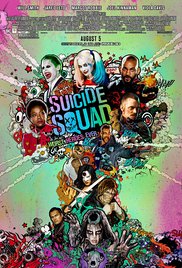
suicide_squad.jpgSUICIDE SQUAD (USA 2016) *
Directed by David Ayer

Starring: Will Smith, Jared Leto, Margot Robbie

Review by Gilbert Seah

SUICIDE SQUAD is the third D.C. comics extended universe film, following the awful BATMAN V. SUPERMAN that barely made its money back from its costly production. SUICIDE SQUAD has so far received awful reviews, including this one from your humble reviewer. It has also been reported that Suicide Squad fans have petitioned to shut down Rotten Tomatoes after negative reviews.

The film has been reported to be rushed out to meet time schedules with lots of editing and rushed scripting by David Ayer (FURY). It shows!

The Suicide Squad initiative functions as an unorthodox work release program. The modern incarnation, the Suicide Squad, is an antihero “strike team” of incarcerated, death row supervillains. Acting as deniable, covert assets of the United States government, it undertakes high-risk, black-ops missions in exchange for commuted prison sentences. The group operates out of Belle Reve Penitentiary under the directorship of Amanda Waller (played with dead seriousness by Viola Davis).

The members of the squad in this film is taken from different the different volumes of the comic books. In the aftermath of Superman’s death in BATMAN V. SUPERMAN, intelligence operative Amanda Waller assembles a team of dangerous criminals – the deranged Harleen Quinzel (Margot Robbie), also known as “Harley Quinn”; elite hitman Floyd Lawton (Will Smith getting star billing), who longs to be reunited with his daughter Zoey; pyrokinetic ex-gangster Chato Santana (Jay Fernandez), who refuses to fight after accidentally killing his wife and children and opportunistic thief Digger Harkness (Jai Courtney) who is supposed to use his boomerang among others. Each member is introduced at the start of the film with a famous tine. Harleen is introduced with the song “Super Freak”; Lawton with “Spirit in the Sky” etc. The Suicide Squad are offered reduced sentences in exchange for their services and implanted with nanobombs so Waller can terminate them should they go rogue. Flag (Joel Kinnaman) leads the squad under instruction from Waller.

Though billed as a comedy action film, the film’s comedy lie mainly in the one-liners. THE SUICIDE SQUAD’s comedy is similar to that of GUARDIANS OF THE GALAXY. Margot Robbie and Oscar Winner Jared Leto (as the Joker) steal the movie. Leto is plain creepy delivering a performance of equal stature to Heath Ledger’s.

One of Waller’s recruits is Flag’s girlfriend, Dr. June Moone, an archaeologist who has become possessed by a malevolent spirit witch known as “The Enchantress” after touching a cursed idol. She and her brother form the villains of the film that have to be taken out by the squad in an extended action sequence in which a barely recognizable downtown Toronto (where the film is shot) is destroyed. (Dundas Square can still be recognized at least.)

Beware. Characters that die midway in the film can suddenly appear live and well in later parts of the film. There is a 2-minute meeting between Waller and Bruce Wayne (Ben Effleck) midway during the end credits, indicating that it might serve as an entry point to a sequel.

Like BATMAN V. SUPERMAN, SUICIDE SQUAD is plain awful. The 2 films contain the similar traits of being incoherent and a complete mess. If there are 10 D.C. comics films slated till 2020, heaven help the D.C. Universe!

Film Review: OPERATION CHROMITE (South Korea 2016)

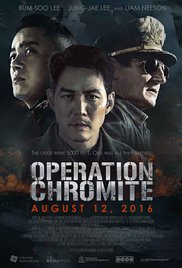
operation_chromite.jpgOPERATION CHROMITE (South Korea 2016) **
Directed by Lee Jae-han (John H. Lee)

Starring: Liam Neeson, Sean Dulake, Jung-jae Lee

Review by Gilbert Seah

In order to appreciate the film, a bit of Korean/American history is required. The first is a knowledge of the Battle of Inchon.

The Battle of Inchon was an amphibious invasion and battle of the Korean War that resulted in a decisive victory and strategic reversal in favour of the United Nations. The operation involved some 75,000 troops and 261 naval vessels, and led to the recapture of the South Korean capital of Seoul two weeks later. The code name for the operation was OPERATION CHROMITE, the title of this film. Though not seen in the film, the epic battle began on 15 September 1950 and ended on 19 September.

The battle ended a string of victories by the invading North Korean People’s Army (NKPA). The United Nations and South Korean forces were commanded by General of the Army Douglas MacArthur (Liam Neeson) of the United States Army. MacArthur was the driving force (heavily emphasized in the film) behind the operation, overcoming the strong misgivings of more cautious generals to a risky assault over extremely unfavorable terrain.

The plot of the film has General Douglas MacArthur and 8 South Korean troop members led by a South Korean Navy Lieutenant (Lee Jung-Jae) carry out a covert “X-ray” operation. The “X-ray” must succeed in order to carry out “Inchon” Landing Operation. The film concentrates of the X-ray operation and not the Battle of Inchon.

Nothing much is said of this covet X-ray operation in the history books, so a lot of the action going on in the film is likely made-up by the script which takes liberties to create a big budget action film. Extra sentiment is provided whenever possible for example in one scene, by one of the soldiers in the X-Ray operation meeting up with his wife and baby son. General MacArthur also adds his spill on how it is to grow old and hold on to ones principles.

The action segments (chases through the city amidst machine gun fire) are exciting enough but they tend to undermine the reality of a film based on historical events. The segment set on the eve of September 15 to secure a lighthouse, however, is clumsily done as it is hard to see what is going on in the dark of night.

OPERATION CHROMITE is more an action movie than a film based on historical events. The background of the film is the history lesson. Other than that, the group of men that have gone on fighting to make the Battle of Inchon and their exploits are hardly plausible. A parallel can be drawn of the about to be released ANTHROPOID on the real assassination of Rienhard Heydrich.

North Korea would be flabbergasted with premise, story and delivery of this South Korean propaganda piece. The film has already broken South Korean box-office records with an opening weekend box-office gross of $18.5 million on its $15 million production. South Koreans love the film. But the North Korean state-run outlet Uriminzokkiri called the film a product of “ridiculous bravado from ignorant lunatics”.

That said, OPERATION CHROMITE is a pretty bad war film. But for less discerning moviegoers who like that action heroes to be true to life, this film will be a hit, as already proven by the film’s box-office success.

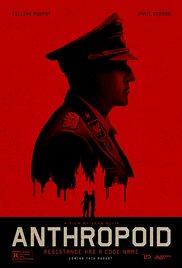
ANTHROPOID (UK/Czech/France 2016) ***

anthropoid.jpgANTHROPOID (UK/Czech/France 2016) **
Directed by Sean Ellis

Starring: Jamie Dornan, Cillian Murphy, Brian Caspe

Review by Gilbert Seah

The word ANTHROPOID comes from‘Operation Anthropoid’, the real life plan initiated by the Czechoslovakian Government to assassinate one of Hitler’s top right hand men, Reinhard Heydrich (aka the butcher of Warshaw) during World War II.

If a film has ever failed because of overeagerness, ANTHROPOID is the one. Despite sharing a few excellencies in certain departments like in costume and sets, the film, co-written directed and photographed (Ellis is both cameraman and cinematographer) has too much in the hands of its director.

Ellis is also not one for subtlety, He wants his audience to feel what is happening. His hand held, jittery camera method used in the end shoot-out climax, with the sound turned up several notches ends up giving the audience a headache more than anything else. To show the hero with trembling hands unable to pull the trigger more than once is nagging the audience. In Hitchcock’s torture scene in TOPAZ, no torture need be seen. The tortured were only shown after the torture in each other’s arms when the woman whispered the name, barley audibly “Juanita” to Fidel Castro. In ANTHROPOID, as if the tortured man’s explicitly shown broken hands broken were not enough, he has to scream out loud “the church”, the place where the hidden paratroopers are hiding. The tortured man was also shown the head of his mother in a bucket that was more laughable than scary.

For a film so controlled by its director, it is surprising that the film goes totally out of control in its last 20 minute climatic scene – the takeout in the church by the Germans. It is an extended and tedious scene, where the hero shoots and kills dozens of German soldiers while dodging bullets, grenades and other artillery. The shot of ‘Uncle’ (Toby Jones), the Resistance Fighter head losing his glasses and clambering to find his dropped cyanide pill before the Germans break down the door is nothing more than cheap theatrics.

It would also be good if the Germans were not always featured as bad guys with no redeeming qualities. In THE EAGLE HAS LANDED, there was a nice touch of a German soldier, part of an invasion in an English hamlet, died saving a drowning girl.

Nothing is mentioned of the priest who harboured the paratroopers in his church or the aftermath of Hitler’s retaliation to Heydrich’s assassination. Hitler slaughtered at least 1300 innocent Czechs in retaliation. But to be fair to Ellis, he has one scene where “Uncle” warns the two (Jamie Dornan and Cillian Murphy) of their mission: “Do you know Hitler will tear Prague apart? The question is whether Prague is ready to resist Nazi Germany.”

ANTHROPOID is not the first film about the assassination of a high ranking official during the War. VALKYRIE, MAN HUNT and the most famous, John Sturges’ THE EAGLE HAS LANDED (about Hitler’s plan to assassinate Winston Churchill) come to mind. The latter film remains the best of the lot, and though totally fictional is more believable than ANTHROPOID which is based on actual events.

ANTHROPOID finally emerges as an earnest film based on historical facts unfortunately spoilt by its director turning it out to look more like an action flick.