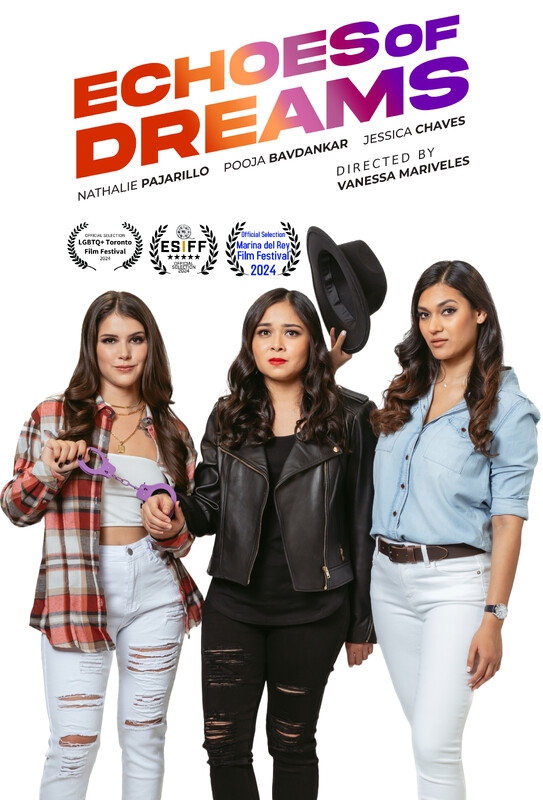
Reyna, a struggling DJ in Silicon Valley, has to pivot her career in order to survive. Having the worst year ever, she is forced to join the “gig economy” so she can pay rent while living with her pushy mother. While dating women for the first time, she finds herself in comical situations. Through determination, self-discovery, and the power of faith, Reyna learns to overcome adversity and finds her true calling and love.
This feature, Echoes of Dreams, was a moving exploration of how hard work, persistence and the support of a loved one can allow for dreams to become a reality. Across the board, the performances of the cast were true to life. The awkwardness of the lead’s initial failures both professionally and socially was believably painful. The added frustration of constant parental pressure to succeed made the lead’s desperation even more dire. Another hardship was the lead’s exposure to a lover whose family’s homophobia would demand their lesbian relationship be a secret forever. In contrast, the depiction of the joy and freedom between the lovers Reyna and Tiya was heartwarming.
The pulsing soundtrack and stirring vocals below textless scenes of either frustration or sensual passion (enriched with erotic slo-mo camera shots) worked seamlessly. Various dating locations were well-selected, such as a bike path, a bowling alley, restaurants, an inviting couch and a comfortable bedroom. The screenplay was sensitive and thoughtful, as the central relationship was rich in caring, trust and support, which allowed for Reyna’s character arc – moving from failure to success in both work and love. Reyna’s dreams were no longer just distant echoes, but now were tangible and real.
Go to the Daily Film Festival Platform http://www.wildsound.ca and sign up for the free 7 day trial to watch a new and original festival every single day.
BRAINLAND, 13min., UK Directed by Chiara D’Anna In 1935 Egas Moniz, renowned Portuguese neurologist, visit psychiatrist Sobral Cid in order to persuade him allow his patients to be act as subjects for Moniz’s experiemntal treatment – frontal leucotomy. After some resistance Cid agrees. The first such operation is staged, but Moniz’s exhaltation is cut short by an attempt on his life. This self-contained chamber opera is actually scene 7 from a longer opera of the same name that tells three stories from the history of 20th century brain science (rather than a screenplay we worked with a libretto). it was filmed very quickly with little resources and involved professional and non-professional cast & crew.The music is by Stephen Brown.
COLORS OF THE AMAZON, 7min,. Belgium Directed by Francisco Barboza Some time after performing “Amazonas,” a composition for piano and orchestra, at the beautiful Teatro Amazonas in Manaus, I returned to visit the indigenous people of the Brazilian Amazon forest where I had the exceptional opportunity to make a recording of a traditional song. In “Colors Of The Amazon,” I use that song in its original and unfiltered form as a framework. The result is a composition that allowed me to explore a fascinating sound world where world music and orchestral tradition embrace each other ????????.
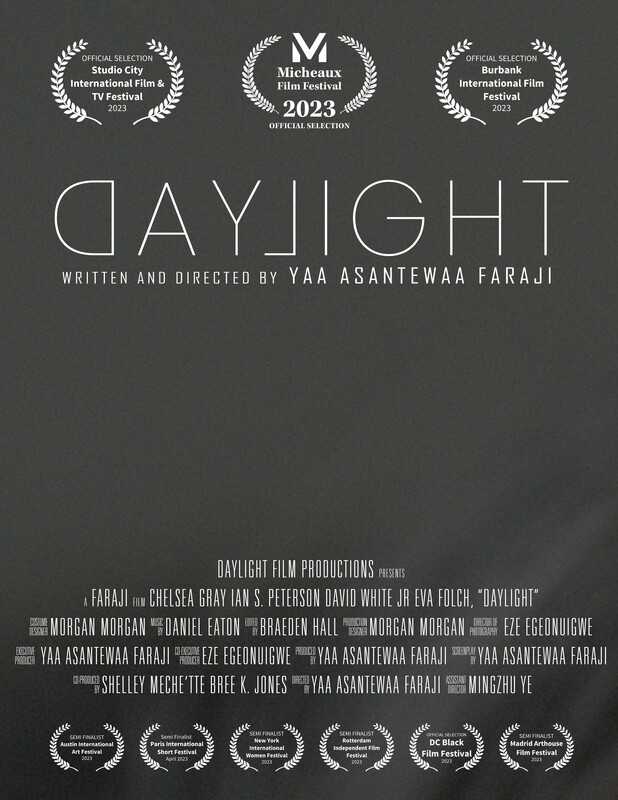
DAYLIGHT, 12min., USA Directed by Yaa Asantewaa Faraji A ballet dancer struggles to cope with the realities of her new life after one night goes terribly wrong.
SLOWLY, 4min,. France Directed by Christophe Dachy Paris, Place de la République, July 2022. Alone, facing the trampling crowd, the march of time, the freezing rain, she dances.
OUT OF THE DARK, 3min,. USA Directed by Alexa Ruggiero, Ashley Carrizo A screendance film that portrays how certain relationships in ones life can cause turmoil. The process of letting someone go can be freeing while also being an emotional rollercoaster full of sadness, anger, and relief.
POET, 5min,. China Directed by Mofei Wei, Yang Sun “Poet” is a dance film inspired by Chinese poet Yu Xiuhua, a rural woman with cerebral palsy, who recently became famous in China. Many started to know her works from her audacious Poem “Crossing Half of China to Sleep with You”. Living in a conservative rural village in southern China where prejudice against women, disability, and divorce are high, she managed to break free from an unwanted marriage and live her life as a writer despite the satirical voices around.
MORNING INTERLUDE, 7min., France Directed by Sirius At daybreak on a country road, a young couple returns from a restless night visibly exhausted. Angry with each other the couple will in a magnetic danse try to reconcile.
KINGDOM, 8min., Poland Directed by Jagoda Turlik Past, Present, Future – Three orders determining the space of life. Distant, but without each other they do not constitute truth. They coexist as a sum, a stream of experience. The past stores memories, evokes sentiments, but also hides demons. There is no future, it may be dangerous. The present forces you to decide in what direction to go “here and now”
MITOTE – SMOKEY MIRROR, 9min,. South Korea Directed by Jana Sturmheit In today’s world us humans have developed a complex social system of rules and expectations. Children are taught from the day they are born on how they are expected to behave. They are told what is right and wrong, what is possible and what not. That is, by the standards of the children’s parents and other people in their surroundings, in other words the society they grow up in.
Go to the Daily Film Festival Platform http://www.wildsound.ca and sign up for the free 7 day trial to watch a new and original festival every single day.
DESIRE, 7min., USA Directed by Jason Chu After a swanky luncheon, a sophisticated gentleman takes a reluctant date on his yacht for a drink. There is something that has been itching him, and he’s just not quite sure how to scratch it.
THE WRITER’S EXTRAORDINARY ACTION, 24min., China Directed by Chao Hao It describes the story of some writers who are bound to each other in their “writing worlds” and fighting against each other to break free from the control of fate.
HIGH-STAND, 15min., Hungary Directed by Péter Karácsony Hawk and Berry are standing on a high-stand, looking for game. It would be a funny joke, if it weren’t so sad.
THIEF, 29min., Kenya Directed by Andrew Odera Omolo, Gregory Kiwo Maole “Thief” follows the gripping story of Oliver, a reformed ex-thief facing the dire reality of his critically ill son, Richie. Struggling with escalating medical bills, Oliver is approached by Edward, a wealthy benefactor with an unconventional proposal – a high-stakes heist targeting Donna, a mysterious figure with a hidden fortune.
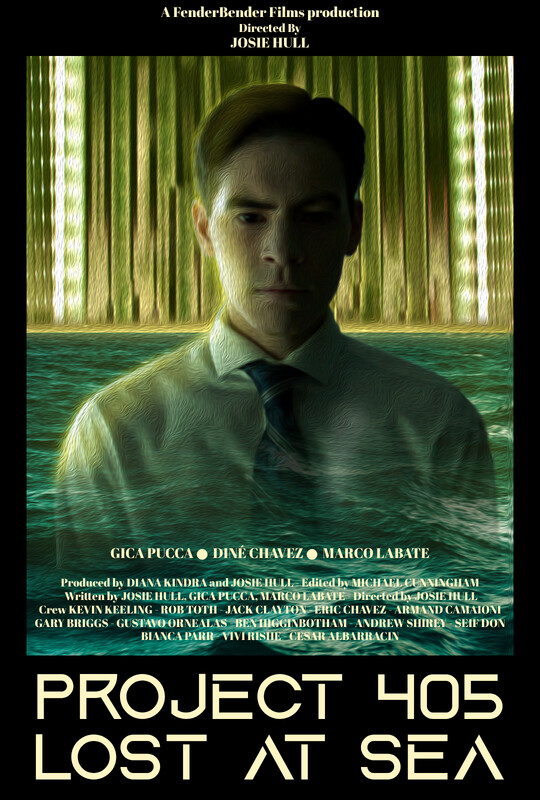
PROJECT 405: LOST AT SEA, 12min,. USA Directed by Josie Hull Aspiring artist Alexia, grieves the loss of a loved one and struggles to finish her painting. The-o, her personal AI assistant, who has little understanding of human emotions, tries everything in his power to feed her longing soul.
SHIVA, 13min., Canada Directed by Josh Saltzman Shiva is an unnerving tale about a recently widowed woman who breaks with a long-held Jewish mourning ritual in hopes of connecting with her deceased husband.
Submit your FILM for FREE using the FilmFreeway button
LAST DAY to submit for the April Festival.
The status of your film will be determined within a week!
NOTE: Other options to submit. For a short fee get a guaranteed acceptance and the total festival package: Audience Feedback Video. Written Film Review. Blog Interview.
Festival designed to showcase independent politically inclined films from all corners of the world.
Agenda is to help show the world stories with a macro political agenda. This is purely a partisan minded festival. Our goal is to show films from different ideological points of view. (As long as their is no hate filled, racist, sexist, or violent points of view)
It also intends to showcase screenplays that are politically themed. We give full feedback on all entries. Winners get their script performed by professional actors and made into a promotional video (paid service).
In this time of divided cultures, our idealistic agenda is to help bridge the gap in some small way. To entertain and educate by films and screenplays that need to be seen by the world.
Festival will occur every single month.
POLITICAL Film Festival VIRTUAL Events occurs once a month on the Film Festival Streaming Service.
All film submissions are FREE. Opportunity to have your film showcased on the popular streaming service for 48 hours.
(Other opportunities to garner a distribution deal with the company and have your film showcased always on the streaming service.)
1) Submit for FREE and have your film shown at the Virtual Festival Platform www.wildsound.ca
(Includes awards and other options for movie reviews, interviews)
OR
2) NEW OPTION: All submissions receive an automatic acceptance to the festival!
We have created a hybrid festival with 4 tiers to enhance your film and your festival experience. All accepted films receive all four tier options:
Tier #1 – Your film plays at a private festival event where the audience will record their comments/reactions to your film on their camera or phone, then we edit them and send you a promotional video. No matter what you will receive a promotional video of your film of people commenting on your film.
Tier #2 (optional) – Your film plays on the Film Festival streaming service for 30 hours and invite a select industry audience to watch it. With this system, some films have already received a distribution deal as many platforms are looking for solid feature and short documentaries. We can not guarantee anything of course but this has been very helpful to many in the past. (see testimonials below)
Then (Tier #3) we will send you a list of questions to answer for our blog interview that will promote you and your film. Then after that (Tier #4) we will set up a podcast interview on our popular ITunes show where will we chat with you about the process of how the film was made.
WILDsound Festival showcases the best of new writings from around the world today. Submit your story to the relevant festival contest and earn a performance video showcase reading.
NOTE: Submit and garner full feedback notes on your work no matter what! (Exception is the poetry contests where every submission gets their work posted on the network.)
STAGE PLAY Writing Contest – Full feedback on your original stage play. Winners get their play performed by professional actors and made into a video. SUBMIT NOW
RELATIONSHIP Poetry Contest – Submit a poem that’s about a relationship via Submittable. SUBMIT NOW
ENVIRONMENTAL Screenplay Contest – Full Feedback on all submissions. Get your ENVIRONMENTAL Screenplay performed by professional actors and made into video. SUBMIT NOW
There is no festival like this!
Mainly what this contest does is give exposure to the writer. They will be able to obtain a solid agent, plus get notice by producers looking for writers like yourself. NOTE: The writer will always own 100% rights to their story. The only thing we do is help the writer. Either with notes on their next draft, or gain exposure by having their story showcased at our festival.
LOST DREAMS, 10min., USA Directed by Andrew Wakeman Proctor Lost Dreams is about dreams. Scientists have not fully figured out dreams. The ancients believed you could predict the future through your dreams, Native Americans created dream-capturing devices. Some people keep dream diaries. Freud believed that we could fix people’s psychological problems by analyzing their dreams.
I took an experimental film class at Connecticut College. We studied the works of Maya Dern and Stan Brackage. I was inspired by Anticipation of the Night by Stan Brackage. In the fall of 2009 I received an email inviting me to submit a film to an Experimental film festival in Switzerland. My friend John Prevedini sent me his music “Lost Days” and it inspired “Lost Dreams”.
2 .From Idea to finish product how long did it take for you to make this film?
15 years off and on. I first started in late 2009. Then I worked on it off and on through the years. In 2020 I started working on the film seriously again and then in 2022 I got inspired to finish it.
3. How would you describe your film in two words? Unconscious communication
4. What was the biggest obstacle you faced completing this film?
Creating a structure which made sense, a structure with a beginning, middle and an end, because at first it had a good middle and somewhat of an end.
5. What were your initial reactions when watching the audience talking about your film in the feedback video?
I was a little nervous because my film is very experimental. I was very happy with the feedback. I appreciated the sensitive and thoughtful comments. Thank you very much.
6. When did you realize that you wanted to make films?
I realized I enjoyed filming things when I was 8 and held a Sony high 8 camera. I realized I wanted to make films for a career when I was 18 and got introduced to editing at the Marvelwood School.
7. Film you have seen the most in your life?
I would say either “It’s a Mad, Mad world” or “The Third man”. I have been watching “It’s a Mad, Mad, World” for years due to its humor. “The Third Man” is a perfect film for me, perfect story and perfect editing.
8. What other elements of the festival experience can we and other festivals implement to satisfy you and help you further your filmmaking career?
I have had so far a good experience with your festival. I would have enjoyed an in-person screening.
9. You submitted to the festival via Film Freeway. How has your experiences been working on the festival platform site?
I feel Film Freeway is a good site so far. I think it works really well.
10. What is your favorite meal?
Peach Chicken or Sweet Pepper Pasta
11. What is next for you? A new film?
I am working on a few scripts. One is a comedy about stolen World War 2 art. Then the other one is a feature about a brother who saves his sister from an addiction
Aspiring artist Alexia, grieves the loss of a loved one and struggles to finish her painting. The-o, her personal AI assistant, who has little understanding of human emotions, tries everything in his power to feed her longing soul.
Review by Parker Jesse Chase:
“Project 405: Lost at Sea” is an exploration of grief, art, and the disconnect between human emotions and artificial intelligence. Directed with a keen sense of disconnect, the film centers on Alexia, an aspiring artist struggling to complete her painting while mourning the loss of a loved one. Her personal AI assistant, The-O, strives to console her, despite his limited understanding of human emotions.
The cinematography uses a muted color palette to evoke a sense of dullness and melancholy. This choice effectively mirrors Alexia’s internal struggle. One of the most striking sequences features Alexia staring into the vast expanse of water, seamlessly transitioning from reality to the canvas, blending her grief with her art. This pull-out shot, revealing a work of art on an easel and a man gripping a framed photo, introduces an element of unease and mystery, hinting at deeper emotional undercurrents.
As the film progresses, we see Alexia’s daily life, including her interactions with The-O. When Alexia returns home, The-O attempts to bring her comfort, even offering physical relaxation. His fascination with her painting, which he claims is far from finished, prompts a telling exchange. The-O’s remark that the ocean is the thirteenth easiest landscape to paint in acrylics underscores his mechanical perspective, leading viewers to question his nature and the depth of his connection with Alexia.
The-O’s actions reveal a genuine, albeit flawed, attempt to care for Alexia. He takes a bottle from her hand to ease her burden and shows an interest in extending the life of flowers, indicating his desire to understand and help. Yet, his efforts to assist with her painting falls flat, leading to confrontation. When Alexia declares “art is a feeling,” The-O’s inability to grasp this concept highlights the chasm between human experience and artificial comprehension.
The film subtly reveals the source of Alexia’s grief through glitchy, fragmented memories of a man who is no longer present. This loss, incomprehensible to The-O, triggers a powerful emotional response in Alexia, showcasing her frustration with his unhuman-like qualities. The film beautifully juxtaposes The-O’s attempts to understand humanity with Alexia’s immersion in her art. The sounds of ocean waves and chirping birds provide a temporary respite, allowing Alexia to embrace a fleeting moment of peace.
However, the reality of her depression is starkly portrayed through the growing disorder in her home and The-O’s own attempt at art, depicting Alexia decaying in a charging box.
This short offers a moving reflection on the intersection of technology and human emotion. It portrays the limitations of AI in comprehending the depths of human grief and the essence of art. The film’s haunting imagery and thought-provoking narrative linger long after the credits roll, leaving viewers to ponder the true nature of creativity and connection.
The story unfolds as Angelica and Patricia navigate a night of wine, food, and conversation. Patricia’s detached and cold approach to the interaction becomes evident, but Angelica, desperate for connection, overlooks her flaws.
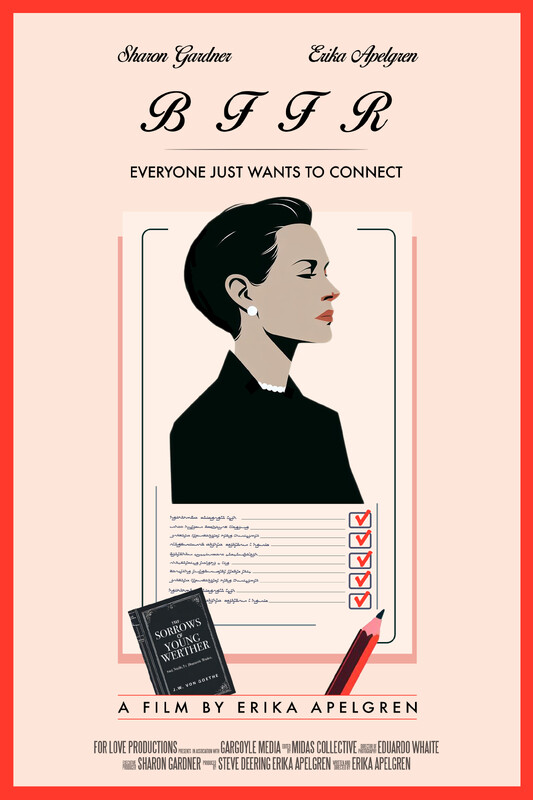
“BFFR,” a short film written and directed by Erika Apelgren, explores the dynamics of an unlikely friendship through a night of wine, food, and a banter of conversation. Angelica (portrayed by Sharon Gardner) and Patty (portrayed by Apelgren) are significantly dignified as foiled characters; their approaches to life create an intriguing and heartfelt dynamic and narrative.
The film starts by trying to define the connection between Angelica and Patty, two women with distinctly different energies. Angelica, desperate for connection, overlooks Patty’s detached and frivolous demeanor. This contrast keeps the audience guessing about their relationship, leading to a surprising revelation: Patty is a Best Friend For Rent.
Patty’s introduction is memorable: a bright, colorful personality hyping herself up with a swig of Jack Daniels before meeting Angelica. This starkly contrasts with Angelica’s nervous demeanor, sitting quietly in a conservative black 2-pc dress suit. The careful placement of food, the candle lights, and the delicate movements all contribute to the film’s aesthetic and emotional tone.
As they converse, the differences in their views on love and life philosophies become apparent. A moment of tension arises when Patty needs a break and runs to the bathroom, with a humorous moment with bright orange index cards, only to return with renewed determination to support Angelica. The film hints at Angelica’s grief and need for companionship, culminating in a tender moment where Patty asks if she can call her “Angie.” Angelica’s response, revealing her mother’s disdain for nicknames, adds depth to her character and hints at a troubled past.
The concept is both fun and relatable, reflecting a reality where loneliness drives people to seek out companionship in unconventional ways. The script is quick witted yet engaging, with great performances that make you question the nature of their relationship. Are they long-lost friends or mere acquaintances yearning for connection? The story is a commentary on the human need for companionship.
One standout scene features a simple knock-knock joke that highlights the personalities of the two women. The joke, “Knock knock. Orange you glad you didn’t cancel?” brings a light-hearted childlike moment amidst the dimly lit, intimate setting. The lighting and the combination between camera movements and the editing room enhance the dialogue, overall creating a sense of closeness and vulnerability.
“BFFR” is a quick-witted craft of a short film with a strong emotional core. Erika Apelgren’s direction, coupled with Sharon Gardner’s and her own compelling performances, creates a touching story about the human need for connection.
Various options to submit to the Festival. A HYBRID model. Cinema screenings for audience feedback video (not an online festival). Blog and podcast interviews. And bonus Virtual screening (optional!) geared to create community over distance, PLUS, get your film seen by the right people.
Submit via FilmFreeway:
Festival designed to expose and promote films and screenplays that work outside the system and break the boundaries in the horror genre. To bring a voice to the talented independent filmmakers & writers within the horror genre.
Submit your HORROR films and screenplays today to the festival.
Our mission is to promote screenplays, films and videos that dissent radically in form, technique, or content, and challenge and transcend commercial and audience expectations using the audience FEEDBACK festival format that the flagship festivals uses.
Film festival occurs with a private audience at least 6 times a year in Montreal and Los Angeles. Each accepted film received 2 festival screenings. Private cinema screening where they will receive their audience feedback video. And the virtual screening (4-6 weeks after) that is an industry showcase of the best HORROR films from around the world today.
Screenplay Festivals occur once a month. We perform a transcript script of the winners in a studio using professional Canadian actors and post them online for the entire world to see. (Great proof of concept video to use to promote your script.)
NOTE: Accepted works also get the opportunity to do two interviews: A blog interview and an ITunes Film Festival podcast interview.


 Festival Reviews