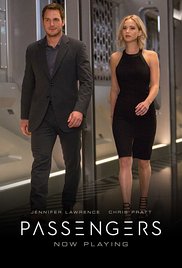
Film Review: PASSENGERS (2016). Jennifer Lawrence. Chris Pratt

passengers_movie_poster.jpgDirector: Morten Tyldum
Writer: Jon Spaihts
Stars: Jennifer Lawrence, Chris Pratt, Michael Sheen

Review by Gilbert Seah

 
PASSENGERS arrives at the height of the success of polished looking sci-fi hits like THE MARTIAN, GRAVITY and ARRIVAL. PASSENGERS also looks stunning, thanks to the awesome art direction, wardrobe, cinematography and sets. But unfortunately, the film soon gets lost in space, unable to wake up from its initial promise.

The film’s action takes place aboard the Starship Avalon, on a 120-year voyage transporting over 5000 colonists to Homestead II, a planet so far from earth the journey takes 120 years. The colonists are placed into hibernation for the journey. The ship hits a meteor storm. A malfunction wakes up a passenger, mechanical engineer Jim Preston (Chris Pratt), 90-years early. The film spends a lengthy first 40 minutes or so with Jim roaming around the spaceship alone discovering the horror of not only being the only one alive but knowing he would be dead by the time the ship reaches its destination. Humorously, he tries to send an S.O.S. message back to earth but realizes that it not only takes 5 years for the message to reach earth but that it will cost him several thousand dollars.

He gets some companionship (and free drinks) from a bartender android (Michael Sheen). Preston notices a beautiful sleeping writer in another pod, Aurora Lane (Jennifer Lawrence) and decides to wake her up from hibernation to keep him company. (The script could also have been more imaginative than naming the heroine Aurora.) This means a death sentence for her as well. They fall in love and things go smoothly till she learns the truth. This is when the film falls apart.

The couple eventually get back together with Aurora finally saving Jim from being lost in outer space very much the same way Matt Damon almost got himself lost in THE MARTIAN. Things get even more ridiculous with an oasis present complete with birds (yes, birds – where did they come from?) by the 90 years the ship reaches Homestead II.

PASSENGERS is directed by Morten Tyldum who made the World War II thriller THE IMITATION GAME. In PASSENGERS, he and the scriptwriter Jon Spaihts cannot decide if the film is supposed to be a thriller, horror, romance or sci-fi adventure. They decide on ‘all of the above’. This is basically a story of a really intelligent writer and a creepy stalker who should pay for his sins. Instead, he is forgiven and saved and made a hero. PASSENGERS would have succeeded as a horror flick close to what ALIENS was.

The film is also basically a two handler. Lawrence and Pratt are fortunately two fine looking actors that audiences can look at for two hours. But the introduction of Lawrence Fishburne as Gus, an engineer also woken up by pod failure, adds a welcome change to the proceedings.
There are a few action sequences such as Jim’s race against time to repair the ship before it explodes in heat and his rescue from outer space. These are two of the film’s most ridiculous segments. PASSENGERS ends up both ridiculous and plain silly.

Trailer: https://www.youtube.com/watch?v=7BWWWQzTpNU

Watch Winning Best Scene Readings:

TV CONTESTSUBMIT your TV PILOT or TV SPEC Script
Voted #1 TV Contest in North America.
FILM CONTESTSUBMIT your SHORT Film
Get it showcased at the FEEDBACK Festival
writing CONTEST1st CHAPTER or FULL NOVEL CONTEST
Get full feedback! Winners get their novel made into a video!
SCREENPLAY CONTESTSUBMIT your FEATURE Script
FULL FEEDBACK on all entries. Get your script

Film Review: HARRY BENSON: SHOOT FIRST (USA 2016) ***

harry_benson_shoot_first_movie_posterDirectors: Justin Bare, Matthew Miele
Writers: Justin Bare, Matthew Miele
Stars: Harry Benson, Alec Baldwin, Gigi Benson

Review by Gilbert Seah

Directors Matthew Miele and Justin Bare are the co-founders of Quixotic Endeavors, a multimedia production company focusing on subjects with an iconic theme. In their new documentary, their subject is Scottish photographer Harry Benson, now 86. The documentary charts the illustrious career of the renowned photographer who initially rose to fame alongside The Beatles, having been assigned to cover their inaugural trip to the United States in 1964. With unprecedented behind the scenes access, Benson captured some of the most vibrant and intimate portraits ever taken of the most popular band in history.

The two most famous of these is the pillow fight in their hotel and the one in a gym with Muhammed Ali.

Miele and Bare’s film is quite plain in terms of narrative and research. They let the fame and photographs of Benson speak for themselves. And this is a good thing. It also helps that Benson is still alive and able to give a perspective of both his work and life as he is present from the start to end of the film. Among the interviewed are his wife (behind every successful man is a woman), his assistant and various famous icons in the publishing and fashion world.

The film also charts his background back to Scotland. There is a segment where Benson visits his old house and school. The interviewed are asked what they thought was the secret of Benson’s success. The answer is hard work. Benson would leave everything at any moment if there is an opportunity for a good photograph. He had to be at the right place at the right time. Then comes the part of creating art out of his work. Benson hated posing and wanted his subjects to be shot candidly.

The paparazzi side of Benson is also mentioned. He captured a private shot of ageing star Greta Garbo to her chagrin. Other private shots, however, he was given permission like to shoot the shaved head of Elizabeth Taylor right after her surgery.

The film is fascinating for all the celebrities Benson has shot during his career. These included Dr. Martin Luther King Jr., Bobby Kennedy, Charles De Gaulle, Michael Jackson in his private ranch and even Sir Winston Churchill.

The question arises as to which of his photographs are the best. The one on the cover of Vanity fair with Ronald and Nancy Reagan dancing is one of them. The two with the Beatles are another two. There is also a great one with Bill Clinton kissing his wife. The photographs speak for themselves and illustrate Benson’s talent. Directors Miele and Bare ensures that the audience see the talent as well.

HARRY BENSON: SHOOT FIRST is a very easy-going watchable film. All one needs to do is sit back and enjoy Benson’s work, travelling through time and observing candid shots of celebrities through the years. There is as a bonus, Benson’s work in areas of war and famine that show human suffering.

Trailer: https://www.youtube.com/watch?v=8o-RC4YWkWg


Watch Winning Best Scene Readings:

TV CONTESTSUBMIT your TV PILOT or TV SPEC Script
Voted #1 TV Contest in North America.
FILM CONTESTSUBMIT your SHORT Film
Get it showcased at the FEEDBACK Festival
writing CONTEST1st CHAPTER or FULL NOVEL CONTEST
Get full feedback! Winners get their novel made into a video!
SCREENPLAY CONTESTSUBMIT your FEATURE Script
FULL FEEDBACK on all entries. Get your script

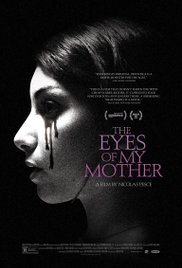
Film Review: THE EYES OF MY MOTHER (USA 2016) ***1/2

the_eyes_of_my_mother_movie_poster.jpgDirected by Nicolas Pesce

Writer: Nicolas Pesce

Stars: Kika Magalhaes, Will Brill, Olivia Bond

Review by Gilbert Seah

It takes less than the first 10 minutes of watching THE EYES OF MY MOTHER to realize that this is going to be one creepy, scary little film. Writer/director/editor Nicolas Pesce seems to have got the grip of the art of creepiness.

THE EYES OF MY MOTHER can best described as a gothic horror film. It is shot in black and white with the set design set up as a gothic tale, though the setting of the story is the remote American countryside where the subjects live on an isolated farm. The camera almost always tracks the characters from the back. The characters from the mother to the daughter and father to the stranger all possess a weird look. The music (by Ariel Loh) is haunting and the cinematography (by Zach Kuperstein) chillingly dark. The dialogue is ripe for terror. The boy is scolded by the mother at one point in the film: “I told you never to go in the barn.” or “You have done this before, haven’t you?” the girl questions the serial killer.

The story begins with a home invasion killing but the victim daughter indulges in more violent acts. Pesce also ensures the audience feel the horror. When Francisca ties a cloth around a victim’s neck, one can almost feel the tightening of the cloth as the moaning highlights the horror.
Francisca (Olivia Bond) and her mother (Diana Agnostini) live on a farm where they raise cows and other animals. A trained surgeon, Francisca’s mother teaches her how to remove eyeballs (another creepy scene) from farm animals, and is taught the legend of Francis of Assisi. Suddenly, Charlie (Will Brill), a door to door salesman, appears and against her better judgment, Francisca’s mother lets him use the bathroom. After a struggle, Charlie kills Francisca’s mother.

The father (Paul Nazak) arrives home and injures Charlie. Francisca and her father bury Francisca’s mother in the backyard while holding Charlie captive in the barn. Francisca (Kika Magalhaes) is now grown up. Charlie explains to her, the incomparable thrill of killing others. Francisca then removes Charlie’s eyes and vocal cords. Francisca explains to Charlie that he was not killed because she has no other friends, and tortures Charlie with her mother’s surgical tools.

This is only the mild part of the film. It gets really horrifying when Francisca steals the baby of a woman, Lucy (Flora Diaz) she hitches a ride from. Lucy is given the same treatment as Charlie and kept in chains in the barn for years while the baby grows up to become a boy. Francisca is the name given to Francis of Assisi who is the patron saint of animals and the natural environment. The character survives in her little world of animals and nature in her own distorted universe.

To watch an innocent mother deprived of her baby son, and blind and dumbed, living in bondage is unbearable. So, the film is definitely not for the faint hearted. Pesce’s film, that premiered at Sundance to accolades is well constructed and executed achieving what it intended – to scare or horrify audiences. But it is clearly not everyone’s film – so, the faint hearted had better stay away.

Trailer: https://www.youtube.com/watch?v=WWLNn5kk0iU


Watch Winning Best Scene Readings:

TV CONTESTSUBMIT your TV PILOT or TV SPEC Script
Voted #1 TV Contest in North America.
FILM CONTESTSUBMIT your SHORT Film
Get it showcased at the FEEDBACK Festival
writing CONTEST1st CHAPTER or FULL NOVEL CONTEST
Get full feedback! Winners get their novel made into a video!
SCREENPLAY CONTESTSUBMIT your FEATURE Script
FULL FEEDBACK on all entries. Get your script

Film Review: FENCES (USA 2016) ****

fences_movie_poster.jpgDirected by Denzel Washington

Writers: August Wilson (screenplay), August Wilson (play)

Stars: Denzel Washington, Viola Davis, Mykelti Williamson

Review by Gilbert Seah

FENCES is the film adaptation of the Pulitzer Prize source material by August Wilson, who passed on in 2005. His only demand for consent of his play being filmed was that it be directed by an African American. So, when Denzel Washington came on board, Wilson could not be too pleased in his grave.

FENCES has been produced twice on Broadway with James Earl Jones in the title role in the first production and Washington in the title role in the second. Both won Tonys for their performances. Washington does justice in his directorial debut, with Viola Davis, playing his long-suffering wife of 18 years. Davis also won a Tony for her performance in the second production on Broadway, and she just shines in her role in the film. The 2016 Best Supporting Actress Oscar is practically hers.

As the film opens, Troy (Washington) is working his garbage collection job with his buddy Bono (Stephen Henderson). The camera is proud to span the streets of the city filled with the vintage cars of the 50’s period when the story is set. There is not only two or three cars but a dozen or more – to show that director Washington spares no expense to take his film out into the open. There are as many sets as there are story set-ups. But the film still feels stagey – not for any fault of Washington but for the well written dialogue that come out of the actors’ mouths as written by August Wilson.

The film looks stagey. This is expected as the film is based on a play. The same can be said for all Neil Simon film adapted plays (THE ODD COUPLE, MURDER BY DEATH, THE CHEAP DETECTIVE) or for Norman Jewison’s adapted play films like A SOLDIER’S STORY and AGNES OF GOD. At least film audiences get a chance to see a good play – when adapted to the screen. And FENCES is more than a proficiently adapted play on film with the play’s two stars reprising their roles – and performing their best as well.

As an African American film, FENCES is more positive compared to the other recent ones like MOONLIGHT, THE BIRTH OF A NATION and LOVING. The main character, Troy a black worker believes in the working class system. In fact when he complains that he should be given the position of driver of a trash truck as only whites have been given that opportunity, the complaint gives him the promotion. But Troy is his own worst enemy. He enforces the system he believes in but not for his two sons, For them, hard work achieves results and nothing else. When his younger son is offered the chance of a football scholarship, he resents and prevents his son the opportunity. But it is when he cheats on his wife Rose (Viola Davis) that all hell breaks loose. Sample of confrontation scene as shown in the trailer: Troy: It’s not easy for me to admit that I’ve been standing in the same place for eighteen years! Rose: Well, I’ve been standing with you! I gave eighteen years of my life to stand in the same spot as you! This marks the film’s best segment – well worth the price of the admission ticket.

The film, a bit dated, shows the tragedy of the black working class, but it can be apply to white working class folk as well. FENCES has many good reasons to be seen – Viola and Washington’s Oscar winning performances, the convincing period setting, but most of all August Wilson’s brilliant written words performed on screen. It is seldom that a hardworking American hero with good heart is laid bare faults and all – due to the fact that no human being can be perfect. The film opens Christmas Day.

Trailer: https://www.youtube.com/watch?v=a2m6Jvp0bUw


Watch Winning Best Scene Readings:

TV CONTESTSUBMIT your TV PILOT or TV SPEC Script
Voted #1 TV Contest in North America.
FILM CONTESTSUBMIT your SHORT Film
Get it showcased at the FEEDBACK Festival
writing CONTEST1st CHAPTER or FULL NOVEL CONTEST
Get full feedback! Winners get their novel made into a video!
SCREENPLAY CONTESTSUBMIT your FEATURE Script
FULL FEEDBACK on all entries. Get your script

Film Review: HIDDEN FIGURES (USA 2016) ***

hidden_figures_movie_poster.jjpg.jpgDirected by Theodore Melfi
Writers: Allison Schroeder (screenplay), Theodore Melfi (screenplay)

Stars: Taraji P. Henson, Octavia Spencer, Janelle Monáe, Kirsten Dunst, Kevin Costner, Jim Parsons

Review by Gilbert Seah

HIDDEN FIGURES is given a limited theatre release at Christmas to qualify for the Oscar nominations. Obviously, 20th Century Fox hopes the film will strike it big at the Academy Awards.

Movies cover the hot topic of racial tensions in a number of ways. There is the angry rile up the emotions LOVING, THE BIRTH OF A NATION or the quieter FENCES(also opening during Christmas) where racial problem are irked out by hard-working law abiding citizens in the long run. In HIDDEN FIGURES, racial tension is covered in a whole different light – in a feel good crowd pleasing movie.

As the film proudly annoys at the start with the titles on screen “Based on true events”, HIDDEN FIGURES tells the true, little-known story of three brilliant African-American women who worked at NASA in the 1950s and ’60s and played a major role in sending astronaut John Glenn into orbit. Dorothy Vaughn (Octavia Spencer), Mary Jackson (Janelle Monáe), and Katherine Johnson (Taraji P. Henson) worked as engineers and “human computers” to push the limits of mathematics — as well as the limits of race and gender in the scientific community. Expect a little bit of romance and a look at the racial tensions of the Civil Rights era in this drama that promises to provide some great, real-life role models for girls and people of colour in STEM fields.

There are a lot of silliness in HIDDEN FIGURES. The most obvious of which is the dialogue penned for astronaut John Glenn (he passed away this month) who is the first American shot into Earth’s orbit. When told of the entry velocity of the spaceship into Earth’s gravitational pull, he remarks: “That’s one hell of a speeding ticket.” When informed where the craft will land, he says: “I always wanted to swim in the Bahamas.” If these were actual words Glen spoke, he must have been quite a clownish goon. The lyrics of the films’ songs (apaprently penned by artists like Pharrell Williams) like: “No more running…” and “Look what you done to me…” which underline the events happening in the film are not only unnecessary but yes, silly to the point of laughter.

Performance-wsie, the three female leads can do o harm. It is also refreshing (and funny) to see supporting actor Jim Parsons (from TV’s THE BIG BANG THOERY) in a thoroughly straight role as an antagonist or the only female in his department. Kevin Costner as the boss adds a certain dignity, welcome in the film.

HIDDEN FIGURES could have turned up a really excellent film instead of this mediocrity written down for audiences to feel good during the Christmas season. It is a question that the director and scriptwriter not having enough faith on the source material that it would work on its own without pumping in additional over-sweeteners.

Trailer: https://www.youtube.com/watch?v=RK8xHq6dfAo


Watch Winning Best Scene Readings:

TV CONTESTSUBMIT your TV PILOT or TV SPEC Script
Voted #1 TV Contest in North America.
FILM CONTESTSUBMIT your SHORT Film
Get it showcased at the FEEDBACK Festival
writing CONTEST1st CHAPTER or FULL NOVEL CONTEST
Get full feedback! Winners get their novel made into a video!
SCREENPLAY CONTESTSUBMIT your FEATURE Script
FULL FEEDBACK on all entries. Get your script

Film Review: JULIETA (Spain 2016) ***** Top 10

julieta_movie_poster

Directed by Pedro Almodovar

Writers: Pedro Almodóvar (guión), Alice Munro (basado en “Destino”, “Pronto” y “Silencio” de)

Stars: Emma Suárez, Adriana Ugarte, Daniel Grao

Review by Gilbert Seah

One of pouts of a good adaptation is that the adaptation contains the main story but has the author’s distinct imprint on it. From the very first 10 minutes of JULIETA, Almodovar’s adaptation of the book, written into a script by himself, the audience sees lots of Almodovar- and the Almodovar everyone likes.

The first scene is the modern apartment of the protagonist. She is dressed in bright red with matching bright red nail polish. She discards an envelope coloured bright blue and books of bright colours like yellow are seen on her book shelf. The next scene, a key one when she chance meets a friend of her daughter’s on the street, has the two quickly c friend is bing hurried along by three obviously queer queenie male friends. From the first two scenes, one can tell this is clearly an Almodovar with more surprised and delights on the way. One scene following is comical enough to feature a bright yellow garbage truck in the background.

JULIETE is one of Almodovar’s most talky films. Most of his later films have a 10- minute of so ‘talky’ segment in which some explanation to a plot is given. But JULIETA is talky from start to end. But this is not a bad or boring thing, as the script is filled with colourful dialogue, written by the master himself and full of his private anecdotes.

The film contains many shots of his past films. One for example has a group of young teens playing basketball. The scene has nothing to do with the movie, it is just thee when Juileta walks around the neighbourhood of her apartment, but it is reminiscent of the voyeuristic view of the bathing boys in the river in LA MALA EDUCATION, Almodovar’s best film. The same scene is visited later with teen girls playing the game.

JULIETA is about the mystery of life. Julieta’s daughter abandons her. It takes Julieat hers before she discovers the reason. It is here i the flashbacks where Almodovar’s film turns from stylized melodrama (no complaint) here to mystery, reminiscent of Hitchcock , complete with a score that sounds like Edward Hermann’s. In one scene, Lorenzo, Julieta’s lover even makes a reference to mystery writer Patricia Highsmith.

JULIETE contains many brilliantly executed scenes. One is the confrontation in which Julieta is told of her daughter’s intentions. “She has chosen her path, and you are not on it,” she is told. But the best scene occurs in the film’s subtle last minute, where a clever line told by Renato to Julieta ends the film.

Almodovar has progressed from comic to a serious director. His early comedies WHAT HAVE I DONE TO DESERVE THIS?, WOMEN ON THE VERGE OF A NERVOUS BREAKDOWN or KIKA have none of the dead seriousness of JULIETA. JULIETA is Amodovar at his most mature and also arguably at his best.

Trailer: https://www.youtube.com/watch?v=YH5_4osOZK8


Watch Winning Best Scene Readings:

TV CONTESTSUBMIT your TV PILOT or TV SPEC Script
Voted #1 TV Contest in North America.
FILM CONTESTSUBMIT your SHORT Film
Get it showcased at the FEEDBACK Festival
writing CONTEST1st CHAPTER or FULL NOVEL CONTEST
Get full feedback! Winners get their novel made into a video!
SCREENPLAY CONTESTSUBMIT your FEATURE Script
FULL FEEDBACK on all entries. Get your script

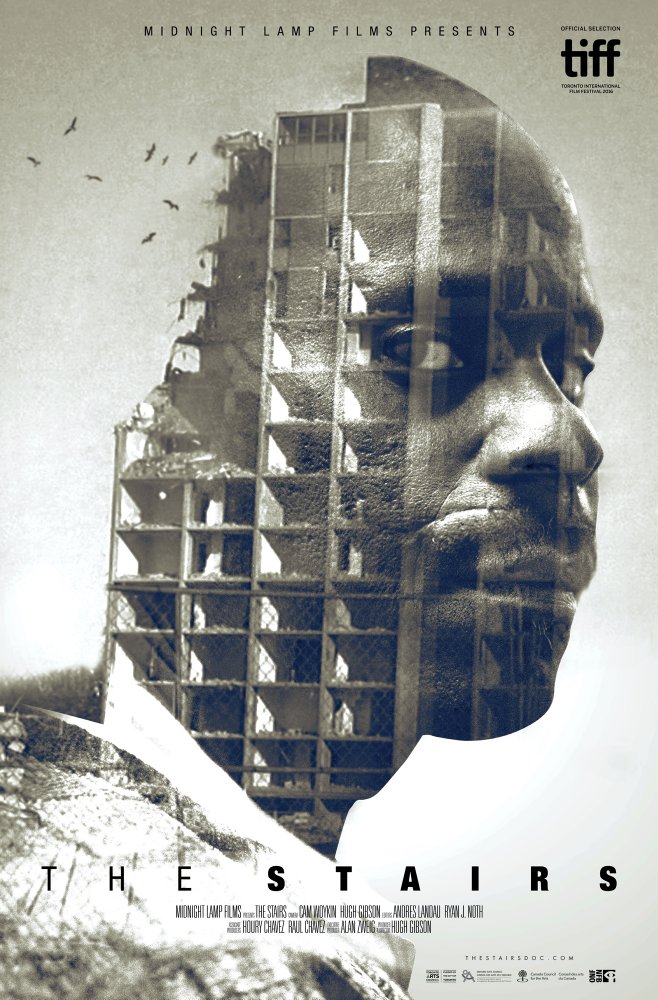
Film Review: THE STAIRS (Canada 2016) ***1/2

Directed by Hugh Gibson

Review by Gilbert Seah

There are certain stories that need to be told. THE STAIRS is one of them. THE STAIRS refer to the back stairs is of an apartment building where homeless drug users that frequent Regent Park live. One step is the bathroom, another step the kitchen and so on. THE STAIRS is also the place where they congregate for drug usage. But it is a safe haven for these people as they can partake safely here than out in the open. As one user says, “If you buy it and try to it in in the open, it is not going to happen.”

This documentary by Hugh Gibson took five years in the making and tells stories of Toronto’s marginal people – not the ones that live in high-rise condos downtown or in large houses in the Greater Toronto Area but the drug users of Toronto’s Regent Park.

The centre of the film is Regent Park Community Health Centre, whose staff of social workers includes both former and current drug users. These workers understand all too well what their clients are going through.

The film is quietly effective as Gibson narrows his film to concentrate on only three subjects, all three of which are staff embers of the Health Centre. One is the loquacious, seemingly tireless Marty, who was so addicted at one point that, after being shot in a deal that went south, he stopped for a hit before going to the hospital; the second is Roxanne, a former sex worker whose tales of life in the trade are beyond harrowing; and finally Greg, a biracial child of the 1960s consumed with a long-delayed legal case hinging on a police officer’s use of excessive force. Gibson spends equal screen time on each of the three subjects, each just as interesting as the next.

One would think that the stories are morbid and horrifying. True but the subjects are thankful to be living and they share a sense of humour. Marty is extremely funny when he confesses that he has never been called grandpa even by his grandchild. Roxanne has a scary tale of being kidnapped that rival the one in the hit film ROOM. She relates how she escaped, naked and hit by a car before being brought down to the police station, and how she identified the house from memory and got her abductor a long prison sentence. She also talks about the sex trade. These stories are human as they come from real people. It is hard for anyone not to feel sorry for Roxanne and also for Greg who was beaten up by the cops for no reason.

The film also challenges prejudices and preconceived notions. It also underlines how tentative sobriety and stability can be for people who have lived in addiction for years. THE STAIRS has been nominated by the Toronto Film Critics Association (TFCA) for the Best Canadian Feature. It has my vote!

Trailer: https://www.youtube.com/watch?v=7WBlH8Sm-ZM

the_stairs_movie_poster


Watch Winning Best Scene Readings:

TV CONTESTSUBMIT your TV PILOT or TV SPEC Script
Voted #1 TV Contest in North America.
FILM CONTESTSUBMIT your SHORT Film
Get it showcased at the FEEDBACK Festival
writing CONTEST1st CHAPTER or FULL NOVEL CONTEST
Get full feedback! Winners get their novel made into a video!
SCREENPLAY CONTESTSUBMIT your FEATURE Script
FULL FEEDBACK on all entries. Get your script

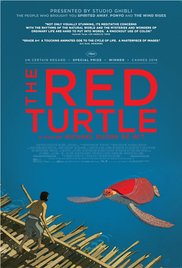
Film Review: THE RED TURTLE (LA TORTUE ROUGE) (France/Belgium/Japan 2015) ****

the_red_turtle_movie_poster.jpgDirector: Michael Dudok de Wit
Writers: Michael Dudok de Wit (story), Pascale Ferran (screenplay)

 A hit at this year’s Cannes, this full animated feature THE RED TURTLE is the first international co-production from renowned Japanese animation giant Studio Ghibli. It enlists the talents of Oscar-winning Dutch animator Michaël Dudok De Wit for a wondrous story about the unlikely friendship between a castaway on a deserted island and an enormous sea turtle. Done without dialogue, it is a mythical tale that could vey be the birth of man like the story of Adam and Eve. The power of the animation is in its apparent simplicity of plot, enhanced by stunning animation and music.

Shipwrecked on a deserted island, a lone man struggles to find his place in this new world. The basics for survival are abundant yet frustratingly out of reach, and danger lurks in the smallest of crevices; every isolated grotto is also a potential grave. The man cleverly uses the forest’s resources to support his raft-making efforts, but his every escape attempt is thwarted by an enormous sea turtle (the RED RURTLE of the film title) who seems intent on having him stay. Enraged, he attacks the turtle, intent on killing it. What happens next is the beginning of a new chapter in the man’s life, one that will instruct him in the ways of companionship and lead him to understand that nature must take its course. The turtle turns into a red-haired woman. They bear a son who undergoes a same demise of the father, falling into a crevice of water.

A tsunami also hits the island. Death also rears its ugly head but the three inhabitants of the island learn or is forced to cope with it.

THE RED TURTLE is a beautifully conceived tale. Director Michael Dudok de Wit was given Carte Blanche to do whatever he wanted with his film, and THE RED TURTLE shows the stupendous result of independent animation. The sea, the fire, grasslands and bamboo are all shown with their enormity compared to the image of man. The film might be confusing to some – with the turtle turning into a female and vice versa but the trick is to treat the story as a fable of man and his environment. Don’t bother trying to figure if there is some metaphor on life hidden in the tale either. Best is just t enjoy the detailed animation and Dudok’s artistry without questioning.

THE RED TURTLE emerges an emotional tale illustrating the powers and wonders of nature. Man is present but in this tim, has to learn to live with the elements. A beautiful film that will cater more to art house audiences than children.

THE RED TURTLE has already garnered lots of awards. The film premiered at Cannes, where it was nominated for the “Camera d’Or”, and won the “Un Certain Regard” Special Prize. It has been nominated for Best Animated Feature by the Critics’ Choice Awards, received runner up for the Los Angeles Film Critics Association Best Animated Film, and has been nominated for several awards by the International Animated Film Association Annie Awards including Best Animated Feature – Independent. It recently was named runner up for Best Animated Film by the Toronto Film Critics Association as well as the Los Angeles Film Critics Circle. In February the film is up for five Annie Awards.

Trailer: https://www.youtube.com/watch?v=y3uYequDQqc

Watch Winning Best Scene Readings:

TV CONTESTSUBMIT your TV PILOT or TV SPEC Script
Voted #1 TV Contest in North America.
FILM CONTESTSUBMIT your SHORT Film
Get it showcased at the FEEDBACK Festival
writing CONTEST1st CHAPTER or FULL NOVEL CONTEST
Get full feedback! Winners get their novel made into a video!
SCREENPLAY CONTESTSUBMIT your FEATURE Script
FULL FEEDBACK on all entries. Get your script

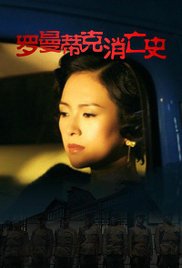
Film Review: THE WASTED TIMES (China/Hong Kong 2016)

the_wasted_times_movie_posterDirector: Er Cheng
Writer: Er Cheng
Stars: You Ge, Ziyi Zhang, Tadanobu Asano

Review by Gilbert Seah

THE WASTED TIMES is a big-budget highly anticipated Chinese-Hong Kong thriller film directed by Cheng Er and starring Ge You, Zhang Ziyi and Tadanobu Asano released by Chia Lion. The film is slated for a Christmas release hoping to make it big at the box-office for both Asian and western audiences.

From the film’s opening scene – the meeting among Mr. Lu, the film’s protagonist and Japanese collaborators, the artistic design and art direction of the scene are stunning from the lighting to the decoration. The meeting culminates with the shocking dismemberment of a lady’s hand still wearing a jade bracelet.

THE WASTED TIMES is a revenge story, set mainly in Shanghai during the conflict with the Japanese from the 1930’s up to the end of World War 11 in 1945. The elements of love, hatred, and betrayal are on full display in the story. As loyal to his own people and refusal to collaborate with the Japanese, Mr. Lu is ambushed during an important meeting with the Japanese army, but his sister’s husband, Watabe sacrifices himself to save Mr. Lu. Worse still, the Japanese brutally murder Mr. Lu’s children and sister. To avenge their deaths, Mr. Lu’s mistress attempts to kill the culprit but ends up dead.

The story leads to the end of 1945 when Mr. Lu visits the abandoned wife of his former boss, Mrs. Wang. She reveals that Watabe is still alive and did not sacrifice himself to save Mr. Lu, but is actually a Japanese spy responsible for the deaths of his family members and captured her as a slave in his basement. Given this new revelation, Mr. Lu takes Mrs. Wang to the war camp where Watabe is held to finally make him pay for his bad deeds.

If the story sounds confusing, the film is even more difficult to follow. It does not help that director Er is fond of telling his tale in non-chronological order, making it artistic through weird songs (partly sung in English) and also often changing the setting of his film from Shanghai, to the Philippines to Japan. The languages spoken also shifts from Mandarin to Japanese.

The historical film is made more emotional though the introduction of characters like the county bumpkin (and his sexual innocence) who learns the ropes about gang warfare. Er also seems quite interested in the activity of sex as illustrated in the many erotic sex scenes, including an artistically staged one at the back of a car.

Western audiences are unfamiliar with Chinese history and are more often than not, uninterested. It does not help that the history is not explained either. At least the audience will assume (correctly) that the end of the Sino-Japanese war comes at the end of 1945, the end of World War II. THE WASTED TIMES will definitely be a hard sell for China Lion with this film running into stiff competition with Hollywood films like the commercial ROGUE ONE: A STAR WARS STORY as well as more artistic flair like the musical LALA LAND.

Trailer: https://www.youtube.com/watch?v=pB_Dj-X51RU


Watch Winning Best Scene Readings:

TV CONTESTSUBMIT your TV PILOT or TV SPEC Script
Voted #1 TV Contest in North America.
FILM CONTESTSUBMIT your SHORT Film
Get it showcased at the FEEDBACK Festival
writing CONTEST1st CHAPTER or FULL NOVEL CONTEST
Get full feedback! Winners get their novel made into a video!
SCREENPLAY CONTESTSUBMIT your FEATURE Script
FULL FEEDBACK on all entries. Get your script

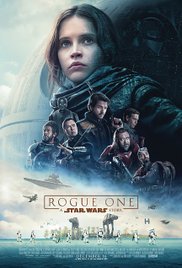
Movie Review: ROGUE ONE: A STAR WARS STORY (UA 2016) ***1/2

rogue_one_movie_poster.jpgDirector: Gareth Edwards
Writers: Chris Weitz (screenplay), Tony Gilroy (screenplay)
Stars: Felicity Jones, Diego Luna, Alan Tudyk, Forest Whitaker, Mads Mikkelsen, Jimmy Smits

Review by Gilbert Seah

It is finally here and the world is waiting to hear how good (or bad) the $200 million production of the new Star Wars film is. For one, the filmmakers are clear to emphasize that this is a standalone story. By this, they mean that the story, set shortly before the events of the original Star Wars, is not part of the other STAR WARS films, though there are already two more films after ROGUE ONE in the making as ROGUE ONE is the first of three anthology films.

There is not much original in the story of ROGUE ONE. But there is little to disappoint. Again, the film begins with the title, “Long time ago in a galaxy far away..”, though the words are differently laid out. The scriptwriters Chris Weitz and Tony Gilroy, from a story by John Knoll and Gary Whitta ensure the successful formula is untampered with. And there are lots of spectacle, new characters, explosions, exotic futuristic sets combined with exotic setting – space towers emerging from a tropical paradise. At times, the film feels like a James Bond film, where the hero and troops storm the villain’s lair, take him out while blowing everything up.

It all starts with the escape of young Jyn Erso as a child as she witnesses her mother shot dead and her inventor father (Mads Mikkelsen) taken away to create a planet destroyer for the Empire. With this weapon, the rebels would stand no chance of winning the battle for the galaxy.

So, the Rebel Alliance recruits the grown up Jyn Erso (Felicity Jones) after freeing her from prison, to work with a team including Cassian Andor (Diego Luna from Y TU MAMA TAMBIEN) to steal the design schematics of the Empire’s new superweapon, the Death Star. That is about it for the story, leaving the film plenty of time for action, spectacle and more action and more spectacle. Music is by Michael Giacchino with pieces taken from the original score by John Williams.

The enmity between Cassia and Jyn inevitably turns into romance. But the romance is executed in good taste without distraction from the action at hand. The two are just shown holding hands in the key scene.

The choice of a female protagonist heroine as in the last STAR WARS film last year is a good one, given these politically correct times. After all, Princess Lea, a key Star Wars character is female and key to the whole saga.

The main villain of the piece is played with sufficient relish by Ben Mendelsohn next to the odd appearances of Darth Vader. But the new characters that steal the show are played by Donnie Yen and Jiang Wen. Have the Chinese taken over? The new droid K-2SO,(Alan Tudyk) a Rebel-owned Imperial enforcer also makes a new welcome non-human hero.

As in last year’s THE FORCE AWAKENS, reviewers were asked not to reveal plot points or twists. In THE FORCE AWAKENS, these included the death of Hans Solo and the end appearance of Luke Skywalker. In ROGUE ONE, there ares equal surprises to please the fans.

Trailer: https://www.youtube.com/watch? v=frdj1zb9sMY 


Watch Winning Best Scene Readings:

TV CONTESTSUBMIT your TV PILOT or TV SPEC Script
Voted #1 TV Contest in North America.
FILM CONTESTSUBMIT your SHORT Film
Get it showcased at the FEEDBACK Festival
writing CONTEST1st CHAPTER or FULL NOVEL CONTEST
Get full feedback! Winners get their novel made into a video!
SCREENPLAY CONTESTSUBMIT your FEATURE Script
FULL FEEDBACK on all entries. Get your script