Movie Review: THE FOREST (2016) Horror

Deadlines to Submit your Screenplay, Novel, Story, or Poem to the festival: http://www.wildsound.ca

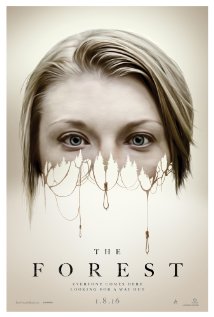
the_forest_posterTHE FOREST (USA 2015) ***
Directed by Jason Zada

Review by Gilbert Seah

The beginning of January usually sees new low budget films make number one at the box-office. Universal’s little horror flick , THE FOREST aims to do just that, and hopefully keep their fantastic 2015 year of box-office hits carried over to 2016.

Twins have always been a favourite pick in the horror genre. Films like Brian De Palma’s SISTERS, David Cronenberg’s DEAD RINGERS and others like THE OTHER and last year’s German GOODNIGHT MOMMY are prime examples. THE FOREST combines the twins story to a haunted forest plot in a relatively scary film about a young woman Sara (Natalie Dormer) who travels to Japan’s forest below Mount Fuji to search for her missing twin, Jesse (also played by Dormer but with black hair).

For a ghost story, there is little gore except a stabbing and a few imagined maggots. Director Zada is fond of false alarms to scare the audience out of the seats. These include a homeless man suddenly banging Sara’s taxi window in Japan, her dream of little Jesse in the tent screeching at her and scares from a Japanese teenager in school uniform among others.

At its best, the film has genuine cinematic scares. The dark of a forest is already creepy in itself. THE BLAIR WITCH PRJECT was scary enough with its camping segment shot mainly in the dark. Zada utilizes the segment in which Sara sits in the tent in the forest to stay the night waiting for her sister to return, to maximum effect. The use of light and shadows from the burning fire adds to the creepiness. Sara’s fall into a huge hole and exploring an underground cave also adds to the film’s best moments.

Story-wise, the plot is simple enough. It is a sister’s search for her twin in a Japanese forest known as a place where people go to die. A few loose ends could be easily explained. One immediate point that is questionable is character Rob (Eoin Macken), who meets Sara. He is supposed to be an Australian journalist in Japan. But he speaks with an American accent. But from the dialogue that specifies Rob as a traveller, it could be assumed that Rob is American with an Australian posting. One scene has the Japanese guide tell Sara that in the forest bad things can happen, but they are not real and are all in the head. This is an excuse for other non-explanations in the plot such as Jesse’s photos on Rob’s cellphone or Rob’s answer to Sara that Jesse has been dead for 5 days. These could be dismissed as imaginations in Sara’s head.
Still, this relatively slow moving horror movie is well scripted by no less than 3 writers. Zada’s direction is apt enough and there are sufficient scares – false alarms or real ones.

Do not expect scenic shots of Mt. Fuji or its forests below. The film was actually shot in a National Park in Serbia with an entire crew of Serbians, as can be seen in the end credits. But the cinematography is excellent for a horror flick and the Serbian National Park looks like quite the place to visit.

THE FOREST will definitely make one think twice when camping at night.

Also, Free logline submissions. The Writing Festival network averages over 95,000 unique visitors a day.
Great way to get your story out: http://www.wildsound.ca/logline.html

Deadlines to Submit your Screenplay, Novel, Story, or Poem to the festival:www.wildsound.ca

Watch recent Writing Festival Videos. At least 15 winning videos a month:http://www.wildsoundfestival.com
Movie Review: THE WRONG MAN (1956) Directed by Alfred Hitchcock

Deadlines to Submit your Screenplay, Novel, Story, or Poem to the festival: http://www.wildsound.ca

THE WRONG MAN MOVIE POSTER
THE WRONG MAN, 1956
Classic Movie Review

Directed by Alfred Hitchock
Starring Henry Fonda, Vera Miles
Review by Steven Painter

7.5/10 fan rating on IMDB

Read more professional reviews

SYNOPSIS:

The police were convinced… The witnesses were positive …Yet he was… THE WRONG MAN

REVIEW:

“The Wrong Man” could have been the title for many movies directed by Alfred Hitchcock. It was bestowed on a movie he directed in 1956. The tone of the movie is different from other Hitchcock ones. It is also out-of-date, a rarity among the works of Hitch before the late-60s. Despite these drawbacks it is wonderfully acted.

The Wrong Man is based on a true story. This is probably one of the reasons why there is a lack of humor in it. Hitch always used humor in his movies to counteract the suspense. He felt the audience needed to be let off the hook at times. There is no humor present here. It is a straightforward, grim look at the breakdown of a family.

The story involves Christopher Emmanuel Balestrero, played by Henry Fonda, known as Manny to his family. He is a musician at New York’s Stork Club, trying to make ends meet like a lot of other people. He has a wife, Rose, played by Vera Miles, and two young sons. Rose has recently gotten some dental work done, so the family is in financial difficulties. Despite these difficulties, Rose and Manny try their best to hide it from their kids.

Manny decides to borrow a little money against Rose’s life insurance policy. When he goes to the insurance office, some workers there claim that Manny is the person who recently committed armed robbery in the office. The man had not been caught yet. So the next evening, Manny is picked up outside his house by the police.

One of the reasons why Hitchcock wanted to make this movie was because it involved a scene where Manny is being driven through his own neighborhood in the back of a police car. He sees the normal, trivial routines of everyone, but is unable to take part in any of it. Instead, he is caged in. This fear of being picked-up by the police for something that he didn’t do, is something present in all of Hitchcock’s works and a great fear the man himself had. Manny is brought into the police station. In this pre-Miranda rights era, he is held with no reason. Of course arguments could be made today that the Miranda rights are being ignored by police officers, but at least at this point in time, there were no such rights. This is one of the biggest drawbacks of the movie. It is outdated in this instance and because a lot of audience sympathy is built up because Manny is held with no rights, it just doesn’t seem believable today.

Anyways, Manny is held and some local business owners are brought in to identify him. They can’t say for certain if Manny is the robber, but he seems close enough to the real criminal in looks and handwriting. This satisfies the police and they continue with their prosecution.

Strapped for money and with a husband facing a trial, Rose begins to lose it. She drifts farther and farther from Manny, the kids, and the world itself. Eventually she has to be put in an asylum. This secondary vein of the movie distracts from the main story of Manny being falsely accused of the crime, but in Hitchcock’s defense, the real wife of Manny did in fact end up in an asylum.

As with all things of this time period in Hollywood, the movie has a happy ending. In a great dissolve shot, we see Henry Fonda’s face become that of the real robber. The real robber is caught while trying to rob another store in the neighborhood. When this robber is brought in to be identified, the storeowners come in and say the same things they did when Manny came in. Of course Hitch put this in to cause some doubt in the audience. He asks “do we really ever know who the right man is?”

The movie ends with a blurb across the screen stating that the Balestrero family lived happily ever after. In real life, Rose was committed to the asylum and never regained her sanity. The ordeal crippled the family, instead of making them stronger – as the movie implies.

The Wrong Man is not a bad movie. It is outdated and it is grimier than most Hitchcock movies. But it is well acted. Vera Miles and Henry Fonda give tremendous performances. For this reason alone the movie should be watched. But if you need another reason, the fear of being a falsely accused person with no rights is something that is inherent in a lot of people. That fear is played out in this story.


Also, Free logline submissions. The Writing Festival network averages over 95,000 unique visitors a day.
Great way to get your story out: http://www.wildsound.ca/logline.html

Deadlines to Submit your Screenplay, Novel, Story, or Poem to the festival:www.wildsound.ca

Watch recent Writing Festival Videos. At least 15 winning videos a month:http://www.wildsoundfestival.com

Movie Review: NORTH BY NORTHWEST (1959) Directed by Alfred Hitchcock

Deadlines to Submit your Screenplay, Novel, Story, or Poem to the festival: http://www.wildsound.ca

NORTH BY NORTHWEST MOVIE POSTER
NORTH BY NORTHWEST, 1959
Classic Movie Review

Directed by Alfred Hitchcock
Starring Cary Grant, Eva Marie Saint
Review by Steven Painter

IMDB fan rating: 8.4/10

SYNOPSIS:

A hapless New York advertising executive is mistaken for a government agent by a group of foreign spies, and is pursued across the country while he looks for a way to survive.

REVIEW:

In 1935 Alfred Hitchcock made a movie called The 39 Steps about a man who is falsely accused of murder and is chased throughout the Scottish countryside by the police and a group of spies before clearing his name. Nearly 25 years later, Hitchcock made a similar movie, this time based in America, called North by Northwest (1959).

What separates North by Northwest from the majority of Hitchcock’s wrong man accused movies is that there is a lot of humor here. The talented Cary Grant plays the lead role of Roger Thornhill. Grant had been a huge success in screwball comedies like Bringing Up Baby (1938) and His Girl Friday (1940). He had also been one of Hitchcock’s favorite actors to use.

Thornhill is an advertising executive who deals with the hustle and bustle of New York City the best way he can. He always seems to be on the move, but he makes sure he enjoys himself. On the way to lunch one day, he is stopped in a restaurant by some men. The men say they need to talk to him and then they kidnap Thornhill. He is taken out to the countryside where the kidnappers believe he is government agent named George Kaplan, a man who is supposed to be hot on their trail as the kidnappers are doing some spying on the U.S. government.

The spies are never specified as to their country of origin or really what the significance is of what they are after. Microfilm is what drives these spies, we find out. This is the largest McGuffin used in Hitchcock’s movies. It is merely a device to further the story, but matters little as the real story is about the relationships between the people in the movie.

Thornhill denies being Kaplan to no avail. The kidnappers decide to get him drunk and then set him loose on a drive through the countryside. This scene is similar to the one in Notorious (1946) where a drunken Ingrid Bergman takes a wild car ride with Cary Grant. Even the scene in To Catch a Thief (1955) with Grace Kelly and Cary Grant comes to mind. Grant seems to find himself in dangerous automobile situations when working with Hitchcock. He was even in a treacherous car ride in Suspicion (1941), just before Joan Fontaine gave her Oscar winning speech.

Getting back to the story, Grant ends up drunk in a police station and has to call his mother for help. The mother is a frequent character in Hitchcock movies. Thornhill’s mothers might be the most quirky of all Hitchcock ones. Anyway, Thornhill explains that he was kidnapped and the cops go with him to the countryside estate where the kidnappers are. At least that is where they were. No one knows what Thornhill is talking about. They say the house belongs to a man who is a part of the United Nations.

Embarrassed, Grant goes to the United Nations to find the man who owns the estate. This is an important scene in the movie and one that almost didn’t happen. The government would not allow Hitchcock to film on the UN property. So Hitch asked if he could go in to make measurements so they could rebuild some of the building in the studio. Hitch snuck a camera into the building and got some of the great shots used in the movie illegally.

Thornhill goes to the UN where the man he is looking for is killed. Stabbed in the back by someone. Thornhill is the only one around and he pulls the knife out of the man’s back. Being the UN, there are photographers around and Thornhill is captured while holding the knife over the dead man. He is obviously branded as the murderer. Now the situation is set up: Thornhill is on the run from the spy ring because they think he is Kaplan. He is also on the run from the police because they believe he killed the man in the UN.

At this point we cut away from Thornhill’s troubles and listen in to a meeting in Washington. Here it is explained by government officials that there is no man named Kaplan. He was just made-up to keep the spy ring occupied while the real secret agent infiltrates them. Since Thornhill has become the target of the spy ring, the government officials believe all is well. No sense in disrupting their good fortune by telling Thornhill that there is no Kaplan, although it would mean saving his life.

Thornhill makes his way onto a train headed toward Chicago, where Kaplan is supposed to be at this point. On the train he meets the cool blonde Eve Kendall, played by Eva Marie Saint. In a scene similar to that of The 39 Steps, Thornhill is on the run from the police and ends up “accidentally” stepping into the cabin of the cool blonde. Unlike in The 39 Steps, here Eve accepts the advances of Thornhill.

The train makes it to Chicago where Eve makes sure she handles all the details between Thornhill and Kaplan, as it would be a bad idea to have a wanted man picked up in a public phone booth. Eve says Kaplan will meet Thornhill at a bus stop in the middle of nowhere. So Thornhill gets on the bus and heads from the city to farmland.

The famous crop duster scene occurs here. Hitchcock took the typical cliché of being set up from the dark alleys of the major metropolitan area to the warm sunshiny cornfields of the Midwest. Film noir this is not, but it is suspenseful.

Getting chased by a crop duster would make anyone angry and Thornhill is just that as he makes it back to Chicago. He discovers that Eve has been playing him for a sap and vows vengeance on her as he discovers she has been palling around with Philip Vandamm, played by James Mason, the head of the spy ring.

To give a quick recap of what happens, the officials in Washington step in to help Thornhill out as he has almost blown the cover of their secret agent, Eve, while trying to embarrass here at an auction. The officials take Thornhill to Mount Rushmore where he is briefed on the situation. A plan is executed, Thornhill is almost executed, and the movie ends with a harrowing trip around the monuments of Mount Rushmore. Like the UN building, Hitch was unable to film on the monuments — something about defacing them by having people run over the faces. It didn’t matter, as they were recreated in the studio.

North by Northwest is one of Hitchcock’s best movies. It is also one of his most beloved. This is because the movie is filled with plenty of suspense, plus an equal amount of comedy. Cary Grant and Eva Marie Saint are a wonderful team on-screen and James Mason plays a wonderful bad guy. This is simply an enjoyable movie for people of all tastes.

Also, Free logline submissions. The Writing Festival network averages over 95,000 unique visitors a day.
Great way to get your story out: http://www.wildsound.ca/logline.html

Deadlines to Submit your Screenplay, Novel, Story, or Poem to the festival:www.wildsound.ca

Watch recent Writing Festival Videos. At least 15 winning videos a month:http://www.wildsoundfestival.com

Movie Review: MARNIE (1964) Directed by Alfred Hitchcock

Deadlines to Submit your Screenplay, Novel, Story, or Poem to the festival: http://www.wildsound.ca

MARNIE, 1964
Horror/Thriller Movie Review
Directed by Alfred Hitchcock
Starring Tippi Hedren, Sean Connery
Review by Steven Painter

7.2/10 IMDB fan rating

Read more professional reviews of Marnie.

SYNOPSIS:

Mark marries Marnie although she is a habitual thief and has serious psychological problems, and tries to help her confront and resolve them

REVIEW:

There are many gems Alfred Hitchcock made that do not get the fanfare other movies of his have gotten. From the 1940s, Foreign Correspondent is underappreciated. In the 1950s it is Strangers on a Train. In the 1960s that movie is Marnie (1964).

Marnie is Hitchcock at his psychological best and probably the last great movie of his career. It is certainly the final movie of an era. It would be the last time Hitch worked with cinematographer Robert Burks, who would die soon after finishing the picture from a heart attack, and legendary composer Bernard Herrmann. The two had artistic differences.

The bad thing about this is that when Hitchcock had a difference of opinion with someone – they left the Hitchcock production company. It happened to Ingrid Bergman and it happened during this movie to Ian Hunter. The screenwriter had worked on several Hitchcock pictures, but disapproved of the rape scene in the novel version of Marnie. He voiced his displeasure over the scene to Hitch and Hitch severed relations with the screenwriter. It was only later that Hunter learned the only reason why Hitch wanted to make the movie was because of the rape scene.

Marnie can be looked at as the last great Alfred Hitchcock movie. It is a fitting tribute to a career that spanned more than four decades up to this point.

Tippi Hedren returns to the screen as Margaret Edgar, also known as Marnie. The original choice for the role was Grace Kelly, but at this time she was Princess of Monaco and it would have looked bad if a princess was playing a kleptomaniac. So Hedren got the role of the psychologically confused kleptomaniac.

Using different names and appearances, Marnie moves from job to job, stealing money from her employers before moving on to another town. One job she takes is with publisher Mark Rutland, played wonderfully by Sean Connery. Mark happens to recognize Marnie’s features from a previous business encounter. He becomes fascinated by her and tries to move in on her romantically. She ignores him as the only love she has ever felt in her life has come from stealing money.

She steals money from Mark’s company and makes a dash for it. Mark discovers the loss and balances it. He then takes off to find out who this wild girl really is. He tracks Marnie down at some stables she frequents, as horseback riding is one of her escapes. He then uses blackmail as a technique to get her to marry him.

The wonderful idea of marriage backfires on Mark as Marnie is cold to any sort of sexual advances. When Mark forces himself on her during their honeymoon, in Hitchcock’s favorite scene, she attempts suicide.

Unable to understand Marnie and still fascinated by her, Mark investigates her past. He ends up bringing Marnie to her mother, Bernice. The mother and daughter have always had a frigid relationship. In one of the best climaxes in all of Hitchcock, it is revealed in stunning detail why Marnie is so cold sexually, why she and her mother express little love for each other and why she despises the color red. The atmosphere around this movie is what makes it great. Credit must be given to Robert Burks for creating the camera angles and photographing exactly what Hitchcock had in his mind when reading the novel written by Winston Graham. Credit has also got to be paid to Bernard Herrmann for his magnificent score. It was the last time the two would work together, but it is probably the best overall score Herrmann gave to Hitchcock. The Vertigo and Psycho ones stand out, but Marnie has a score that perfectly expresses through music the atmosphere on screen.

Marnie is a complex movie. I could go on for paragraphs and paragraphs about all the little interesting things contained in it, but I’ll leave you to discover that for yourself. Robin Wood, the film theorist, proclaimed that if you don’t like Marnie then you aren’t a fan of Hitchcock. Then he went a step further and said if you don’t like Marnie then you aren’t a fan of movies. I fully agree with his statements.


Also, Free logline submissions. The Writing Festival network averages over 95,000 unique visitors a day.
Great way to get your story out: http://www.wildsound.ca/logline.html

Deadlines to Submit your Screenplay, Novel, Story, or Poem to the festival:www.wildsound.ca

Watch recent Writing Festival Videos. At least 15 winning videos a month:http://www.wildsoundfestival.com

Movie Review: CHICKLAND (Short Film) 2015

CHICKLAND played to rave reviews at the November 2015 FEEDBACK Film Festival

Watch the Audience FEEDBACK Video from the Festival:

  MOVIE POSTERCHICKLAND, 11min, France, Comedy/Sci-Fi
Directed by Stanislav Graziani

Bubu and Toufik think they are the next Steve Jobs and Martin Zuckerberg… They have implanted a chip in their brain, which gives them access to the web… giving them instant access to universal knowledge. For their first experiment, they test it on picking up girls…

Review of the Short Film by Amanda Lomonaco:

Chickland left me a little bit on the fence. With the growing dissemination of devices like the Google Glass, and the expansion of Virtual Reality technology Chickland is a bit of a terrifying reminder of a reality that we could all soon be living in. Nevertheless, director Stanislav Graziani did a good job at balancing out the miracles of new technology, with the limitations of our own human psyche, providing  a slightly less dystopic view of the future.

The hardest thing to understand about the film was the age range of the actors involved. The male actors seemed far too young to be approaching the girls they were trying to pick up, although perhaps this was done on purpose, considering the end result of their experiment. The end of the film itself is also a bit reassuring, emphasizing the humanity of even the most technologically oriented minds.

There isn’t much that can be said about Chickland without revealing much of the film’s plot. It’s a peek into the future, into what life might look like if Google Glass ever really catches on. Of course there are certain differences. It’s not likely that the Google Glass “victims” of the future will have no suspicion of the tactics being used on them. Then again perhaps this was what Graziani was indicating in his depiction of the boy’s interaction with the math student.

Students of art might also find this film a little insulting in how easily the one boy was able to fake being a literary connoisseur, while his counterpart struggled to prove his math prowess. Nevertheless both the boys’ reactions to “completing the task” at the end of the film showed a lot of emotional sensitivity, one that most young boys of that age would normally not be so ready to admit or expose.

Chickland is an interesting experimental look into what our future might look like, how our grandchildren might date, find partners, or explore their sexuality. It sparks a lot of thinking about where our technological pursuits are heading, what it might truly bring us in the future. This wasn’t by any means one of my favourite short films to watch, but it certainly carried some interesting ideas that will inspire you to consider how natural human emotion is able to coexist with the calculated patterns of digital technology.

Movie Review: THE LAST POST (Award Winning Short Film) 2015

THE LAST POST played to rave reviews at the November 2015 FEEDBACK Film Festival

Watch the Audience FEEDBACK Video from the Festival:

  MOVIE POSTERTHE LAST POST, 15min, UK, Comedy/Social Media
Directed by Adam Preston

A halfwit is invited to speak at the funeral of a girl he only knew through the internet.

Review of the Short Film by Amanda Lomonaco:

Hilariously cringe-worthy. There’s no other way to describe this one. We all now a girl like her; updating her social media constantly, her life seems near perfect, everything she does is amazing, and fun, everything she eats is delicious, and if you wanted you could find out everything about her. Well, almost everything. As we all know social media and online profiles only give us little peeks into a person’s life. No matter how often you update it, how much content you add to it, it’s hard to know the real truth of who a person really is purely through their social media profiles.

Adam Preston has somehow managed to perfectly balance the tragedy and comedy of our excessively interconnected lives. Using the knowledge you can typically gather from a person’s social media accounts Preston writes a hysterical eulogy for one such social media star. This is certainly one film where credit needs to be highly awarded for performance. The Last Post’s main character had me tearing up with laughter non-stop.

Admittedly Preston could have added to the comedic value of his short by having the funeral attendants accept the eulogy as a sincere tribute to the deceased. Nevertheless his actual choice of direction didn’t  detract from the hilarity in any way. I also feel obliged to question Preston’s choice of the social class of the deceased and her family. It seems a little reductionist to have her and her family be from a region with a certain reputation for ignorance, simplicity, and poverty. It might have been a little more interesting if they had been from a posh family. However, part of the reason for this could have been to increase the threatening demeanor of the two bully brothers.

The Last Post is more than just a hilarious short film; it’s a commentary on today’s modern, digitally centered society. I had a very odd feeling as soon as the film was over because after having laughed the entire way through the film, I found myself pondreing deeper issues as soon as it was over. Comedy is for everyone, and comedy that is pertinent to current issues is all the more worth it. It kind of suits all flavour preferences; if you’re up for something more serious, this movie will work for you, if you’re up for a good laugh, add this to your list, heck it even has a little violence if that’s your cup of tea! I think you can see where I’m going with this one. Definitely give The Last Post a watch, whatever your inclination. It will be worth it.


Movie Review: SHOOT GRANNY (Short Film) 2015

SHOOT GRANNY played to rave reviews at the November 2015 FEEDBACK Film Festival

Watch the Audience FEEDBACK Video from the Festival:

  MOVIE POSTERSHOOT GRANNY, 5min, Spain, Comedy/Musical
Directed by Olivier Kowalczyk

Shoot Granny or when an ordinary tea time between three friends turns into an improvised Gymkhana. On a music of Todd Terje.

Review of the Short Film by Amanda Lomonaco:

Shoot Granny garnered a really good laugh from the audience, with great reason. It’s common to hear complaints about loud, partying teenagers, but what happens when those loud partiers are actually your grandparents?

The director Olivier Kowalczyck says he was inspired by his work as a doctor; disappointed by how they seemed to perscribe anti-depressants to help seniors sleep rather than provide them with any real psychological support. He claims to have felt like more of a drug dealer than a doctor, and this thought led him to create the storyline for Shoot Granny.

Thankfully Kowalczyck has managed to turn this upsetting subject matter into quite a hilarious repartie. With the background knowledge of this film in mind it might be easy to reprimand Kowalczyck for his comedic approach, but in actual fact what he has done by injecting comedy into this topic is open it up to a much wider public that might otherwise want to ignore the issue. Kowalczyck also manages to add a stronger element of agency to the elderly, allowing us to relate to them as people who like to enjoy themselves, just as we all do, rather than as victims with no control over their ailments.

Some members of the audience seemed a little put off by the loud music, or by the fact that the film didn’t carry subtitles, but Shoot Granny could very well be played on mute and still get its message across. Someone once told me that a film is only truly good if it is able to be played in black and white, and silently while still achieving the same level of emotional impact. Despite the fact that its bright, psychodelic patterns and blaring music adds greatly to the story, I still believe this film would achieve the same purpose without these elements. I think anyone would benefit from watching Shoot Granny, who knows, it might help you approach and understand again, or your elderly loved ones, with just a little more affection and care.

Movie Review: POINT BREAK (2015)

Deadlines to Submit your Screenplay, Novel, Story, or Poem to the festival: http://www.wildsound.ca

point_break_posterPOINT BREAK (USA/China/Germany 2015) *1/2
Directed by Ericson Core

Review by Gilbert Seah

POINT BREAK is a remake of the Kathryn Bigelow 1991 hit film starring Patrick Swayze and Keanu Reeves. Bigelow is a female director able to create big hits with strong male content action films like THE HURT LOCKER, ZERO DARK THIRTY, STRANGE DAYS and my favourite and her first film, NEAR DARK. Director Ericson Core has tough shoes to fill.

The surfing definition of POINT BREAK refers to the type of long-lasting wave found off a coast with a headland or point. A point break is formed when a swell moves around the land almost at a right angle to the beach and a break which begins near the point gradually progresses along the wave. Bigelow’s film involves a FBI agent going undercover to infiltrate a gang of bank robbers disguising themselves as surfers.

The difference in the new POINT BREAK is a series of robberies done by not surfers but extreme sport specialists. They do the big surf in the last climatic scene but engage too, in other sports such as snowboarding, rock climbing and wingsuit flying.

The story of the new POINT BREAK involves a young FBI agent, Utah (Luke Bracey) infiltrating a team of extreme sports athletes he suspects of masterminding a string of unprecedented, sophisticated corporate heists. He engages in this quest as redemption after losing his brother in an extreme sport accident. Deep undercover, and with his life in danger, he strives to prove these athletes are the architects of the mind-boggling crimes that are devastating the world’s financial markets.

Newcomer Luke Bracey delivers a weak performance. With his blond hair and chiseled body, he looks like a model in many scenes with his perfect blond hair flung across his face. Delroy Lindo playing Utah’s boss fairs worse. All he does is bitch about Utah’s job. Utah takes the risks and fights the bad guys but his boss keeps complaining and giving Utah a hard time. Edgar Ramirez (an up and coming star, his last film JOY), who plays bad guy Bodhi, cannot help much either.
The film contains some good scenes involving extreme sports. The rock climbing, surfing and motorbike segments are well shot. But the action and fight sequences lack any excitement.

The plot lacks credibility. The eight ordeals that Bodhi seeks make little sense. He ends up completing seven with the last one left in limbo. Utah somehow manages to figure out all the ordeals Bodhi has completed, something hardly believable.

POINT BREAK which costs close to $100 million only made $10 million domestic the first weekend. However, being a Chinese and German co-production, it opened elsewhere a week before North America grossing a remarkable $50 million, which helps the poor domestic numbers. Still, POINT BREAK is far from being a satisfying action flick. The film sags after the first 15 minutes and picks up just a little towards the end. The open ending does not help either. Action fans prefer closure. Open endings are more suited to artsy films which POINT BREAK definitely isn’t.

POINT BREAK ends up the most boring action film of 2015.

Also, Free logline submissions. The Writing Festival network averages over 95,000 unique visitors a day.
Great way to get your story out: http://www.wildsound.ca/logline.html

Deadlines to Submit your Screenplay, Novel, Story, or Poem to the festival:www.wildsound.ca

Watch recent Writing Festival Videos. At least 15 winning videos a month:http://www.wildsoundfestival.com

Movie Review: TWISTED (Award Winning Short Film) 2015

TWISTER was awarded best cinematography at the November 2015 FEEDBACK Film Festival

Watch the Audience FEEDBACK Video from the Festival:

  MOVIE POSTERTWISTED, 14min, Australia, Drama/Thriller
Directed by James Hartley and James Shepherd

After a night with the girl of his dreams, Michael has a story to tell. And a favour to ask…

Review of the Short Film by Amanda Lomonaco:

Wow! Is any Australian film at the WILDSound Festival ever going to be bad? I never thought I would have a bias for flicks from the land down under, but I may have to reasses. I promise my preference for these films is in no way intentional. I’ll do my best to keep this one as balanced as possible.

To begin with, the title itself is the perfect definition of the film. The story is, in fact, incredibly twisted. From the very start you can feel something is a little bit off about the film. The shaky camera angle, the slightly unkempt boy in a school uniform coaxing you to do something you clearly don’t want to do. In fact, the very position of the camera is offputting; throughout the film the main character, Michael, addresses the camera directly as his school mate. This allows Jame Shepherd & James Hartley, the directors of Twisted to throw audience members directly into the world of the film, and creates a sense of complicity with Michael’s acts.

Despite all my bias and admiration, Twisted is obviously far from perfect. Since the film is carried almost entirely by the monologue and perspective of a single character, there are some inevitable points of monotony, which I’m not sure whether to blame on the writing, or on the acting. Neither element was poor, which is why it’s so difficult to pinpoint where exactly the film goes wrong at the few moment where it does.

One particular moment that pulled me out of the story abruptly was  when the film’s title was inserted into Michael’s monologue. I’ve never been a fan of playing with film titles inside the actual story, precisely because it removes me from the story world. In this instance the disruption is even more jarring as Michael’s repeated enunciation of the word “Twisted” gradually appears more forced and unnatural. This might have been more appropriately treated with some more complimentary camera movement, perhaps, but as it stands on its own I can’t say I appreciated it.

Regardless of this one instance, I loved this film, even with all its flaws. Some of my reason for this bias towards the Aussies may just be their propensity towards making slightly disturbing and… well… twisted films, which I have already been vocal about preferring. With that said, it would probably be advisable to stay away from this film if horror and suspense aren’t really your genre of choice. For all the rest of you, add this to your bucket list, for sure.

Movie Review: EXIT RIGHT (Award Winning Short Film) 2015

EXIT RIGHT was awarded best film at the November 2015 FEEDBACK Film Festival.

Watch the Audience FEEDBACK Video from the Festival:

  MOVIE POSTEREXIT RIGHT, 5min, Germany, Drama
Directed by Bernhard Wenger & Rupert Holler

Look away or intervene? When a black man is victim of unfounded, racial abuse in a packed bus, there is only one passenger who won’t ignore the situation like everyone else.

Review of the Short Film by Amanda Lomonaco:

In Exit Right Bernhard Wenger & Rupert Holler take a light hearted approach to an unfortunately all too common situation. With the current discussion about Syrian refugees, as well as the Paris bombings, this film is incredibly relevant to the issues we face today, and yet still manages to permeate through time with it’s gentle, comedic approach to the topic. It’s comforting to see that even tragic and disturbing issues can be given a lighter tone.

Those of us who use public transport frequently are well accustomed to witnessing awkward, messy, and at times even violent situations while riding the bus, or sitting in the subway car. On these occasions most of us will look away and pretend we don’t hear or see anything, however every once in a while a brave samaritan will stand up and do something about it. Wenger and Holler decided precisely to portray one such situation in their short film, and with it demonstrate that standing up to bullies doesn’t always need to result in aggression, or negativity.

It’s a lesson that we all learned in school, but often needs to be repeated throughout our lives. Many different cultures have similar stories that you may have heard before in different manners, but no matter how many times it is told or portrayed, the result is always heartwarming. By bringing this anecdotal tale to life within modern day Europe, Wenger and Holler also emphasize how this lesson persists through time periods, cultures, and locations.

Exit Right is definitely a great film to watch when you feel like you’re starting to lose your faith in humanity a little, but it’s also a fun short to enjoy on any day of the week. The directors did miss a slight opportunity for a fun extended ending that could have shown what happens to the man after he has been kicked off the bus, but that itself did not leave the film lacking in anything. This one is worth a few repeated watches, whenever you feel like you need a reminder that standing up to bullies and racists is always the right thing to do, so long as you don’t stoop to their level and respond with equal aggression.