Film Review: TAKE EVERY WAVE: THE LIFE OF LAIRD HAMILTON (USA 2017) ***

Submit your Screenplay to the Festival TODAY

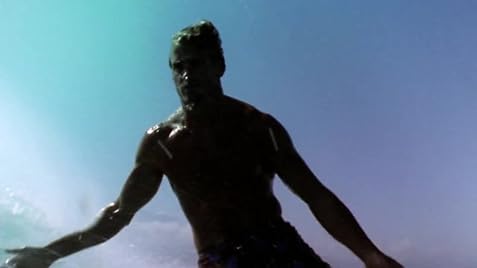
Take Every Wave: The Life of Laird Hamilton Poster
Trailer

This is the remarkable story of an American icon who changed the sport of big wave surfing forever. Transcending the surf genre, this in-depth portrait of a hard-charging athlete explores.

Director:

Rory Kennedy


The film opens with breathtaking cinematography that puts the audience right inside the surging waters, a real high even when watching the waves on screen before introducing the main star and film subject – big wave surfer Laird Hamilton.

After 5 minutes of surf footage, director Rory Kennedy (LAST DAYS IN VIETNAM, GHOSTS OF ABU DHABI), delves into the life of Laird Hamilton.  Director Kennedy, born into the Presidential Kennedy family knows what it is like to be singled out and looked upon by the world.

Kennedy’s film uses archival footage, home movies, contemporary scenes, and interviews with his step-father, Bob Hamilton who introduced Laird to the sport, his wife (former volleyball star and model Gabrielle Reece) and his surfing buddies (even those with whom he’s fallen out) and former editors of Surfer Magazine. 

Told in chronological order, the film traces Laird’s early beginnings as a boy raised by his single surfer mother left pregnant by another surfer dude.  When meeting Bob for the first time on the beach, he is shown how to body surf before his mother meets up and ends up marrying Bob.   In his interview on camera, the now middle-aged Laird recounts his rebellious days in school, throwing desks out the classroom window and yelling obscenities while getting the occasional whopping for his stepfather Bob.  As the story goes, Laird finds solace in the ocean.

It is fortunate that Laird’s life is interesting as there is more of his life on show than of surfing footage.  As Laird never competes, there is not competition that needs to be won that often forms the climax of sport documentaries.  So Kennedy relies on a different technique to climax her film – Laird riding the biggest wave EVER.

Hawaii where Laird grew up as a boy is revealed for all its racial prejudice – reverse white prejudice that is.  The was one of the few whites in the class and whites always get beaten up and singed out.

There are tons of good looking blond surfing hunks in this movie.  But the good looks slowly fade just as youth does.  Both Bob and Laird Hamilton are gorgeous hunks in the early twenties.  This led to Laird, who dropped out of school, to get into the modelling business – a part of his life just barely touched upon in the film.

Director Kennedy sidetracks his film just as Laird sidetracks his life on big wave surfing.  Laird is also revealed as an inventor, first of the foil board (a surf board that rides above the water, amazing as it looks due to Physics), then of the board strap, that enables surfers to do summersaults while being attached to their boards.

The film also brings into the picture, the invention of both the jet ski and the windsurf.  Laird and his gang tackled the new sport of windsurfing (I myself tried it too, – and it is not easy), but gradually went back to big wave surfing.

TAKE EVERY WAVE is a documentary that ends up as interesting as Laird the man.  The best scenes are the ones with the biggest waves.  Director Kennedy has done his research and TAKE EVRY MAN is as exhaustive as any filmmaker can get on Laird.

Trailer: https://www.youtube.com/watch?v=vaGCdymhA40

Submit your Screenplay to the Festival TODAY

Film Preview: Half Magic (2017)

Three women unite out of their frustration over men. They pledge to each other that they should each learn to love themselves before they become romantically involved with anyone again.

Director: Heather Graham

Writer: Heather Graham

Stars: Heather Graham, Stephanie Beatriz, Johnny Knoxville, Jason Lewis, Thomas Kennon, Angela Kinsey, Molly Shannon, Luke Arnold, Chris D’Elia, Alex Beh, Michael Aronov, Jesse Heiman, Odessa Rae, Sandra Rosko, Patty Guggenheim, Lee Raviv

Half Magic is the directorial debut of Heather Graham. While the actress has starred in several mainstream and indie flicks, this is the first project where she serves as part of the creative team. According to Hollywood Reporter, the comedy film follows Honey (Graham’s character), along with two of her friends, as they make a pact to each find great sex and a good man, preferably from the same person.

Starring in a comedy is not particularly new to Graham, whose recent projects include the indie films “Wetlands” and “Last Rampage” and an advertising campaign for the hugely popular British gaming community Foxy Bingo. In fact, it has somewhat become her brand over the years. The Huffington Post said that the actress, who has consistently ranked as among the most beautiful faces in Hollywood, used her looks to her advantage and managed to make a career off the back of it. Writing the script and directing Half Magic, however, proves that she is more than just another pretty face in the industry.

Graham confessed to the People that the urge to write the script came after she broke up with someone. She purposely made her writing funny to help her get over the relationship, and incorporated some of her own, as well as her friends’, life experiences in the story. Although, it’s worth noting that they were exaggerated for comedic value.

But beyond the humor of the film and the catharsis it gave her post-breakup, Graham admitted in an interview with Digital Spy that she wrote the film as a way to address sexism in Hollywood. The actress explained, “It’s hard – you want to make a movie about how some of the entertainment industry is sexist, and then you’re like, ‘Why doesn’t everyone want to make this movie?’”

In another interview, Graham mentioned the reason why she pushed to turn her script into a full-fledged movie. She realized that instead of waiting for the dream role to come to her, she would just create that dream role herself. While she was quick to say that she’s thankful for her projects throughout her career, she wished there were more movies made that told things from a feminine point-of-view. The thespian commented that Hollywood’s tendency is to present things from the male perspective. She actually stated in several interviews in the past that her reason for taking on raunchy roles was to help open discussions on female sexuality.

In fact, her character in the film is a tongue-and-cheek parody of what she experienced in her career. She relayed that Honey works for a man who told her that the content she produced will never get picked up because it was written from a woman’s perspective. And the only way to have her story made was if she instead told things from a man’s point-of-view.

The release date of Half Magic is yet to be announced.
half_magic

Film Review: ONLY THE BRAVE (USA 2017) ***1/2

Submit your Screenplay to the Festival TODAY

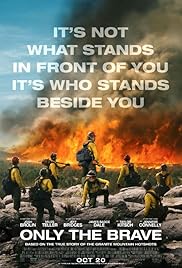
Only the Brave Poster
Trailer

Based on the true story of the Granite Mountain Hotshots, a group of elite firefighters risk everything to protect a town from a historic wildfire.

Director:

Joseph Kosinski

Writers:

Sean Flynn (based on the GQ article “No Exit” by), Ken Nolan


Warning: This review contains spoilers.  Spoilers are highlighted in italics

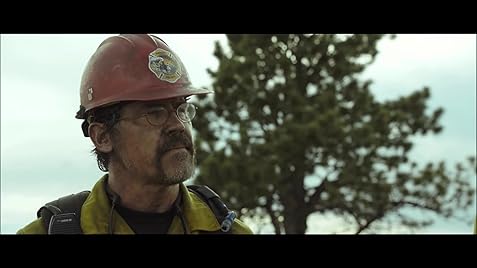
ONLY THE BRAVE, based on true events is a tough American biographical action disaster drama that tells the true story of the Granite Mountain Hotshots.  The Hotshots are an elite crew of firefights that have first rights in the front lines to stopping fires (in decision and execution).  A local Arizona firefighting team finally gain qualification as hotshots under the leadership of Eric Marsh (Josh Brolin).

ONLY THE BRAVE is a disaster film not unlike THE TOWERING INFERNO.  It is one of the better firefighting films compared to past successes like John Wayne’s THE HELLFIGHTERS and Ron Howard’s BACKDRAFT.   A well balanced script by Ken Nolan (the excellent BLACKHAWK DOWN) and Eric Warren Singer (AMERICAN HUSTLE) ties in the human drama to the action.  As the ad goes: “It’s not what stands in front of you; It’s who stands beside you.”

There are a few human dramas on display.  They seems superfluous at the start but the actors and script hammer at the material till it finally grows on you.  The main one involves the chief Eric Marsh and the sacrifice his marriage to his wife, Amanda (Jennifer Connelly) has taken.  She sees him only 10% of the time and she wants a change in their lives.  The other deals with hot shot youngster, an ex-addict, Brendan (Miles Teller) who joins the firefighters in order to support his daughter that has resulted from an unexpected pregnancy.    Brendan is given a chance by Eric who calls him ‘donut’.  The confrontation scene between Eric and Amanda strikes fireworks.

ONLY THE BRAVE marks the other kind of action hero film – the ones (like the recent PATRIOT’S DAY) that involve real life heroes in real life events.  These are the kind of heroes America needs these days, in times of terrorist attacks in a world gone crazy.   ONLY THE BRAVE celebrates true heroes and real people in an excellent executed film.  The fire scenes are authentic, as director Kosinski has said in an interview that he had gone for authenticity.

Great performances all around, particularly from Brolin and Jeff Bridges.  Miles Teller delivers another winning performance as a bad-ass character – annoying in the beginning, but capturing the heart of the audience by the end.

For such a serious topic, the script inserts a few metaphors (like the burning bear – a terrifying yet beautiful sight) and some needed honour.  The best and funniest line is the advice given by Duane Steinbrink (the Bridges character) to Eric: “You must know what you can live with and what you can die without.”  Even Duane does not know what it really means!

The climax of the film involves the Granite Mountain Hotshots (as they then call themselves) fighting the out-of-control Yarnell Hill Fire in the June of 2013.  Those who know the history will recall the sacrifice these firefighters made in order to control the fire and save lives.  Kosinski’s film ends up a tearjerker, so make sure you bring lots of Kleenex.  But these are tears well shed.  ONLY THE BRAVE is a worthy tribute, and as the words emphasize during the losing credits dedicated to the Granite Mountain Hotshots.

Trailer: https://www.youtube.com/watch?v=EE_GY6zccqc

Submit your Screenplay to the Festival TODAY

Film Review: HUMAN FLOW (Germany 2017) ***

Submit your Screenplay to the Festival TODAY

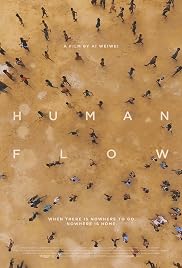
Human Flow Poster
Trailer

Human Flow is director and artist, Ai Weiwei’s detailed and heartbreaking exploration into the global refugee crisis.

Director:

Ai Weiwei


Chinese artist Ai WeiWei’s ambitious film about refugees around the world has his clear impression stamp.  Ai was himself a political dissident in his own country, jailed for his openly anti-government and artistic displays (as observed in the documentary about himself – Alison Klayman’s AI WEI WEI – NEVER SORRY).

The film begins with the arrival of a boat full of refugees – a scene that is repeated at the end of the film, but then explained in greater and horrific detail.  HUMAN FLOW traces the plight of refugees, the most current being the Syrians, Afghanis and Iraqis as they escape war for a better life in any country they can find open to them.

HUMAN FLOW is unfortunately very long, close to two and a half hours and occasionally all over the place.  One particular example that stands out is the segment that comes out of the blue, of a tiger that is evacuated back to freedom in Africa.  (The tiger happened to escape through a tunnel just like a refugee.)

Ai’s artistry can be observed in many parts of his film.  The overhead shots of one of many makeshift refugee camps such as the back of trucks and the ending segment of colours are reminiscent of his art in his documentary, AI WEIWEI – NEVER SORRY.  His use of deafening silence is noticeable in the scene of a refugee boat sailing across the ocean as well as the devastating burning of the oil fields.  Ai is also fond of quoting poets of different nationalities as the refugees are (of different nationalities).

HUMAN FLOW could do with a tighter narrative with a head and conclusion.  Ai does also touch the topic of returning refugees.  He opens ones eyes to the problem of internal displacement – when refugees return home after too long a period and find that things have changed too much against them.  They no longer own their lands or know the people they once knew.

Refugees suffer a lot during their travels, often contacting diseases and undergoing sub-human living conditions.  Ai does not show these sufferings visually but they are described in voiceover or by the people interviewed verbally.  They are just as horrifying.  The people in the packed boats arrive, with diarrhoea, and scurvy (lack of Vitamin C).  Among them are children, babies and expecting women.

On the film’s more positive side, Ai includes interviews of people that work to help the refugees.  The Princess of Jordan talks candidly of human beings needing to do their part.  HUMAN FLOW also shows how certain countries like Germany and Sweden have done their part while others have not.

I remember a few months back when a friend asked my advice if he should take a refugee Syrian family to his home for a few months.  His wife was unsure of the kindness but I advised him against it as to be fair to his wife and not put his family at possible risk.  After seeing HUMAN FLOW, I regretted my advice.  Though Ai’s film is by no means perfect, it accomplishes its aim to make a difference.  If one cannot sacrifice a little for a suffering fellow human being, then, what are we?

Trailer: https://www.youtube.com/watch?v=DVZGyTdk_BY

Submit your Screenplay to the Festival TODAY

1957 Movie Review: PATHS OF GLORY, 1957

Submit your Screenplay to the Festival TODAY

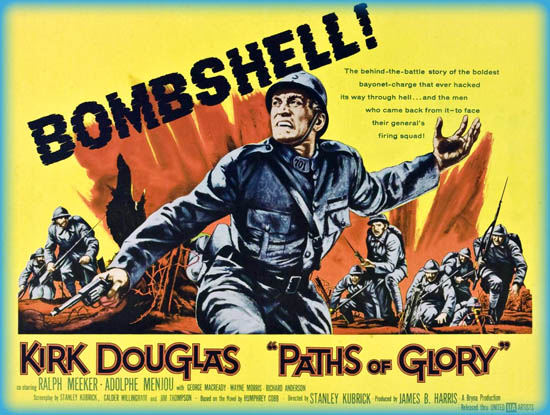
PATHS OF GLORY, 1957
Movie Reviews

Directed by Stanley Kubrick

Starring: Kirk Douglas, Ralph Meeker, Adolphe Menjou, Richard Anderson, Joe Turkel, Wayne Morris, George Macready, Timothy Carey

What the critics say: 

More than 20 years after Mr. Cobb’s novel was first published, Mr. Kubrick reminded us that human folly is rarely checked for long. A half-century on, he is still right.

March 26, 2013 | Full Review…
——-

Kirk Douglas gives one of his finest performances as the intelligent and courageous Col. Dax.

March 26, 2013 | Full Review…
 Top Critic
——-

The sardonic rhetoric may be laid on a little heavily at times, but the movie is blunt and scornfully brilliant.

March 26, 2013 | Full Review…
 Top Critic
——-

While the subject is well handled and enacted in a series of outstanding characterizations, it seems dated and makes for grim screen fare.

May 8, 2007 | Full Review…
 Top Critic
——-

This masterpiece still packs a wallop, though nothing in it is as simple as it may first appear; audiences are still arguing about the final sequence, which has been characterized as everything from a sentimental cop-out to the ultimate cynical twist.

May 8, 2007 | Full Review…
 Top Critic
——-

The final scene, in which Kubrick presents close-ups of soldiers watching a captured German girl being forced to sing for their pleasure is nothing short of masterful.

June 24, 2006 | Full Review…
 Top Critic
——-

paths of glory

Submit your Screenplay to the Festival TODAY

1957 Movie Review: NIGHTS OF CABIRIA, 1957

Submit your Screenplay to the Festival TODAY

NIGHTS OF CABIRIANIGHTS OF CABIRIA, 1957
Movie Review

Directed by Federico Fellini
Starring: Giulietta Masina, François Périer
Review by Aria Chiodoi

SYNOPSIS:

A waifish prostitute wanders the streets of Rome looking for true love but finding only heartbreak.

OSCAR Winner for Best Foreign Film


REVIEW:

Le Notti di Cabiria (Nights of Cabiria) from 1957 is another somewhat early film in Fellini’s career- a preface to his later extravagant and intellectual films. Fellini is a quintessential Italian filmmaker; it’s obvious how much he loves his country and its people, but his love is complex, never simple. If one wants an idea of life in Rome during the 50s, this film shows it, albeit with some fantastic and tragic situations. The screenplay was written by Fellini and his frequent collaborators, Ennio Flaiano and Tullio Pinelli, a writing team nominated for three Oscars (although this film wasn’t one of them, it did win Best Foreign Film). Le Notti di Cabiria also boasts another score by Nino Rota, and black and white cinematography of Otello Martelli. Pier Paolo Pasolini, who became a famous Italian director in his own right, also helped write the script.

The amazing Giulietta Masina is again the center of this film, as she was in La Strada. Here she plays Cabiria, a fun-loving, raucous, and spirited prostitute who lives on the outskirts of Rome, and works the streets of the city at night. The film begins with her getting robbed and thrown in the river by a lover- just the first of many misadventures that Cabiria experiences. Cabiria is our tour guide of Rome and its people; whether they’re rich, homeless, or just young and dancing in the streets, Cabiria comes across them all. And she handles everything with an indomitable spirit and vivacity (if this story is at all familiar, it’s because it is the basis of the musical Sweet Charity of 1969)

On this tour of Rome and its outskirts, we are shown the whores and their lovers, who dance and fight under Roman ruins, and hide in the bushes from cops. We also find the rich and famous, who lead glamorous but odd and somewhat sad lifestyles. Then, in a dreamlike but memorable scene, we follow Cabiria and her friends in a procession to the altar of the Madonna. This scene and other scenes of religious imagery display the fervent Catholicism of Italy, the wonder and piousness every Italian feels (even a simple whore like Cabiria) when faced with the prodigious altar of the Madonna. In this scene we are given the peasants and lower classes of Rome, the elderly and the sick, all coming, in the hundreds, to pray and beg for something from the Madonna. Afterwards, Cabiria goes to a magic show, and joins other volunteers from the audience on stage to be hypnotized by the magician. Fellini gives us a grave religious procession but follows it with a show of entertainment and illusion, as if to purposely blend the imagery of religion and illusion.

Cabiria herself is trying to find something in her life that has meaning. Being a prostitute is not a very glamorous or rewarding line of work; she might be taken out by a famous movie star, but then has to spend the night in his bathroom when his girlfriend shows up; she may dance with her friends in the ruins, but they all have to run from the cops every now and then. Whether it’s love or faith, her life is missing something essential, and in her roundabout way, she’s always searching for it. Her group of friends, the other whores, or ex-prostitutes and their boyfriends, are a lively bunch, who make life look fun and breezy, but they don’t understand Cabiria’s need for something meaningful.

When Cabiria meets a nice and respectable man who thinks their meeting is destiny, her prayers may be answered. She might have a chance for a pleasant and normal life with a good man, but knowing Fellini, this could just be another misadventure. I don’t want to ruin anything, but while many may see the ending as tragic and sad, through the tragedy there is life, a life that should be celebrated. Fellini ends on a note of hope, since Cabiria is actually (although she often blunders and gravely misjudges) a ray of hope. Whatever she experiences, she gets back up and brushes it off, smiles through her tears and moves on, searching for something new. Some may call her a fool with no real future, but I saw her as a symbol of humanity: although one meets with tragedy and bad luck, the only thing to do is keep going, and find the good in life again. The face of Masina in the last shot is powerful and poignant, it can make one smile or cry, or do both, as she does. In La Notti di Cabiria, Fellini focuses on the character of Cabiria, and on the colorful Italian community of people who are full of exuberance, in order to capture life and the endurance of humanity.


NIGHTS OF CABIRIA

Submit your Screenplay to the Festival TODAY


1957 Movie Review: THE MONOLITH MONSTERS, 1957


Submit your Screenplay to the Festival TODAY

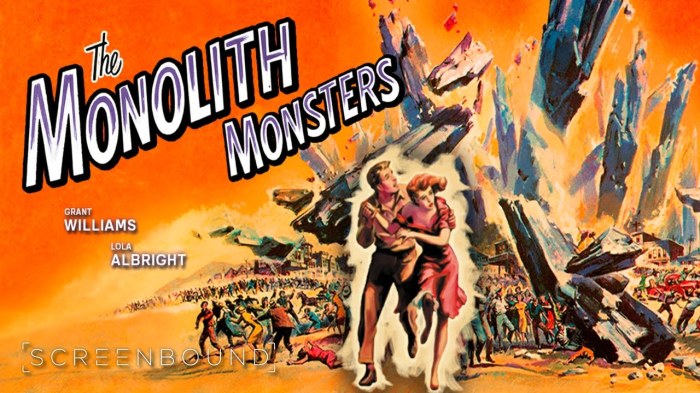
THE MONOLITH MONSTERS MOVIE POSTERTHE MONOLITH MONSTERS, 1957
Movie Reviews

Director: John Sherwood

Starring: Grant Williams, Lola Albright, Trevor Bardette
Review by Kevin Johnson 

SYNOPSIS:

A meteorite piece grows endlessly when contacted with water, which solidifies everyone it comes in contact with; two geologists must figure out how to stop it.


REVIEW:

The Monolith Monsters has one of the riskiest and outlandish premises that you will ever see, even in B-movie standards. The title is rather misleading; it would probably be more accurate to call it “The Monolith Threat” or, to keep the alliteration intact, “The Monolith Menace”. The term “monsters” implies something organic, creepy and/or crawly – some kind of being or creature that stalks its victims in some manner. But really, the threat are rocks.

Grant, the rocks grow immediately when they come in contact with water. The rate they grow is exponential, and they have the power to remove silicates from the skin – ie, “turn you into stone”. But, ostentatiously, we’re dealing with deadly rocks. It’s hard to really feel any kind of tension from this scenario, and to be so invested in this threat, even at a campy level, asks a lot of the audience’s willingness to suspend disbelief. Also, there’s a ton of question: couldn’t a couple of missiles filled with “the solution” solve this problem? How come water vapor doesn’t effect it? And why is everyone running from ROCKS?

Specifically, the plot is thus: a meteor crash lands on Earth, shattering into a ton of pieces. When a couple of local geologists inspect said pieces, especially when found in conjunction with a stone-cold-dead person, they have to work to discover how to reverse the stone-transformation process, as well as disrupt the rocky enlargement before it “grows” out of hand.

I should comment on the pseudo-science more when it comes to these B-movies, mainly because it’s rather disconcerting how much these films emphasize them. Blockbuster sci-fi films tend to gloss over the explanations, or utilize metaphors to “explain” phenomena, or just straight-up ignore them; these low budget works spend an awful amount of time postulating, detailing, speculating, hypothesizing, and theorizing. But why? These over-explanations tend to bring up more questions than answers; opening that scientific door, while informative, pretty much invites the nerdiest among us to pinpoint the flaws in such arguments. It’s clearly just a way to pad for time, although it’s weird that researching mumbo-jumbo is preferred over even the most cliched of character developments. Dead father? Coming of age? Pining for a loved one? There’s plenty to choose from.

Still, there are some rather interesting effects. I was somewhat impressed with the smooth growth of the rock monoliths. I’m not exactly sure how they achieved it; it looks to be some sort of crude mechanic mixed with a clever camera angle. What ever it was, it didn’t look too cheesy, and was rather cool as it towered over miniature mountain ranges.

The female role was pleasantly handled as well. While it started off precociously glaring, with a young girl outing the relationship between Albright’s character and Williams’s character in that “why are kids paying attention to this!?” sort of way. But there are only a few scenes that harp on the romantic elements, and it seems natural to the beats, instead of random or throwaway.

But even with the solid elements the film purports, The Monolith Monsters has a hard-to-swallow premise that never quiet pushes its way out of Unbelievable Town. But the attempt is there, and the flow and style works, so you can’t fault its B-movie shortcomings in its execution. The idea of killer rocks may be lame, but at least it application was not wholly unbearable.


Submit your Screenplay to the Festival TODAY

THE MONOLITH MONSTERS

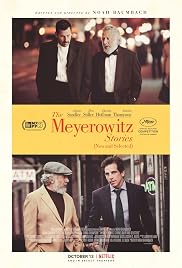
Film Review: THE MEYEROWITZ STORIES (NEW AND SELECTED) (USA 2017) ****

Submit your Screenplay to the Festival TODAY

The Meyerowitz Stories (New and Selected) Poster
Trailer
An estranged family gathers together in New York for an event celebrating the artistic work of their father.

Director:

Noah Baumbach

Writer:

Noah Baumbach


The one of two Netflix originals that premiered at Cannes this year (with OKJA), THE MEYEROWITZ STORIES took critics by surprise (despite being booed at the screenings for being a NETFLIX film) with many hailing it as one of their favourite Top 10 at Cannes.

The film is so-called THE MEYEROWITZ STORIES as it revolves around multiple stories among the different members of the Meyerowitz family.  It starts off with Danny driving around the city with his daughter cussing while trying to find parking.  “Garage it,” the daughter says.  The family patriarch is Harold (Oscar Winner Dustin Hoffman sporting a full beard).  He is old, hospitalized at one point and is more interested in his art and coming-up museum showcase opening than in his family.  His new wife is alcoholic recovered, Maureen (Emma Thompson) wanting to seek the family house.  Their sons include Danny (Adam Sadler) who is recently separated and moving ingot he parents house and who has never worked a day in his life.  The successful son, making the money is Matt (Ben Stiller) who the family resents because of jealousy that he is capable to making the most money.  The daughter is Jenny (Elizabeth Marvel) into into making movies.  Everyone comes together in this dysfunctional family with drastic and comedic results.  Bambauch has mastered this genre with his film flowing smoothly.

Director Bambauch (THE SQUID AND THE WHALE, MISTRESS AMERICA, FRANCES HA) allow each actor their freedom to do their own thing and inhabit the characters they portray.  Adam Sandler and Ben Stiller in their rare serious roles shine in their performances.  They show both angst and desperation as men that been betrayed by the artistic father (Dustin Hoffman sporting a full white beard.)  Emma Thompson sporting elderly age makeup plays the step-mother reminiscent of a similar motherly role in the British film THE LEGEND OF BARNEY THOMSON. 

The film has a Jewish cast and crew, led by its director Bambauch.  The film has definitely a Jewish impression that leaves a fine imprint and is not overpowering.  It runs a bit long at 2 hours, but the free flowing characteristic of the film allows it to keep going, without it getting monotonous or boring.  One can always count on Bamnauch to add another story to his list.

The film’s best moments are in the script’s sharp dialogue.  The best line comes from Dr. Soni after the children abruptly questions her saying it isn’t fair for on her leaving for vacation in China while leaving their father in an induced coma.  (This current state of affairs is already really funny in itself)  Her reply: “yes, it isn’t!”  The response sums up what each of the siblings have gone through being a member of the Meyerowitz family.

THE MEYEROWITZ STORIES establishes Bambauch once again as the Master of films on dysfunctional families and quirky characters.

The film is available on NETFLIX for on-line streaming to subscribers.

Trailer: https://www.youtube.com/watch?v=czyMIIm12JY

Submit your Screenplay to the Festival TODAY

Film Review: OFFICE (Hong Kong 2015) ***

Submit your Screenplay to the Festival TODAY

Office Poster
A musical set mainly in a corporate high-rise. Two assistants, Lee Xiang and Kat, start new jobs at the financial firm Jones & Sunn.

Director:

Johnnie To

Writer:

Sylvia Chang


Hong Kong action director Johnny To (TRIAD ELECTION, BLIND DETECTIVE among 70 directorial credits) does a Chinese musical satirizing office culture in the mildly amusing but ambitious OFFICE.  OFFICE was screened at the Toronto International Film Festival in 2015 before release though it never made it to Canada.  And OFFICE is full of unexpected surprises.

The story of OFFICE follows the IPO (Initial Public Offering) of shares by a major  company led by the Chairman (Chow Yun-Fat) and his CEO who also happens to be his mistress (Sylvia Chang).  Meanwhile, his wife is comatose in the hospital.   But they are clever people as they control money and not let money control them, as the CEO advises a newbie at one point in the film.

The film opens as two new interns show up at the posh financial company Jones & Sunn.  Lee Xiang (Ziyi Wang) and Kat-Ho (Yueting Lang), start new jobs but learn that there are lots of kissing asses and dirty business that need be done in order to be successful.  Lee Xiang is earnest and naive.  He goes about saying his name Lee is from Ang Lee (the Taiwanese director) and Xiang means thinking.   Two other characters that play a part in the plot are high flyers Sophie (Wei Tang) and David (Eason Chan) who forge financial figures.

OFFICE is pleasant to the eyes – great set decoration and design.  The fathomless office space with countess desks and faceless employees at each desk not only look stunning (credit to production designer William Cheung) but gets the point across.  Each office space is designed artistically and modern, often with crystalline and curved shapes.  Wardrobe, especially those worn by Sylvia Chang are haute couture.

The characters break into song at any time with the film looking a bit similar as a result, to LALA LAND.  But the songs are often clumsily inserted, and break the flow of the narrative, despite a few being really inventive, especially if one understands Chinese in order to get the innuendo.  Songs are by 1980s pop icon Lo Ta-yu.

OFFICE is based on the play “Design For Living” written (as is the film ) by screen veteran Sylvia Chang who also plays a lead as the company CEO.  The film is shot in both Mandarin (when they speak in the office) and Cantonese (when they speak more casually to friends and family).

OFFICE barely succeeds as a musical and satire and runs a bit long at just under two hours.  The novelty of the sets and songs wears off quite soon.  Being a Johnny To film, one feels that guns could start blazing at various points in the film.  Still for sheer courage of ingenuity, OFFICE is worth a look for its eccentricity.

OFFICE has a special screening at the TIFF Bell Lightbox on October the 28th at 930 pm.  OFFICE is screened as part of TIFF Cinematheque’s first retrospective on Johnny To entitled “Expect the Unexpected”.

Trailer: https://www.youtube.com/watch?v=hFS1sdkSOwQ

Submit your Screenplay to the Festival TODAY

Deadline Oct. 15th: Screenplay Festival Submissions (Feature or Short)

WILDsound Festival's avatarWILDsound Festival

SCREENPLAY CONTESTSUBMIT your FEATURE Script
FULL FEEDBACK on all entries. Get your script performed

Deadline: Screenplay Festival – Get FULL FEEDBACK. Get script performed by professional actors
http://www.wildsound.ca/screenplaycontest.html

Watch WINNING Screenplay Readings – Watch videos of past winners performed by professional actors
http://www.wildsoundfestival.com/feature_script_readings.html

READ 100s of testimonials from past submitters –
https://wildsoundfestivalreview.com/feature-screenplay-submission-testimonials-wildsound-screenplay-contest-review

WILDsound is a screenwriter’s treasure! They take enormous time to provide the most expert, detailed feedback, even allowing my choice to incorporate all the committee’s ideas or stay with my draft. With caring support, they’ve honored each deadline and every award they promised, and I’m forever grateful for their right-on insightful niggles to enhance my story. WILDsound provides everything a screenwriter needs to find the way to a story’s successful completion. I’m forever grateful!
– Elan Carlton, Cahoots, Feature Script

I have taken the time to review your feedback and have found your comments and suggested invaluable. As an…

View original post 400 more words