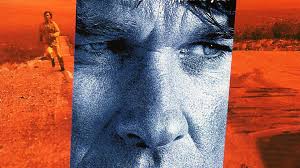
1997 Movie Review: BREAKDOWN, 1997


BREAKDOWN MOVIE POSTERBREAKDOWN, 1997
Movie Reviews

Directed by: Jonathan Mostow

Cast: Kurt Russell, JT Walsh, Kathleen Quinlan, M.C. Gainey, Kim Robillard
Review by Jarred Thomas

SYNOPSIS:

After their new Jeep conks out on a desolate stretch of Arizona highway, a well-heeled Massachusetts couple accepts the help of a kindly, honest-seeming trucker, who drives the wife to a diner while the husband stays behind to “protect” the vehicle. After saying goodbye, the husband gets two surprises: the Jeep starts, and his wife never actually arrived at the diner, and the trucker doesn’t recollect having picked her up at all…

REVIEW:

An exciting and compelling thriller that star Kurt Russell as a husband desperately trying to find his wife who may or may not have been kidnapped by some desert locals. What’s great about this film in particular is the suspense which in many films try to capture it, only to come up with nothing. But here Mostow and Russell work well in conveying husband’s anguish and the looming tension.

Jeff and Amy Taylor are moving to California and must drive across the country. While driving the jeep starts to breakdown, or at least appears so. When they find themselves stranded in the middle of a desert with hardly anyone or anything around, their trip comes to a sudden halt.

When a truck driver pulls up he offers the two a ride to the nearest diner, 60 miles away. Jeff however wants to remain with the jeep, believing that the jeep might have just overheated, which is what the trucker suggested. But Amy reasons that if it’s not overheated they may be stranded for a lot longer.

So, they agree for her to take a ride with the trucker to the diner where she can call for a tow truck. She leaves. But after a long time with no tow truck, Jeff becomes worried.

The jeep starts working again, and he heads off to the diner where he finds that no one in the diner has seen or heard from his wife. When he finds the trucker who gave Amy the ride, the trucker swears he has never seen her. Now Jeff must attempt to find his wife, who has been kidnapped and is being held for ransom.

There are a few twists that pop up throughout the film which actually adds depth to certain characters. JT plays the villain but there’s more to his story than simply a one note bad guy. He has a family, and a son who admires him greatly.

Kurt Russell has always been solid actor and many of his roles, and here he’s no different. It’s nice to see him again since nowadays he’s rarely seen in films. But here he shows us why he was such valuable commodity in the business. Maybe he’ll show up some more in future movies.

BREAKDOWN1.jpg

1997 Movie Review: THE BOXER, 1997


THE BOXER,  MOVIE POSTERTHE BOXER, 1997
Movie Reviews

directed by: Jim Sheridan

Starring: Daniel Day-Lewis, Emily Watson, Brian Cox, Nye Heron, Jer O’Leary
Review by Virginia De Witt

SYNOPSIS:On the eve of peace being declared in Northern Ireland, Danny Flynn is released from prison after serving 14 years for his youthful involvement with the IRA. Danny’s former girlfriend, Maggie, married his best friend, Tommy Doyle, and had a son, Liam. Tommy is now in prison himself and Maggie is watched vigilantly by the local community as she is now a prisoner’s wife and must be above reproach at all times. Danny sets out to start his life anew, and continue with his boxing career which had been interrupted by his prison term. He begins by initiating a training program for young boxers in the youth centre where Maggie also works. They reconnect even though it is dangerous for them to be seen together. At the same time, Danny begins to fight professionally again. Events spiral out of control as Maggie’s young son, Liam, is furious over his mother’s attachment to Danny. As well, Danny’s newfound commitment to the peace process sets him on a collision course with members of the local IRA.

REVIEW:

This third collaboration between writer/director Jim Sheridan and Daniel Day-Lewis is the least well known. It was shot from an original screenplay co-written by Sheridan and Terry George. Their main object in telling the fictional story of Danny Flynn was to dramatize the culmination of the peace process and the consequences of it in the lives of ordinary people living in Belfast. In an interview on the DVD, Sheridan says the idea for the story came to him while he was living in New York in the ‘80s watching the news from Ireland, which was all bad. Then one night, a young Irish boxer, Barry McGuigan, was featured and said, “Leave the fighting to McGuigan.” Sheridan relates how he found it “… kind of innocent and naive a little bit, but great. Here was a guy in a violent profession saying stop fighting. That contradiction interested me.”

It’s that contradiction that is at the heart of the drama Sheridan and Geoge have crafted here. It is a thoughtful and intelligent take on the sometimes painful and dramatic progress of the peace process in Northern Ireland, which however, lacks some of the focus and tightness of storytelling that distinguished “My Left Foot” and “In The Name of the Father.” The tension that drives the story comes from the split on the republican side over whether to accept the terms being offered by the British to achieve peace, ie decommissioning weapons, etc. Danny (Daniel Day-Lewis), his friend and boxing mentor, Ike Weir (Ken Stott) and Maggie’s father (Brian Cox), an IRA chief, are all on the side of negotiating. They are each, in turn, confronted by Harry (Gerard McSorley), a break away IRA member, in violent episodes meant to sabotage the peace process. In the midst of this political drama, Sheridan works in a love story that is affecting and simply drawn.

Sheridan is ambitious here, attempting to combine what initially seem like too many elements for a small film. He does manage, however, to keep the political story, the love story and finally the boxing narrative of Danny’s attempted career comeback, balanced for most of the film. It is not until well into the last act when Sheridan cuts to Danny’s big fight in a London hotel that the film loses its momentum and bogs down. The London sequence is unnecessary dramatically as it doesn’t show us anything we haven’t already seen in Belfast regarding the peace process. It does, however, allow the filmmaker to make his point about violence by having Danny refuse to keep fighting a man who is clearly in distress. This scene is also an emotional nod to Barry McGuigan (who worked on the film as Daniel Day-Lewis’s trainer). McGuigan relates in an interview on the DVD how, when he was a professional boxer, he had fought a man in London, who had died later of head injuries. As admirable as all of this is, the point has already been made about Danny’s desire to use his boxing skills for peace in the earlier Belfast scenes. The result is that the build up to the final confrontation between Danny and Harry at the end of the film has been crucially interrupted.

Despite this lapse, overall the film works well. As usual Sheridan, and his actors, are wonderful at capturing the nuances of Irish life believably and dramatically. In the extended wedding scene that opens the film or in the depictions of the daily interactions at the Holy Family Boxing Club, the rhythms of language, the pleasures and pressures of family life and social obligations are all caught knowingly, and yet seem completely natural in their context.

The cast is crucial in this process. Daniel Day-Lewis is intense, but quiet, as Danny Flynn, displaying a barely acknowledged sadness just beneath his surface that is moving. This is a man who is aware of what he has lost by virtue of his earlier decisions and has now grown used to being alone. It is easy for us to understand how Danny now only wants to start his life again. As an important part of that new life, Emily Watson, as Maggie, displays a disarming simplicity. Maggie is quiet too, but it is a quiet strength. We come to know that in her world to talk too much is dangerous. Maggie learned long ago how to navigate her way through the byways of a life lived in proximity to violence. Watson lets us know subtly that this endless process, both personal and political, is now wearing her down. As well, she has a nice rapport with Daniel Day-Lewis in their scenes together. Ken Stott, as Danny’s trainer, is memorable as an older man who, like Danny, is desperately trying to begin again but knows the odds are against him.

The original music by Gavin Friday and Maurice Seezer is eery, evocative of tribal chants, mixed with Celtic sounds. The cinematography by Chris Menges has a sometimes strangely blueish tint to it, but is clear and sharp and captures the dark world out of which these characters are struggling to emerge.

The ending of “The Boxer” lacks the joyous completion of “My Left Foot” or the triumphal vindication of “In The Name of the Father.” There is, instead, an air of quiet resolution about it, and the film overall. Nonetheless, “The Boxer” deserves its place alongside these other two excellent films and should be revisited


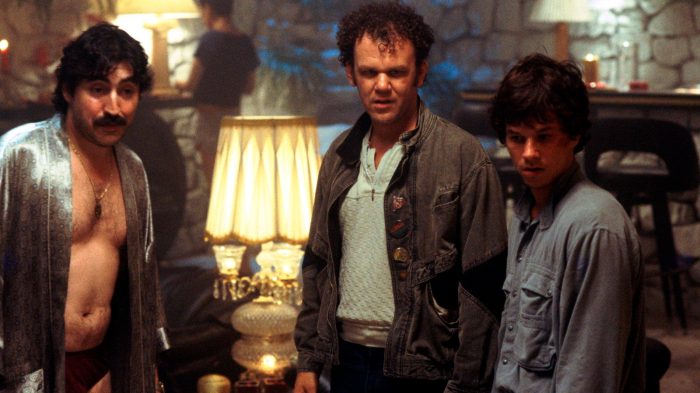
1997 Movie Review: BOOGIE NIGHTS, 1997

BOOGIE NIGHTS MOVIE POSTER
BOOGIE NIGHTS, 1997
Movie Reviews

Directed by Paul Thomas Anderson
Starring: Mark Wahlberg, Julianne Moore, Burt Reynolds, John C. Reilly, Philip Seymour Hoffman, Don Cheadle, William H. Macy
Review by Cathryn Naiker

SYNOPSIS:

A famous porn director discovers a young man in a nightclub. He is soon thrusted into the pornography scene of the late seventies and early eighties. They enjoy great success together and are looking into crossing over into mainstream film. However, the year 1980 along with being wired on cocaine and the introduction of videotape turn their worlds

About:

This was director Paul Thomas Anderson’s sophomore feature film. Anderson had been researching this film since the late eighties and based a lot of the characters on real life accounts. The film was picked up by new line cinema who was constantly in battle with Anderson over length and content of the film. The studio was disappointed with the film until critics started praising it. Burt Reynolds, in arguably his best work as Jack Horner, won a Golden Globe for best supporting actor. The film was also nominated for a few Oscars, but no wins.

Highlights:

Boogie Nights was the movie that turned “Markey Mark” into Mark Wahlberg. From pop music (“Good Vibrations”, anyone?) to infamous Calvin Klien tighty whitey ads, Mark was able to somehow make the transition from a pop-star to a serious actor in an era where singer/actor transitions were not so common or successful. I think that the role of Eddie/Dirk Diggler for Mark was a great role for him at the time since so much of the film focuses on his “package” and that was also the cause for a lot of his publicity in real life. Another outstanding performance came from Julianne Moore who plays Amber Waves. Amber is the main starlet in Jack Horner’s films. She is the maternal role model in a house full of lost souls. In the mist of a custody battle for her son, we see her being motherly towards Dirk Diggler at the same time we see her introduce Dirk (and presumably other characters) to cocaine.

Review:

When this film first started being reviewed most people were expecting a comedy about the porn industry of the 1970’s. Instead, there was a very long dramatic ensemble piece about sex, drugs and not enough disco or rock and roll. This film came at a time where 90’s chic became a crossover between the “heroin look” and bellbottoms. The 70’s made a huge comeback in 1997 in fashion and in films like “54” and “Austin Powers”.

I feel where this movie fails is at telling the story of all the characters they portray. Then again, if it did tell such a story, it would be five hours long. All the characters are strong but there are just too many of them. Some key players don’t even get introduced until halfway through the film. The movie got very muddled with too many story lines but was eventually tied together in the end. For example, Don Cheadle’s character, Buck Swoope, has a great story line about a porn star that wants to open his own speaker and electronics store. But what does his journey have to do with Dirk Diggler? After watching the film again I can’t even remember if they share any dialogue together. I’m not saying Buck Swoope shouldn’t be in the film (because he’s fantastic in this movie) but his character is just an example of why there is just too much going on at once. On the flip side, it’s the charm of these characters that make the film what it is.

Overall I thought this film was highly entertaining, full of energy and impulse and kept me on the edge of my seat for an ending that was worth sticking around for (in more ways than one!).
boogie nights.jpg


1997 Movie Review: AS GOOD AS IT GETS, 1997 (starring Jack Nicholson)


AS GOOD AS IT GETS MOVIE POSTER
AS GOOD AS IT GETS, 1997
Movie Reviews

Directed by James L. Brooks
Starring: Jack Nicholson, Helen Hunt, Greg Kinnear, Cuba Gooding Jr., Yeardley Smith
Review by Matthew Toffolo

SYNOPSIS:

The trials and tribulations of a compulsive writer, Melvin Udall. After his homosexual neighbor is brutally beaten, he is entrusted to the care of the neighbor’s dog, with a difficult relationship with a waitress to add on top of that. What develops is a weekend trip/triangle between these three individuals, and together they learn the true meaning of “the sunny side of life”.

WINNER of 2 OSCARS – Best Actor (Nicholson), Best Actress (Hunt)

REVIEW:

I had plans to go out and was about to turn off the television and leave when As Good as it Gets came on. The beginning grabbed me so I a decided to watch the first 5 minutes. Next thing you know it’s 2 hours later and my plans changed. I was touched from the first to last minute in this film. I laughed. I cried. I got angry. I just had a smile on my face when the credits finally went up and the movie ended. It got to me. Even though I’ve seen the film before, it was like I’ve watched it for the first time.

That’s because I first saw it in my early 20s and I had no idea what life was about as I was in that “I think I know everything stage.” That stage in my life where you would call me a classic idealist (aka – a moron). I believed certain things because life was just easier that way. The more absolute truths you have the more it helps you to not deal with your fears. So you can pretend that they aren’t important because your phony ideals have told you that. So the first time I watched As Good at it Gets, it contradicted the many foolish thoughts I had at the time and I decided that this was a goofy film with no point. How wrong I was and 12 years later after a second viewing this film showed me how much I’ve changed. And thank god for it.

The tale of the blue color waitress, the obsessive compulsive novelist, the gay artist and the cute dog. Put them all together and you have yourself a film that will stand the test of time.

There’s something extremely charming about As Good as it Gets that makes this a special film and I think I figured out how they did it:

This film is a bundle of emotions. It’s dramatic, it’s funny, it’s sad and it’s very uncomfortable to watch at times. But uncomfortable in a good way because it’s so true to life and pretty much anyone can relate with some or all of the characters in the film. We keep watching because it’s almost like we’re rooting for ourselves. We want them to do what we want to do in our own lives but perhaps are too scared to or just not smart enough at the time to think about doing it. As Good as it Gets is an interesting title because it’s only as good as it gets when you try your best for what you want. If you don’t try it’s just not that good.

In its storytelling roots this is a film about growth. How you can change for the better no matter how jaded or old you are. And we tend to want to change for the better because another person in our life has touched us so much we demand to be a better person from ourselves because of it. There is nothing more motivating to be the best for yourself in an attempt to gain respect from someone you care about. It’s human nature to do this. And it’s the special people in the world that do it.

Both leads earned Oscar awards for their performances and in hindsight they really deserved it. Helen Hunt gives a remarkable performance playing the waitress who has been forced to give all of her life to her sick son. She’s a smart one but someone that you would call street smarts. She’s been through a lot of tough times and you can see it in her eyes. And Jack Nicholson plays the successful novelist who has a high degree of obsessive compulsive disorder. The guy who’s greatest strengths are that he’s incredibly focused and obsessed with his own thoughts, which are also his greatest weaknesses. But there’s something inside of the soul of that waitress that he’s extremely intrigued about and it sets off a chain of events.

It all begins with the dog. I never understood man’s relationship with dogs at all. I always thought it as a thing people get so they have someone who they can love no questions asked because they are after all the ones who feed them. Of course things aren’t that black and white and As Good as it Gets taught me that. The dog opens up the emotional can that has been buried inside of the novelist’s soul for a long, long time. Because he begins to care about the dog, it opens up more thoughts from his insides and he realizes that things must change.

Changing yourself is a long process and it usually takes a lot of growing pains to succeed at doing it. We humans really like to condition ourselves and it’s hard to get out of that because it’s just too damn hard. So this is essentially what this story is about. What a man must do to break his negative patterns. Because if he does he might, just might, get himself an amazing woman.

Great film. And a film that taught me how much I’ve changed my own negative patterns but how far I still have to go.

AS GOOD AS IT GETS, 1997

1997 Movie Review: AIR FORCE ONE, 1997 (starring Harrison Ford)


AIR FORCE ONE MOVIE POSTER
AIR FORCE ONE, 1997
Movie Reviews

Directed by Wolfgang Petersen
Starring: Harrison Ford, Gary Oldman, Glenn Close, Wendy Crewson, William H Macy, Dean Stockwell, Tom Everett
Review by Emma Hutchings

SYNOPSIS:

After Russian terrorists hijack the Presidential plane, the only hope of regaining control and averting disaster is the President himself. He has just made a speech stating he will not negotiate with terrorists, but is he willing to stand by that if it means sacrificing his wife and daughter?

OSCAR NOMINEE for Best Film Editing, Best Sound

REVIEW:

‘Harrison Ford is the President of the United States’. If that tagline fills you with dread, chances are you probably aren’t going to enjoy Air Force One. However, if the image of the great American action star playing the President, as a tough, heroic, Medal of Honor winner, beating up the terrorists who dare to take control of his plane, makes you grin, then you’ll love this action-packed thrill ride.

At the start of the film, President James Marshall makes a brave speech in Moscow condemning terrorists and saying he will not negotiate with them. Coincidentally, upon leaving, a group of Russians sympathetic towards General Radek (the once tyrannical leader of Kazakhstan, now in prison) board Air Force One posing as a press crew, helped by a mole in the Secret Service.

When things get hairy, the President is rushed to an escape pod in the cargo hold. But what the hijackers don’t know is that the President refused to leave and while his staff and family are held captive, he endeavours to rescue them single-handedly.

Consequently, what ensues is your typical ‘lone hero against a group of criminals’ scenario (think Die Hard or Under Siege). The terrorists conveniently prowl around the plane individually and he is able to pick off a few before being rumbled.

This rather tired formula is given a new lease of life and works mainly because of Harrison Ford’s star power. Ford inspires confidence; he does the right thing no matter how difficult, the audience know this and have that expectation before the film even starts. We know he’ll do the right thing, take care of his family and be a great leader of his country because he’s Harrison Ford, the Hollywood star. If it was an unknown actor we perhaps wouldn’t know how he’d respond in certain situations, and we wouldn’t be drawn into the film as much as we are, knowing Harrison Ford is going to save the day. This is basically, ‘what would happen if terrorists hijacked a plane and Indiana Jones was on board?’ or Jack Ryan, or any number of the characters he has previously played.

Praise must go to Gary Oldman as Ivan Korshunov, leader of the group of terrorists. He excels at playing the bad guy but I think this character is something special. Usually the villain’s motives aren’t explained, they are de-humanised and the audience feels no sympathy for them. But far from being a crazy lunatic, he makes Korshunov human, which can be quite unsettling. There are times when his persuasive rhetoric (combined with a convincing Russian accent) makes you wonder if he isn’t just a regular guy who was pushed to the very edge and foolishly chose to resort to extreme methods. In using the argument, “You, who murdered a hundred thousand Iraqis to save a nickel on a gallon of gas, are going to lecture me on the rules of war?” he makes the audience see the Americans, and by association The President, in an unflattering light. Korshunov is a powerful character, and pitting him in opposition to the President adds an extra interesting facet to the film.

The bottom line is that Air Force One is completely unbelievable. It’s a fantasy story about the President saving the day. Yet it keeps you hooked. It’s a little longer than I like my action movies but it held my attention. There are some great action sequences; the pilot’s urgent attempt to land the plane at a German airbase near the start of the film is a remarkable set piece. My advice is don’t think about it too much because if you start to examine the plot you will find gaping holes and you’re likely to realise it’s all a bit silly. But it’s a very enjoyable film if taken for what it was meant to be; a summer blockbuster, a popcorn movie, a film you can sit down and enjoy without taxing your brain. So, just go with it and enjoy the ride, or should that be flight?

AIR FORCE ONE, 1997

1997 Movie Review: ABSOLUTE POWER, 1997 (dir. Clint Eastwood)

ABSOLUTE POWER MOVIEABSOLUTE POWER, 1997
Movie Reviews

Directed by Clint Eastwood

Cast: Clint Eastwood, Ed Harris Gene Hackman, Laura Linney, Scott Glenn, Dennis Haysbert, Judy Davis, Richard Jenkins
Review by Surinder Singh

SYNOPSIS:

Professional thief Luther Whitney (Clint Eastwood) finds himself the sole witness to a murder involving the US President Richmond (Gene Hackman) during a routine robbery. A dangerous game of cat and mouse begins. Whitney must stop the murder weapon and his own daughter Kate (Laura Linney) from falling into the hands of the corrupt President and his aids. How can a guilty thief bring the President of the United States to justice and still make a clean getaway?

REVIEW:

Absolute Power is a feast for movie lovers with its all-star cast (including Eastwood’s own daughter Alison Eastwood). Also, with it being a thriller directed by the capable hands of Clint Eastwood himself you really can’t lose! Absolute Power is indeed a brilliant thriller with solid performances all round (not that this is a surprise). The nineties marked Eastwood’s transition to senior roles where his age became a large part of his roles. In The Line Of Fire (1993) and Unforgiven (1992) showed us Clint Eastwood actually exploring his age as a subject/theme in his work.

As the older thief, Luther Whitney has to reflect on the life he has lead. His wife is dead and he’s trying to make amends with his estranged daughter Kate. Naturally the event of the murder will change his life forever. The murder scene is quite simply an exquisite piece of filmmaking; bringing together acting and writing to sinister effect. We watch Whitney observe through a one-way mirror a simple affair turn into a tragic killing. Eastwood crafts the scene with a voyeuristic suspense and intrigue allowing the action to unfold dramatically but also showing us the important details. You can imagine the scene being in a Hitchcock movie.

As President Allen Richmond, Gene Hackman takes a role going against his usual typecast. Rather than being the brash hard man on the front line, Hackman plays a scheming, snake-in-the-grass of a President who gets others do his dirty work! Richmond’s partner in crime is a thoroughly nasty piece of work: Chief of Staff Gloria Russell (Judy Davis). She’s the real personification of evil using her two Secret Service agents: Burton (Scott Glenn) and Collin (Dennis Haysbert) to carry out her deeds. The idea of a US President trying to cover up an affair was certainly a relevant topic given the Clinton/Lewinsky scandal in 1997.

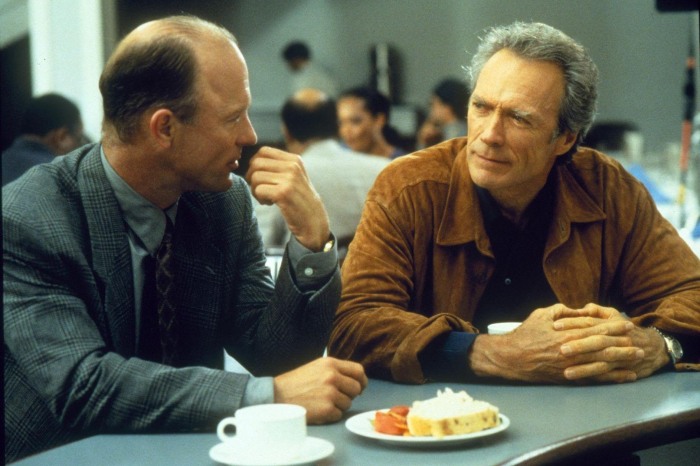
Hot on the trail of both Whitney (and trying to get his head around a murder scene that makes no sense at all) Seth Frank (Ed Harris) is a good cop who gets close to Whitney’s daughter Kate during the investigation. In wonderful scene in the art gallery both Frank and Whitney cross swords and discuss the case at hand. Both Harris and Eastwood show what great actors they are here. Not a single line of the script becomes cryptic and they both make clear the underlying conversation about the investigation.

Another interesting element is the Secret Service agent Burton. His guilt bears down hard on him, unlike Collin who is more of a cold killing machine that only responds to orders from above. Burton represents the only person inside the President’s circle who seems to realize the moral issues at play. While everyone is blinded by their duty to the President, he is the one who stops and realizes they made a mistake that was not just. It’s fascinating that two men like Burton and Collin (so different in beliefs) can work side by side in government.

As fate would have it Whitney’s daughter Kate is of course a law prosecutor. This is quite an obvious move by the script to push moral questions onto Whitney who (being a thief) obviously an individual moral compass. Kate also provides a good motive for him to come out of hiding. In the scene in the outdoor cafÈ we see Whitney risk snipers to see his daughter who is now working with Frank to bring her father in. Eastwood does well to keep the action simple and not go over board.
The key to Whitney’s redemption is for him to allow the law to solve the murder and bring the real killers to justice. Whitney uses his slippery skills to incriminate the guilty people but not before he reverses his own sin (putting the swag he robbed back). The movie is about the importance of telling the truth sure, but the movie also makes the point that corruption blinds good people and so bad things happen.

Absolute Power is solid viewing and well worth a watch on a Saturday night in. Like much of Clint Eastwood’s directorial work in the 90s, it shows him building toward the quality of directing we now take for granted in his more recent work: Million Dollar Baby (2004) and Mystic River (2003).

Surinder Singh – Feb 2010


ABSOLUTE POWER, 1997

1987 Movie Review: SPACEBALLS, 1987


SPACEBALLS MOVIE POSTER
SPACEBALLS, 1987
Movie Reviews

Directed by Mel Brooks
Starring: Mel Brooks, John Candy, Rick Moranis, Bill Pullman, Daphne Zuniga
Review by Mark Engberg

SYNOPSIS:

Having squandered their own air supply, the inhabitants of Planet Spaceball kidnap a wealthy princess to rob her planet of its precious resources.

CLICK HERE and watch 2009 MOVIES FOR FREE!

REVIEW:

“Everybody got that?” Dark Helmet asks the audience after his chief-in-command Colonel Sandurz delivers the plot exposition to his fellow villains.

This late 80’s parody of science-fiction fanfare may have been tardy in satirizing the “Star Wars” empire that George Lucas built a decade earlier. In describing his prime target in making “Spaceballs”, Mel Brooks calls the sci-fi epic “the final frontier. It is the last genre I can destroy. So I am destroying it.”

Additionally, he has categorized this entry as “half wit, half physical, half disgusting, and sometimes beautiful. It’s my appreciation of the human event.”

While some critics have challenged Mr. Brooks’ timeliness in the sci-fi parody, this film has enjoyed a cult appreciation in terms of its clever writing and enjoyable characters. Another factor to appreciate: Apogee, Inc accomplished the special effects in this comedy in the dwindling days of pre-digital CGI. Like the original “Star Wars” trilogy, Agogee’s special effects team had to construct models with computerized motion control systems to give the flying Winnebago and endless Spaceball One the illusions of movement.

During these contemporary days of special effects design where anything and everything can be done with digital enhancement, it is refreshing to watch a master like Mel Brooks carve genuine comedy out of handcrafted science fiction.

Even though “Spaceballs” features lasers, spaceships, and alien make-up galore, Brooks never steps too far away from his fan base in delivering the pratfalls and one-liners that made the man a comic icon. He even gets a guy in a bear suit to get a cheap laugh in the third act.

The movie begins with a “Star Wars” scroll giving the audience a brief history of the Spaceballs universe. Under the hilarious leadership of President Skroob (Mel Brooks, hmm, I just realized the name is an anagram) the citizens of Planet Spaceball are forced to invade new worlds in order to steal their air supply.

Mimicking “Star Wars” to the last detail, Dark Helmet (Rick Moranis) and Colonel Sandurz (George Wyner) kidnap Princess Vespa (Daphne Zuniga) in an effort to blackmail her father, King Roland (Brooks all-star for father figures, Dick Van Patten).

This is where Bill Pullman and John Candy come in, as Captain Lone Starr and his sidekick Barf, an allusion to Chewbacca in that he is half-man, half-dog. Candy is hysterical in his performance of the mawg, but the real winners of this role are the operators of Barf’s mechanical canine-like ears. Every time Barf appears to listen, his auto-receptive ears perk up like antennae. The effect is comic gold.

Like Han Solo, the character of Lone Starr is motivated by money. With perfect deadpan, Pullman says, “Barf, we’re not doing this for the spacebucks. We’re doing it for a shitload of spacebucks!”

The reason for the greed is that Lone Starr has a heavy debt to pay Pizza the Hut (voiced by the recently departed Dom DeLuise). And Pullman plays the character of Lone Starr with a humorous yet touching sentiment that would have made Harrison Ford proud. With a note of sadness, Lone Starr tells Vespa he hails from the Ford Galaxy. Those who do not remember the Ford Galxie 500 have come to assume that this joke is a reference to the actor who played Han Solo.

But there is more than enough of “Star Wars” reference to go around. Brooks even uses the famous Wilhelm scream as one of his Spaceball troops is shot in the ass by incoming laser fire.As a matter of fact, keep an eagle eye out for the Millennium Falcon parked next to Lone Starr’s Winnebago at the interstellar gas station.

This is not to say that George Lucas’ beloved saga of “Star Wars” is the sole target of Mr. Brooks’ parodying lightsabre. In “Spaceballs”, he references “The Wizard of Oz”, “Star Trek”, “Alien”, and even “Planet of the Apes”. Keep a sharp ear ready for that last one. That is the voice of Michael York playing the second ape on horseback.

Brooks definitely goes above and beyond his traditional self-reflective voice in this film. In ways like never before, the writer/director/producer/star lists his former Hollywood achievements as videotapes stored upon a futuristic spaceship.

“Instant cassettes,” says Col. Sandurz. “They’re out in stores before the movie is finished.”

In one of my favorite comedic sequences of all time, the villainous Spaceballs fast-forward through their own movie in order to discover the location of the good guys. After which, Dark Helmet and Sandurz engage in an Abbott and Costello routine of existential misunderstanding.

And the self-reflective filmmaking joke continues throughout the movie. Before teaching Lone Starr about the powers of the Schwartz, Yogurt (also played by Mr. Brooks) explains his profession upon his lonely planet.

“Merchandising,” says Yogurt. “Where the real money from the movie is made.” Yogurt then goes on to sell the audience item after item of Spaceballs merchandise, all of which is a joke. In fact, Mr. Lucas allowed Brooks to make “Spaceballs” on the condition that there would be no merchandising for this movie. This would, of course, account for the spotty nature of the “merchandise”. Notice that “Spaceballs: The Coloring Book” is nothing more than a Transformers illustration book (Twenty years before Michael Bay began ruining my beloved robotic heroes himself!)

There are many other individual items of “Spaceballs” to enjoy for the pure sake of silliness. John Candy wins the award for the best use of the middle finger (beating out Keanu Reeves in “The Matrix” and Jennifer Aniston in “Office Space”) after Lone Starr and Barf park the Winnebago in the Spaceball penal territory.

I am also a big fan of the great Stephen Tobolowsky’s short yet pleasing scene as an effeminate Captain of the Guards. He only has a couple of lines, but there is just something about his delivery that makes his character as memorable as Barf.

“Spectacular stunt, my friends, but all for not . . .” he lectures to his captives before realizing they are nothing more than stunt doubles.

The scene when Dark Helmet is caught playing with the Spaceballs action figures is also one of my favorite reactions in filmed comedy. According to cinema trivia, Moranis performed this scene impromptu after Brooks suddenly conjured up the premise on set. How they got the action figure so quickly is anyone’s guess.

And let’s not forget Joan Rivers as the voice of Dot Matrix, Princess Vespa’s personal assistant droid. Ironic, though, that the Joan Rivers of today currently resembles the physical appearance of the golden android.

A subtle shout is also made to fans of literary essays. When Spaceball One is revealed to be a gigantic transformer about to engage in “metamorphosis”, Dark Helmet prompts his officer: “Ready, Kafka?” Think about that one.

Final thought: Does the alien that bursts out of John Hurt’s stomach play a song that seems familiar to all who watched those classic Looney Tunes cartoons? It should. The song and top hat dance number is homage to “One Froggy Evening”. You know, the one where the frog grabs a cane and dances to “The Michigan Rag.”
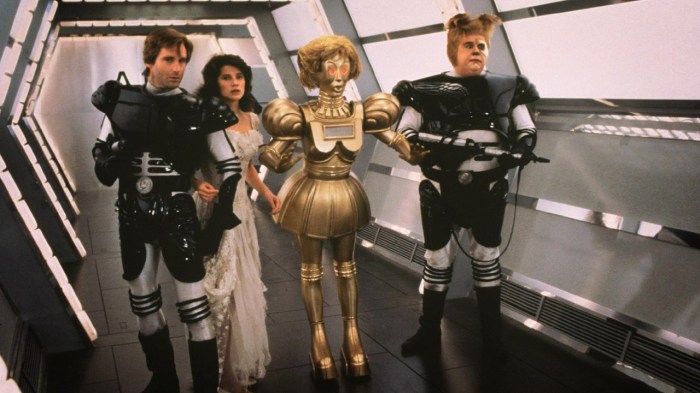
SPACEBALLS, 1987.jpg

Also, Free logline submissions. The Writing Festival network averages over 95,000 unique visitors a day.
Great way to get your story out: http://www.wildsound.ca/logline.html

Deadlines to Submit your Screenplay, Novel, Story, or Poem to the festival:http://www.wildsound.ca

Watch recent Writing Festival Videos. At least 15 winning videos a month:http://www.wildsoundfestival.com