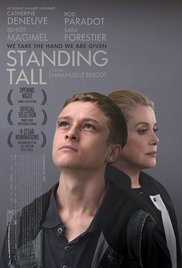
LA TETE HAUTE (STANDING TALL) (France 2016) ****

standingtall.jpgLA TETE HAUTE (STANDING TALL) (France 2016) ****
Directed by Emmanuelle Bercot

Starring: Catherine Deneuve, Rod Paradot, Benoît Magimel

Review by Gilbert Seah

LA TETE HAUTE follows, for a large portion, the same filming style as the Cannes winner Laurent Cantet’s ENTRE LES MURS (THE CLASSROOM) and the more recent Stephanie Brize’s LA LOI Du MARCHE (MEASURE OF A MAN). All three turn out to be fascinating films, real life dramas suited to this kind of filming technique. The filming often has the camera stationed in a set-up in which a confrontation occurs. The actors have their role plays and they go at it, ensemble-style. The result is a compelling watch, with a more realistic feel as the scene looks totally unscripted, though it may not be. The camera focuses primarily on the actors, often with closeups on the reactions of dialogue that take place. The Dardenne Brothers attain an identical realism with a different technique, often placing the camera at neck level of the actors and following them closely around. LA TETE HAUTE occasionally feels like a Dardennes film since the protagonist is a kid, as kids are frequently the subjects in a Dardennes film. It would to be surprising if Bercot herself got some inspiration from Dardennes’ LE FILS another film about a delinquent boy.

Bercot allows the audience to root for the hot-tempered delinquent called Malony(Rod Paradot). Who would not like to see someone progress through the system and improve to be a functional citizen? But Bercot shows that the process is long and difficult but not impossible. Bercot (who co-wrote the script) attributes more effort by those helping the boy than put in by the boy himself. As the adage goes: “It takes a village to rear a child.”

Besides the boy, the supporting characters are all equally interesting. The mother, who is herself a delinquent, loses her two younger boys to social services. The boy’s councillor was himself a delinquent, younger on and got this job believing in the system. And there is the judge, magnificently played by Deneuve with all her regality. The scene in which she stretches out her hand to the boy in both desperation and sympathy is the film’s most touching moment.

But director Bercot takes her film one step further. She inserts more incidents than are normally found in a family drama. Included is a car crash, expertly shot and a home abduction.

There is much change the boy goes through, but these changes must be observed by the viewer. Malony is shown for once in a very vulnerable state crying for his mother when placed in prison for the first time. The way he holds the pencil to sign his name at the judge’s office shows progress from the way he held a pen with his fist at the start of the film. It can also be observed that most of the characters, the councillor and judge are also victims of the system. They have to work the system, just like the boy to each’s own advantage. There is much to be observed and learnt from Bercot’s film. That is what makes it so outstanding. It is a film about life and hardship – and how everyone faces his or her own at one time or another.

It is seldom that we get good French films these days. Cinefranco is gone. The number of French films that are commercially released has been reduced. This winner, that was chosen to open Cannes this year (the last time a French film opened Cannes was in 2005, Dominik Moll’s LEMMING that never got released here). It is a surprise and indeed good news that LA TETE HAUTE is released and before TIFF. The film comes highly recommended.

Movie Review: STEPHEN THE TIME TRAVELLING DOG (2016)

STEPHEN THE TIME TRAVELLING DOG, 3min, UK, Comedy/Fantasy
Directed by Kyran Davies

Where’s Stephen?

Seen at the July 2016 COMEDY FEEDBACK Film Festival in Toronto.

Movie Review by Kierston Drier

Written and directed by Kyran Davies, Stephen The Time Traveling Dog is a delight. Short, humorous and filled with a surplus of sublet and colorful hints of Stephen’s mysterious powers, this film is an all-age laugh.  

The premise left room for much more possibility in the actual plot, but the story was entertaining regardless. It focuses on Stephens’ owner walking home, looking for him. Apparently Stephen gets lost a lot. Along the way of course are hints and clues that Stephen is living a fantastical life away from his owner.

Reprints of famous works of art that feature Stephen litter the owner’s walls.  Prehistoric size bones sit in the dog’s bed.  Antique knick-knacks from all over the world and from every time period litter Stephens’ owner’s’ home, and all serve to assist the world building aspect Stephen The Time Traveling Dog. From a production standpoint, the art and design team put incredible care into the detail, for the more you watch the short, the more subtle clues you find.

Absolutely worth a watch for a quick laugh and a whimsical story, Stephen The Time Traveling Dog will make you wonder what your pet is up to when you’re not around.

Watch the Audience FEEDBACK Video of the short film:

Movie Review: NATIVE IMMIGRATION, 15min, UK, Comedy (2016)

  MOVIE POSTERNATIVE IMMIGRATION, 15min, UK, Comedy
Directed by Eric Romero

A mockumentary about a new shocking phenomenon named by the experts as ‘Native Immigration’. We will put a face to people like Manuel, Olamilekan and Chen Lee, whose life took a 180 degree turn when they discovered that…. they are immigrants.

Seen at the July 2016 COMEDY FEEDBACK Film Festival in Toronto.

Movie Review by Kierston Drier

Native Immigration by Eric Romero is a fine example of political satire. It follows, mockumentary style, one reporter investigating the phenomena of EU natives who come to shocking realization that they are foreigners. The irony here is that they are not actually immigrants, but would be able to pass as immigrant due to their ethnicity or cultural origin.

Unapologetically poking at the ridiculousness of judging a person based on their appearance, Native Immigration is full of one-line gems like “ I thought he was my dad, but it turns out he was just another chinese guy.”

With immigration being a hot topic with the EU in regards to Brexit, this movie is crucially timed to be a hot comedy button. Also potentially controversial enough to land itself in trouble. But for the audiences in North America, the film produces laughs, chuckles and more than a few ironic moments.

The risk of the film’s premise is to be commended, and while the comedy was flat in certain areas, the piece has some truly brilliant comic moments and a hilarious tag at the end. To quote the late and great Oscar Wilde, “ If you want to tell people the truth, make them laugh. Otherwise they’ll kill you.” Bravo Native Immigration.

Watch the Audience FEEDBACK Video of the short film:


Movie Review: THE DRUNK: GETTING HOME, 6min, UK, Comedy (2016)

  MOVIE POSTERTHE DRUNK: GETTING HOME, 6min, UK, Comedy
Directed by Gabriel Foster Prior

Embark on a hilarious journey of a drunk trying to break into his own house. A slapstick comedy written by and starring Fosters Edinburgh Comedy Award nominee Seann Walsh

Seen at the July 2016 COMEDY FEEDBACK Film Festival in Toronto.

Movie Review by Kierston Drier

Take your best friends’ worst drunk story, then double it. We are on the path to The Drunk, written by Seann Walsh directed by Gabriel Foster Prior, a story about getting a little too intoxicated for your own good.

At first you think the story might be an animation as it opens with a charming animated title sequence, but not to be fooled- it is a full live action comedy. Like many under 5 minute short comedy films, it is one long set up. But it certainly doesn’t lack comedy along the way to the punchline. From losing your money in the cab to not finding any food in your fridge, The Drunk takes you step by step through the antics one might get into and the thoughts that flicker through one’s’ mind when they’ve had a few too many.

They say the the true things are the funniest, and The Drunk certainly follows that philosophy as our leading man trips, staggers and crawls his way home, only to be met with the unpleasant realization that he is in the wrong house.

Full of physical comedy, well suited sound and music design and comically developed characters, The Drunk is a great comedy-centric short with lots of offer, if you want to sit back and enjoy someone else’s crazy night- with none of the sober sitting.

Watch the Audience FEEDBACK Video of the short film:

Movie Review: CLEAN BREAK, 5min, UK, Comedy (2016)

  MOVIE POSTERCLEAN BREAK, 5min, UK, Comedy
Directed by Tim Butcher

It’s about time Ben and Elle split. If only they could agree who’s breaking up with who.

Seen at the July 2016 COMEDY. FEEDBACK Film Festival in Toronto.

Movie Review by Kierston Drier

A comedy about people who break up for all the right reasons. The aptly named Clean Break,  written and directed by Tim Butcher,  is about the couple from hell finally ending it- and coming clean with all the things they hate about each other.

Simply shot, effectively stitched together, perhaps the most charming this about this piece is simply the realness of the characters. They are the people we all want to be when we are fighting and know we are right (even if we aren’t), they are the people that say the things we’d like to say when we know we should hold our tongue. They are coarse, rude, jerks. And every minute is wonderfully laughable. It is like watching your Ex from hell, date your friends’ Ex from hell, and those Ex’s are trying to break up with each other.

If you have ever dated a narcissist, an egotist, a pathological liar, a manic, a crazy-person, or a cold hearted monster from the black lagoon, you’ll find something to enjoy in this anti-romantic romp down break-up alley. Clean Break is a mini romantic comedy, where the guy doesn’t get the girl  (and that’s probably for the best.)

Watch the Audience FEEDBACK Video of the short film:

Movie Review: DRAGON DREAMING, 5min, Australia, Documentary (2016)

  MOVIE POSTERDRAGON DREAMING, 5min, Australia, Documentary
Directed by Daniel Clarke & Amy Pysden

Meet Kushia Young. She can’t hear you. But she can draw you a mystical character in under 10 minutes. This profoundly deaf 20-year-old artist from the remote APY Lands is being recognised for her unique contemporary indigenous drawings.

Seen at the July 2016 Under 5min. FEEDBACK Film Festival in Toronto.

Movie Review by Kierston Drier

Dragon Dreaming is a biographical piece following 20 year old Kushia, an indigenous visual artist from Australia born profoundly deaf. While beautifully shot and with a wonderfully good intentions, Dragon Dreaming has some controversy in it that may be missed at first glance.

The film is undoubtedly meant to raise awareness about this talented young artist and her incredibly skills with the visual medium. And to its credit, Dragon Dreaming does an excellent job at showcasing Kushia’s clear ability. Much of her art is shown throughout the movie, which follows her present story and culminates the Art Exhibition the community organizes for her.

It is certainly a gesture of love that sparks the community to open an exhibition for Kushia, however, many areas of Kushia’s life and her art are glossed over. Very little attention is given to the fact that she is deaf (it is mentioned only once or twice in the movie) and there are less than a handful of shots without sound- which show the world as Kushia would experience it. There is no interpreter for Kushia, meaning she is virtually voiceless for the entire film. She has no way to express herself, except through her art and her own indigenous sign language, but even that is never translated for the audience. It is apparent that Kushia and her family come from a community and background that is marginalized, and her standard of living is well below those around her.

The underlying issue here- the elephant in the room, so to speak- is relationship Australia has with its indigenous people. Too big an issue for this small short film with a big heart.
What Dragon Dreaming reminds all audiences is that talent comes from all walks of life, and it can be nurtured if discovered and given a chance. In this way, all audiences of Dragon Dreaming must hope that the film makes it into the hands of Animators in our most illustrious studios, so that maybe Kushia’s future can be as bright and colorful as her personality.

Watch the Audience FEEDBACK Video of the short film:

Movie Review: DREAMS OR DEMONS, 3min, Denmark, Drama/Life (2016)

  MOVIE POSTERDREAMS OR DEMONS, 3min, Denmark, Drama/Life
Directed by Lisa Svelmoe

A woman liberates herself from her strive for the perfect body.

Seen at the July 2016 Under 5min. FEEDBACK Film Festival in Toronto.

Movie Review by Kierston Drier

Written by Lisa Svelmoe and starring Karoline Bruun-Sorensen, Dreams or Demons is a cinematic piece that highlights our pursuit of the beautiful. A jogger (Bruun-Sorensen) is the relatable character for the audience, running on a treadmill alone to shed, what we must assume, is unwanted pounds. Beside the images of her running, are images of a beautiful lingerie wearing model (Ekatrina Krarup Andersen) as well as unclothed mannequins. As the running intensifies, it is further intercut with our leading ladies’ naked body, with the tell tale blue-marker lines of impending plastic surgery. The mannequins appear as well, but begin to be distorted, with only partial body parts being seen. Finally, a close up of our hero’s head appears wrapped in bandages and silent scream cuts the frantic flurry of images to a halt.

The audience has no dialogue to use as a frame of reference to understand the mind of the hero, but the final images produce closure. In the second last image, our hero is running, naked all for running shoes. She is not on a treadmill but outside on a street at night. Unlike the early images, here she is smiling.

What really must be noted here is the editing. Without the specific choices the editor made, the mind of the character may not have been as clear as it was. Editing it often an overlooked part of the Cinema process. The editing in this piece gave Dreams or Demons a distinct level of clarity.

This piece is clear in it’s goal- what can be altered on the surface is never worth running after. But brings you joy is worth running for. In this way Dream or Demons has an important message to send. To aspire to an unrealistic goal is unfair to yourself- but own your body and it’s appearance is something to be proud of.

Watch the Audience FEEDBACK Video of the short film:

Movie Review: WALK, 1min, Netherlands, Dance/Experimental (2016)

  MOVIE POSTERWALK, 1min, Netherlands, Dance/Experimental
Directed by Nicola Balhuizen Hepp

“The day of my birth, my death began its walk. It is walking toward me, without hurrying.” Jean Cocteau

Seen at the July 2016 Under 5min. FEEDBACK Film Festival in Toronto.

Movie Review by Kierston Drier

Clear your mind of any conventional cinema and open it to the world of experiential and interactive dance and you have a foundation for WALK by Nicola Balhuizon Hepp. The sound design is reminiscent of the low-hum of industrial white noise, and the lighting is highly stylistic, the ultimately affect being something almost other-worldly. This is appropriate for a film like WALK because it offers no clear questions, and no easy answers.

It showcases two unnamed men, dancers Aimar Perez Gali and Rolf Hepp, who may actually be portraying the same character at different stages in life. Both performers, clearly skilled in modern dance, artistically move themselves through a dark void space using what appears to be every creative movement except walking. A metaphor it seems for fluid, but often aimless, movement through life.

If you enjoy the interpretive and the avant-garde, then WALK will be an enjoyable experience. It has interesting imagery, powerful spectacle and indeed, beautiful movement of the human body. Perhaps one way WALK is more powerful as a piece of cinema than it would be a live dance performance, is that the audience is privileged by the means of the camera to look more intimately on the performer. One frame in particular is a close up on the dancer’s bare foot, a detail given emphasis that may have been missed in a live performance.

WALK is an intimate experience, and yet it leaves you with no real answers as to how it wants you to feel. Some may argue in this way it is a perfect metaphor for life itself- captivating, intriguing and coming to an end in what seems like far to short a time.

Watch the Audience FEEDBACK Video of the short film:

Movie Review: CRE-AZIONI, 5min, USA, Drama/Experimental (2016)

  MOVIE POSTERCRE-AZIONI, 5min, USA, Drama/Experimental
Directed by Elena Vannoni

A film about women and time.

Seen at the July 2016 Under 5min. FEEDBACK Film Festival in Toronto.

Movie Review by Kierston Drier

In many ways, theatre gave birth to Cinema. The two share many elements of spectacle and form, although their medium is substantially different. What happens then, when the two mediums converge? Cre-Azioni written and directed by Elena Vannoni is one such product. Avant Garde, theatrical and wholly unconventional for a short film (if there is such a thing) is an artistic interpretation of women in the confines of society.

The film is simply shot, with one shot and set up panning into a woman looking out of a window. The background is stark- black and white. All that seems to exist in this world is the woman, the window and the world beyond it we can hear, but not see. As she stares out, presumably at children laughing and playing, the woman closes the window and begins to touch her face. The music of the piece becomes frantic and panicky, and our heroine is swept up into a corset, a wig put on her and large fake lips placed in her mouth. Hands appear out of nowhere with syringes and appear to inject her body. The woman grapples with her corset, frees herself from her confines, her wig and her accessories. She begins to dance in the apparent void of space behind her window, until she goes to the now open window- this time with ample light hitting her face.

The piece is unapologetically clear about its intent- the constraints of women in society to look a certain way, and they suppression and oppression that occurs within those confines. The way the message is framed, however, is what makes this film really interesting. It is a very theatrical piece, in the sense that the exact same actions could be played out on a stage to a live audience with as equally strong effect. Perhaps the medium of film allows a wider reach to audience, perhaps it translates a different type of solitude for our heroine, as she is not behind simply one pane of glass (the window) we see but also the camera lenses, which we don’t.
The audience can interpret the works’ medium from many angles, but the message, no matter how avant garde, is a good one- happiness is dancing unencumbered. Whether is it on stage or screen, the spectacle of Cre-Azioni is emotional, strong and mindful with clear intent.

Watch the Audience FEEDBACK Video of the short film:

Movie Review: SILENCE, 5min, UK, Romance (2016)

  MOVIE POSTERSILENCE, 5min, UK, Romance
Directed by Elena Brodach

The story of love that everyone dreams.

Seen at the July 2016 Under 5min. FEEDBACK Film Festival in Toronto.

Movie Review by Kierston Drier

Music may well be the language of love. Perhaps that is the thesis of the charming, poignant piece short Silence by director Elena Brodach. Shot in one frame, with no cuts, no dialogue and only two characters, Brodach proves that less really is more. The emotional mastery of the piece is that it is able to produce such strong feelings with seemingly such little effort.

For a film with little in the way of story set-up, the story is very clear. An elderly couple sit in a completely empty theater, watching some sort of performance the viewer cannot see. They can however hear the beautiful orchestra music playing, interrupted only by the occasional squeal of one of the couple’s’ hearing aids going out. After a few moments of uncomfortable adjusting, the two simply lean their heads together and hear the music equally well out of a shared aid. Together, the music swells.

A film that encapsulates one beautiful moment shared between two people who love each other. The wonderment in this short film is that it strips away the youth from beauty. So often our society shows love in the hands of the young, the innocent, the beautiful. Yet Silence reminds us that love is not often falling to our knees in front of the object of our affection, grand romantic gestures or bouquets of flowers. Love is a series of simple gestures that translate to “you matter, I care, these moments are shared.” And Silence pays tribute to love after 30, after 40, after 80.

Silence is colorfully shot, the sound is gorgeously designed and the moment is simple and sweet. It may not win and Oscar, but it can win your heart.

Watch the Audience FEEDBACK Video of the short film: