Movie Review: THE PROGRAM (UK/France 2015)

Deadlines to Submit your Screenplay, Novel, Story, or Poem to the festival:http://www.wildsound.ca

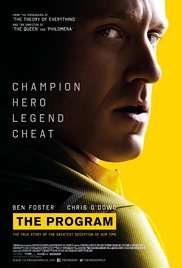
the_programTHE PROGRAM (UK/France 2015)**
Directed by Stephen Frears

Starrting: Ben Foster, Chris O’Dowd, Guillaume Canet, Jesse Plemons, Lee Pace, Dustin Hoffman

Review by Gilbert Seah

Lance Armstrong is infamous the world over. The recent documentary on his disgrace THE ARMSTRONG LIE had informed the world of his demise, and now the fictionalized version is ready to do more of the same. Lance Armstrong (played by Ben Foster) is an American cyclist who won the Tour De France 7 years running. He entertained controversy of his taking performance enhancing drugs (particularly EPO in short). He denied it totally and the world believed him. But after his comeback after a 4-year break, a fellow team member, Floyd Landis (Jesse Plemons) confessed to his and Armstrong’s taking of EPO. The Tour De France stripped Armstrong of all 7 wins.

THE PROGRAM is understandably a French/British co-production as Armstrong obviously not only disgraced himself but the county he represented. THE ARMSTRONG LIE was made and shelved when the disgrace hit the news 3 years later, but released after Armstrong appeared on Oprah.

THE PROGRAM of the title refers to the drug program enforced by the French Doctor, Michele Ferrari (Guillaume Canet), who was eventually banned from practice after word came out of his abuse. When Armstrong realized other cyclists may be using performance enhancing drugs, he begged the doctor to put him on the program at all costs.

It is surprising that Frears and the script by Jon Hodge sees so little time on the Irish reporter, David Walsh (Chris O’Dowd) who uncovered the truth of the story. The film based on Walsh’s book “Seven Deadly Sins’ spends minimum time, showing the reporter’s work and quiet after Armstrong put him to shame. But when he was eventually proven correct, his triumph is just dismissed with the fact that the Sunday Times got their money they initially paid as damages to Armstrong back. Dustin Hoffman, credited in the film also has a one-line scene.

Armstrong is an extremely dislikable man. He shows no humility, is proud and obsessive and full of himself. A film that centres on a lead character with such a personality is obviously going to run into problems. Audiences disliking the lead will most likely dislike the film as a result. Director Frears who has in his carer made some excellent films (PHILOMENA, THE QUEEN) seems at a loss with the character of Armstrong. In his previous films that dealt with unsavoury characters like the pregnant teenage daughter in THE SNAPPER and homosexuality in MY BEAUTIFUL LAUNDRETTE, Frears used humour and satire to make his movie work. But in THE PROGRAM, Frears uses none of these tactics. He tells the story of the ARMSTRONG LIE in a straight forward story-telling convention. Using standard formulaic biopics story-telling, he charts the rise to fame, and slow downfall of the cyclist, highlighting his winning moments to lift the spirit of the story.

There is absolutely no need to watch another version of a disgraced human human being. Armstrong describes himself as a champion. But in reality he is one who has disgraced the sport and a spineless worm with no conscience. The documentary THE ARMSTRONG LIE has already told the same story and extremely well by Alex Gibney (ENRON, TAXI TO THE DARK SIDE), with the real Armstrong as himself using actual footage of himself at the race without any re-enactments. At least Frears shows him, as the worst person that can be, still trying to convince the world of his ability.

The end credits predictably showing each of the featured characters in real life from Armstrong, to the doctor that enforced the drug program re-enforce the fact that Frears seem to be gnu through the motion with this one.

Also, Free logline submissions. The Writing Festival network averages over 95,000 unique visitors a day.
Great way to get your story out: http://www.wildsound.ca/logline.html

Deadlines to Submit your Screenplay, Novel, Story, or Poem to the festival:http://www.wildsound.ca

Watch recent Writing Festival Videos. At least 15 winning videos a month: http://www.wildsoundfestival.com

Interview with Festival Director James Harmon (Sanford International Film Festival)

James Harmon is a high school communications teacher, film club advisor, independent filmmaker, and new dad. Three years ago he started The Sanford International Film Festival in response to the breakdown of another Maine festival, and it has grown in popularity and reputation since. This is the third year of Sanford IFF, which runs five days from May 25-29th across Sanford and Springvale Maine.

http://www.sanfordfilmfest.com/

Matthew Toffolo: What is your Film Festival succeeding at doing for filmmakers?

James Harmon: We’re putting together an amazing showcase of some of the best independent films in the world. We’re presenting our city as a great place to make films, and building a community of passionate, creative, fun people. Filmmakers who make it to their screenings can expect great picture and sound, an attentive and appreciative audience, and respect from film festival staff. We appreciate the sacrifices our filmmakers have had to make to get their films to us, and I take our stewardship very seriously. We pay tribute to our city, our filmmakers, and their films.

MT: What would you expect to experience if you attend the festival this year (2016)?

JM: Our five days will be packed with high-quality experiences. We have local restaurants, ice cream makers, and brewers contributing their best work as well, so expect great movies, great people, great food, and great beverages, and don’t expect to pay a lot! I must insist that everyone buy up tickets to our award ceremony as soon as the ticketspice site goes live. Admission will come with lots of food and drink tickets, and it’s going to be MCd by a local comedian with ties to the film scene.

MT: What are the qualifications for the selected films?

JM: We have ten judges who all have been assigned about twenty hours of films to review. That includes overlap, so each film will be reviewed by at least two different judges, but likely three by the time we’ve made our final decisions. The highest rated films will be programmed first, and we’ll fill our schedule up. There aren’t clear and specific criteria, but our judges have diverse and good taste in movies, so expect quality films. Some might not be your cup of tea, but every one will have something to admire.

MT: Do you think that some films really don’t get a fair shake from film festivals? And if so, why?

JM: Last year we were overwhelmed with over a thousand submissions. It was insane getting through all of them, but decided to charge a submission fee, which is a promise to give every film our undivided attention, and we did. Being on the filmmaker side, I knew from the get go that five, ten, or fifteen bucks isn’t chump change on a micro-budget film. When they put that money to SIFF, we have a duty to the filmmaker. I can’t say that I’ve ever been turned off by a genre, but programming feature films is much more difficult than shorts–when you put a 100 minute film in your festival, you’re picking one long film over ten shorts, which means you’re turning more people away. I think that Experimental Feature films don’t always get a fair shake, but that’s a mistake that SIFF doesn’t make. Last year we showed an incredible one called “Encouragement” by Devin Terrence McAdam and it was one of the scariest films in the festival. Experimental filmmakers aren’t bound to narrative to make you feel. I think our festival also does a great job of showcasing the local film scene without oversaturating the program in it. We balance genres, locals, and internationals.

MT: What motivates you and your team to do this festival?

JM: I love film, and I love the experience of watching and thinking about all of these films, and then communicating with the people who made them, and then celebrating the films with some of those people. It’s incredibly hard work keeping a team together that cares about this, but when you have that, it’s so rewarding to make it happen. It also helps that immediately after the festival locals start asking about the next one. It’s a beloved event around here, and it’s hard to imagine my life without it!

MT: How has the festival changed since its inception?

JM: This festival came to be under very strange circumstances! I had worked with about twenty students on a feature film that was supposed to premiere at the Lewiston Auburn Film Festival in April 2013, and two weeks before our screening, that festival fell apart. The director was arrested on some unrelated unsavory charges, and all of a sudden, I had to cancel a field trip that my filmmakers had been looking forward to all year. When I got word that the festival was cancelled, they CCd all of the filmmakers, and I thought it was a great opportunity to screen films in Sanford, so I contacted our newly-elected Mayor, and he got back to me right away in support of the idea, and I invited all of those filmmakers to come screen in Sanford; we scheduled a meeting and then six weeks later we held The Sanford International Film Festival. It was an amazing effort by so many facets of our city, and we knew that given more time, more thought, and more money we could do it even better. Last year we exploded from two days to five days, from forty movies to one-hundred forty movies, and we judged every submission (adding unbiased judging, a unique 3D printed trophy https://youtu.be/BTEb65PpN6w?list=PLYznuvGuYZb6qp_41sHrryXlX37VE7-t- , and cash prizes to the mix). It has always been about paying tribute to our films and filmmakers, but I think we’ve gotten better at making the process fun for staff as well, and we’ve thought long and hard about what our filmmakers want and what they expect from a festival, and we’ve gotten better year after year delivering on those expectations.

MT: Where do you see the festival by 2020?

JM: I hope we’ve become the festival of the northeast. I think we have the infrastructure in place to grow and refine what we do so that we become more and more attractive, so each year we’ll examine our work and our feedback, and we’ll grow and refine until May in New England means SIFF.

MT: What film have you seen the most times in your life?

JM: Probably Aladdin, Jurassic Park or a Nightmare on Elm Street. I try not to rewatch movies since there are so many amazing ones I have yet to see, but we’re in the dozens on those three. I wouldn’t even necessarily call them my faves, but or whatever reason, they made the cut for question 8!

MT: In one sentence, what makes a great film?

JM: There are three things that need to come together. The technical aspects (does it look and sound good), then I think even more importantly for me, it’s the realistic details… Does everything add up the way it should? Do I believe every bit of dialog and more importantly the non-verbal interaction among characters? The last thing is does this movie need to be? Sometimes a movie can have the first two, but it falls flat because it’s just an average day in an average life. I think a good movie needs to command your attention; why it is should be self-evident.

MT: How is the film scene in your city?

JM: Sanford, Maine is a great place for film and filmmaking. I’ve shot two features and dozens of shorts here, and a few years ago I found out about another film production company that was also doing great work in Sanford after a couple of people mistook them for us, and I read about them in the paper. Neo Phoenix studios is cranking away at a dystopian web series (I DPd their first three episodes: http://www.entertainmentexperiment.com/#!dystopia/l6f7p ) and we have restaurants, local businesses, schools, and city departments all willing to lend a hand, as long as you ask them at the right time, in the right way, for the right thing. I think another great part of filming here is the variety of locations. We’ve got all the natural and rural stuff you can imagine. Sanford can’t double for Metropolis, but you can locate urban scenes in some of the more dense neighborhoods or downtown areas, and our police, fire department, and even the hospital are all very film friendly.


____
Interviewer Matthew Toffolo is currently the CEO of the WILDsound FEEDBACK Film & Writing Festival. The festival that showcases 10-20 screenplay and story readings performed by professional actors every month. And the FEEDBACK Monthly Fesival held in downtown Toronto on the last Thursday of every single month. Go to www.wildsound.ca for more information and to submit your work to the festival.
Deadline Today: Thriller/Suspense Novel Writing

WILDsound Festival's avatarWILDsound Festival

Thriller/Suspense Novel Writing –

SUBMIT your NOVEL

SAVE $50 off the regular submission for full novel submissions. Garner FULL FEEDBACK on your novel by our committee of industry professionals. Get a transcript of your novel performed by professional actors at the Thriller/Suspense Festival.

Watch Recent Thriller/Suspense Stories performed at the festival:

View original post

Interview with Leslie-Ann Coles (Founder & Executive Director Female Eye Film Festival)

14th Annual Female Eye Film Festival – “Always Honest, Not Always Pretty June 14th – June 19th, 2016

The FEMALE EYE VOTED TOP FIFTY FILM FESTIVALS FOR THREE CONSECUTIVE YEARS (2013, 2014, 2015) by MovieMaker Magazine. 

Interview with Leslie-Ann Coles:

Matthew Toffolo: What is your Film Festival succeeding at doing for filmmakers?

Leslie-Ann Coles: The Female Eye Film Festival celebrates its 14th annual edition June 14th – June 19th, 2016 (Toronto, Canada) in which we showcase independent films directed by women. We are known for our excellence in film programming, our professional development and industry sessions, and provide formal and informal networking opportunities to our filmmakers. *I think our most notable success is that we introduce films directed by women to the general public, industry members and stakeholders, and by doing this we help to dispel the myth that women create films for a femme centric audience. In other words, we help break the stereotype that women make “chick flicks”. Also although we present films directed by women, our script development program is open to both men and women. Script must feature a female protagonist.

MT: What would you expect to experience if you attend the festival this year (2016)?

LAC: Attendees will see an eclectic selection of features and shorts in all genres directed by women from around the globe. Independent auteur films that they will not often find in mainstream cinema, or in blockbuster theatres.

MT: What are the qualifications for the selected films?

LAC: Films must be compelling and of high production value. Films must also be directed by women.

MT: Do you think that some films really don’t get a fair shake from film festivals? And if so, why?

LAC: With the plethora of women’s film festivals being birthed around the world, I think there is a strong need to provide a forum in which to showcase films by women directors. Women are making films. Therefore, I do not feel women filmmakers are being represented adequately yet in the international film festival circuit outside of festivals dedicated to female filmmakers.

MT: What motivates you and your team to do this festival?

LAC: Passion. Dedication, and a strong compulsion to represent women filmmakers until there is gender equity in the industry at large.

MT: How has the festival changed since its inception?

LAC: In the early years we received under 200 submissions per year. Now, we receive over 400 submissions annually. Hence, the festival has grown from a four day event to a 6 day festival to accommodate more films. Our industry programs have also evolved and we have been recognized in the “Top Fifty Film Festivals Worth the Entry Fee” for four consecutive years by Movie Maker magazine!

MT: Where do you see the festival by 2020?

LAC: I hope to see the festival expand to ten days.

MT: What film have you seen the most times in your life?

LAC: I tend not to watch the same movie over and over again but if there was a movie that I’ve watched multiple times, it would be The Godfather.

MT: In one sentence, what makes a great film? Feel free to use any of these…sorry can’t keep this to one sentence 🙂

LAC: A great films starts with a great story and it manifests in character, picture, and sound. It is an immersive experience where everything comes together, frame by frame.

A great film is defined by the audience. The audience make a film great. Filmmakers know when their experiencing a great film when their minds don’t wander off into directions of their own filmmaking, ha. And the audience know when they’re experiencing a great film when they are subsumed by the experience and the outer world disappears.

MT: How is the film scene in your city?

LAC: Toronto, Ontario, Canada boasts the most film festivals per capita in the world now. Toronto is rich with film festivals, there’a every week of the year. I believe this is reflective of our innate appreciation for multiculturalism coupled with a deep appreciation for cinema.


____
Interviewer Matthew Toffolo is currently the CEO of the WILDsound FEEDBACK Film & Writing Festival. The festival that showcases 10-20 screenplay and story readings performed by professional actors every month. And the FEEDBACK Monthly Fesival held in downtown Toronto on the last Thursday of every single month. Go to www.wildsound.ca for more information and to submit your work to the festival.

Interview with Festival Director Ruben Kazantsev (IPhone Film Festival)

The iPhone Film Festival was started by a filmmaker for other filmmakers. There are thousands of talented artist that don’t have the resources that major film companies have to create a film. The website was designed to give artist an avenue to show off their gifts to the world by simply using their talents, creativity, and their iPhone.

http://www.iphoneff.com/

Interview with Ruben Kazantsev:

1) What is your Film Festival succeeding at doing for filmmakers?

A: Providing a outlet to showcase their work to the world

2) What would you expect to experience if you attend the festival this year (2016)?

A: Amazing films created by talented film makers from across the globe.

3) What are the qualifications for the selected films?

A: Shot on an iPhone

4) Do you think that some films really don’t get a fair shake from film festivals? And if so, why?

A: For the most part I believe in the process of all festivals and hope they are doing their job to give a fair chance to all films submitted. I know we do

5) What motivates you and your team to do this festival?

A: Knowing that films are created because of us.

6) How has the festival changed since its inception?

A: Quality of the film get better year after year

7) Where do you see the festival by 2020?

A: We will be as big as the Oscars

8) What film have you seen the most times in your life?

A: iPhone film would have to be Departure https://vimeo.com/127691315 because I created the project 🙂

9) In one sentence, what makes a great film?

A: Creativity, team work and the drive to complete it

10) How is the film scene in your city?

A: My city started the film scene, so it is fun to be here

____
Interviewer Matthew Toffolo is currently the CEO of the WILDsound FEEDBACK Film & Writing Festival. The festival that showcases 10-20 screenplay and story readings performed by professional actors every month. And the FEEDBACK Monthly Fesival held in downtown Toronto on the last Thursday of every single month. Go to www.wildsound.ca for more information and to submit your work to the festival.

Interview with Festival Director Tadd Good (Snake Alley Festival of Film)

The Snake Alley Festival of Film is dedicated to showcasing the best short films from around the world. Films will screen at the beautifully restored Capitol Theater in the heart of downtown Burlington, Iowa.

Interview with Festival Director Tadd Good:
Matthew Toffolo: What is your Film Festival succeeding at doing for filmmakers?

Tadd Good: The Snake Alley Festival of Film brings together filmmakers from all corners of the world to network, learn, and enjoy each others films. Many professional and personal relationships have blossomed out of our little film festival. Our festival is all about the filmmakers and giving them an outlet to show their hard work to other like-minded people.

MT: What would you expect to experience if you attend the festival this year (2016)?

TG: Our festival includes several blocks of short films, live screenplay stage readings, and this year we are working on workshops and guest speakers. We also organize after-parties for each night, and an awards ceremony to wrap up the event.

MT: What are the qualifications for the selected films?

TG: SNAFF accepts short films from almost every genre of film. The length limit is 45 minutes.

MT: Do you think that some films really don’t get a fair shake from film festivals? And if so, why?

TG: I think all of the local film festivals I’ve attended keep an open mind.

MT: What motivates you and your team to do this festival?

TG: Our love for film and our local community is what motivates us.

MT: How has the festival changed since its inception?

TG: Since our inceptions we try to grow each year. We look at what works as well as what doesn’t work and try to find a balance. We’ve definitely grown in number of submissions.

MT: Where do you see the festival by 2020?

TG: Bigger and better. We want to be a festival filmmakers remember and return to each year.

MT: What film have you seen the most times in your life?

TG: John Carpenter’s Halloween.

MT: In one sentence, what makes a great film?

TG: A great story told by a passionate filmmaker.

MT: How is the film scene in your city?

TG: Our film scene is slowly growing. I actually program film at our local non-profit theater, so we’re trying to do more cult films, anniversary showings, and bigger events.


____
Interviewer Matthew Toffolo is currently the CEO of the WILDsound FEEDBACK Film & Writing Festival. The festival that showcases 10-20 screenplay and story readings performed by professional actors every month. And the FEEDBACK Monthly Fesival held in downtown Toronto on the last Thursday of every single month. Go to www.wildsound.ca for more information and to submit your work to the festival.

Read Audience Transcript of the Short Film BURGLAR

WILDsound Festival's avatarWILDsound Festival

BURGLAR, 5min, South Korea, Crime/Action
Directed by Hojin Kim

A crime takes place inside of a child’s imagination.

BURGLAR Played at the WILDsound FEEDBACK Film Festival in January 2016. Here is the transcript of the audience feedback from the festival.  Moderated by Matthew Toffolo

Burglar – Audience Feedback

Matthew Toffolo: The film “Burglar” which is a caper movie, kinda cool, a lot going on, it’s from South Korea, and in the end there is a Usual Suspects twist to it where we see that it’s all been in the imagination of the boy. Any comments to make about “Burglar”?

Audience 1: The thing that I really liked about it was that the film was mostly silent so you just get really into the motions and the actions really become the focus. You really feel the tense moments like “maybe they’re going to get caught!” through their actions and I really…

View original post 255 more words

Read Audience Transcript of the Short Film F**KING WORLD

WILDsound Festival's avatarWILDsound Festival

  MOVIE POSTERF**KING WORLD, 1min, Italy, Experimental
Directed by William Mussini

Modern man lives his life in just under a minute and thirty seconds. Frustration, joy, and a sense of incompleteness jumping from one emotion to another, from a knowledge gap to a lack filled by media messages.

Read interview with the director William Mussini

F-KING WORLD Played at the WILDsound FEEDBACK Film Festival in January 2016. Here is the transcript of the audience feedback from the festival. Moderated by Matthew Toffolo

F-KING WORLD – Audience Feedback

MT: I think there are 60 shots in this film, there is a shot every second. Anybody want to tell me what this film is about?

Audience 1: I was so confused, but to their credit that was amazing editing and I think by the end of it I got what they were trying to do. My first impression was that this sounds like a…

View original post 411 more words

Read Audience Transcript from the short film LIKE IN THE MOVIES

WILDsound Festival's avatarWILDsound Festival

  MOVIE POSTERLIKE IN THE MOVIES, 5min, Italy, Documentary
Directed by Francesco Faralli

Following his cinephile passion, Daniele Bonarini (from the Association “Il Cenacolo Francescano”), realizes digital feature films shot with the enthusiastic support of friends and volunteers using disabled persons as actors.

Read interview with director Francesco Faralli

LIKE IN THE MOVIES Played at the WILDsound FEEDBACK Film Festival in January 2016. Here is the transcript of the audience feedback from the festival. Moderated by Matthew Toffolo.

LIKE IN THE MOVIES – Audience Feedback

MT: “Like in the Movies”, a documentary film about making a film with disabled actors. This kind of tugged at out heart strings a little bit and with some comedy as well. Would anybody like to make the first comment?

Audience 1: The start of it was really nice, I mean for the first couple of seconds it almost feels like it’s going to be exploiting them…

View original post 277 more words