Interview with Festival Director Joseph Kephart (Wait A Minute Film Festival)

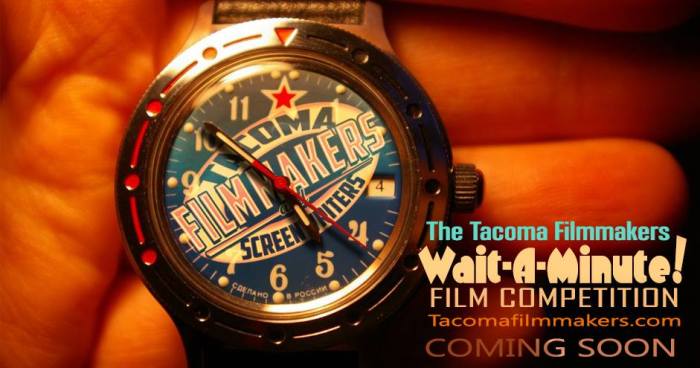
wait_a_minute_2.jpgThe WAM (Wait-a-Minute) Film Competition and Festival started in 2013. It is part of the Tacoma Filmmakers group. You can find them at http://www.Tacomafilmmakers.com as well as Facebook.  They are here to help the community as well as facilitate contacts to help filmmakers. They look forward to partnering with companies to assist the needs of filmmakers.

Matthew Toffolo: What is your Film Festival succeeding at doing
for filmmakers?

Joseph Kephart: We’ve just started a few years ago, so as far as succeeding I’m not sure yet, but the intent is to give filmmakers an opportunity and a venue to display their craft.

MT: What would you expect to experience if you attend the festival this year (2016)?

JK: A great time, recognition, some nifty prizes and if needed the push for filmmakers to continue on their path.

MT: What are the qualifications for the selected films?

JK: Films must be 1 minute in length and contain the mystery element required for the current competition. Filmmakers have 1 week to film their masterpiece. We are unique in the fact that among other competitions where filmmakers are given 24 to 72 hours to complete a film, we believe in giving them a week to polish their films. Also, we require a mystery element to be included in the film, but unlike other festivals we offer a concept that must be used. Example, our most recent requirement was the concept of “Transformation.”

MT: Do you think that some films really don’t get a fair shake from film festivals? And if so, why?

JK: As I understand it, the trend is to cram as many films into a festival as possible. Which I can understand from a marketing standpoint. So… speaking from experience if your film doesn’t fit into the box so easy, you may not have a chance.

MT: What motivates you and your team to do this festival?

JK: We like to help filmmakers and believe in promoting this type of “art medium” in our community. It’s also a great way for everyone to network.

MT: How has the festival changed since its inception?

JK: The prizes have gotten bigger and we’ve changed venues. We’ve gone from showing in a historical building to showing films at a lovely historical theater.

MT: Where do you see the festival by 2020?

JK: I’d like it to be an institution, a fun one, eventually passed onto others to run.

MT: What film have you seen the most times in your life?

JK: Probably Delicatessen by Jean-Pierre Jeunet and Marc Caro.

MT: In one sentence, what makes a great film?

JK: For me it’s always been creativity.

MT: How is the film scene in your city?

JK: As far as indie film making goes, it seems to be blossoming. Tacoma and the Pacific Northwest is a great place and most people that I’ve met are cool and laid back. This film festival is all about helping and promoting filmmakers. I think Tacoma shares that same sentiment.

wait_a_minute_1.jpg

_____
Joseph Kephart is a filmmaker who lives in Tacoma WA and serves on the executive committee of Tacoma Filmmakers. His production company Hooligan Street Pictures, has made short films in the past and is now venturing into the world of feature film making. Visit www.hooliganstreet.com for more information.
_____

Interviewer Matthew Toffolo is currently the CEO of the WILDsound FEEDBACK Film & Writing Festival. The festival that showcases 10-20 screenplay and story readings performed by professional actors every month. And the FEEDBACK Monthly Festival held in downtown Toronto on the last Thursday of every single month. Go tohttp://www.wildsound.ca for more information and to submit your work to the festival.

TIFF 2016 Movie Review: UNLESS (Canada/Ireland 2016) ***

Movie Reviews of films that will be playing at TIFF (Toronto International Film Festival) in 2016. Go to TIFF 2016 Movie Reviews and read reviews of films showing at the festival.

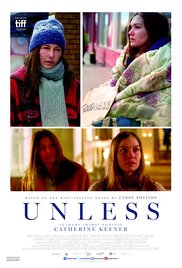
unless_poster.jpgUNLESS (Canada/Ireland 2016) ***
Directed by Alan Gilsenan

Starring: Catherine Keener, Matt Craven, Hannah Gross

Review by Matthew Toffolo

Academy Award nominee Catherine Keener and Hannah Gross star in this adaptation of the final novel by the late, great Canadian novelist Carol Shields, about a writer who discovers her runaway daughter panhandling on the street and seemingly deprived of speech.

An accomplished writer and translator, Reta Winters (Keener) is blindsided and flummoxed by the recent actions of her eldest daughter, Norah (Hannah Gross). For no discernible reason, Norah has dropped out of university and now spends her days panhandling on the sidewalk outside of Toronto landmark Honest Ed’s.

The cardboard sign she affixes to her chest features only one word: GOODNESS. Reta fears losing her connection to her daughter, but is it possible Norah is seeking some way of reconnecting to the world?

The question remains throughout the film of “WHY?”. Why is this happening to this girl? Is this a spiritual journey that Norah is experiencing, or is it more of an emotional breakdown? The payoff does come in the end and it’s perhaps a bit perplexing on what took so long for this family to figure this all out! The only real flaw of this film.

This is a very original film in terms of its story and how it treats a person like Norah. I’m sure many in the medical profession would roll their eyes at this film as science demands an answer. It’s simple cause and effect equaling a conclusion to why. UNLESS attempts to answer the “WHY” from a more metaphysical point of view. Things are not that simple and many humans need to explore what this world and existence is all about – especially after experiencing a tragedy like Norah has.

UNLESS is simply the perfect film for a festival like TIFF. It’s never going to garner a large amount of attention and many critics will dismiss this film because its plot points and directorial design aren’t something they are used to. If you’re a fan of festivals and are looking to see films that you won’t see at the cinema or on NetFlix, UNLESS is that perfect film.

Free logline submissions. The Writing Festival network averages over 95,000 unique visitors a day.

Great way to get your story out: http://www.wildsound.ca/logline.html

Deadlines to Submit your Screenplay, Novel, Story, or Poem to the festival:http://www.wildsound.ca

Watch recent Writing Festival Videos. At least 15 winning videos a month: http://www.wildsoundfestival.com

Best of 10 Cloverfield Lane

Read interview with the top film crew of the film, plus a praising movie review of the film that will set box office records this weekend:

Movie Review: 10 CLOVERFIELD LANE ***1/2
https://festivalreviews.org/2016/03/10/movie-review-10-cloverfield-lane/

Spoiler Alert: Please note that in order to provide a readable film review, there are minor plot points that have to be revealed in the review.

Interview with Cinematographer Jeff Cutter (10 Cloverfield Lane):
Interview with Cinematographer Jeff Cutter (10 Cloverfield Lane)

From Jeff Cutter: Expect a taut, tense psychological thriller with 1 or 2 big surprises. I had a great time working on the film as we had a wonderful director in Dan Trachtenberg and an extremely supportive production company in Bad Robot. It was a relatively small budget, and had challenges as a result, but since it is mostly a very contained script we could maximize the resources we had.

Interview with Special Effects Coordinator Donnie Dean (10 Cloverfield Lane):
Interview with Special Effects Coordinator Donnie Dean (Emmy Winner – American Horror Story)

From Donnie Dean: I can say we didn’t know until everyone else in the world that it was to be 10 Cloverfield. It was called Valencia up until then and no one knew it was related to Cloverfield at all.

Interview with Stunt Double Olga Wilhelmine (10 Cloverfield Lane):
Interview with Stunt Double Olga Wilhelmine (10 Cloverfield Lane)

From Olga Wilhelmine: I was Mary Elizabeth Winstead’s stand-in, photo double and stunt double on 10 Cloverfield Lane so I was there every day with her on set. We filmed about 7 weeks in New Orleans mainly on a sound stage bunker set which was kept dark and lots of smoke, dust and special effects that add to the bunker feel. Being in the dark all day was a bit harrowing especially in the beginning and we really felt like we were in a bunker.

****
Also, Free logline submissions. The Writing Festival network averages over 95,000 unique visitors a day.
Great way to get your story out: http://www.wildsound.ca/logline.html

Deadlines to Submit your Screenplay, Novel, Story, or Poem to the festival: http://www.wildsound.ca

Watch recent Writing Festival Videos. At least 15 winning videos a month: http://www.wildsoundfestival.com

Interview with Festival Currator Mike Fallek (THE FESTIVAL OF COLORS)

The Festival of Colors is week long film and arts festival in Art Cafe Bar. Daily screenings, workshops, parties, and performances all to bring together this budding artist hub.

The Festival of Colors is concerned with growing its local community of creators in Prospect Heights, so locals who can show up for the festival will get preferred treatment. BUT THIS YEAR’S THEME IS “CIRCLING THE GLOBE FROM SPACE.”

http://www.festivalofcolors.org/

Currator Mike Fallek is a stop motion animator and is best friends with a ferret.

Interview with Mike Fallek:

Matthew Toffolo: What is your Film Festival succeeding at doing for filmmakers?

Mike Fallek: Our festival is focused on filmmakers meeting potential collaborators and future partners. We accept more films and screen on an ON DEMAND basis throughout the week. We focus on throwing amazing parties for filmmakers to meet new people. We all love watching films but festivals are for filmmakers and it’s hard to meet people when everyone has to be quiet in the dark.

Matthew: What would you expect to experience if you attend the festival this year (2016)?

Mike: I expect that it will be a year that helps filmmakers redefine how they want to use their resources. I hope we can provide the knowledge to show the modern independent filmmaker where to focus energy.

Matthew: What are the qualifications for the selected films?

Mike: Good. A qualified film has to be good. I personally watch all of the hundreds of entries start to finish and talk personally to all accepted entrants. Because I want to be a fan of any work that comes my way.

Matthew: Do you think that some films really don’t get a fair shake from film festivals? And if so, why?

Mike: No films get a fair shake ever. Film is a game of emotions. Emotions aren’t fair. Most people, even despite any of their education, judge films on how they are feeling that day. We try to eliminate that human element from our festival. I’ll like your film even if it bums me out on a good day.

Matthew: What motivates you and your team to do this festival?

Mike: Bringing people together. I got this interview in an email. I haven’t met the question asker, but I feel connected to you. I am honored to get to be even more intimate and see the deepest thoughts of filmmakers from around the world. We milk this feeling of connection until there is nothing left. Meeting people is our passion.

Matthew: How has the festival changed since its inception?

Mike: This is our second year and it has exploded already.

Matthew: Where do you see the festival by 2020?

Mike: By 2020, …Lasers? Lasers sound future-y

Matthew: What film have you seen the most times in your life?

Mike: I’ve probably seen that clip about FBI copyright infringement a billion times. I love DVDs and special features. They don’t show the FBI warning in theaters. Running a festival is like the special features for every movie. I get to hear the backstories behind tons of films.

Matthew: In one sentence, what makes a great film?

Mike: Editing make a film great.

Matthew: How is the film scene in your city?

Mike: The festival in in Brooklyn, I think film is doing ok here ;P


____
Interviewer Matthew Toffolo is currently the CEO of the WILDsound FEEDBACK Film & Writing Festival. The festival that showcases 10-20 screenplay and story readings performed by professional actors every month. And the FEEDBACK Monthly Fesival held in downtown Toronto on the last Thursday of every single month. Go to www.wildsound.ca for more information and to submit your work to the festival.


Interview with Festival Director Ruben Kazantsev (IPhone Film Festival)

The iPhone Film Festival was started by a filmmaker for other filmmakers. There are thousands of talented artist that don’t have the resources that major film companies have to create a film. The website was designed to give artist an avenue to show off their gifts to the world by simply using their talents, creativity, and their iPhone.

http://www.iphoneff.com/

Interview with Ruben Kazantsev:

1) What is your Film Festival succeeding at doing for filmmakers?

A: Providing a outlet to showcase their work to the world

2) What would you expect to experience if you attend the festival this year (2016)?

A: Amazing films created by talented film makers from across the globe.

3) What are the qualifications for the selected films?

A: Shot on an iPhone

4) Do you think that some films really don’t get a fair shake from film festivals? And if so, why?

A: For the most part I believe in the process of all festivals and hope they are doing their job to give a fair chance to all films submitted. I know we do

5) What motivates you and your team to do this festival?

A: Knowing that films are created because of us.

6) How has the festival changed since its inception?

A: Quality of the film get better year after year

7) Where do you see the festival by 2020?

A: We will be as big as the Oscars

8) What film have you seen the most times in your life?

A: iPhone film would have to be Departure https://vimeo.com/127691315 because I created the project 🙂

9) In one sentence, what makes a great film?

A: Creativity, team work and the drive to complete it

10) How is the film scene in your city?

A: My city started the film scene, so it is fun to be here

____
Interviewer Matthew Toffolo is currently the CEO of the WILDsound FEEDBACK Film & Writing Festival. The festival that showcases 10-20 screenplay and story readings performed by professional actors every month. And the FEEDBACK Monthly Fesival held in downtown Toronto on the last Thursday of every single month. Go to www.wildsound.ca for more information and to submit your work to the festival.

Interview with Festival Director Crystal Pelkey (Short Shorts Film Festival)

The Short Shorts Film Festival in Duluth, MN is celebrating its 11th year in 2016. 
It is the only festival of its kind in Northern Minnesota. The festival brings 
together amateur and professional filmmakers from all across the globe to 
compete for cash prizes. Each film must be under five minutes. The audience 
scores each film and ultimately, the top three winners. The festival features many 
genres including, but not limited to: animation, comedy, drama, documentary, 
experimental, and music videos.

Interview with Festival Director Crystal Pelkey:

Matthew Toffolo: What is your Film Festival succeeding at doing for filmmakers?

Crystal Pelkey: ​Our film festival provides an opportunity for amateur filmmakers to be on the same stage as professional filmmakers. It’s a place for creative storytelling to take center stage and telling that story in less than five minutes is a unique challenge that many filmmakers embrace and succeed at.

Matthew: What would you expect to experience if you attend the festival this year (2016)?

Crystal: Our audiences can expect to play an active role in our festival, in that that ​​they score each film and ultimately pick the top three cash prize winners!​​ Audiences can also expect to see many genres of film: animation, comedy, drama, documentary, experimental, and music video. to name a few.

Matthew: What are the qualifications for the selected films?​

Crystal: The finalists are selected by a panel of judges–the film must be under five minutes, be appropriate for all audiences (rated G).

Since the audience chooses the winners, the primary qualification, other than it being five minutes or less, is really overall impact–audiences are encouraged to consider things like, creativity, quality, cinematography, etc. while scoring each film.

Matthew: Do you think that some films really don’t get a fair shake from film festivals? And if so, why?.

Crystal: There are so many wonderful films and filmmakers out there, and many festivals are limited by time, schedule and resources, so it’s often impossible to screen all the entries and give every film a fair shot. I know it’s very difficult for us to select our finalists, and some great films often get left out.​ ​In terms of programming, producers have to consider things like variety of genres presented, duration of films in conjunction with the festival time frame, content, overall impact of the work presented, etc.​

Matthew: What motivates you and your team to do this festival?

Crystal: ​We are the only short film festival of our kind in our region (Northern, Minnesota) and our audiences have supported our festival over the past ten years (sold-out houses) so that momentum helps keep our team motivated to produce the best festival possible and continue to improve it from year to year.

Matthew: How has the festival changed since its inception?

Crystal: ​Our format has stayed the same– in that films have always needed to be five minutes or less, and that the audience chooses the winners. Over the years, we’ve added local celebrity emcees and this year we are honoring a local filmmaker that has made great films and helped put our community on the map.

Matthew: Where do you see the festival by 2020?

Crystal: ​Maybe by 2020 we will be accepting 20 minute short films? :)​

Matthew: What film have you seen the most times in your life?
Crystal: ​Friends would tease me and say “The Notebook” (that may be true), but I have a very happy family memory of seeing The Fugitive in the theater when it first came out, and I’ve probably seen it 100 times. Similar story for Shawshank Redemption.

Matthew: In one sentence, what makes a great film?

Crystal: ​A great film is one of the greatest gifts–it can transport you out of a moment in time, and allow you to momentarily forget all of your troubles, and at the end, it may even allow you to understand yourself better, and this wild ride called the human experience.

Matthew: How is the film scene in your city?

Crystal: ​We have a great film scene in Duluth, MN. We have a local art house cinema that continues to bring films to our city that we may not get otherwise. We have an exciting film festival that takes place in a barn every summer (Free Range Film Festival) and ​we have an annual Duluth/Superior Film Festival each Spring that often brings Hollywood starts to our beautiful city on the shores of Lake Superior.

_____

Crystal Pelkey is the producer of the Short Shorts Film Festival and one of the 
festivals co-founders. Her day job is the Director of Patron Services & Special 
Events at the Duluth Playhouse, Minnesota’s oldest community theater. She is an 
active community member, local playwright, and freelance jewelry designer.  
Crystal loves film and is often known to watch Lifetime on Saturday afternoons. 
She once punked George Clooney, by asking him for a photo, then handing him 
her camera to take a picture of her and her friend.  
PHOTO of Crystal Pelkey:
CrystalPelkey1

Interviewer Matthew Toffolo is currently the CEO of the WILDsound FEEDBACK Film & Writing Festival. The festival that showcases 10-20 screenplay and story readings performed by professional actors every month. And the FEEDBACK Monthly Festival held in downtown Toronto on the last Thursday of every single month. Go to www.wildsound.ca for more information and to submit your work to the festival.

Interview with Festival Director Christina Wilkinson (ITSA Film Festival)

The 7th Annual ITSA Film Festival takes place in Sonora, California in the heart of Gold Country the second Friday, Saturday and Sunday of November 2016. Run entirely by volunteers, ITSA Film Festival is dedicated to creating a wider audience and a greater awareness for all filmmakers, especially up-and-coming and students.

I recently chatted with the Festival Founder Christina Wilkinson:

Matthew Toffolo: What is yourFilm Festival ​succeeding at doing for filmmakers?

Christina Wilkinson: We strive to connect filmmakers of all ages at all levels of experience with each other. By screening films from filmmakers as young as 10 years old, we are able to be unique in that we know where our next generation of filmmakers come from; so we go out of our way to feature them at a very young age.

Matthew: What would you expect to experience if you attend the festival this year (2016)?

Christina: We feature one or two (sometimes three) workshops that are included to attend all for free at our festival. One of our favorite genres of films is music videos, so we are also bringing in live music performances for the entire weekend. The average amount of short films we screen is around 60 total over the course of the three days. After each film, we set aside time for Q&A with individual filmmakers and casts. One of our biggest highlights is our main guest speakers panel where we have up to 5 invited industry guests from Los Angeles and San Francisco. We are also planning another private filmmaker reception where they can network with each other.

Matthew: What are the qualifications for the selected films?

Christina: Under 30 minutes in any genre. We normally do not have a strict timeframe a film should have been made, but within the last 5 years is great.

Matthew: Do you think that some films really don’t get a fair shake from film festivals? And if so, why?

Christina: Yes. Sometimes we receive an abundance of films that contain the same subject matter. When this happens, we go back through and select the best of that specific topic. So sometimes a film may be very good, but if too many films about “Alzheimers” get submitted, we have to determine which ones go through and which ones do not. Successful programming is all about screening 60+ films for an audience and the audience feels as though they have not seen the same type of story over and over again. That is the key.

Also, we do program for timing. For instance, if we have already selected numerous films and our extended deadline is coming up, at this time we only set a small amount of time aside to fill. So this is where programming gets complicated. It’s like building a puzzle from scratch. We take the best of what has not been selected and give it the first amount of time. After we have gotten down to maybe seven minutes remaining, even possibly up to two minutes, we are left to determine what film can take that final spot. This could mean a fun film that is only three minutes may be selected to screen over a good 30 minute film because the longer film did not compete well with the other “good” films, and since it is too long to fit the spot, it won’t be selected.

Another reason some films may not get a “fair shake” is due to location. While we have screened many diverse films, there are those that are too strong-handed or political in many directions, and that is not what we are after. Messages can be sent subtlety, yet successfully. A few years ago we had a film submitted about homosexuality. It was star-filled and beautifully made (in the first 20 minutes). But in the last part of it, pre screeners and program directors felt as though it took a negative turn by bashing a segment of our local population. Therefore we made the decision not to accept it. This film probably lost out on winning many awards in other festivals by not being accepted for this very reason.

Our festival’s goal is to get audiences in the seats and get exposure for our filmmakers. If the majority of our audience is upset by too many of our selections, they might not attend again, and this hurts our filmmakers. Therefore we try very hard to be diverse in our official selections.

Matthew: What motivates you and your team to do this festival?

Christina: Our entire ITSA Film Festival family is made up of film fans. We are all volunteers and put any money from the festival back into the festival to make it better. As a founder, ideas on how to spend any proceeds is discussed by the team during regular meetings. So they get input too; and this doesn’t happen in a lot of film festivals. When someone attends the ITSA Film Festival, they know that the faces of Team ITSA have largely remained the same year-after-year. We are about keeping our guests, attending filmmakers and audiences happy. When we hear what a great time everyone has had and the amazing contacts they have made, that is what motivates us and drives us all to continue what we are doing each year.

Matthew: How has the festival changed since its inception?

Christina: This one is difficult to answer because the ITSA Film Festival changes every year. We are constantly trying new things, new presentations, new locations, and whatever else we can to make it fun.

Our first three years we were screening the Emerging Cinematography Award (ECA) films as something different, but these films took up a huge chunk of programming time. So we decided to showcase more submissions and cut the ECA films. We had a formal gala for several years at a substantial cost to ourselves – we actually lost money because of it. Now we have a less formal filmmakers reception for two included in each film official acceptance. This allows better one-on-one time for our guests and filmmakers at no additional cost to them.

We had multiple locations, but felt it became too spread out to handle. So we try to have our entire festival in just one location.

We’ve had live music in the past and are bringing this back.

One of our biggest changes is support from our community. And since our biggest goal is to have audiences as large as possible, our festival is free to the public. We are more about the filmmakers and less about the money – although the money is great to continue doing what we have done. Last year was the first time we did not spend our own personal money out-of-pocket, but every penny we have spent has been worth it.

We also have more sponsors than we did when we started. These relationships are important in our growth.

Matthew: Where do you see the festival by 2020?

Christina: One of our goals is to build up to the attendance numbers that the old Wild West Film Fest had before shutting down in 2000 here in Tuolumne County. We also foresee filmmakers coming back to California’s Gold Country to start making films here again. We feel that our festival is about so much more than screening films and folks will see this by 2020.

Matthew: What film have you seen the most times in your life?

Christina: There are a few; Gladiator, Bridget Jones’ Diary and Groundhog Day

Matthew: In one sentence, what makes a great film?

Christina: One that connects with an audience, because a connection pulls someone into a film and they forget they’re even watching.

Matthew: How is the film scene in your city?

Christina: As far as film festivals, ITSA is the only one based here. We hold two festivals a year; ITSA and our environmental festival called Back to Nature Film Festival. There is also a magnet high school that has an annual film festival for its film students, as well as another (traveling) environmental film festival.

Where movies and commercials are concerned, lots of indie films come through the area and one of the films starred Raj Patel. Numerous commercials are filmed in our county. Overall, there have been over 300 films and television series filmed here which include Back to the Future 3, Hidalgo, High Noon, Little House on the Prairie, among others.


***

Interviewer Matthew Toffolo is currently the CEO of the WILDsound FEEDBACK Film & Writing Festival. The festival that showcases 10-20 screenplay and story readings performed by professional actors every month. And the FEEDBACK Monthly Fesival held in downtown Toronto on the last Thursday of every single month. Go to http://www.wildsound.ca for more information and to submit your work to the festival.
Interview with Festival President Sergey Mavrody (Blow-Up Film Festival)

The 2016 BLOW-UP ARTHOUSE FILM FESTIVAL brings the most original storytellers together with very adventurous audiences for its annual program of dramatic and documentary films, shorts, animations, experimental films, and student work. The Festival was named after the Michelangelo Antonioni’s iconic film “Blow-Up”.

For more information, to go: http://www.blowupfilmfest.com/

I recently sat down with the Festival President Sergey Mavrody:

  • What is your Film Festival succeeding at doing for filmmakers?

We believe we succeed in promoting authentic voices that can awaken new ideas that have the power to push creative boundaries, spark new levels of compassion and understanding, and even lead to social change.

  • What would you expect to experience if you attend the festival this year (2016)?

I would expect to bring the most original storytellers together with very adventurous audiences. It would be a great range of quality art-house films from all over the world. I would also expect a smart audience, people, who love art-house films.

  • What are the qualifications for the selected films?

The Festival welcomes serious, independent films aimed at a specific audience rather than a mass-market consumer. We would like to see films made primarily for aesthetic and philosophical reasons rather than commercial profit. The festival would like to approach the caliber of films made by such great directors as Eisenstein, Antonioni, Fellini, Tarkovsky, Godard, Truffaut, Kurosawa.

  • Do you think that some films really don’t get a fair shake from film festivals? And if so, why?

Yes and no. On one hand, many films have to try very hard to get seen and recognized. On the other hand it is hard to miss a truly great and talented film.

  • What motivates you and your team to do this festival?

The main motivation would be to discover new talented artists promoting that type of films that fit well into our vision, that push creative limits and educate audiences. On the other hand, if we have passion we don’t really need a motivation.

  • How has the festival changed since its inception?

The festival is always evolving. We have changed names, concepts, and places of screening, websites, staff, jury, method of film submission.  This is a great question and answer could be very long.

  • Where do you see the festival by 2020?

By 2020 the festival will be making an even greater impact on the world cinema by discovering talented filmmakers and setting new standards.

  • What film have you seen the most times in your life?

The most times in my life I have seen the films I made, of course.

  • In one sentence, what makes a great film?

Well, Jean-Luc Godard once said: all you need for a great movie is a gun and a beautiful girl J That was an irony, of course. Truth: that’s what makes a great film in a nutshell. More specifically, this includes an authentic story and a sincere unpretentious artistic expression.

  • How is the film scene in your city?

The MovieMaker Magazine recently unveiled its list of cities with the best film scene. You’re probably wondering who topped the list? Well, it’s my Chicago! According to the magazine – the criteria they used include festivals, film schools, movie-related vendors, local theatres, living standards, unemployment rate, median home price and aggressive tax incentives. Chicago is also rich in filmmaking history and has seen an increase in both independent and Hollywood film productions in the last few years. As we speak, a bunch of film production trucks parked right on my street. They are filming the “Empire” TV series.

BIO: Sergey A. Mavrody

Sergey Mavrody moved to US from Moscow, Russia in 1990. He was granted a green card as an “Alien of Extraordinary Ability”.  Sergey received his first graduate degree in animation from VGIK film school, Moscow, Russia. Sergey earned his second MFA degree in Computer Animation from the School of the Art Institute of Chicago.

Sergey was a Production Designer for the Emmy Award-winning musical film “The Bridge”. Sergey produced and directed several animated films. His films have received numerous international awards.

Sergey is also a professor at the School of the Art Institute of Chicago and DeVry University. Sergey served as a board member and as a head of the jury at several film festivals. He is a founder and a president of the Blow-Up Arthouse International Film Festival.


http://blowupfilmfest.com/


_____

Interviewer Matthew Toffolo is currently the CEO of the WILDsound FEEDBACK Film & Writing Festival. The festival that showcases 10-20 screenplay and story readings performed by professional actors every month. And the FEEDBACK Monthly Festival held in downtown Toronto on the last Thursday of every single month. Go tohttp://www.wildsound.ca for more information and to submit your work to the festival.

Interview with Festival Director Jeff Ross (SF IndieFest // SF DocFest // Another Hole in the Head)

Jeff Ross was the Operations Manager at San Francisco International Film Festival in the mid 90s and realized American indies had no venue in San Francisco at the time. He started the SF Independent Film Festival in 1998, which expanded to include the SF Documentary Festival in 2001 and the Another Hole in the Head horror/sci fi festival in 2003.

sfindie.com

Get to know Jeff Ross:

Matthew Toffolo: What is your Film Festival succeeding at doing for filmmakers?

Jeff Ross: We provide great audiences, great press coverage and a fun time in San Francisco.

Matthew: What would you expect to experience if you attend the festival this year (2016)?

Jeff: A full show at the historic Roxie Theater (the old movie house west of the Mississippi). Insightful QA interactions. Fun parties.

Matthew: What are the qualifications for the selected films?

Jeff: We look for uniqueness and competent filmmaking.

Matthew: Do you think that some films really don’t get a fair shake from film festivals? And if so, why?

Jeff: No, I think each festival knows its audience and curates accordingly.

Matthew: What motivates you and your team to do this festival?

Jeff: I love getting people together for shared experiences and the opportunity to introduce people to films they would not have found on their own.

Matthew: How has the festival changed since its inception?

Jeff: We’ve grown from a 4 day event with 3000 attendees to three two-week festivals and a year round attendance of about 21,000.

Matthew: Where do you see the festival by 2020?

Jeff: Not much different than today, or 18 years ago. We are motivated to find good films and bring out good audiences to view them, that wont change.

Matthew: What film have you seen the most times in your life?

Jeff: Blade Runner, Casablanca, Fury Road.

Matthew: In one sentence, what makes a great film?

Jeff: Uniqueness either in story or execution.

Matthew: How is the film scene in your city?

Jeff: The audience for arts and culture in San Francisco is stronger than ever.

Interview with Founder/Director, Susan Johnston (New Media Film Festival)

7th Annual New Media Film Festival. Honors Stories Worth Telling in all media that are innovative, imaginative & inspirational. Submit Now Attend June 7-9, 2016

They accept submissions through April 25th and notify by May 5th.  You can use promo code twitter10 good in any category at www.NewMediaFilmFestival.com

Susan Johnston founded the critically acclaimed New Media Film Festival ® in 2009 to honor stories worth telling in the ever changing landscape of media, New Media. Legendary judges cull over the content for the annual festival in Los Angeles that offers screening, competition ($45k in awards) and distribution opportunities. Currently there are over 600 titles in their library.

Interview with Susan Johnston:

Matthew Toffolo: What is your Film Festival succeeding at doing for filmmakers?

Susan Johnston: We are proud to say, we advance stories and the people that make them. We have category winners and a Grand Prize winner. For some of our category winners, here is what we have learned:

Snipler®-30 second pitch category, the filmmaker received full funding for his feature while his Snipler®-30 second pitch

3D category winner filmmaker told us Discovery made him an offer after he notified them of his win at our festival

Our recent Grand Prize Winner, What Lives Inside said: “Thanks so much for this prize. ‘What Lives Inside’ made its debut at New Media Film Festival and, after winning the Grand Prize(!!), it went on to win 6 Lions at the Cannes Lions Festival of Creativity the following week. We’re honored with all this recognition.”
– Molly Parsley – What Lives Inside

The Grand Prize Winner before that, Curio Shop, also a world premiere, had an amazing festival winner streak that included airing on a network!

In addition, we archive all of the submissions, so, if someone reaches out for something specific, we can search and connect. That has resulted in content being interviewed in Press, screening participation at expos and conventions when we speak (NATPE, AFM, NAB and more) and many other opportunities which are at no cost or obligation to the content creator.

Matthew: What would you expect to experience if you attend the festival this year (2016)?

Susan: In January, we do early selections to start press and newsletter and website for a select few submissions. We are excited to announce that we have Artificial Intelligence (yes, AI), Virtual Reality and Drone as new screenings this year, most of them premieres.

Matthew: What are the qualifications for the selected films?

Susan: Our Mandate is Honoring Stories Worth Telling, our categories cover the tech aspect (even a New Media category for when you create something that you do not know where it fits, it fits here)

Matthew: What motivates you and your team to do this festival?

Susan: Making a difference. Knowing that stories have the power to change our now and our future and remind us of our past so we can keep learning. For me, I often say, What would you like your future to be? Make, write, create, be that story now. You are part of the collective, share wisely.

Matthew: How has the festival changed since its inception?

Susan: Constant change, we are tech and media, always news, always challenging, always exciting.

Matthew: Where do you see the festival by 2020?

Susan: Beaming content to Humans in Space whether on a planet or the very least the International Space Station.

Matthew: What film have you seen the most times in your life?

Susan: Willy Wonka and The Chocolate Factory, Gene Wilder Version Only – So shine a good deed in a weary world (I have an everlasting gobstopper)

Matthew: In one sentence, what makes a great film?

Susan: Story, implementation.

Matthew: How is the film scene in your city?

Susan: Global
_____

Interviewer Matthew Toffolo is currently the CEO of the WILDsound FEEDBACK Film & Writing Festival. The festival that showcases 10-20 screenplay and story readings performed by professional actors every month. And the FEEDBACK Monthly Festival held in downtown Toronto on the last Thursday of every single month. Go to http://www.wildsound.ca for more information and to submit your work to the festival.